
Amboseli Wildlife Guide: Field Routes, Animal Tracking & Safari Packages
Overview
Using a field-tested Amboseli wildlife guide helps you locate the park’s famous elephant herds, big cats, and birdlife across varied savanna habitats. While many travelers assume the park falls under Narok County Council, Amboseli sits entirely in Kajiado County under Kenya Wildlife Service management. Knowing daily animal routines—such as the 10:00 AM elephant march across Sinet Causeway and late afternoon lion hunts along the swamps—makes every game drive far more productive. Full-board 3-day and 4-day safari packages in a private 4×4 Land Cruiser range from $1,080 per person for budget stays to $5,950 per person for fly-in luxury options.
Fast Navigation Links
- Seasonal Safari Packages
- Weather & Seasonality Chart
- Elephant & Predator Tracking Routes
- Park vs. Conservancy Options
- Photography & Gear Checklist
- Gates, Rules & Visitor Safety
Wildlife Safari Packages & Rates
Our road packages cover a private 4×4 Safari Land Cruiser with a pop-up roof for game drives, full-board accommodation, driver-guide allowances, fuel, vehicle park entry, chilled bottled water, and pre-paid KWS non-resident park permits ($90 USD per adult per 24 hours).
3-Day & 4-Day Amboseli Wildlife Safari Packages
| Package Tier & Accommodations | Standard Season (USD / Person) | Peak Season (USD / Person) |
| 3-Day Budget Wildlife Safari (Sentrim Amboseli / AA Lodge) | $1,080 | $1,820 |
| 3-Day Mid-Range Wildlife Safari (Kibo Safari Camp / Zebra Plains) | $1,280 | $2,050 |
| 3-Day Luxury Wildlife Safari (Ol Tukai Lodge / Amboseli Serena) | $1,580 | $2,480 |
| 4-Day Fly-In Luxury Plus Safari (Safarilink Flight + Elewana Tortilis / Angama) | $3,950 | $5,950 |
Rates are calculated for two adults traveling together in a private 4×4 Land Cruiser. Standard season covers January through May and November, while peak season runs June through October and December. Package prices cover your full-board stay, guide fees, fuel, and daily KWS permits ($90 USD/day). Fly-in trips include roundtrip flights from Wilson Airport (WIL) on Safarilink or Airkenya plus airstrip transfers.
Package Inclusions
- A private 4×4 Land Cruiser with a pop-up roof for game drives
- Full-board lodging at your chosen camp or safari lodge
- Pre-paid non-resident KWS permits ($90 USD for every 24-hour cycle)
- English-speaking driver-guide licensed by the TRA
- Chilled bottled drinking water kept in the vehicle cooler
Package Exclusions
- International airfare, visa fees, and processing through the official eTA portal
- Driver tips, alcoholic beverages, and personal laundry
- Cultural village visits ($30 per person) or a hot air balloon flight ($450 per person)
You can review complete transport logistics and fee structures on our Amboseli safari cost breakdown page.
Best Time to Visit: Month-by-Month Weather & Wildlife
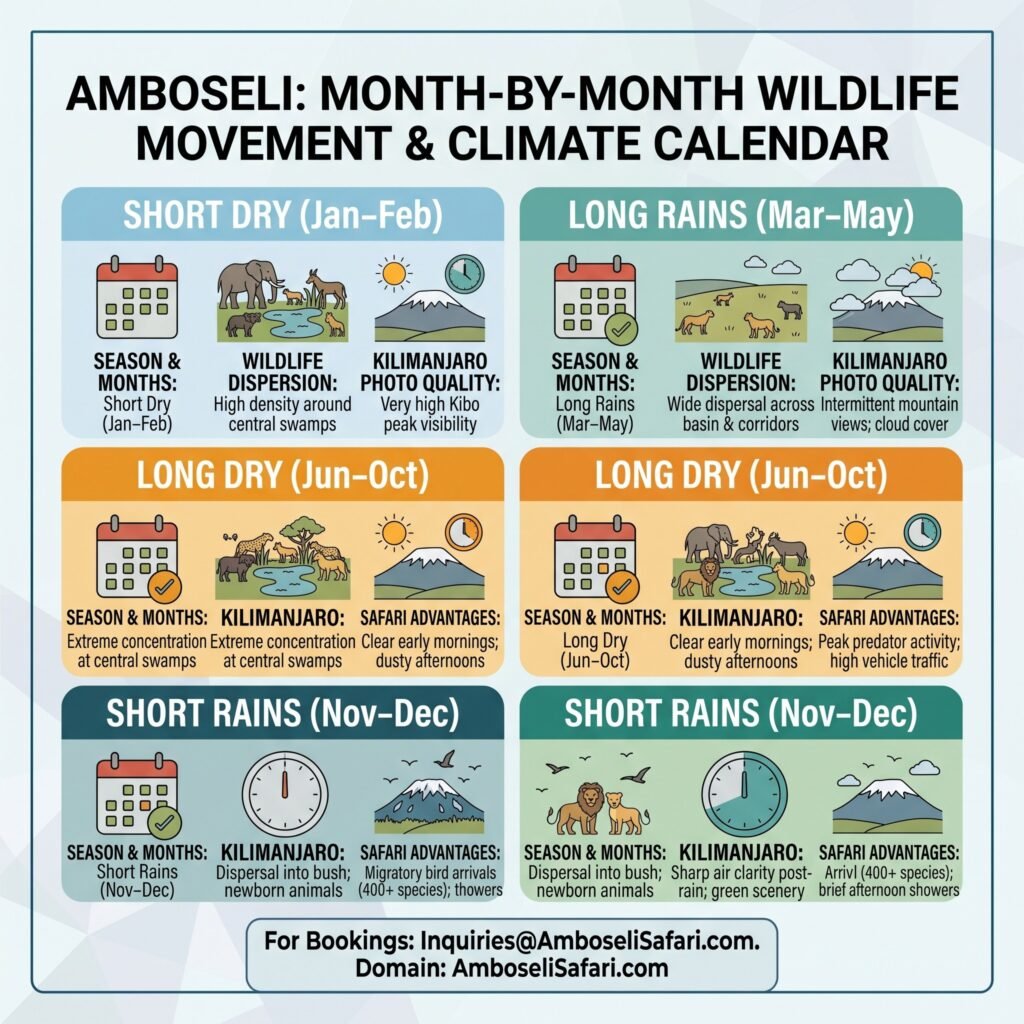
Amboseli changes radically depending on the mud. Here is what to expect month by month:
| Month / Season | Weather & Trail Conditions | Wildlife & Bird Highlights |
| Jan – Feb (Short Dry) | Clear skies, warm days, fine lakebed dust | Elephants gather around central swamps; clear Kibo views at dawn |
| Mar – May (Long Rains) | Heavy showers, deep mud near Lake Amboseli | Newborn gazelles, green grass, lower room rates |
| Jun – Oct (Long Dry) | Sunny, dry tracks, strong midday heat | Peak predator activity; big herds at Enkongo Narok |
| Nov – Dec (Short Rains) | Brief afternoon showers, clear post-rain air | Over 400 migratory bird species arrive |
During dry months (June to October), water holes out on the open plains disappear. Animals congregate in massive numbers around the permanent central swamps, making game viewing straightforward along main tracks.
The wet season (November to May) brings fresh grass and triggers calving. Migratory birds flood the reed beds along Sinet Stream, though you will need low-range 4×4 engaged to navigate slippery clay tracks.
Month-by-Month Wildlife Movement & Climate Calendar
Wildlife concentration across Amboseli’s basin shifts dramatically between dry and rainy months. During dry periods, disappearing water holes force massive herds into central permanent swamps, whereas wet seasons prompt animals to disperse into outer conservancy corridors. Review this month-by-month calendar to align your travel dates with peak predator tracking and clear Kilimanjaro views.
| Season & Months | Wildlife Dispersion & Density | Kilimanjaro Photo Quality | Safari Advantages & Trade-Offs |
| Short Dry (Jan–Feb) | High density around central swamps | Clear Kibo peak views at dawn | Warm temperatures; excellent predator tracking |
| Long Rains (Mar–May) | Wide dispersal into bush & corridors | Intermittent mountain views / clouds | Green scenery, newborn animals; deep mud (4×4 required) |
| Long Dry (Jun–Oct) | Extreme concentration at Enkongo Narok | Clear early morning; dusty afternoons | Peak predator activity; high vehicle density at swamps |
| Short Rains (Nov–Dec) | Dispersal outward; migratory bird arrivals | Sharp post-rain air clarity | 400+ bird species arriving; brief afternoon showers |
How to Get There: Transport, Gates & Logistics
Taking the road from Nairobi covers roughly 230 km. You head south on the paved Mombasa Road (A109) to Emali town, then branch right onto the C103 tarmac road toward Kimana. Drivers coming from Namanga or the Tanzanian border use the C103 approach through Meshanani Gate.
Gate Selection
- Kimana Gate works best for eastern camps like Kibo, Sentrim, or Zebra Plains and gets you to Enkongo Narok swamp faster than any other entrance.
- Use Iremito Gate if you are arriving directly from Emali or staying at northern conservancy properties.
- Meshanani Gate serves as the main western entrance for traffic coming from Namanga or Arusha.
- Kitirua Gate sits in the far southwestern sector near Kitirua Hill.
Flying In
Daily flights depart Wilson Airport (WIL) on Safarilink or Airkenya, landing at either Amboseli Main Airstrip (AMB) inside the park or Kimana Airstrip outside. Your guide meets you right on the apron.
For current road and track updates, see our Amboseli self-drive tips guide.
Inside the Park vs. Surrounding Conservancies
Your base dictates what you can actually do. Park lodges get you to the swamps fast; conservancies let you walk and track at night.
| Feature / Activity | Inside KWS National Park | Private Conservancies (Elerai, Selenkay, Kuku) |
| Swamp Proximity | Immediate access to Enkongo Narok | 20 to 45 minutes to central marshes |
| Night Game Drives | Strictly banned by KWS | Allowed with spotlights & trackers |
| Walking Safaris | Limited to Observation Hill | Guided walking across open bush |
| Off-Road Driving | Strictly forbidden ($100+ fine) | Allowed for special predator sightings |
| Vehicle Density | Higher at major sightings | Exclusive, low-density game viewing |
Staying inside the park gets you to early morning elephant crossings in minutes, but you must be back in camp by the KWS 06:00 PM curfew. Conservancies let you stay out after dark to search for aardvarks and white-tailed mongooses.
Compare boundary lodges and private camps in our guide on where to stay in Amboseli.
Elephant Tracking & Sinet Causeway Routines
Large herds move on a strict schedule. If you pull up parallel to the channel before the matriarch steps off the bank at Sinet Causeway, you get clean, eye-level shots as tuskers splash into the papyrus.
Every morning between 10:00 AM and 11:30 AM, family groups leave the dry acacia scrub along the park borders. They march single-file across the open flats, cross Sinet Causeway, and head into deep feeding grounds at Enkongo Narok swamp and Longinye Swamp.
We identify individual herds using research cataloged by the Amboseli Elephant Research Project (AERP). Looking at specific ear notches (V-cuts or U-cuts) and tusk shapes helps us spot well-known matriarch lines like the ‘AA’ and ‘EB’ families.
Out on the marsh edges, expect thick alkaline dust that gets into everything, especially near the dry lakebed, and heavy heat haze by noon.
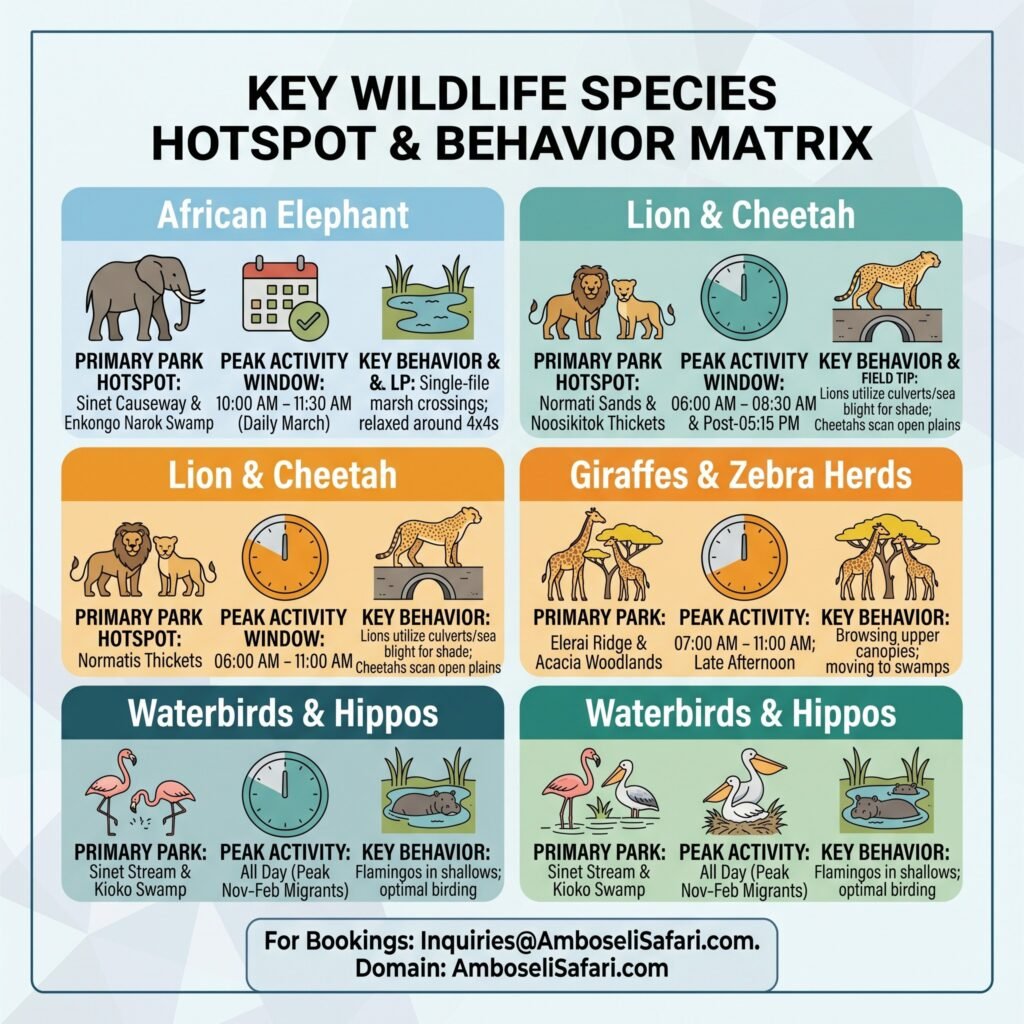
Key Wildlife Species Hotspot & Behavior Matrix
Tracking game across Amboseli requires aligning your drive schedule with daily animal movements between papyrus marshes and acacia thickets. While elephant herds cross open channels to feed during midday, big cats like lions and cheetahs rely on short-grass plains and culverts for daytime shade. Use this species hotspot matrix to plan your morning and afternoon game drive routes across the park.
| Species / Animal Group | Primary Park Hotspot | Peak Activity Window | Key Behavior & Field Tip |
| African Elephants | Sinet Causeway & Enkongo Narok Swamp | 10:00 AM – 11:30 AM (Daily March) | Single-file marsh crossings; ‘AA’ and ‘EB’ matriarch lines |
| Lions & Cheetahs | Normati Sands & Noosikitok Thickets | 06:00 AM – 08:30 AM & Post-05:15 PM | Lions utilize road culverts/sea blight; cheetahs rest on logs |
| Giraffes & Zebra Herds | Elerai Ridge & Acacia Woodlands | 07:00 AM – 11:00 AM; Late Afternoon | Browsing upper yellow-fever canopies; moving to swamps |
| Waterbirds & Hippos | Sinet Stream & Kioko Swamp | All Day (Peak Nov–Feb Migrants) | Flamingos in shallows; pelicans nesting; hippo pods |
Predator Hotspots: Normati Sands & Noosikitok Prides
Big cats in the basin have adapted to open ground, so finding them takes specific habitat knowledge.
Our lead guide, Anthony, avoids driving the salt flats at noon—the Noosikitok pride stays buried deep inside sea blight bushes until the air cools around 5:00 PM.
Tracking Cheetahs
Instead of searching for high termite mounds like in the Mara, look for cheetahs resting on fallen yellow-fever tree (Acacia xanthophloeia) trunks or concrete KWS road culverts across Normati Sands and Ol Okenya Marsh.
Lion Schedules & Ambush Zones
- The Noosikitok Pride patrols the reed edges along the Sinet swamp corridor.
- The Elerai Pride holds the southern thickets along Elerai ridge.
- When midday heat touches 30°C (86°F), lions sleep inside culverts or dense Suaeda monoica (sea blight) brush, emerging after 05:15 PM to hunt zebras.
Observation Hill Scouting & Swamp Navigation
Observation Hill (Noomotio) is the only high point in the park. The stone shelter at the top gives you a shaded spot to map out your drive.
- Glass the open channels of Kioko Swamp right below the hill to count submerged hippo pods.
- Watch for distant dust plumes across the dry Lake Amboseli salt pan, which usually signal moving lion prides or zebra herds.
- Track elephant movements between Ol Okenya and Enkongo Narok before choosing which swamp track to drive next.
Scouting from above saves time and fuel. Review track maps in our main Amboseli National Park guide.
Seasonal Birding Along Sinet Stream
Between November and February, shallow reed beds around Sinet Stream fill with over 400 bird species. Palearctic migrants join resident waterfowl along the water channels.
Watch for Malachite Kingfishers diving from low reeds, African Jacanas picking across lily pads, and Great White Pelicans nesting in flooded papyrus heads alongside hippos.
Plan your travel dates with our Amboseli safari planning guide.
Wildlife Photography & Field Gear
Carrying two camera bodies saves you from swapping lenses in heavy dust. A 100–400mm or 200–600mm zoom handles distant animals, while a 24–70mm works for wide landscape shots with Kilimanjaro in the frame.
- Get your shooting done between 06:00 AM and 08:30 AM. Midday atmospheric heat shimmer distorts long telephoto focus across the open salt flats.
- Fine lakebed silt penetrates lens rings fast. Pack neoprene lens covers, a soft brush, and zip-top dry bags.
- Rest telephoto lenses on a canvas beanbag draped over the pop-up roof rim of your 4×4 Land Cruiser.
- An 8×42 pair of binoculars gives a steadier image in midday heat haze than higher-magnification 10×42 optics.
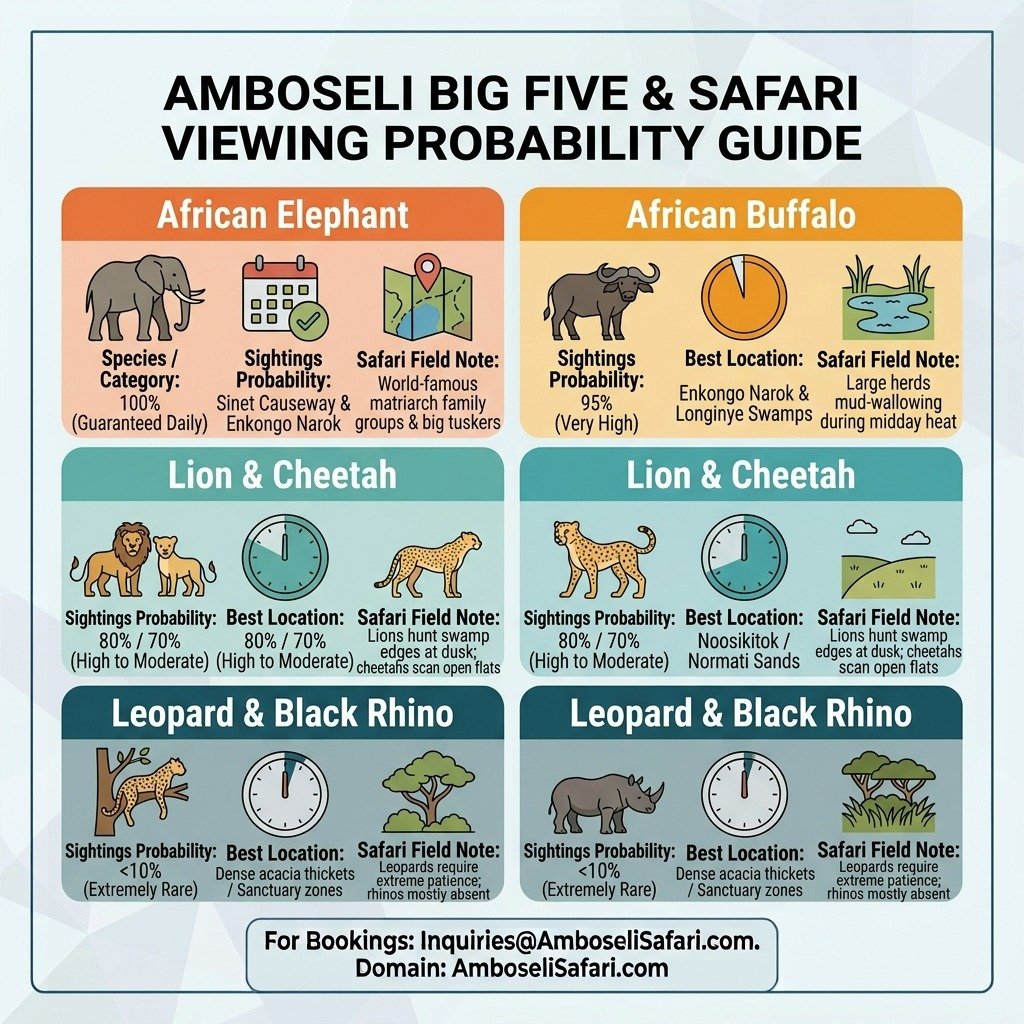
Big Five & Safari Viewing Probability Guide
While Amboseli is celebrated globally for hosting Africa’s longest-studied wild elephant herds and famous tuskers, viewing probabilities for other members of the traditional Big Five vary. Leopards and black rhinos remain elusive due to habitat conditions, while buffaloes and lions are reliably spotted daily around marsh edges. Use this field probability guide to manage expectations for your safari drives.
| Species / Category | Sightings Probability | Best Location / Field Reality | Safari Field Note |
| African Elephant | 100% (Guaranteed Daily) | Sinet Causeway & Enkongo Narok | World-famous matriarch family groups & big tuskers |
| African Buffalo | 95% (Very High) | Enkongo Narok & Longinye Swamps | Large herds mud-wallowing during midday heat |
| Lion & Cheetah | 80% / 70% (High to Moderate) | Noosikitok / Normati Sands | Lions hunt swamp edges at dusk; cheetahs scan open flats |
| Leopard & Black Rhino | <10% (Extremely Rare) | Dense acacia thickets / Sanctuary zones | Leopards require extreme patience; rhinos mostly absent |
Park Rules, Drone Policies & Conservation Ethics
- Never drive off marked tracks inside KWS land. Off-roading crushes ground nests, damages fragile soil, and brings fines ranging from $100 to $500 USD.
- Recreational drones are strictly banned without official clearance. Under Kenya Civil Aviation Authority (KCAA) rules, flying a drone requires a Remote Operator Certificate (ROC), land permits, and written KWS authorization. Unapproved drones get seized at the gate.
- Keep a minimum distance of 25 meters from elephant herds. Never cut off a lead matriarch’s path or pull a vehicle between a cow and her calf.
- Speed limits inside the park are capped at 40 km/h, and all vehicles must clear park gates by 06:00 PM sharp.
Health, Safety & Essential Visitor Checklist
- Apply online for your Electronic Travel Authorization via the official eTA portal before boarding your flight.
- Because Amboseli sits at 1,100 meters, malaria risk is low-to-moderate around the swamps. Pack bug spray containing 10–20% Picaridin and put on long sleeves after dark.
- Bring UV-blocking sunglasses, lip balm, eye drops, and a cloth bandana to deal with airborne dust on open tracks.
- Drink 3 to 4 liters of water a day. Dry air and roof wind dehydrate you long before you feel thirsty.
Dust, Curfews & Daily Pitfalls
Fine lakebed dust coats everything when afternoon winds pick up across the dry basin. Keep camera bodies wrapped in dry bags until you stop, and carry micro-fiber cloths in your daypack.
Searching for big cats at 1:00 PM is usually pointless. Lions stay buried deep in sea blight brush or concrete culverts until late afternoon, so save your fuel for early morning and dusk drives.
KWS entry permits run on a strict 24-hour clock ($90 USD per non-resident adult). If you enter Kimana Gate at 08:00 AM on Day 1, your pass expires at 08:00 AM on Day 3. Overstaying by even 15 minutes triggers an automatic extra day fee per person.
If you want to map out a private game drive schedule or check open vehicle dates with our guiding team, send us a message through our safari inquiry form or request a custom quote on Amboselisafari.com.
Frequently Asked Questions
What is the best time of day to see elephants in Amboseli?
Between 10:00 AM and 11:30 AM at Sinet Causeway. Family herds march out of dry scrub to cross open channels into Enkongo Narok swamp.
Where can you find lions and cheetahs in Amboseli National Park?
Lions stay buried in sea blight thickets near Sinet swamp and Noosikitok until around 05:15 PM. Cheetahs hunt across the flat salt plains of Normati Sands, scanning from fallen fever tree trunks or culverts.
Do I need a licensed guide to spot wildlife in Amboseli?
Self-driving is allowed on marked tracks, but hiring an experienced guide makes it far easier to spot hidden predators, read elephant family behavior, and navigate seasonal mud tracks safely.
How many days do you need for a complete wildlife safari in Amboseli?
A 3-day or 4-day safari gives you enough time to cover morning elephant causeway crossings, evening cat tracking, Observation Hill scouting, and birding along Sinet Stream without rushing.