
Kibo Safari Camp Amboseli: Safari Reviews, Room Rates & Package Pricing
Overview of Kibo Safari Camp Amboseli
Kibo Safari Camp Amboseli operates 73 custom canvas tents located just 1.7 km from Kimana Gate. Set on private bushland facing Mount Kilimanjaro, the camp combines farm-to-table organic dining with fast morning entry into central elephant corridors. Full-board safari packages in a private 4×4 Land Cruiser range from $550 per person for a 1-night stay during standard months to $1,490 per person for a 3-night peak-season trip.
Best For: Travelers seeking farm-to-table dining, Kilimanjaro views, and early-morning park access.
Fast Navigation Links
- Location & Gate Proximity
- Competitor Comparison Matrix
- Fly-In Safari Logistics
- Tent Architecture & Accessibility
- Dining, Dietary & Private Wing Facilities
- Pool Deck & Bush Spa
- Seasonality & Kilimanjaro Sightlines
- Packing & Power Supply Specs
- Practical Field Disclaimers
- 1 to 3-Night Package Rates
- Frequently Asked Questions
Location & Gate Proximity
Staying at Kibo Safari Camp Amboseli gets you through the park gate before the morning convoy forms. The camp sits 1.7 km—roughly a five-minute drive—from Kimana Gate, the main eastern entrance managed by the Kenya Wildlife Service (KWS).
Because the camp is built on community land outside the official park boundary, you don’t pay daily park fees while sitting at the pool or eating lunch.
By 05:45 AM, drivers are already warming up their engines. Early morning drives in an open-roof Land Cruiser get cold fast. Pack a heavy fleece or windbreaker for the morning, because the wind off the plains bites until the sun rises around 06:30 AM. Also, if you arrive by road from Emali, expect a layer of fine reddish dust over your luggage and clothes—that 90 km dirt stretch coats everything.
Leaving camp at first light gets your vehicle through Kimana Gate before tour buses arrive from lodges further down the road. You reach Enkongo Narok swamp right as the morning light hits the water, catching elephants and lions before the heat sets in. You can track Amboseli game movements across our site or check open dates using our safari booking form.
Competitor Comparison Matrix
Choosing a lodge around Kimana comes down to daily permit costs, food quality, and overall setup. Here is how Kibo compares to other popular mid-range choices nearby:
| Feature | Kibo Safari Camp | Sentrim Amboseli | Ol Tukai Lodge |
| Location | 1.7 km outside Kimana Gate | 3 km outside Kimana Gate | Inside central park core |
| Vibe / Style | Rustic tented bush camp | Permanent stone/canvas chalets | Luxury mid-century lodge |
| Park Fees Impact | Pay KWS fee only when entering | Pay KWS fee only when entering | 24-hr KWS fee charged continuously |
| Dining | On-site organic farm-to-table | Standard buffet | Standard buffet |
| Best Advantage | Fast gate access & garden dining | Budget-friendly group space | Immediate marshland elephant views |
Fly-In Safari Logistics
Flying down from Nairobi skips the 4.5-hour highway drive down Mombasa Road.
Flights depart daily from Nairobi’s Wilson Airport (WIL) on Safarilink or AirKenya, landing at Amboseli Airstrip (ASV) or Kimana Airstrip in about 45 minutes. Our driver meets you right on the tarmac for the 30-minute transfer to camp.
Bush planes strictly enforce a 15 kg (33 lbs) limit per passenger using soft-sided duffel bags. Rigid suitcases will not fit into the aircraft belly holds and get left behind at Wilson Airport.
Tent Architecture & Accessibility
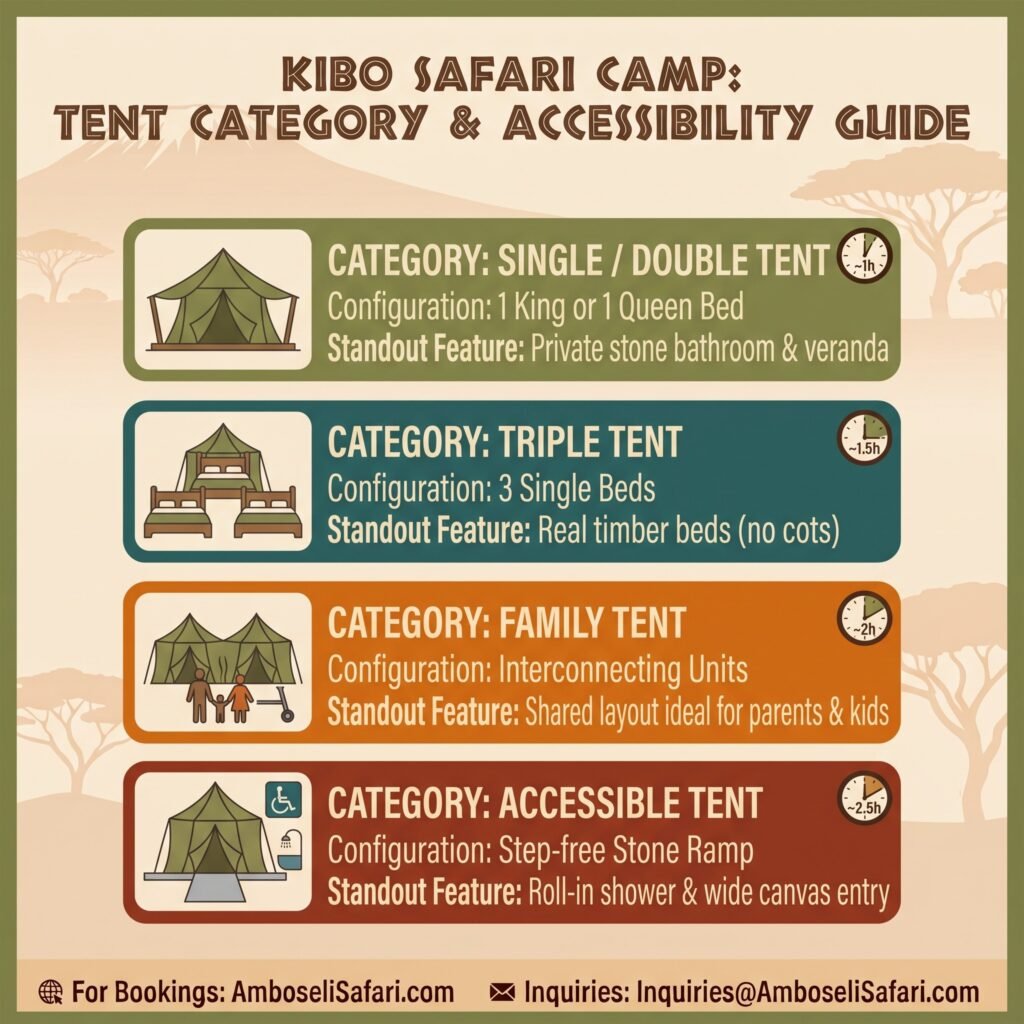
Kibo runs 73 canvas tents set up as single, double, triple, and family units.
Beds and side tables are carved locally from heavy natural logs rather than metal frames. Overhead mosquito netting wraps tightly around each frame, and the stone bathrooms have hot showers backed up by solar panels and wood boilers.
A few tents near reception feature step-free stone ramps, wider canvas doorways, and roll-in showers with grab rails. Paved stone pathways connect these tents directly to the dining area, bar, and pool without stairs.
Canvas walls don’t stop sound. If a group is talking by the campfire at 10:00 PM, you will hear them. Request an outer perimeter tent if you sleep light.
Triple tents use three real single beds, not a rollout cot stuffed into a double room.
Tent Category & Accessibility Guide
Kibo Safari Camp operates 73 custom canvas tents categorized to suit diverse group sizes and mobility requirements. Every unit features hand-carved natural log furniture, overhead mosquito netting, and solar-assisted hot showers. Accessible tents located near central facilities include step-free stone ramps, widened canvas doorways, and roll-in showers. Review this layout guide to select the best tent option for your stay.
| Tent Category | Configuration | Standout Feature |
| Single / Double Tent | 1 King or 1 Queen Bed | Private stone bathroom & veranda |
| Triple Tent | 3 Single Beds | Real timber beds (no cots) |
| Family Tent | Interconnecting Units | Shared layout ideal for parents & kids |
| Accessible Tent | Step-free Stone Ramp | Roll-in shower & wide canvas entry |
Dining, Dietary & Private Wing Facilities
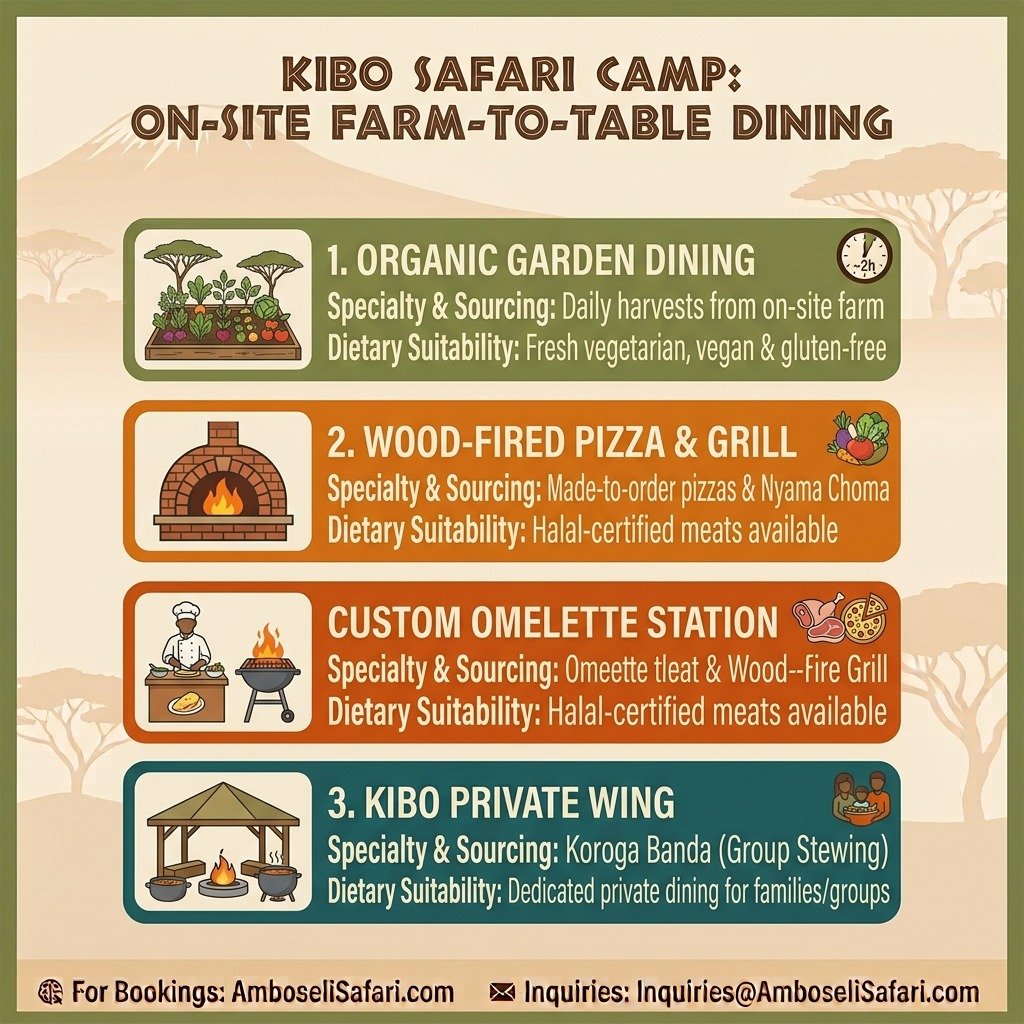
The open-air restaurant faces Kilimanjaro across an acacia grove. Food here tastes fresher than at most bush lodges because Kibo grows its own vegetables, herbs, and fruit in an on-site organic garden. Chefs cook custom omelettes and fresh wood-fired pizzas to order during meal times.
Special Dietary Support
Using daily harvests from the garden, the kitchen handles special diets easily if you give them advance notice:
- Vegetarian and vegan spreads include fresh garden salads, vegetable curries, lentil stews, and roasted roots.
- Meats are Halal-certified.
- Kitchen staff bake gluten-free bread and prepare separate soups if you let them know at check-in.
- While not a certified Kosher kitchen, chefs prepare vegetarian and fish dishes using clean, fresh produce.
On-Site Farm-to-Table & Dietary Options
Dining at Kibo Safari Camp centers around an open-air restaurant fed daily by an on-site organic vegetable garden. The kitchen accommodates varied dietary needs with fresh harvests prepared to order. Small groups and families can also reserve the exclusive Kibo Private Wing for custom group cooking. This dining breakdown outlines available culinary choices and facilities.
| Dining Option | Specialty & Sourcing | Dietary Suitability |
| Organic Garden Dining | Daily harvests from on-site farm | Fresh vegetarian, vegan & gluten-free |
| Wood-Fired Pizza & Grill | Made-to-order pizzas & Nyama Choma | Halal-certified meats available |
| Kibo Private Wing | Open-sided Koroga Banda shelter | Dedicated private dining for families |
Kibo Private Wing
Families or small private groups can reserve the Kibo Private Wing for dedicated dining. It features its own wood-fired pizza oven, a Nyama Choma (roasted meat) grill, and an open-sided Koroga Banda shelter built for group stews and family style cooking.
Pool Deck, Bush Spa & Local Art
Midday heat in the basin often passes 30°C (86°F), making the pool popular between morning and afternoon game drives. The deck is paved with flat slasto slate flagstones that stay cool under bare feet even in direct sunlight. There is also a shallow splash section for kids.
A tented bush spa next to the pool offers deep-tissue massages after dusty drives along washboard tracks. Up near reception, a small gift shop sells paintings, wood carvings, and beadwork bought directly from Maasai artisans living in surrounding Kimana group ranches.
Seasonality & Kilimanjaro Sightlines
Mount Kilimanjaro sits behind camp, but clouds cover the summit for big chunks of the day:
- December through March and July through October offer the clearest skies. Peak mountain views happen early between 06:00 AM and 08:30 AM. By mid-morning, heat rising off the dry plains builds thick cloud cover over Kibo peak.
- The long rains in April and May turn dirt tracks around Kimana Gate into sticky volcanic mud. You need a proper 4×4 Land Cruiser with center-diff lock during these months, along with waterproof jackets and boots that handle deep mud.
Packing & Power Supply Specs
Camp power runs 24/7 on a primary solar system backed up by a silent generator. Socket outlets inside every tent use standard British 3-pin Type G plugs (240V), so camera gear, phones, and medical CPAP machines charge continuously.
- Bring soft duffel bags, neutral clothes (khaki, tan, or olive), sunscreen, and a broad-brimmed hat.
- Pre-dawn drives at 05:30 AM are cold—pack a warm fleece jacket or windbreaker.
- Bring padded lens covers or dry bags to protect cameras from fine lakebed dust.
Practical Field Disclaimers
- Wi-Fi works near reception, the bar, and the pool deck. It drops off sharply as you walk out toward the outer tent lines.
- Fine white lakebed dust gets everywhere when afternoon winds pick up. Wrap your camera in a sealed dry bag inside your daypack when driving routes monitored by the Amboseli Elephant Research Project.
- KWS park permits run on a strict 24-hour clock ($90 USD per adult). Enter at 08:30 AM on Day 1, and your ticket expires at 08:30 AM on Day 3. If you overstay by ten minutes for a sit-down lunch inside the park, you pay for a full extra day. We schedule Day 3 lunches outside the gate to avoid that extra charge.
If you plan on driving down from Nairobi yourself, read our Amboseli self-drive guide before setting out to prepare for gate rules and road conditions.
Kimana Gate Logistics & Morning Timing
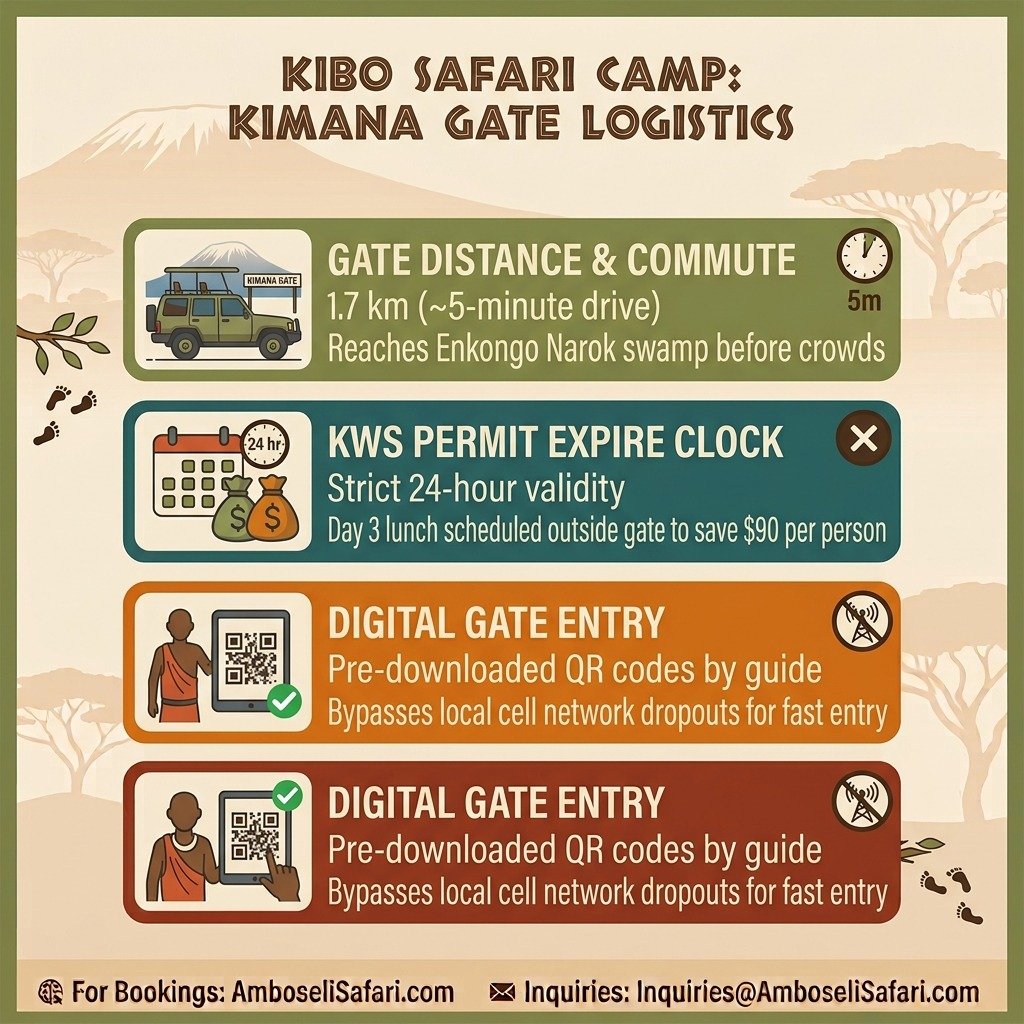
Staying 1.7 km from Kimana Gate allows Kibo Safari Camp guests to reach central elephant corridors ahead of morning safari convoys. Because the camp sits outside KWS boundaries, daily entry permits are charged only during actual park hours. Driver-guides pre-download digital eCitizen codes to avoid network delays at the gate. Utilize this timing schedule to optimize your daily game drives.
| Field Consideration | Kibo Camp Metric | Operational Advantage |
| Gate Distance & Commute | 1.7 km (~5-minute drive) | Reaches Enkongo Narok before crowds |
| KWS Permit Expire Clock | Strict 24-hour validity | Day 3 lunch outside gate saves $90/person |
| Digital Gate Entry | Pre-downloaded QR codes | Bypasses local cell network dropouts |
1 to 3-Night Package Rates & Itineraries
Our road packages include a private 4×4 Safari Land Cruiser, full-board lodging at Kibo Safari Camp Amboseli, driver-guide fees, fuel, bottled water, and pre-paid non-resident KWS park permits ($90 USD per adult per 24 hours).
All vehicle logistics, guide fees, and hotel costs are bundled into the total rates below based on two adults traveling together.
1 to 3-Night Kibo Safari Camp Packages (2027)
| Package Duration & Itinerary | Standard Season (USD / Person)* | Peak Season (USD / Person)* |
| 1 Night / 2 Days Express | $550 | $830 |
| 2 Nights / 3 Days Classic | $800 | $1,160 |
| 3 Nights / 4 Days In-Depth | $1,050 | $1,490 |
*Prices reflect total per-person cost for two adults sharing a tent and a private 4×4 Safari Land Cruiser. Standard Season covers January to May and November. Peak Season covers June to October and December. Includes full-board lodging, private transport, guide fees, fuel, and KWS permits.
Visit our safari booking form on Amboselisafari.com to lock in your Land Cruiser and reserve your tent at Kibo Safari Camp Amboseli.
Package Inclusions:
- Private 4×4 Safari Land Cruiser with pop-up roof for all game drives and transfers.
- Services of a TRA-licensed, English-speaking driver-guide.
- Full-board accommodation at Kibo Safari Camp Amboseli (breakfast, lunch, dinner).
- Pre-paid non-resident KWS park entry permits ($90 USD per 24 hours).
- Chilled bottled drinking water inside the vehicle cooler.
Package Exclusions:
- International airfare, entry visas, and Electronic Travel Authorization (eTA portal) fees.
- Personal expenses like driver tips, spa treatments, or alcoholic drinks.
- Optional Maasai cultural village visits or hot air balloon safaris.
Optional Add-Ons:
- Authentic Maasai cultural village visit: USD 30 per person.
- Sunrise hot air balloon safari over Amboseli: USD 450 per person.
You can review full budget breakdowns on our Amboseli safari cost guide.
Frequently Asked Questions
Is Kibo Safari Camp fenced for safety?
Yes. An electric fence surrounds the entire perimeter of Kibo Safari Camp to keep elephants and buffaloes out while letting birds and small antelopes pass through.
How far is Kibo Safari Camp from Nairobi?
Driving from Nairobi takes roughly 4 to 4.5 hours (~235 km) down the paved A109 Mombasa Road, turning right at Emali onto the C103 highway toward Kimana Gate.
What happens if park payment systems go offline at Kimana Gate?
Cell service at Kimana Gate drops frequently. We pre-download all KWS eCitizen QR entry codes in Nairobi before setting out so you don’t get stuck waiting at the gate.