
Amboseli Self-Drive Safari Tips: 4×4 Rules, Navigation & Gear
Overview
Planning with practical Amboseli Self-Drive Safari Tips keeps your vehicle moving safely across Kajiado County terrain—often mistaken for Narok County Council jurisdiction. The Kenya Wildlife Service regulates track access near Mount Kilimanjaro, where Amboseli Elephant Research Project herds cross fever tree (Acacia xanthophloeia) thickets and Enkongo Narok swamp.
Quick-Reference Self-Drive Logistics & Gate Fees
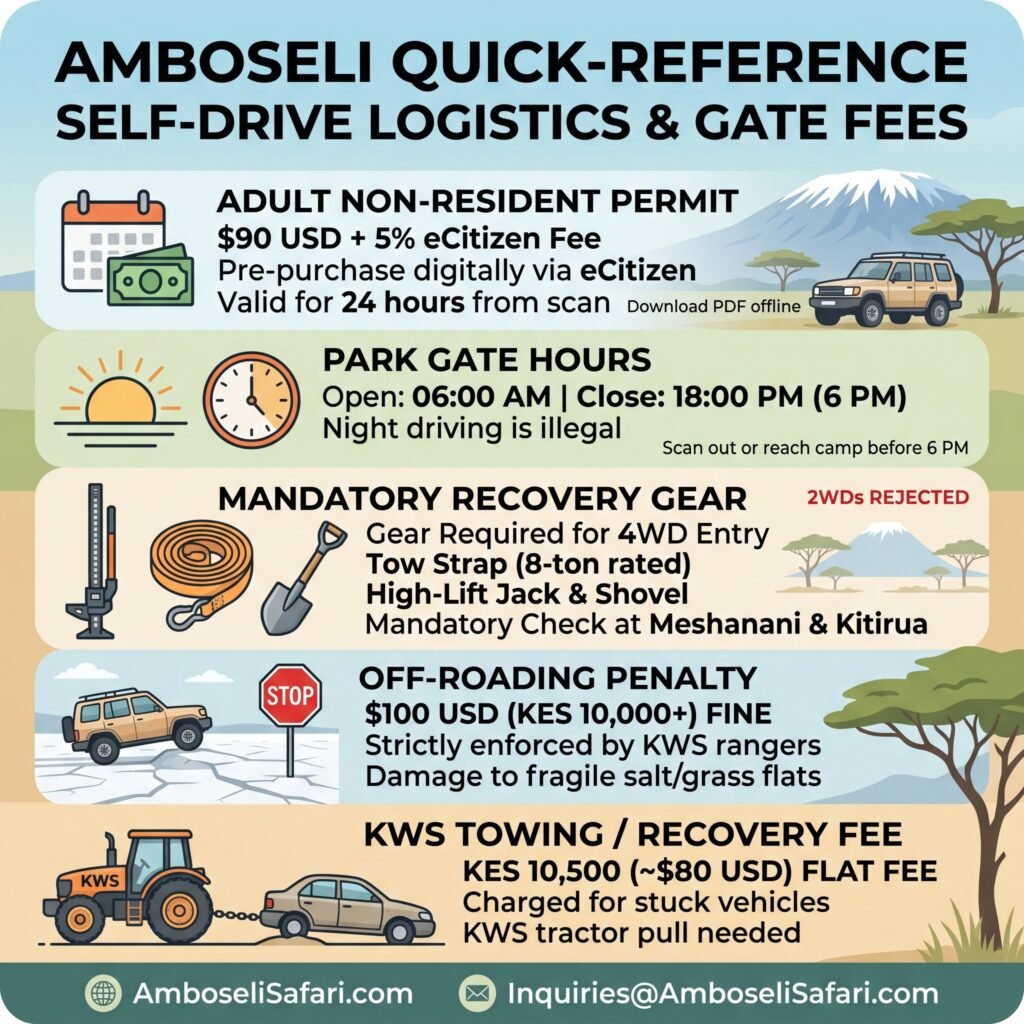
Planning a self-drive safari into Amboseli National Park requires factoring in strict gate regulations, payment portals, and recovery costs before hitting the trail. Entry permits operate on a strict 24-hour clock and must be pre-purchased digitally via the eCitizen platform, as park gates do not accept cash or cards. Below is a quick breakdown of mandatory gate fees, gear requirements, and key operational contact rules.
| Requirement / Fee | Detail / Cost (USD) | Key Operational Rule |
| Adult Non-Resident Permit | $90 + 5% eCitizen Fee | Valid for 24 hrs from scan; download PDF offline in advance. |
| Gate Hours | 06:00 AM – 18:00 PM | Night driving is illegal; scan out or reach camp before 6 PM. |
| Mandatory Recovery Gear | High-lift jack, tow strap, shovel | Mandatory check at Meshanani & Kitirua gates; 2WDs rejected. |
| Off-Roading Penalty | $100 USD (KES 10,000+) | Strictly enforced by KWS rangers on fragile salt/grass flats. |
| KWS Towing / Recovery Fee | KES 10,500 (~$80 USD) | Charged if KWS tractor pulls your stuck rig out of mud or ash. |
Fast Navigation Links
- 4 Day Circuit Package Rates
- Nairobi and Coast Driving Routes
- Gate Inspections and Clearance Rules
- Tire Pressure and Offroad Maps
- Elephant Etiquette and Speed Fines
- KWS Bandas Campsites and Emergency
Driving yourself across the basin takes genuine prep. Fine volcanic ash swallows two-wheel-drive cars, soft salt crusts hide thick mud, and Google Maps routinely sends drivers onto abandoned tracks flooded by swamp water. Our team at Amboselisafari.com knows these tracks inside out, so here is what you actually need to know before turning off the highway.
4-Day Multi-Destination Safari Package (2 Nights Amboseli + 1 Night Lake Nakuru)
If you decide self-driving isn’t right for your group, hiring a private Land Cruiser with an experienced guide removes all vehicle liability. Combining big elephant herds in Amboseli with the flamingo shores and rhino sanctuaries of Lake Nakuru makes a solid circuit.
Rates below show total costs per person for two adults traveling together:
4-Day Circuit Rates & Lodging Options
| Package Tier & Accommodations | Included Lodges & Hotels | Price Range Per Person (Low – Peak)* |
| Budget Tier | Sentrim Amboseli Camp & Lake Nakuru Lodge | From USD $1,290 to USD $1,890 |
| Mid-Range Tier | Kilima Safari Camp & Sunbird Lodge Nakuru | From USD $1,620 to USD $2,380 |
| Luxury Tier | Porini Amboseli Camp & Sarova Lion Hill Game Lodge | From USD $2,240 to USD $3,150 |
| Luxury Plus Tier | Elewana Tortilis Camp & The Cliff Nakuru | From USD $3,920 to USD $5,580 |
*Rates cover 2026/2027 travel for two adults sharing a room or tented suite with a private 4×4 Land Cruiser and driver-guide. Standard/Low season covers January through May and November. Peak season spans June through October and December. Rates include full-board lodging, private transport, fuel, daily $90 USD KWS park permits (plus the mandatory 5% eCitizen gateway processing fee), Nakuru sanctuary fees, and chilled vehicle water. Luxury Plus includes domestic flights from Wilson Airport (WIL).
To request custom dates or compare private vehicle setups, submit your request through our safari booking form.
What’s Included
- Private 4×4 Safari Land Cruiser with pop-up roof hatch and custom beanbag mounts
- Dedicated, TRA-certified driver-guide for the full itinerary
- Full-board accommodation covering breakfast, lunch, and dinner daily
- Pre-paid daily $90 USD KWS park permits (plus 5% eCitizen fee) and Nakuru sanctuary passes
- Chilled drinking water stocked in the vehicle cooler
What’s Excluded
- International flights, travel insurance, and digital Kenya entry processing through the official eTA portal
- Tips for your driver-guide or lodge staff
- Alcoholic beverages, sodas, or personal laundry
- Optional Maasai village entry vouchers ($30) or hot air balloon flights ($450)
Optional Add-Ons
- Local village entry voucher & cultural walkthrough: USD 30 per person
- Night game drive in a private conservancy: USD 50 per person
- Sunrise hot air balloon flight over central marshes: USD 450 per person
Nairobi & Coast Driving Routes
The Emali route is fast tarmac; the Namanga route will shake your teeth out over 50 kilometers of corrugated dirt:
- Nairobi via Emali (A109 to C103): 228 km, about 4 hours total. Take the smooth Mombasa highway past Athi River to Emali, then turn right onto the paved C103 straight to Kimana Gate or Iremito Gate. This is by far the easiest drive.
- Nairobi via Namanga (A104 to C103): 240 km and closer to 5 hours. You head south toward the Tanzania border, turning left at Namanga onto the C103 dirt road for Meshanani Gate. Expect rattling corrugations and heavy dust.
- Mombasa & Coast Route: Drive north on the A109 past Voi. Cut through Tsavo West via Chyulu Gate, or head through Taveta and Loitokitok along the C103 to Kimana Gate.
Gate Clearance Checks & Crossover SUV Rejections
We regularly see light crossovers get turned away at Kimana Gate during the rains. Compact AWDs like RAV4s or X-Trails lack the low-range 4WD and ground clearance needed when tracks turn slick. Rangers will restrict soft-roaders to the main gravel loops so they don’t slide off narrow causeways into the papyrus.
Rangers at Meshanani and Kitirua gates also check your gear if you plan to head into the western sectors. You’ll need to show:
- A high-lift jack that actually fits your 4×4 frame.
- A heavy-duty tow strap rated for at least 8 tons.
- A solid steel shovel for digging out tires.
- A fully inflated spare tire and a working lug wrench.
Review our guide on where to stay in Amboseli to find camps located close to main entry gates.
Tire Pressure Setup for Volcanic Ash & Thorns
Highway pressures (35+ PSI) will bounce your teeth loose on washboard tracks and sink your tires right into volcanic ash (Empusel).
Drop your pressure down to 22–25 PSI as soon as you reach the dirt.
Deflating expands your tire footprint, helping you float over soft powder instead of digging ruts. Flexible sidewalls also roll over sharp acacia thorns without popping. Just remember to air back up when you hit the tarmac at Emali or Namanga.
Navigation App Failures & Swamp Causeway Routing Errors
Do not trust Google Maps inside the park. It regularly tries to route drivers across long-abandoned causeways spanning Enkongo Narok and Ol Okenya swamps. You end up staring at bonnet-deep papyrus mud or a locked KWS gate near Kitirua.
Switch to offline topological apps like Maps.me or Tracks4Africa. They accurately mark reinforced gravel drifts, concrete culverts, and seasonal track closures. Download your map areas in Nairobi—cell signal dies completely once you drive out into the central marshes.
Inspect park gate access points and swamp causeways on our main Amboseli National Park guide.
Terrain Matrix: PSI Setup, Navigation & Seasonal Hazards
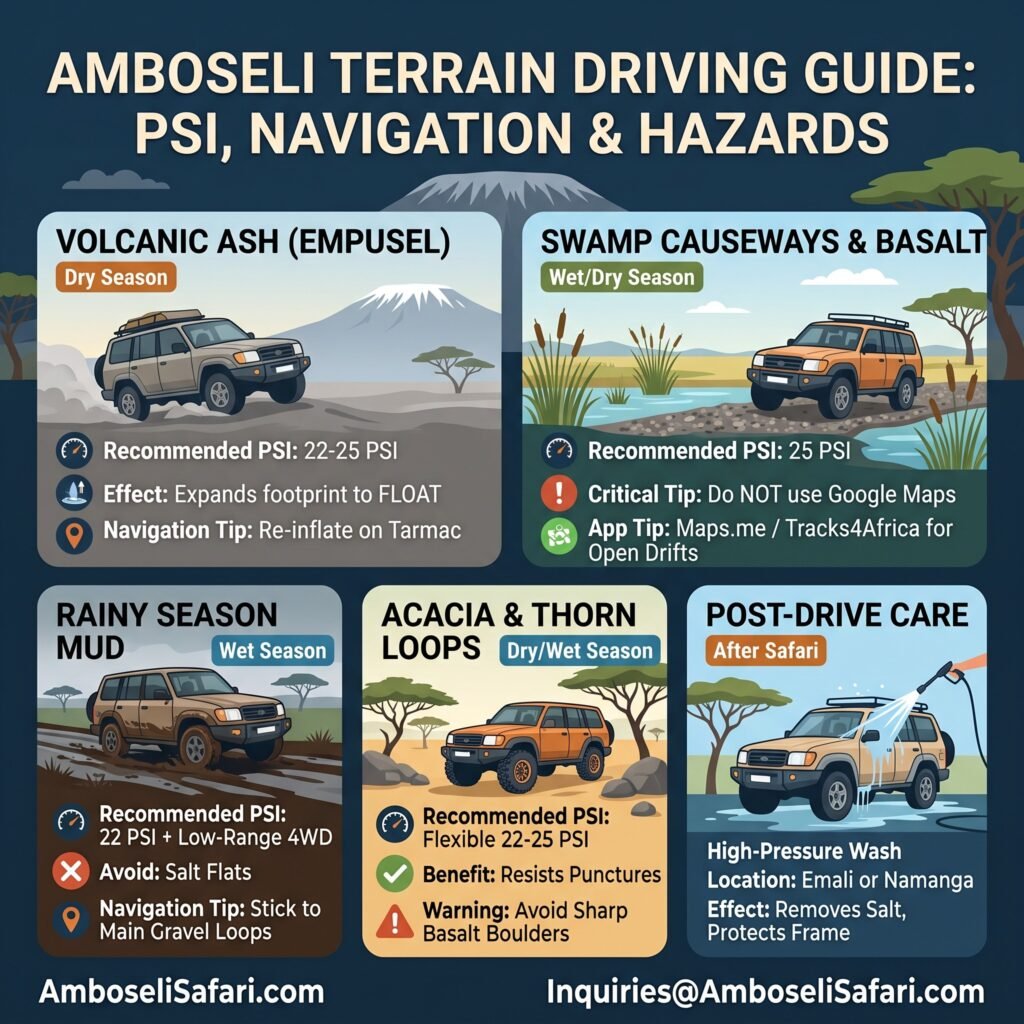
Navigating Amboseli’s extreme terrain requires adapting your driving technique to match distinct ground conditions across dry and wet seasons. Blindly trusting standard navigation apps or highway tire pressures often leads to severe vehicle damage or strandings in deep volcanic powder. Use this terrain matrix to set optimal tire pressures, select safe navigation apps, and avoid major breakdown zones.
| Surface / Season | Recommended PSI | Navigation & Hazard Tip |
| Volcanic Ash (Empusel) | Drop to 22–25 PSI | Expands tire footprint to float over soft powder; re-inflate on tarmac. |
| Swamp Causes & Basalt | Maintain 25 PSI | Do NOT use Google Maps; use Maps.me / Tracks4Africa for open drifts. |
| Rainy Season Mud | 22 PSI + Low-Range 4WD | Avoid salt flats; stick to main gravel loops to avoid black cotton mud. |
| Acacia & Thorn Loops | Flexible 22–25 PSI | Flexible sidewalls resist thorn punctures; avoid sharp basalt shoulders. |
| Post-Drive Undercarriage | High-Pressure Wash | Alkaline salt eats metal; blast ladder frame at Emali or Namanga. |
Elephant Encounter & Wildlife Etiquette
Driving among large elephant herds requires practical bush safety:
- Give elephant herds at least 30 meters. If a matriarch stops, flares her ears, or scoops dust with her trunk, put the truck in reverse immediately.
- Keep your reverse gear engaged and the engine idling whenever you stop near a solitary bull or a family group crossing a causeway.
- Stick strictly to the 40 km/h (25 mph) speed limit. Driving faster kicks up blinding dust and startles animals.
- Never drive off-road. Tearing across fragile grass or salt flats damages the terrain and gets you an instant $100 USD (KES 10,000+) fine from patrolling rangers.
Read more about tracking elephant herds near salt pan borders in our famous elephants guide.
Park Gate Hours & Time Management
Park gates open at 06:00 AM and close at 18:00 PM (6:00 PM) sharp.
Night driving inside the park is illegal. You need to scan out through the turnstile or be inside your lodge grounds before 6:00 PM.
If you get stuck in volcanic ash near sunset, stay inside your vehicle cabin. Do not walk through the bush after dark—call KWS dispatch or hail a passing guide truck to alert rangers.
Basalt Slabs & Emergency Fuel Reserves
The acacia loops around Observation Hill (Noomotio) hide sharp basalt boulders under the tall grass. Pulling onto the shoulder to let oncoming traffic pass can shear off your oil pan if your truck doesn’t have a steel skid plate. Wait for a clear, widened pull-out instead.
Fuel logistics are simple: there are no commercial gas stations inside the park. The KWS workshop at Ol Tukai keeps emergency diesel, but they charge steep cash rates and reserve it for stranded drivers. Fill up completely in Kimana Town or Namanga before crossing the gate.
If you are calculating fuel budgets or private vehicle hire—where daily Land Cruiser rates range from USD $250 in low season to over USD $350 for peak season—check our complete Amboseli safari cost breakdown page.
Emergency & Route Fuel Strategy Matrix
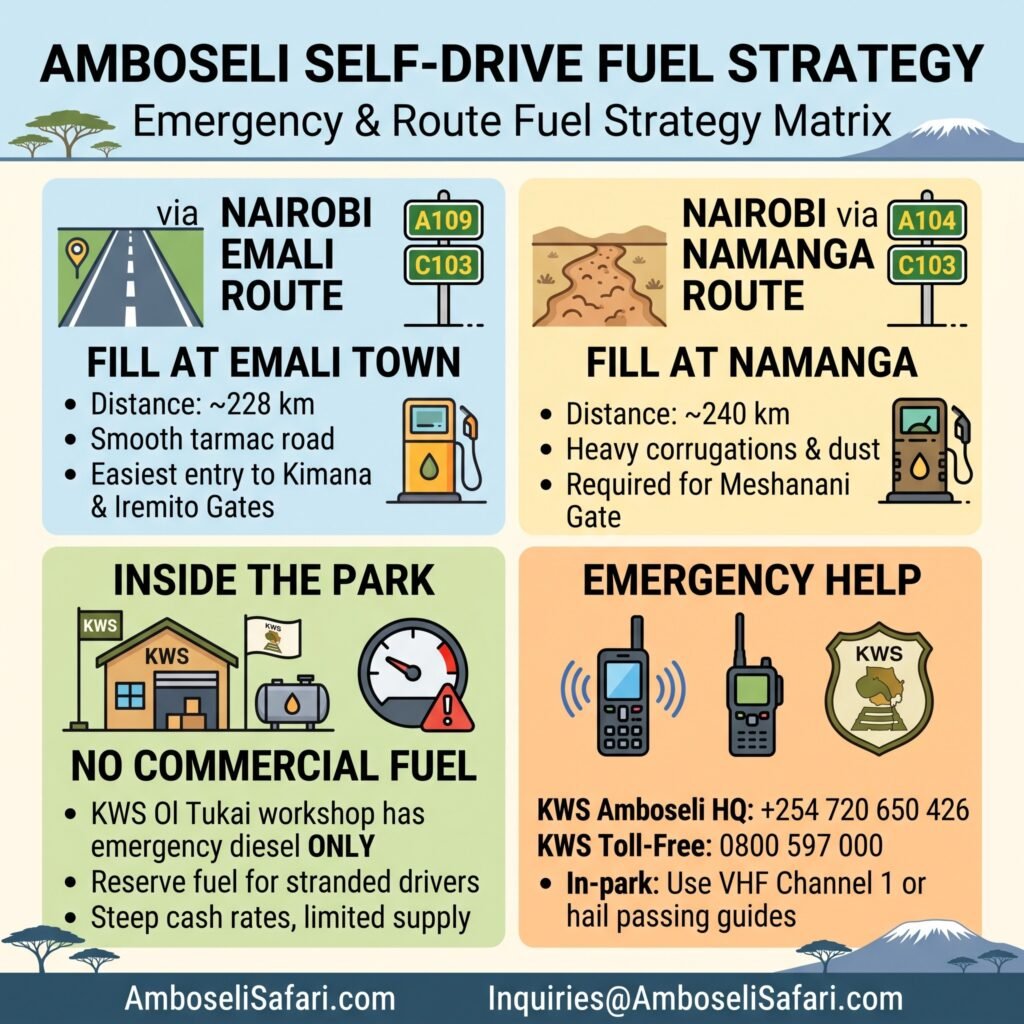
There are no commercial gas stations operating inside Amboseli National Park, making route planning and fuel checks critical before crossing entry gates. While emergency diesel exists at park headquarters, cash rates are steep and supplies are reserved primarily for stranded motorists. The matrix below outlines key route distances, fuel stop locations, and emergency contacts to keep your safari moving safely.
| Route / Sector | Distance & Fuel Stop | Emergency / Channel Info |
| Emali Route (A109-C103) | 228 km / Fill at Emali | Smooth tarmac; fastest route to Kimana & Iremito gates. |
| Namanga Route (A104-C103) | 240 km / Fill at Namanga | Corrugated dirt; fill tank before taking dirt track to Meshanani. |
| Inside Park Boundaries | NO commercial fuel | Emergency diesel at Ol Tukai KWS workshop (high cash rates). |
| Park Emergency Contact | KWS Desk: +254 720 650 426 | KWS Toll-Free: 0800 597 000 for ranger dispatch. |
| In-Park Guide Channel | VHF Channel 1 | Use VHF radio or hail passing driver-guides if stranded at dusk. |
Post-Safari Undercarriage Salt Washdown
Alkaline dust from Lake Amboseli settles deep into brake calipers, wheel arches, and frame channels. Left alone, it eats through metal fast.
Stop at a car wash bay in Emali or Namanga as soon as you hit the pavement. Pay the washer a few extra shillings to blast high-pressure water inside the ladder frame and brake backing plates until the runoff turns clear.
Self-Driver Camping & Accommodation Options
If you’re camping or self-catering, you have a few good setups:
- KWS Self-Catering Bandas: Simba Cottages, Chui Cottages, and Kilimanjaro Guest House near park HQ offer basic beds, kitchen setups, and solar power.
- Public & Special Campsites: The main public campsite near KWS HQ has cold showers and drop toilets. Special campsites along outer perimeter tracks offer total privacy but require advance booking.
- Community Sanctuaries: Kimana Sanctuary, just outside Kimana Gate, has excellent self-catering campsites run in partnership with local Maasai landowners.
Seasonal Driving Conditions & Weather Hazards
Terrain challenges change with the rainfall:
- Dry Season (July–October, Jan–March): Dust is your main enemy. Fine ash turns tracks into powder bowls (Empusel), hiding deep ruts, while sudden thermal dust devils (Sipili) sweep across the salt pan.
- Rainy Season (April–May, November): Salt flats turn into shallow lakes and dirt tracks turn into sticky black cotton mud. Seasonal streams like Kimana Stream can flash flood in under half an hour.
For seasonal weather updates and road track updates, explore our Amboseli safari planning guide.
4×4 Rental Vehicle Sourcing & Insurance Guide
Sourcing the right rig in Nairobi saves headaches on the trail:
- Rent a real 4×4 with low-range gears, like a Toyota Land Cruiser 70-series or Prado J150. Skip soft-roader crossovers entirely.
- Check your rental contract to confirm Collision Damage Waiver (CDW) covers off-road tracks, underbody hits, and shredded tires.
- If you’re camping at unfenced public sites, a rooftop tent keeps you safely elevated above nocturnal wildlife. Ground tents should only be pitched inside fenced compounds or campsites guarded by local Askaris.
Self-Drive Navigation & Digital Resources
Having offline routing tools and physical gear saves time during vehicle preparation:
| Technical Resource | Format & Usage | Traveler Benefit |
| GPX / KML Route Tracks | Downloadable files for Maps.me & Tracks4Africa | Pre-loads verified swamp causeways & safe lakebed drifts offline. |
| Custom Park Logistics Map | Printed or saved PDF image overlay | Shows gate locations, fuel stops, and basalt hazard zones at a glance. |
| Printable Gear Checklist | PDF packing sheet | Verifies tow straps, high-lift jack, pressure gauge, and spare tire tools before departure. |
| HowTo & Travel Schema | Structured digital data markup | Formats step-by-step gate permit protocols for instant offline access. |
eCitizen Gate Permits & KWS Contact Directory
Permits run on a 24-hour clock from the exact minute you scan in. Non-resident adults pay $90 USD per 24 hours.
Gates do not take cash or credit cards. Pay online at https://kwspay.ecitizen.go.ke/single-park-entry/amboseli-national-park/guests before you arrive. Note that eCitizen adds a 5% gateway fee. Download your PDF ticket to your phone in advance because gate cell signal is notoriously weak.
KWS Emergency & Recovery Directory
- KWS Amboseli HQ Desk: +254 720 650 426
- KWS Toll-Free Customer Line: 0800 597 000
- Ol Tukai KWS Workshop / Ranger Dispatch: Available via VHF Channel 1 inside park boundaries.
Practical Field Advice from Our Guides
Self-driving takes patience and a sharp eye for animal body language.
Anthony Mule, who has guided these tracks for over ten years, keeps a soft microfiber cloth on his dashboard to wipe dust off camera lenses, along with a spare water jug to clear salt spray off the windscreen. Out near the open salt pans at 06:30 AM, the morning air feels crisp against your face as Mount Kibo’s snowcap reflects the early light.
Ready to organize a private vehicle or ask about route conditions? Get in touch with our team using our safari booking form.
Frequently Asked Questions
Can I enter Amboseli National Park in a 2WD car?
No. Rangers at Kimana and Iremito gates strictly enforce 4WD rules. Two-wheel-drive cars get stuck almost instantly in volcanic ash and black cotton mud.
Where is the nearest petrol station?
The nearest commercial fuel stations are outside the gates in Kimana Town and Namanga. Fill your tank completely before entering the park.
What offline map app works best inside the park?
Maps.me and Tracks4Africa work far better than Google Maps. They correctly show open causeways, gravel drifts, and closed seasonal tracks.
How much does KWS charge to tow a stuck vehicle?
If your vehicle sinks into deep mud or ash and needs a KWS tractor pull, KWS charges a flat recovery fee of KES 10,500 (~$80 USD).