7-Day Kenya Safari Including Amboseli: Route, Permits & Package Pricing
Overview of 7-Day Kenya Safari Including Amboseli
A 7-day Amboseli to Masai Mara safari loop (2 nights in Amboseli, 1 night in Lake Naivasha, and 3 nights in the Masai Mara) costs between $2,560 and $11,410 per adult sharing based on two travelers in a private 4×4 Safari Land Cruiser. This 6-night circuit covers big elephant herds beneath Mount Kilimanjaro, Rift Valley boat rides, and lion tracking on the Mara plains, complete with full-board lodging, private vehicle transport, and all KWS and Narok County park permits.
Jump Ahead
- Highway Route & Transit Matrix
- Multi-County Permits & 4×4 Selection
- Wildlife Highlights & Seasonality
- 7-Day Itinerary Schedule
- Package Costs & Hotel Tiers
- Health, Dietary & Solo Logistics
Combining Amboseli, Lake Naivasha, and the Masai Mara in a single week-long loop covers serious mileage. We’ve driven this route for over a decade, and managing road logistics makes or breaks the trip. Knowing which highway to take, how separate park portals work, and where to do laundry keeps things comfortable from start to finish. You can check seasonal wildlife movements across the region on Amboselisafari.com before picking your dates.
Highway Route Hacks & Transit Matrix
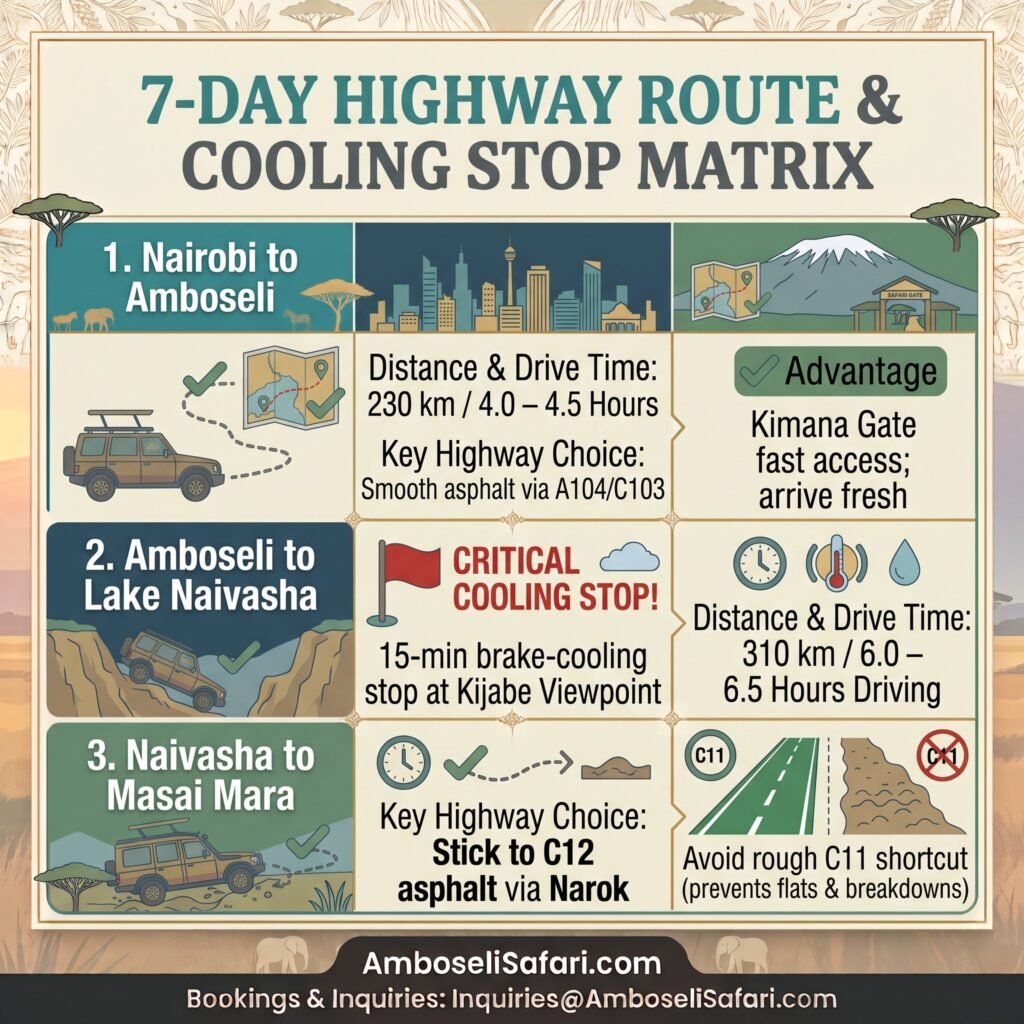
Driving from Amboseli up to the Mara covers long distances. When heading toward the Mara, navigation apps often suggest taking the C11 dirt shortcut through Ewaso Ngiro. Avoid it. That track has deep corrugation and potholes that shake vehicle fittings loose and cause flats.
Instead, stick to the main C12 asphalt running through Narok town to Sekenani Gate. It looks longer on paper, but smooth pavement saves almost two hours and prevents breakdowns.
7-Day Highway Route & Cooling Stop Matrix
Completing a 7-day multi-county circuit across Kenya requires smart highway navigation to ensure vehicle safety and passenger comfort. While navigation apps often recommend dirt shortcuts like the C11 through Ewaso Ngiro, staying on the paved C12 asphalt via Narok prevents severe corrugated road damage and flat tires. Scheduled cooling breaks at high-altitude viewpoints also protect heavy Land Cruiser brake systems and radiators during steep escarpment descents. Review this route and transit matrix to plan your driving legs across the circuit.
| Transit Leg & Route | Distance & Drive Time | Key Highway Choice & Cooling Protocols |
| Nairobi to Amboseli | 230 km / 4.0 – 4.5 Hours | Smooth asphalt via A104/C103; Kimana Gate fast access |
| Amboseli to Lake Naivasha | 310 km / 6.0 – 6.5 Hours | A104 Escarpment descent; 15-min brake-cooling stop at Kijabe |
| Naivasha to Masai Mara | 235 km / 5.0 – 5.5 Hours | Stick to C12 asphalt via Narok; avoid rough C11 shortcut |
Transit Distance & Driving Time Matrix
| Transit Leg | Distance | Average Drive Time | Road Condition Notes |
| Nairobi to Amboseli | 230 km | 4.0 – 4.5 Hours | Smooth asphalt via A104/C103 |
| Amboseli to Lake Naivasha | 310 km | 6.0 – 6.5 Hours | Escarpment descent via A104 |
| Naivasha to Masai Mara | 235 km | 5.0 – 5.5 Hours | Paved C12 highway via Narok |
| Masai Mara to Nairobi | 270 km | 5.5 – 6.0 Hours | Highway asphalt; Nairobi traffic |
Two quick cooling stops keep long drives safe:
- Suswa Viewpoint Stop: On the drive between Amboseli and the Mara, we pull over at Suswa Viewpoint on the C12 to let the radiator and tires cool down.
- Kijabe Viewpoint Stop: Coming down the steep A104 Escarpment Road toward Naivasha, heavy Land Cruisers build up brake heat. A 15-minute stop at Kijabe Viewpoint lets the brakes cool before hitting flat valley traffic.
4×4 Land Cruiser vs. Safari Minivan
Choosing a 4×4 Safari Land Cruiser over a 2WD safari van is essential for a 7-day cross-county circuit. While a van saves roughly $150 to $250 per person, its lower clearance and stiff spring suspension make long highway stretches exhausting.
More importantly, when it rains in the Masai Mara, black cotton mud traps light vans easily. A heavy-duty Land Cruiser gives you high clearance, better shock absorption on long asphalt stretches, and low-range 4WD to get through muddy tracks without waiting hours for a tow.
Multi-County Park Permit Desynchronization
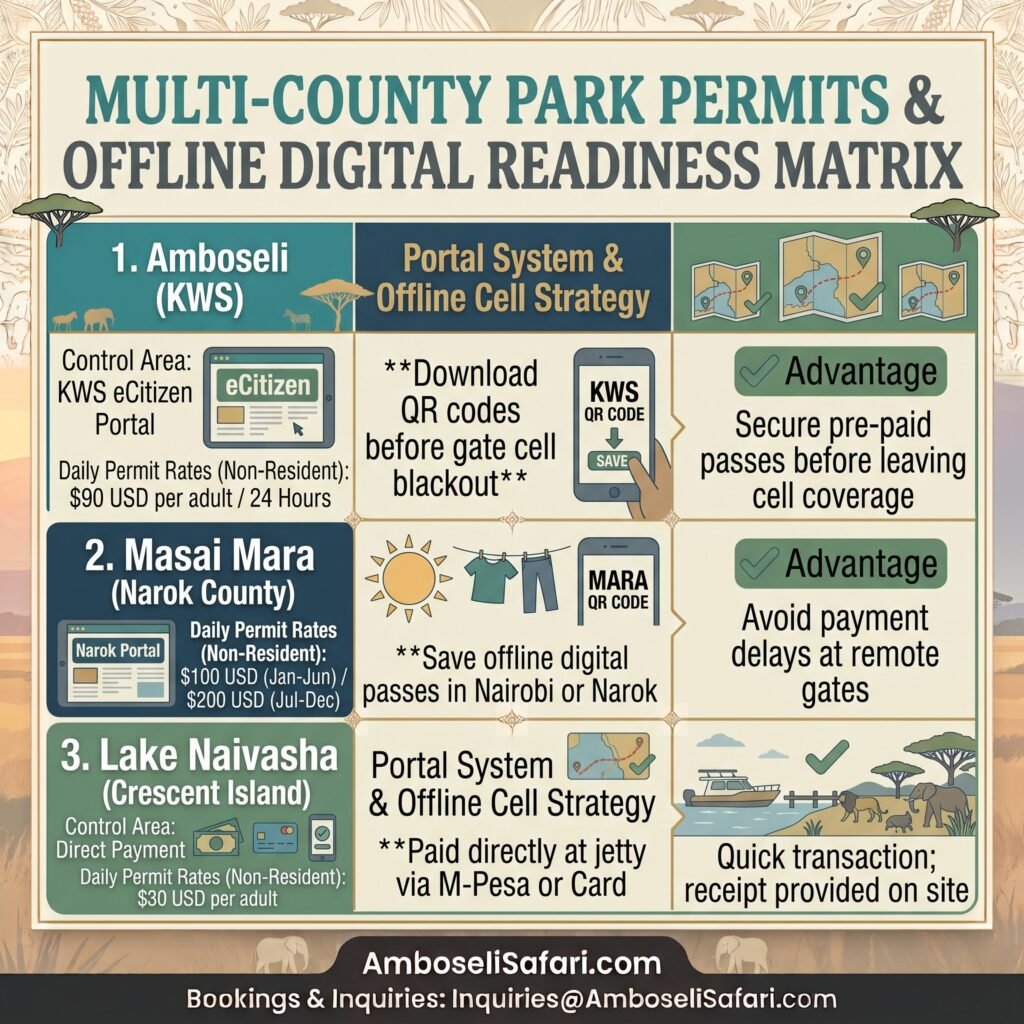
This trip covers parks run by two separate agencies: the Kenya Wildlife Service (KWS) for Amboseli and Lake Nakuru, and the Narok County Council for the Masai Mara. Their entry portals are separate and cannot be combined:
- Amboseli (KWS): $90/day per adult. Must be bought on eCitizen ahead of time—do not rely on gate Wi-Fi.
- Masai Mara (Narok County): $100/day per adult from January to June, rising to $200/day during peak season from July to December.
- Data Dead Zones: Cell service dies about 10km before Sekenani Gate in the Mara and Kimana Gate in Amboseli. Download all entry QR codes to your phone while you still have 4G in Nairobi or Narok town. Trying to load live payment portals at remote gates causes long delays.
Multi-County Park Permits & Offline Digital Readiness Matrix
Managing park access on a 7-day safari involves navigating two separate governing systems: national KWS portals and local Narok County portals. Because entrance passes cannot be merged across different park jurisdictions, securing pre-paid electronic permits prior to departure is essential. Furthermore, cellular coverage drops completely near major park gates, making advance offline media storage critical for entry. Use this permit readiness matrix to handle park portal rules without delays.
| Park & Governing Authority | Daily Permit Rates (Non-Resident) | Portal System & Offline Cell Strategy |
| Amboseli (KWS) | $90 USD per adult / 24 Hours | eCitizen Portal; download QR codes before gate cell blackout |
| Masai Mara (Narok County) | $100 USD (Jan–Jun) / $200 USD (Jul–Dec) | Narok Portal; save offline digital passes in Nairobi or Narok |
| Lake Naivasha (Crescent Island) | $30 USD per adult | Paid directly at jetty via M-Pesa or Card |
Camera Dust Care & Mid-Safari Laundry Hacks
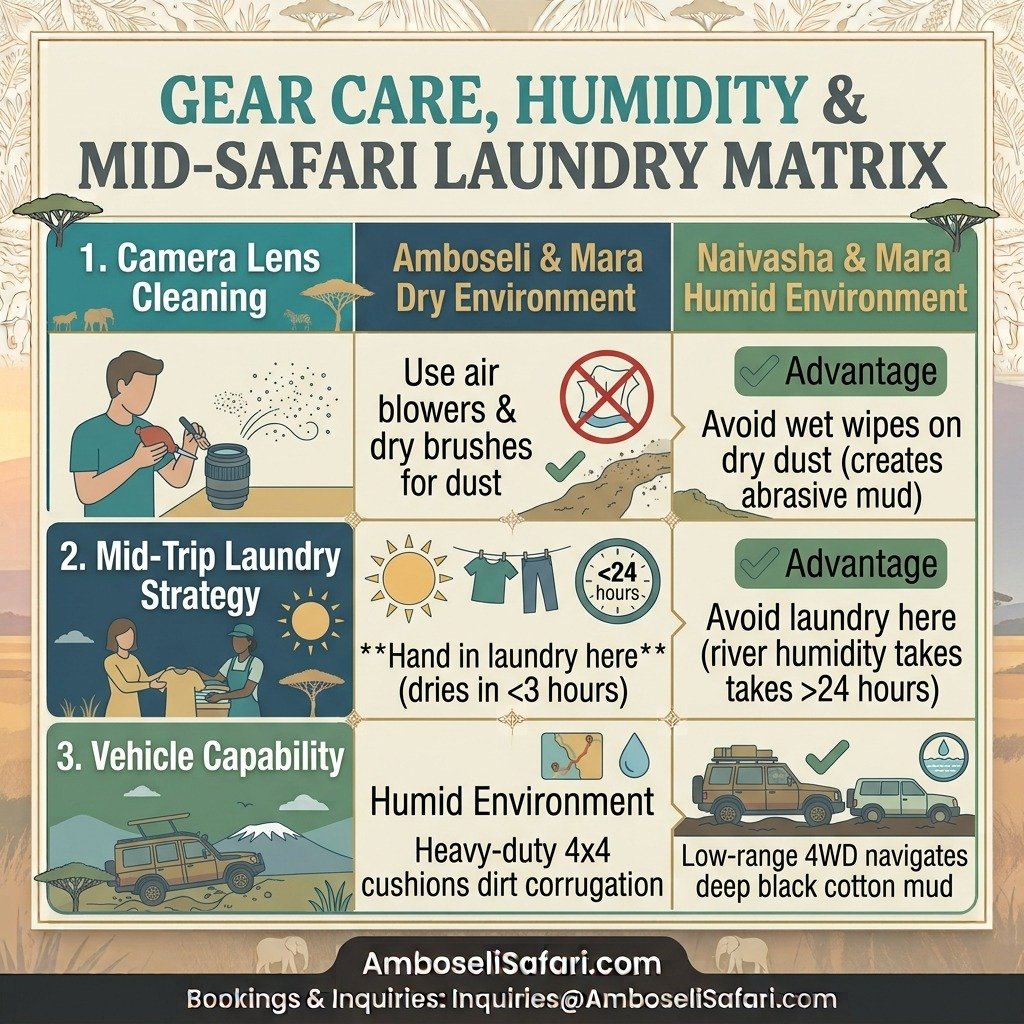
Switching between dry salt flats and humid river valleys requires basic care for your gear and clothes.
During your first two days in Amboseli, fine dust covers everything. When you reach the Mara or Naivasha, river humidity rises. Wiping dry Amboseli dust off camera lenses with wet wipes creates an abrasive mud that scratches glass coatings. Use a dry rubber air blower and a soft brush to blow off dry dust before using wet wipes later in the week.
Luggage limits are capped at 15 kg per person in soft duffel bags, so you’ll need to do laundry mid-trip:
- Hand in your laundry during your 2-night stay in Amboseli rather than in the Mara.
- Amboseli’s dry, windy climate dries thick trousers and socks in under 3 hours.
- High humidity along the Mara and Talek rivers means wet clothes can take over 24 hours to dry, leaving them damp inside your bag.
Gear Care, Humidity & Mid-Safari Laundry Matrix
Moving from Amboseli’s dry alkaline salt flats to the humid river environments of Lake Naivasha and the Masai Mara requires specific gear and garment management. Cleaning lenses improperly after exposure to fine volcanic dust can cause permanent scratches when combined with rising river humidity. Additionally, laundry drying times vary dramatically between high-wind savannas and moist riverine thickets. Use this practical management matrix to protect your optics and optimize mid-trip laundry stops.
| Focus Category | Amboseli Dry Environment | Naivasha & Mara Humid Environment |
| Camera Lens Cleaning | Use air blowers & dry brushes for dust | Avoid wet wipes on dry dust (creates abrasive mud) |
| Mid-Trip Laundry Strategy | Hand in laundry here (dries in <3 hours) | Avoid laundry here (river humidity takes >24 hours) |
| Vehicle Capability | Heavy-duty 4×4 cushions dirt corrugation | Low-range 4WD navigates deep black cotton mud |
Park-by-Park Wildlife Highlights
- Amboseli: Large elephant families, super-tuskers, flamingos on Lake Amboseli, serval cats, and cheetahs hunting across open ground.
- Lake Naivasha & Crescent Island: Hippo pods in shallow water, fish eagles diving for tilapia, and walking tours right alongside giraffes and waterbucks on Crescent Island.
- Masai Mara: Resident lion prides, cheetah coalitions, leopards in river thickets, Nile crocodiles along the Mara River, and black rhinos in the Trans-Mara sector.
Month-by-Month Seasonality & Timing Guide
- July to October (Peak Migration): Combines the wildebeest river crossings in the Mara with clear morning views of Mount Kilimanjaro in Amboseli. High-season rates apply.
- January to March & November (Green Season): Calving season for plains game, dust-free air, vibrant birdlife, lower lodge rates, and far fewer vehicles at sightings.
- April to May (Rainy Season): Heavy rains make dirt tracks in Amboseli and the Mara muddy, requiring experienced drivers and full 4WD. Lodge prices drop up to 40%.
Complete 7-Day / 6-Night Itinerary Schedule
Day 1: Nairobi to Amboseli & Afternoon Game Drive
Pick up from your Nairobi hotel at 06:30 AM in a private 4×4 Safari Land Cruiser. Drive south along Mombasa Road through Emali, reaching your lodge near Kimana Gate for lunch. At 3:30 PM, head out for an afternoon game drive along Ol Okenya swamp to track elephant families feeding near yellow-fever trees.
Day 2: Full-Day Amboseli Swamps & Kilimanjaro Views
Start at 06:00 AM to photograph Mount Kilimanjaro before clouds settle over Kibo peak around 09:30 AM. Track bull elephants along research routes monitored by the Amboseli Elephant Research Project in Enkongo Narok swamp. Enjoy a picnic lunch atop Observation Hill (Normatior) and return to camp by 6:00 PM.
Day 3: Amboseli to Lake Naivasha & Geothermal Spa
Depart Amboseli after breakfast at 07:00 AM. Stop for a 15-minute brake-cooling break at Kijabe Viewpoint before descending into the Great Rift Valley. Reach Lake Naivasha by 1:00 PM for lunch. Spend the afternoon soaking in the natural hot springs at the Olkaria Geothermal Spa inside Hell’s Gate National Park.
Day 4: Naivasha Boat Safari, Crescent Island Walk to Masai Mara
Board a 07:30 AM morning boat trip on Lake Naivasha to spot hippos and watch fish eagle dives. Take a guided walking safari among giraffes and zebras on Crescent Island. Drive west along the paved C12 highway via Narok town, arriving at your Masai Mara lodge by 5:00 PM.
Day 5: Full Day Masai Mara Plains & River Tracks
Spend a full day exploring the Masai Mara savanna. Drive along the Mara and Talek rivers tracking lion prides, cheetahs, and hippos. Enjoy a picnic lunch under an acacia tree in the open reserve, returning to camp by 6:00 PM for dinner.
Day 6: Second Full Day in the Masai Mara
Set out on an early morning game drive at 06:00 AM to catch active predators before midday heat sets in. Visit a traditional Maasai village or explore less-visited sectors of the reserve before enjoying sunset over the Mara plains.
Day 7: Check-Out & Return to Nairobi
Enjoy a relaxed breakfast at your lodge. Check out by 08:30 AM and start the drive back to Nairobi via Narok town, arriving in the capital by 2:30 PM for airport drop-off or hotel check-in.
Package Pricing & Lodging Tiers
Our week-long safari packages cover a private 4×4 Safari Land Cruiser for all 7 days (including driver allowances, fuel, and vehicle entry fees), 6 nights full-board lodging (2 nights Amboseli, 1 night Naivasha, 3 nights Masai Mara), pre-paid non-resident KWS permits (90/dayAmboseli),NarokCountyMarafees(100 or $200/day), boat fees, and Crescent Island entry.
Vehicle logistics run USD 190 per person sharing per day during standard months, rising to USD 400 per person sharing per day during peak dry season (July to October). Rates assume two adults traveling together.
7-Day Safari Package Rates
| Property Tier | Included Lodges* | Normal Season (Jan–Jun, Nov–Dec) | Peak Season (Jul–Oct) |
| Budget Tier | AA Lodge Amboseli / Crayfish Camp / Olmoran Tented Camp | USD 2,560 per person | USD 4,810 per person |
| Mid-Range Tier | Ol Tukai Lodge / Lake Naivasha Country Club / Ashnil Mara Camp | USD 3,040 per person | USD 5,530 per person |
| Luxury Tier | Tortilis Camp / Lake Naivasha Sopa Resort / Mara Intrepids | USD 4,120 per person | USD 7,090 per person |
| Luxury Plus Tier | Angama Amboseli / Chui Lodge / Angama Mara | USD 6,940 per person | USD 11,410 per person |
*Prices reflect total per-person cost for two adults sharing a private 4×4 Land Cruiser. Budget camps run generator power on scheduled hours (off 10 PM – 5 AM).
Reserve Your Safari on Amboselisafari.com to lock in your private 4×4 Land Cruiser and confirm multi-park lodge bookings.
Package Inclusions:
- Private 4×4 Safari Land Cruiser with pop-up roof for all game drives and transfers.
- Services of a TRA-licensed, English-speaking driver-guide for 7 days.
- 6 nights full-board accommodation across selected lodge tiers.
- Non-resident KWS park entry permits for Amboseli ($90/day).
- Narok County park entry permits for Masai Mara ($100 or $200/day).
- Lake Naivasha boat ride and Crescent Island entry permit ($30 USD).
- Bottled drinking water in vehicle coolers and AMREF Flying Doctors evacuation cover.
Package Exclusions:
- International airfare and Electronic Travel Authorization (eTA portal) fees.
- Personal expenses such as driver tips, laundry, or alcoholic beverages.
- Olkaria Geothermal Spa entry fee (~$20 USD per person).
Optional Add-Ons:
- Hot air balloon safari in the Masai Mara: USD 450 per person.
- One-way flight from Masai Mara airstrip to Wilson Airport (Nairobi): USD 580 per person (Note: Changing your Mara airstrip midway incurs a $50 USD per person re-manifesting tax at the airstrip tower).
- Authentic Maasai cultural village visit in Amboseli or Mara: USD 30 per person.
Health, Dietary & Solo Travel Logistics
- Health Protocols: Yellow Fever vaccination certificates are required if entering Kenya from endemic countries. Taking recommended malaria prophylaxis (such as Atovaquone/Proguanil) is strongly advised for low-altitude river sectors in the Masai Mara.
- Dietary Needs: Full-board safari lodges cater to Halal, Vegan, Vegetarian, and Gluten-Free diets. Mention specific requirements at booking so lodge kitchens can stock fresh ingredients ahead of time.
- Solo Traveler Costs: Solo travelers taking a private 4×4 Land Cruiser pay a single room supplement plus the unshared daily vehicle rate, as vehicle logistics cannot be split across multiple passengers.
- US Dollar Notes: Tellers and lodge cashiers in Kenya reject pre-2013 USD bills due to bank counterfeit rules. Bring clean notes printed in 2013 or later.
- Tipping Standard: Plan on tipping your private driver-guide $15 to $20 USD total per day from your group.
- Kenya Shillings (KES): Keep KES 5,000 to 10,000 ($35 to $70 USD equivalent) in small notes for fruit stands or roadside craft purchases.
- eTA Rules: Apply for an Electronic Travel Authorization online at least a week before departing.
Frequently Asked Questions
Is it better to drive or fly between Amboseli and the Masai Mara?
Driving takes 8.5 to 9.5 hours along the paved C12 highway via Narok, giving you a real look at rural Kenya. Flying via Wilson Airport or direct bush flights takes under two hours, though one-way flight extensions add $580 per person to the package cost.
How much luggage can we bring on a 7-day Kenya safari?
Safari Land Cruisers enforce a strict limit of one soft-sided duffel bag weighing up to 15 kg (33 lbs) per person. Hard-shell rolling suitcases block rear visibility and steal footwell space inside the vehicle.
Can we add Lake Nakuru to this 7-day safari itinerary?
Yes. Lake Nakuru can easily replace or accompany Lake Naivasha on Day 3 or Day 4, though adding Nakuru requires paying an additional $90 USD KWS non-resident park fee per person.
Written by Patrick Mulei. Reviewed by Anthony Mule, Senior Safari Guide with over a decade of field experience in Amboseli.