
Kenya Fly-In Safari to Amboseli: 4-Day Itinerary & Costs
Overview of Kenya Fly-In Safari to Amboseli
A 4-day Kenya fly-in safari to Amboseli (3 nights) costs 2,700–9,900 per person. Taking a 40-minute Safarilink flight from Wilson Airport includes return airfare, private 4×4 Land Cruiser game drives, airport transfers, full-board lodging, and pre-paid KWS permits.
Jump Ahead
- What Are Luggage Limits & Best Seats?
- Which Amboseli Airstrip to Fly Into?
- Triangular Flight Circuit Savings
- 4-Day Fly-In Itinerary Schedule
- Safari Package Costs & Hotel Tiers
- Frequently Asked Questions
Skip the 4-hour truck crawl down Mombasa Road. Flying out of Wilson gets you onto the dirt tarmac in 40 minutes flat. A plane saves precious time on game drives, but light aircraft come with strict rules you have to respect.
Check seasonal wildlife movements across Kajiado County before picking dates, or drop a line through our trip planner on Amboselisafari.com to adjust flight schedules.
What Are the Luggage Limits & Best Seats for Amboseli Flights?
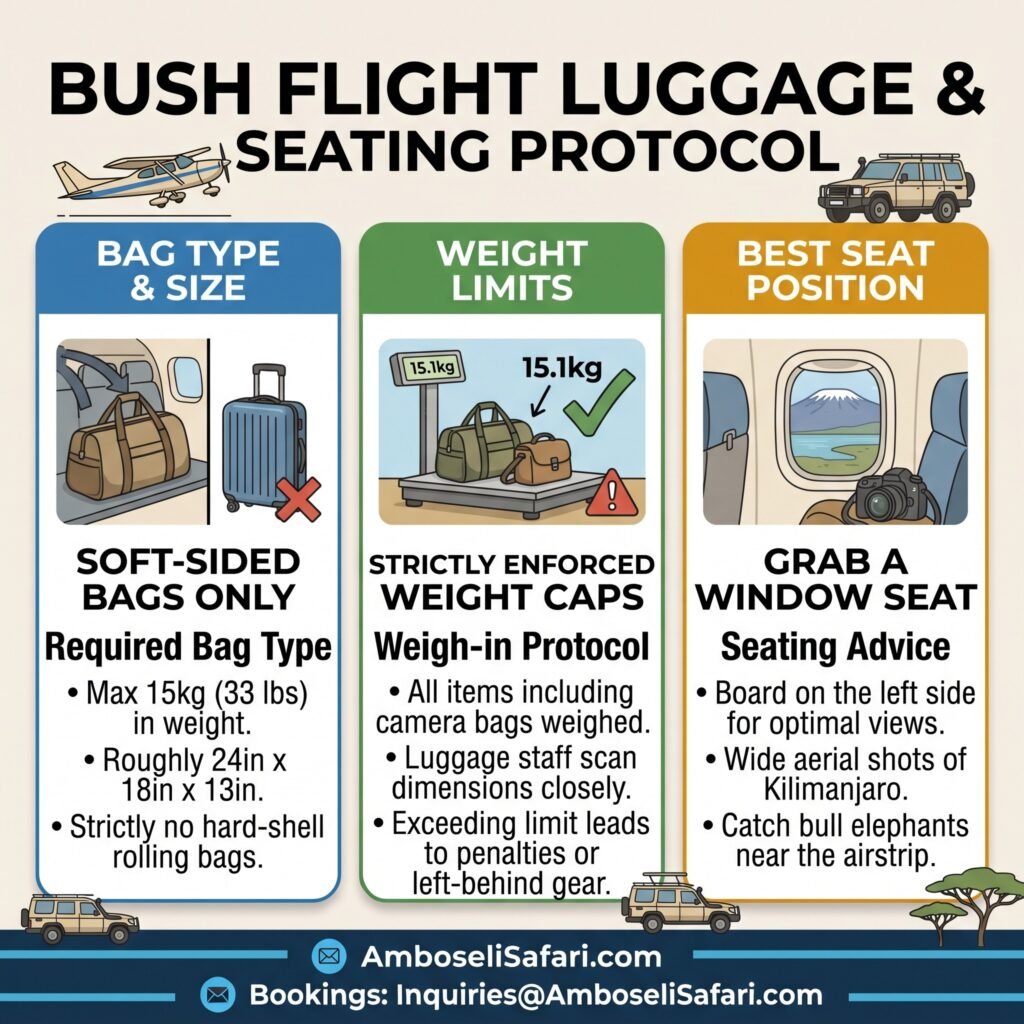
Morning flights on Safarilink or AirKenya push back from Wilson Airport (WIL) around 07:30 AM. Get there early, grab a quick coffee at Paul’s Caffe in the terminal, and head to check-in. Planes leave early because the basin floor heats up fast—by 11:30 AM, thermal air makes light aircraft bump violently. Rainy months (April, May, November) are trickier; early morning departures avoid sudden cloud holds over Nairobi.
Wilson Airport staff don’t negotiate on weight or suitcase dimensions. Hard-shell rolling bags won’t squeeze into a Cessna Caravan’s belly hold, so rigid luggage gets turned away at check-in. They weigh every single piece on platform scales—including your camera bag.
Your luggage must be a soft-sided duffel bag maxing out at 15 kg (33 lbs) and measuring roughly 24 in x 18 in x 13 in. Push past 15.5 kg and you’ll pay steep overweight fees or leave gear behind. Safarilink offers secure luggage holding at their Wilson terminal, while AirKenya stores extra bags for about $20 USD a day. Leave your hard city rolling bags in Nairobi.
Boarding at Wilson? Grab a window seat on the left side of the plane.
Descending into the basin, left-side windows give you wide aerial shots of Mount Kilimanjaro’s Kibo peak and the bright salt flats of Lake Amboseli. Right-side windows stare into harsh morning sun glare off Tsavo. Keep your camera on your lap. Huge bull elephants regularly cross the dirt access track 300 meters from the runway threshold—giving you epic shots before you even hit camp reception.
Bush Flight Luggage & Seating Protocol
Flying into the bush on light aircraft requires strict adherence to luggage dimensions, weight thresholds, and seating strategy to ensure a seamless departure from Wilson Airport. Light aircraft belly holds cannot accommodate rigid frames, and strict weight caps are enforced at check-in scales. Use this quick reference guide to prepare your gear and maximize your aerial photography opportunities during flight.
| Flight Requirement | Specification / Limit | Critical Reason |
| Bag Type & Size | Soft duffel (24″ x 18″ x 13″) | Hard-shell suitcases are rejected; won’t fit plane belly holds. |
| Weight Limit | 15 kg (33 lbs) total weight | Strict aircraft payload limits; camera gear weighed at check-in. |
| Best Seat Position | Left-side window | Unobstructed views of Mount Kilimanjaro during descent. |
Which Amboseli Airstrip Should You Fly Into: ASV or Private Strips?
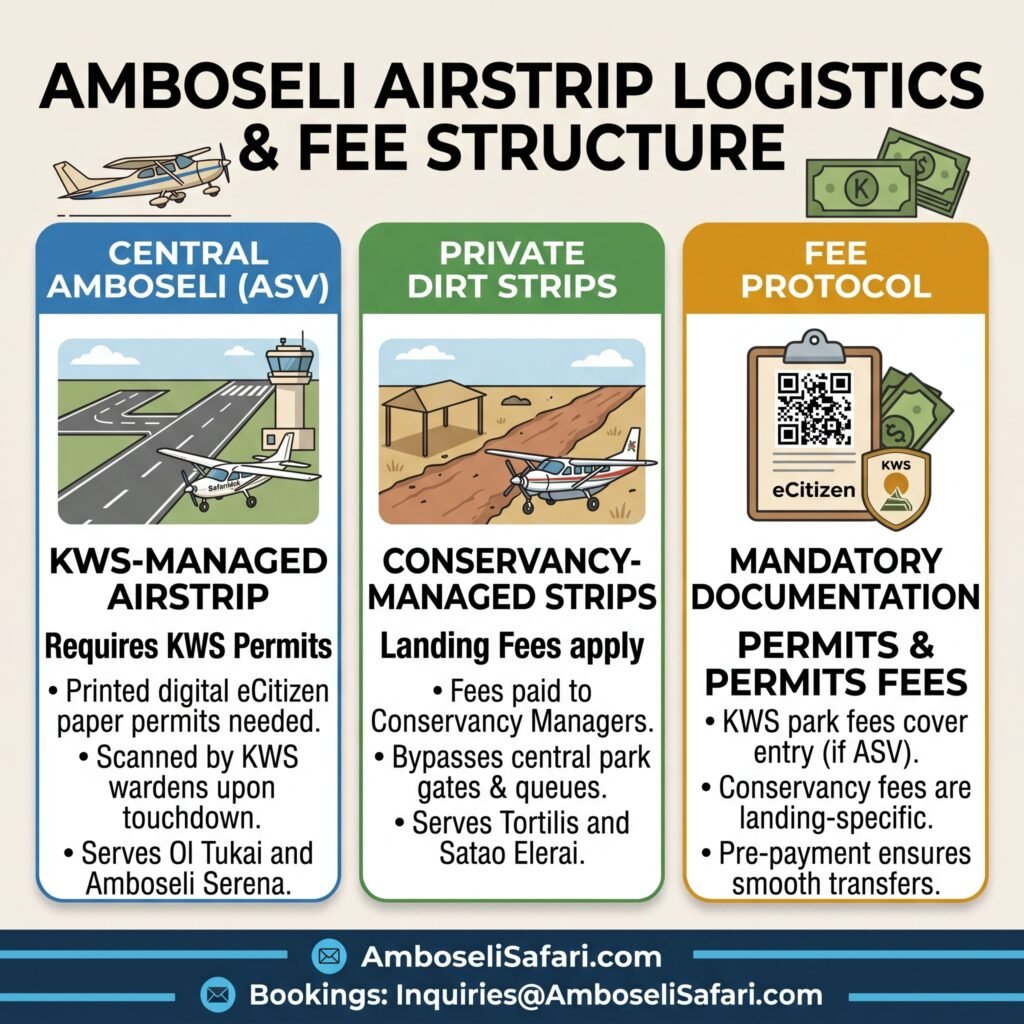
Central Amboseli Airstrip (ASV) sits right in the middle of the park near Ol Tukai Lodge.
The second you step off the plane onto the dusty apron, Kenya Wildlife Service (KWS) wardens scan digital eCitizen QR codes at the tarmac shade shelter. You won’t get past the runway gate without pre-paid permits—our drivers keep paper receipts printed and ready.
Luxury camps in outer sanctuaries use private dirt strips like Tortilis Airstrip in Kitirua or Selenkay Airstrip.
Landing on a private strip bypasses central gate queues entirely and drops you right onto quiet conservancy tracks. Landing on private dirt strips means paying landing fees directly to conservancy managers instead of standard KWS entry fees. Double-check KWS permit fees or read gate operational hours before booking air seats.
Airstrip Logistics & Fee Structure
Choosing between central public airstrips and private conservancy dirt tracks dictates your arrival logistics, park entrance formalities, and overall crowd exposure. Knowing what documentation and entry fees are required at the tarmac prevents unexpected delays upon touchdown. Compare the entry requirements and key operational differences for Amboseli’s primary landing strips below.
| Airstrip | Location / Access | Entrance & Fee Protocol |
| Amboseli Airstrip (ASV) | Central Park (near Ol Tukai) | KWS warden QR scan; requires printed eCitizen paper permits. |
| Tortilis Airstrip | Kitirua Conservancy (West) | Bypasses central park gates; requires conservancy landing fees. |
| Selenkay Airstrip | Selenkay Conservancy (North) | Quiet private tracks; direct conservancy fee processing. |
Triangular Flight Circuit Savings (Amboseli + Masai Mara)
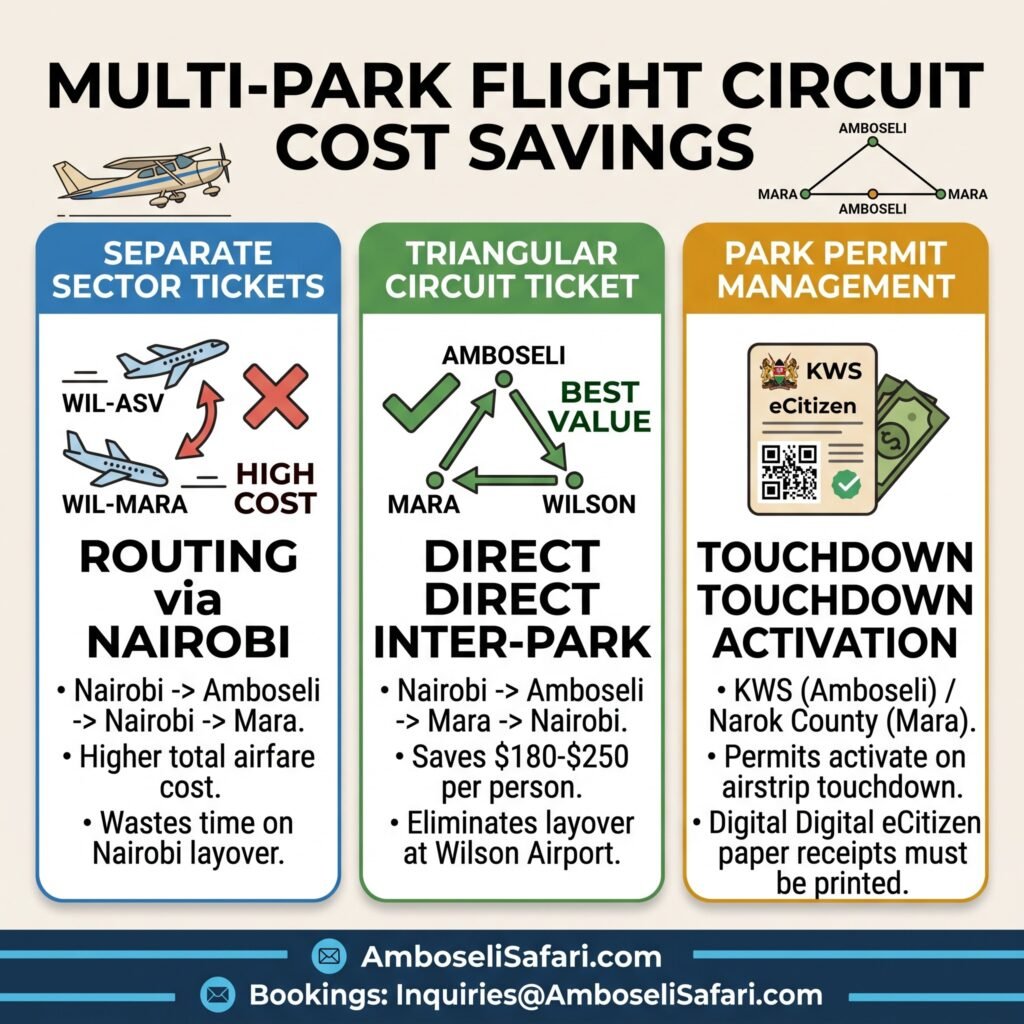
Combining Amboseli and the Masai Mara? Book a single “triangular circuit” air ticket.
Routing your flight from Wilson to Amboseli, across to the Masai Mara, and back to Wilson knocks $180 to $250 USD per person off separate sector fares. It also saves you an unnecessary stopover back in Nairobi.
Narok County Council park fees take effect the moment you touch down in the Mara, while KWS covers your Amboseli permits.
Multi-Park Flight Circuit Cost Savings
Linking Amboseli with the Masai Mara on a single safari circuit can be optimized by choosing direct inter-park flights over separate point-to-point transfers. Booking a unified triangular ticket eliminates repetitive Nairobi layovers while significantly reducing overall airfare expenses. Use this comparison to understand how flight routing affects your itinerary efficiency and travel budget.
| Flight Route | Routing Connection | Financial & Time Impact |
| Separate Sector Tickets | Nairobi ➔ Amboseli ➔ Nairobi ➔ Mara | Higher total airfare; wastes time on Nairobi layover. |
| Triangular Circuit Ticket | Nairobi ➔ Amboseli ➔ Mara ➔ Nairobi | Saves 180–250 per person; eliminates layover. |
| Park Permit Management | KWS (Amboseli) / Narok County (Mara) | Permits trigger on touchdown at respective airstrips. |
4-Day / 3-Night Fly-In Itinerary Schedule
Day 1: Fly Nairobi to Amboseli & Afternoon Game Drive
05:30 AM pickup from your Nairobi hotel for the short drive to Wilson Airport. Board your 07:30 AM flight to Amboseli Airstrip (ASV). Your guide meets you at the tarmac, clears permits, and starts your game drive immediately. After lunch at camp, head back out along Enkongo Narok swamp to watch elephant herds feeding among yellow-fever tree groves.
Day 2: Full Day Swamps & Mount Kilimanjaro
Out the gate by 06:00 AM. You want clear mountain shots before clouds cover Kibo peak by mid-morning. Track big tuskers along research paths monitored by the Amboseli Elephant Research Project, then hike up Observation Hill (Normatior) for a view across the marshes.
Day 3: Full Day Central Basin & Observation Hill
Spend the morning exploring Ol Okenya swamp and western salt flats where zebra and wildebeest herds kick up dust storms. Eat lunch at camp, then take an evening drive along acacia woodland edges tracking lions and cheetahs.
Day 4: Morning Departure & Fly Back to Nairobi
Relaxed breakfast at camp. Load duffel bags into the Land Cruiser for the short drive back to the airstrip. Board your 09:05 AM flight to Wilson Airport—our driver meets you at 09:50 AM to drop you at your hotel or international terminal.
Safari Package Costs & Hotel Tiers
This 4-day fly-in package covers return airfare from Wilson Airport, private Nairobi transfers, a dedicated 4×4 Safari Land Cruiser assigned to your group in Amboseli, 3 nights of full-board lodging, and pre-paid non-resident KWS park permits ($90 USD per adult per 24 hours).
Vehicle, fuel, and guide logistics run USD 190 per person sharing per day during standard months, rising to USD 400 per person sharing per day during peak dry season (July to October).
| Package Tier | Included Lodges* | Normal Season (Jan–June, Nov–Dec) | Peak Season (July–Oct) |
| Budget Tier | AA Lodge Amboseli | USD 2,700 per person | USD 3,900 per person |
| Mid-Range Tier | Ol Tukai Lodge | USD 3,200 per person | USD 4,600 per person |
| Luxury Tier | Tortilis Camp | USD 3,900 per person | USD 5,800 per person |
| Luxury Plus Tier | Angama Amboseli | USD 6,500 per person | USD 9,900 per person |
*Prices reflect two adults sharing a private 4×4 Land Cruiser. Budget camps run generators on strict schedules (power off 10 PM – 5 AM). Wi-Fi at mid-range lodges stays confined to main lounge areas.
Children under 12 get 50% off lodging when sharing a room with two adults. Single travelers pay a single supplement fee between 20% and 35% depending on travel dates.
Send us a note through our safari booking form to check room availability before locking in bush flights.
Package Inclusions:
- Return flight tickets between Nairobi Wilson Airport and Amboseli Airstrip
- Private airport transfers in Nairobi ($40 per person each way)
- Private 4×4 Safari Land Cruiser with pop-up roof for all game drives
- Services of a TRA-licensed, English-speaking driver-guide
- 3 nights full-board accommodation
- Non-resident KWS park entry permits (3 x 24-hr permit blocks)
- Bottled drinking water in vehicle coolers and emergency medical evacuation insurance
Package Exclusions:
- International airfare and Electronic Travel Authorization (eTA) fees
- Personal extras like guide tips, souvenirs, laundry, or lodge bar bills
- Optional activities like hot air balloon safaris or cultural village tours
Optional Add-Ons:
- Authentic Maasai cultural village visit: USD 30 per person
- Sunrise hot air balloon safari over the plains: USD 450 per person
- One-way flight extension connecting to the Masai Mara: USD 350 per person
To see how these properties line up against park boundaries, compare the best luxury lodges in Amboseli.
Cash, Gear & Packing Rules
- Bank tellers and lodge cashiers in Kenya are relentless about USD bills. If you hand them a pre-2013 note—even a crisp $100 bill with a minor fold—they will hand it right back. Bring clean US Dollar bills printed in 2013 or later.
- Keep KES 5,000 to 10,000 ($35 to $70 USD equivalent) in small Kenya Shillings notes. Fruit vendors near Kimana or roadside M-Pesa agents can’t break a $50 bill.
- Tipping your 4×4 driver-guide runs $15 to $20 USD per day total from your group.
- Reception tip boxes handle back-of-house staff; $10 USD per day covers room stewards and kitchen crew.
- Apply for an Electronic Travel Authorization at etakenya.go.ke at least a week before flying. Carry a physical Yellow Fever card if transiting through endemic countries, and pack a Type G UK 3-pin adapter to charge camera gear during generator hours.
Frequently Asked Questions
Can I bring my hard-shell Samsonite bag on a fly-in safari?
No. Bush airlines enforce a strict 15 kg (33 lbs) weight limit per passenger in soft-sided duffel bags. Hard-shell suitcases with wheels get turned away at Wilson Airport gate scales because they physically won’t flex into aircraft belly holds.
What happens if my flight is delayed by weather at Wilson Airport?
Morning departures rarely delay, but if thick fog or heavy rain hits Wilson, planes wait for visibility before taking off. Airlines adjust flight slots, and our pickup drivers shift transfer times so you don’t miss a beat.
Are game drives included as soon as we land at Amboseli Airstrip?
Yes. Your assigned 4×4 Land Cruiser meets you right at the tarmac edge. Because central Amboseli Airstrip sits directly inside the park, your safari starts the second you step off the plane.
Written by Patrick Mulei. Reviewed by Anthony Mule, Senior Safari Guide with over a decade of field experience in Amboseli.