
Wet Season Birding in Amboseli: Migrant Hotspots, Routes & Rates
Overview
Taking a trip for Wet Season Birding in Amboseli brings over 400 species to flooded marshes beneath Mount Kilimanjaro. While visitors confuse local administration with Narok County Council, Kajiado County and Kenya Wildlife Service manage this basin alongside the Amboseli Elephant Research Project.
Fast Navigation Links
- Custom Birding Package Rates
- Wet Season Birding Calendar
- Species Habitat Master Table
- Sinet Causeway Hotspot Routes
- Optics and Identification Tools
- Black Cotton Mud Hazards
2027 Wet Season Safari Packages & Vehicle Rates
When November rains hit the basin, bird populations swell as hundreds of migratory species arrive from Europe and Asia. We run these birding itineraries in modified 4×4 Safari Land Cruisers fitted with wide pop-up roof hatches and padded window rails so you can rest heavy telephoto lenses comfortably.
Rates below show the total cost per person for two adults sharing a private vehicle setup:
3-Day & 4-Day Amboseli Wet Season Birding Safari Packages
| Package Tier & Accommodations | Standard / Green Season (USD / Person)* | Peak Season (USD / Person)* | Booking Action |
| 3-Day Budget Birding Safari (Kibo Safari Camp / Kimana Bush Camp / Amboseli Junction Eco Lodge) | $1,180 | $1,880 | Book Now |
| 3-Day Mid-Range Birding Safari (Kilima Safari Camp / Amboseli Sopa Lodge / Zebra Plains Camp) | $1,480 | $2,180 | Book Now |
| 3-Day Luxury Birding Safari (Ol Tukai Lodge / Amboseli Serena Safari Lodge / Satao Elerai Camp) | $1,980 | $2,780 | Book Now |
| 4-Day Fly-In Luxury Plus Safari (Flight + Elewana Tortilis Camp / Tawi Lodge / Angama Amboseli) | $3,950 | $5,950 | Book Now |
*Rates cover 2026/2027 for two adults sharing a room or tented suite with a private 4×4 Land Cruiser. Standard and green season rates apply during the main rainy months (November, December, and March through May). Rates include full-board lodging, private transport, driver-guide allowances, fuel, daily $90 USD KWS entry permits, and custom vehicle gear. Fly-in options include roundtrip domestic flights from Wilson Airport (WIL) on Safarilink or Airkenya plus airstrip transfers.
If you want to hold specific travel dates or talk through specialized routing, send your details through our safari inquiry form.
Package Inclusions
- Private 4×4 Safari Land Cruiser with pop-up roof hatches and beanbag mounts
- Services of a TRA-licensed driver-guide trained in bird identification and call tracking
- Full-board accommodation covering breakfast, lunch, and dinner
- Pre-paid daily $90 USD KWS park entry permits
- Chilled drinking water stocked in the vehicle cooler
Package Exclusions
- International flights, travel insurance, and digital entry processing via the official eTA portal
- Tipping your driver-guide or lodge staff
- Alcoholic beverages, soft drinks, or personal laundry
- Optional extras like a Maasai village visit ($30) or a sunrise balloon flight ($450)
Optional Add-Ons
- Night birding & game drive in a private conservancy: USD 50 per person
- Sunrise hot air balloon flight over central marshes: USD 450 per person
If you’re mapping out fuel math and KWS fees, we list those exact numbers on our safari cost breakdown.
Month-by-Month Wet Season Birding Calendar
Timing your trip depends on whether you want migratory flocks, clear mountain backdrops, or maximum wetland coverage:
- November – December: The Palaearctic migrants pour in. European Bee-eaters, Steppe Eagles, and Eurasian Rollers land right as heavy downpours trigger subterranean termite hatches. It’s a total feeding frenzy along yellow-fever tree (Acacia xanthophloeia) branches.
- January – February: A brief dry gap. Skies clear up, giving you fantastic morning shots against Mount Kilimanjaro while resident birds flash full breeding plumage. Less mud risk, too.
- March – May: Long rains flood Lake Amboseli completely. Waterbirds like Lesser Flamingos and Great White Pelicans arrive in huge numbers, but be warned: secondary dirt tracks turn into impassable soup.
Seasonal Migrant Migration & Flight Window
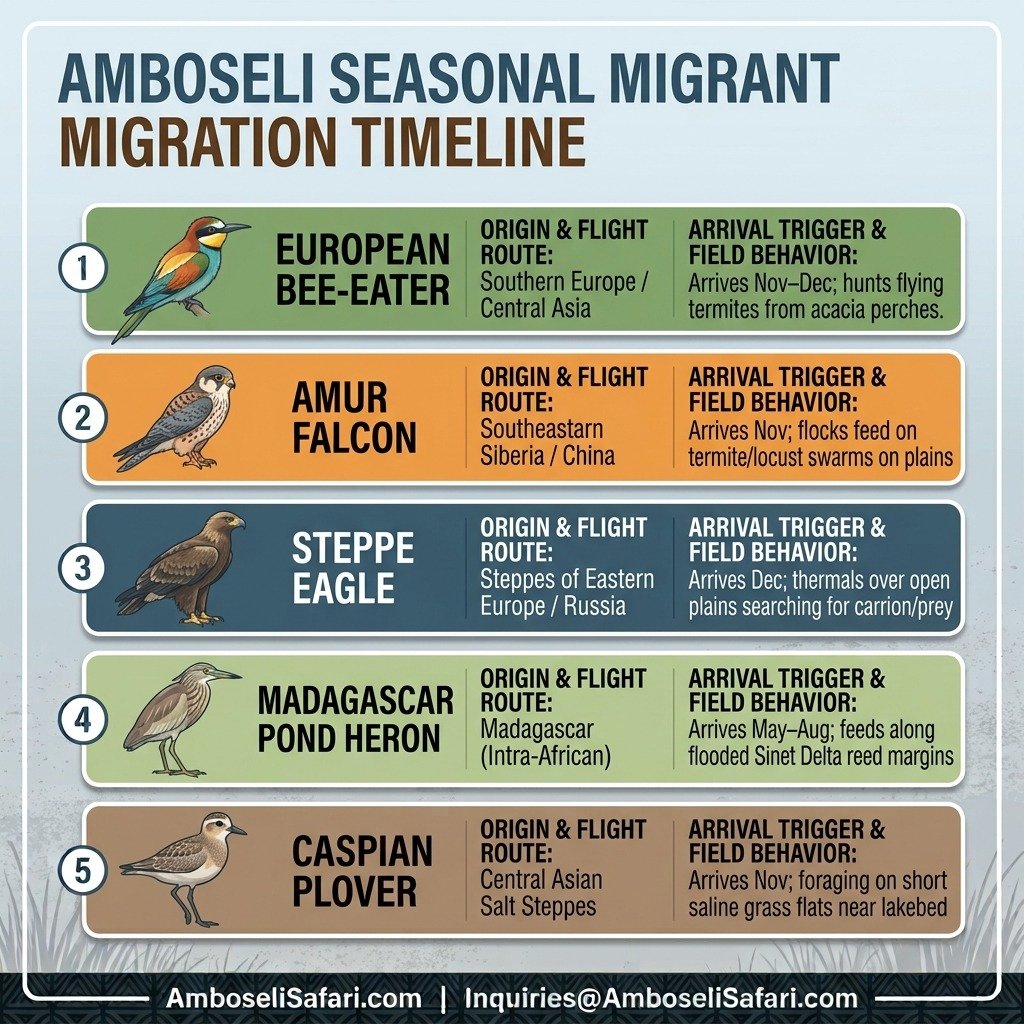
The arrival of Palaearctic and intra-African migratory birds in Amboseli is tied directly to regional rainfall cycles and seasonal food surges. Thousands of species travel thousands of kilometers from European and Eurasian breeding grounds to exploit insect hatches across the basin. This timeline outlines the peak flight windows, origins, and arrival behaviors for key migratory families.
| Migrant Species | Origin & Flight Route | Arrival Trigger & Field Behavior |
| European Bee-eater | Southern Europe / Central Asia | Arrives Nov–Dec; hunts flying termites from acacia perches. |
| Amur Falcon | Southeastern Siberia / China | Arrives Nov; flocks feed on termite/locust swarms on plains. |
| Steppe Eagle | Steppes of Eastern Europe / Russia | Arrives Dec; thermals over open plains searching for carrion/prey. |
| Madagascar Pond Heron | Madagascar (Intra-African) | Arrives May–Aug; feeds along flooded Sinet Delta reed margins. |
| Caspian Plover | Central Asian Salt Steppes | Arrives Nov; foraging on short saline grass flats near lakebed. |
Categorized Habitat Species Master Table
Amboseli’s diverse ecosystems concentrate specific bird families across distinct micro-environments:
| Ecosystem Habitat | Key Resident Species | Migratory / Seasonal Highlights |
| Flooded Swamps & Marshes | Grey Crowned Crane, African Jacana, Malachite Kingfisher. | Madagascar Pond Heron, White Pelicans, and huge flamingo flocks. |
| Open Grasslands & Mudflats | Pangani Longclaw and Kori Bustard. | Amur Falcons, Caspian Plovers, and Jackson’s Widowbirds leaping over grass. |
| Acacia Woodland & Scrub | Von der Decken’s Hornbill and D’Arnaud’s Barbet. | European Bee-eater, Steppe Eagle, and Eurasian Roller. |
Expanded Birding Hotspots Beyond Sinet Causeway
Navigating the park during wet months requires knowing which sectors hold the highest species concentrations.
Sinet Delta Causeway
When rains fill the basin, runoff transforms Sinet Delta into a sprawling swamp flanked by yellow-fever tree (Acacia xanthophloeia) groves. The Sinet causeway often sits under 30 cm of moving water. Minibuses usually turn around here. Anthony Mule, our senior guide, prefers parking our 4×4 right in the shallow flow to watch the birds.
Key species around the causeway include:
- Taveta Golden Weaver (Ploceus castaneiceps): Localized weavers building woven nests in flooded papyrus reeds directly alongside the road.
- Madagascar Pond Heron (Ardeola idae): A rare migratory wader that uses flooded delta margins as a seasonal feeding stop.
- Malachite Kingfisher: Perched on low reed stalks, diving for small fish trapped in slow-moving causeway currents.
When mapping out wetland sectors across our Amboseli National Park guide, Sinet always sits at the top of our morning route list.
Enkongo Narok Swamp & Observation Hill
The open water channels and sedge marshes around Enkongo Narok swamp hold high-density waterbird aggregations. Scoping from the elevated stone lookout at Observation Hill lets you spot Goliath Herons, African Swamphens, Glossy Ibises, and Grey Crowned Cranes feeding in deep reed beds.
Ol Tukai Acacia Woodlands
The fever tree canopy surrounding Ol Tukai provides core habitat for dry-country woodland species. It’s our most reliable spot for Von der Decken’s Hornbills, Steel-blue Whydahs, White-bellied Go-away-birds, and D’Arnaud’s Barbets performing synchronized duets from lower branches.
The “Green-Out” Insect Hatch & Migrant Feeding Frenzies
People often complain that long grass hides big cats during rainy months. But if you’re holding binoculars, this “green-out” is pure gold.
Heavy downpours trigger subterranean termite and locust hatches across central plains. Millions of winged insects take flight simultaneously, drawing Palaearctic migrants down from the sky.
Flocks of Amur Falcons, Steppe Eagles, and European Bee-eaters pack onto the lower branches of yellow-fever trees (Acacia xanthophloeia). They swoop down to snatch flying termites directly off the ground and mid-air.
If you want to match your dates against regional weather patterns, we’ve broken down rain cycles in our Amboseli safari planning guide.
Namelok Grassland Endemics & Aerial Display Flights
While waterbirds crowd central swamps, rain revives the short saline grass flats surrounding the dry lakebed perimeter and Namelok fence lines.
This micro-habitat attracts specialized grassland endemics that are difficult to spot during dry months:
- Pangani Longclaw (Macronyx aurantiigula): Look for their bright yellow-orange throats as they sing from raised tussocks.
- Spike-heeled Lark (Chersomanes albofasciata): These birds run along bare dirt tracks near Namelok before launching into high-altitude courtship display flights over green shoots.
If you’re taking your own vehicle out toward these boundary tracks, keep our Amboseli self-drive tips in mind so you don’t drop a tire off the shoulder.
Jackson’s Widowbird Breeding Leaps & Conservation Etiquette
During the dry season, widowbirds look like non-descript brown sparrows easily overlooked in scrubland. Once short rains land in November, male Jackson’s Widowbirds (Ploceus jacksoni) molt into jet-black breeding plumage with long, arching tail feathers.
Along flooded roadside ditches between Iremito Gate and Ol Tukai, male widowbirds flatten out circular “dance rings” in tall grass. They leap a meter straight into the air, flashing their long tail plumes to attract watching females.
When watching these courtship leaps, our drivers keep our Land Cruisers strictly on established gravel road shoulders. Pulling off onto soft grassy verges crushes active dance rings and destroys grassland tussock nests hidden in roadside vegetation. Always view display grounds through binoculars or telephoto lenses from inside the vehicle frame.
We track similar seasonal movements near the marsh borders in our famous elephants guide.
Field Optics & Digital Identification Tools
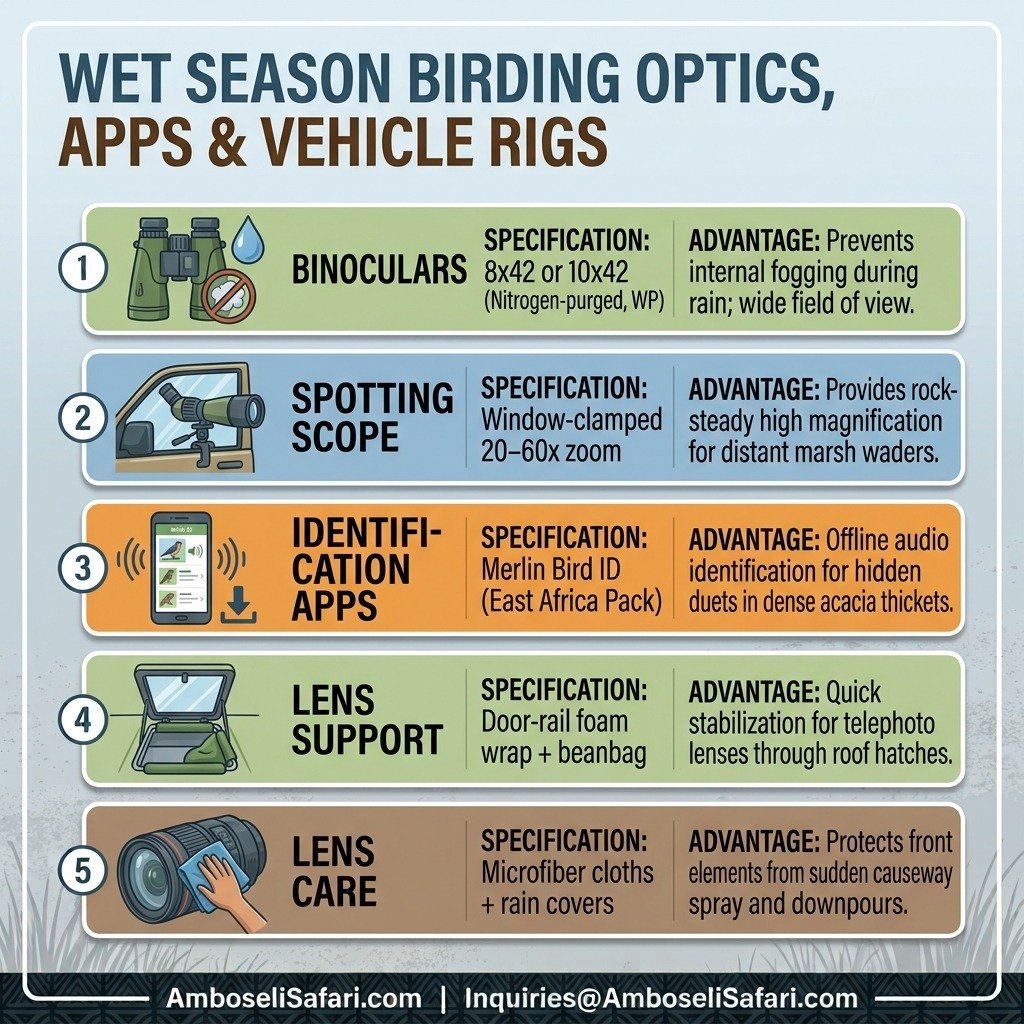
Having the right field gear makes tracking fast-moving migrants much easier in wet conditions:
- Optics & Vehicle Support: Nitrogen-purged, waterproof 8×42 or 10×42 binoculars handle sudden rain showers easily. For extended causeway watching, a window-clamped spotting scope mounted onto the Land Cruiser door frame gives you stable, high-magnification views across flooded swamps.
- Digital Identification Apps: Download offline field tools before entering the park, including Merlin Bird ID (with the East Africa pack loaded) and Roberts Bird Guide Africa. Active eBird hotspot tracking helps you check recent local sightings submitted by guides along the Sinet and Ol Tukai loops.
Wet Season Optics, Apps & Support Rigs
Tracking fast-moving migratory flocks through dense, wet foliage requires gear built to withstand high humidity and sudden equatorial downpours. Standard photography setups can suffer from fogging or lens instability during extended causeway watches. Use this field optics and vehicle mounting cheat sheet to optimize your birding configuration.
| Gear Category | Field Specification | Practical Safari Advantage |
| Binoculars | 8×42 or 10×42 (Nitrogen-purged, WP) | Prevents internal fogging during rain; wide field of view. |
| Spotting Scope | Window-clamped 20–60x zoom | Provides rock-steady high magnification for distant marsh waders. |
| ID Apps | Merlin Bird ID (East Africa Pack) | Offline audio identification for hidden duets in dense acacia thickets. |
| Lens Support | Door-rail foam wrap + beanbag | Quick stabilization for telephoto lenses through roof hatches. |
| Lens Care | Microfiber cloths + rain covers | Protects front elements from sudden causeway spray and downpours. |
Black Cotton Clay (Vertisol) Traps at Namelok & Kitirua
I’ve spent hours winching Land Cruisers out of Namelok vertisol—if you hit that wet black cotton clay without dropping tire pressure, you’re stuck fast. Unlike the powdery volcanic ash over near Meshanani, this mud turns into thick, heavy glue within 50 meters.
When tracking Rufous-bellied Herons along swamp margins, our drivers drop tire pressure slightly to widen the tire footprint and maintain steady forward momentum. Never stop in a standing puddle on black cotton soil; keep moving until your tires hit firm gravel.
If you’re trying to pick a camp that avoids the worst mud tracks, our guide on where to stay in Amboseli outlines which lodges sit closest to solid gravel roads.
Black Cotton Mud vs. Salt Silt Vehicle Protocol
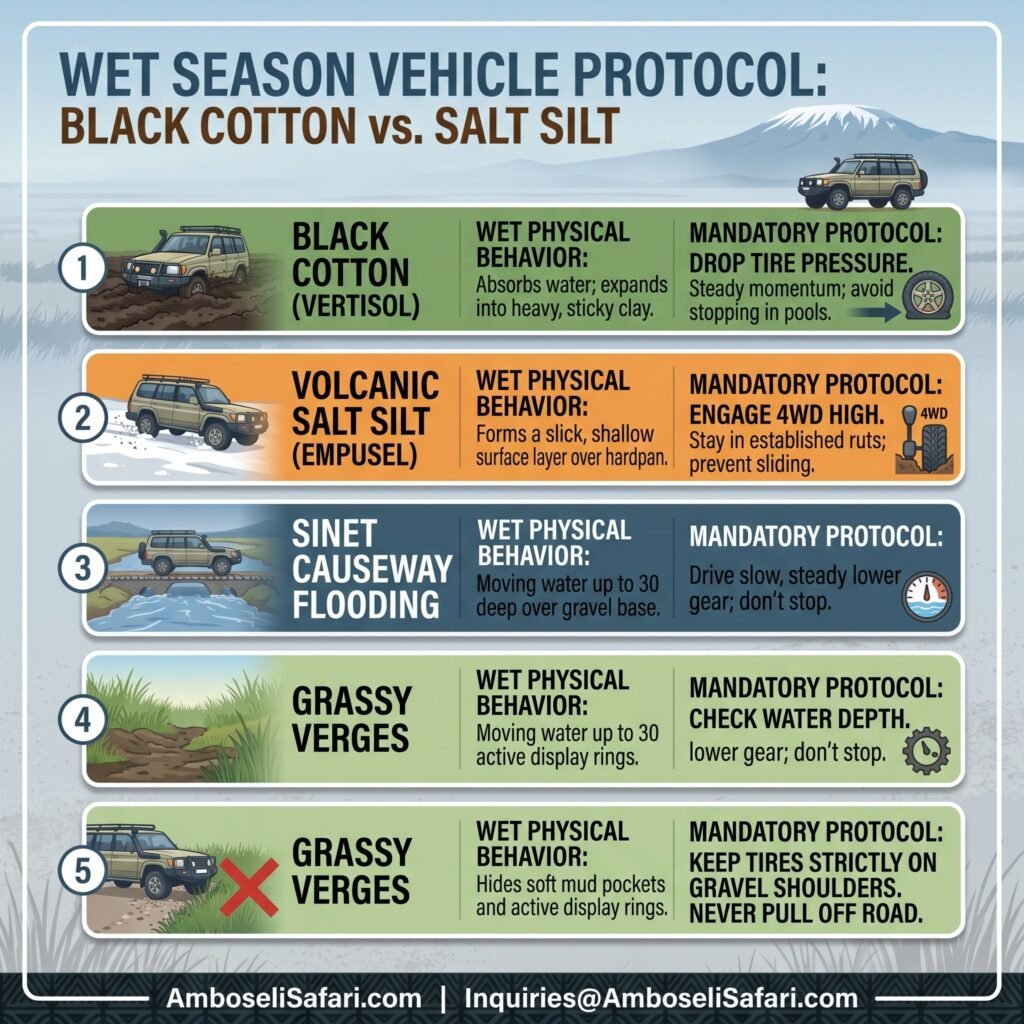
Navigating Amboseli during the rainy season requires recognizing two distinct soil types that behave differently when wet. While powdery volcanic salt crusts turn into slick surface soup, black cotton vertisol clay creates deep, heavy mud traps that immobilize vehicles. This protocol summary outlines driving tactics and tire management required for safe wet-track navigation.
| Terrain Soil Type | Wet Season Physical Behavior | Mandatory Driving Protocol |
| Black Cotton (Vertisol) | Absorbs water; expands into heavy, sticky clay | Drop tire pressure; maintain steady momentum; avoid stopping in pools. |
| Volcanic Salt Silt (Empusel) | Forms a slick, shallow surface layer over hardpan | Engage 4WD high; stay in established tire ruts to avoid sliding. |
| Sinet Causeway Flooding | Moving water up to 30 cm deep over gravel base | Check water depth; drive slow, steady lower gear without stopping. |
| Grassy Road Verges | Hides soft mud pockets and active display rings | Keep vehicle tires strictly on gravel shoulders; never pull off road. |
Pre-Dawn Acoustic Soundscapes & Barbet Duets
Dry-season morning drives are relatively quiet, but wet-season pre-dawn drives greet you with a wall of sound.
Anthony, our head guide, usually kills the Land Cruiser engine near Ol Tukai thickets around 06:00 AM while it’s still dark. D’Arnaud’s Barbets (Trachyphonus darnaudii) perform synchronized “clockwork” duets from acacia branches, sounding like small mechanical toys winding up. Below them, thousands of African reed frogs call from flooded roadside ditches, creating a steady background hum under the cool morning air.
Killing the engine before first light lets you listen to calls and spot species hidden in dense foliage.
Real-World Wet Season Challenges & Disclaimers
Wet-season birding offers incredible species counts, but you need to prepare for real-world field conditions:
- Obscured Big Game: Tall grass means lions and cheetahs lie hidden for long stretches. If your main goal is seeing big cats, the dry season is easier.
- Impassable Dirt Tracks: Certain dirt loops around Lake Amboseli close completely when heavy downpours fill clay depressions. Stick to main gravel roads unless traveling with an experienced driver.
- Humid Insect Waves: Mosquitoes and lake flies thrive after heavy rains. Pack insect repellent containing DEET or Icaridin and wear long sleeves for evening drives.
Ready to book a specialized vehicle and expert guide for your trip on Amboselisafari.com? Send your dates through our safari inquiry form or request a custom quote via our main safari booking form.
Frequently Asked Questions
Which wet season month is best for birding in Amboseli?
November and December are exceptional. Palaearctic migratory species arrive from northern latitudes, resident birds enter full breeding plumage, and insect hatches provide abundant food across the basin.
How many bird species can you spot during the wet season?
Amboseli records over 400 bird species. During a dedicated 3-day wet-season birding safari, an experienced guide can help you log between 150 and 200 distinct species.
What is the main difference between salt pan dust and black cotton mud?
Salt pan dust (Empusel ash) is powdery volcanic silt found on western flats that creates dust clouds in dry months. Black cotton mud (vertisol) sits around eastern and southern swamps, expanding into sticky, slippery clay when wet.
Is a 4×4 mandatory for wet season birding in Amboseli?
Yes. Heavy rains turn dirt tracks into mud traps and flood low causeways like Sinet Delta. A custom 4×4 Safari Land Cruiser with high clearance and four-wheel drive is essential for navigating wet tracks safely.