
Tracking Lions and Cheetahs in Amboseli: Field Guide & Safari Rates
Overview
Tracking down Amboseli Predators Lions and Cheetahs across the open salt pans and marsh channels comes down to understanding how big cats move with the weather and daily heat. While many travelers assume the park is managed under Narok County Council, it sits entirely within Kajiado County under Kenya Wildlife Service (KWS) jurisdiction. Large prides and swift coalitions share this basin with massive elephant herds monitored by the Amboseli Elephant Research Project. From lions ambushing prey in Enkongo Narok swamp mud to cheetahs using safari vehicles as hunting blinds, knowing where to be at first light saves hours of empty driving. Full-board 3-day and 4-day predator safari packages in a private 4×4 Land Cruiser range from $1,080 per person for budget stays up to $5,950 per person for fly-in luxury trips.
Fast Navigation Links
- Packages & 2027 Rates
- Where Cats Go by Season
- Sinet Pride & Canopy Resting
- Vehicle Shadow Blinds & Hyenas
- Cheetah Nurseries & Maasai Guardians
- Road Routes & Entrance Gates
- Observation Hill Lookout
- Sample 3-Day Field Itinerary
- Camera Settings & KWS Rules
- Frequently Asked Questions
2027 Predator Safari Packages & Rates
Driving across dry salt crusts looking for cats takes patience. In our 10+ years guiding these tracks, Anthony and I always recommend a 4×4 Land Cruiser with a pop-up roof. You can stand comfortably, rest a heavy 400mm lens on a canvas beanbag, and scan distant tree lines without vehicle engine vibration shaking your viewfinder.
All rates below reflect total per-person costs for two adults traveling together in a private vehicle. Packages cover full-board accommodation, private transport, guide allowances, fuel, vehicle entry fees, chilled bottled water, and pre-paid non-resident KWS park permits ($90 USD per adult per 24 hours).
3-Day & 4-Day Amboseli Predator Safari Packages
| Package Tier & Accommodations | Standard Season (USD / Person)* | Peak Season (USD / Person)* | Action |
| The Amboseli Budget Classic (Sentrim Amboseli / AA Lodge / Amboseli Eco Camp) | $1,080 | $1,820 | View Budget Rates |
| Mid-Range Wildlife Circuit (Kibo Safari Camp / Zebra Plains / Kilima Safari Camp) | $1,280 | $2,050 | Check Availability |
| Central Swamp Luxury Package (Ol Tukai Lodge / Amboseli Serena / Tawi Lodge) | $1,580 | $2,480 | Select Luxury Option |
| Luxury Fly-In Experience (Safarilink Flight + Elewana Tortilis / Sanya Camp / Porini) | $3,950 | $5,950 | Book Fly-In Trip |
*Rates are based on two adults sharing a room/tent and a private 4×4 Land Cruiser. Standard season runs January through May and November. Peak season spans June through October and December. Includes lodging, transport, guide allowances, fuel, and daily $90 USD KWS permits. Fly-in options include roundtrip domestic flights from Wilson Airport (WIL) on Safarilink or Airkenya plus airstrip transfers.
Package Inclusions
- Private 4×4 Safari Land Cruiser with pop-up roof for game viewing
- Services of a TRA-licensed, English-speaking driver-guide
- Full-board lodging (breakfast, lunch, and dinner)
- Pre-paid non-resident KWS park permits ($90 USD per 24 hours)
- Chilled bottled drinking water kept in the vehicle cooler
Package Exclusions
- International flights, visa fees, and processing through the official eTA portal
- Driver-guide tips, laundry, and alcoholic beverages
- Optional Maasai village visits ($30 per person) or hot air balloon safaris ($450 per person)
Optional Add-Ons
- Local Maasai village cultural walk: USD 30 per person
- Sunrise hot air balloon flight over central marshes: USD 450 per person
We break down every park fee, vehicle rate, and seasonal permit cost in our Amboseli safari cost breakdown.
Where the Cats Go by Season
Finding big cats in Amboseli comes down to following water availability across Kajiado County.
Dry Season Tracking (June–October & January–February)
When outer water holes dry up, thousands of zebras, wildebeests, and gazelles crowd into permanent marshes like Enkongo Narok swamp and Ol Okenya. Receding water makes hunting predictable. Lions hide in tall papyrus reeding along the edges, waiting for thirsty animals to get stuck in deep mud.
Green Season Dispersal (November–May)
Rain fills shallow pans across outer community ranches. Game spreads out over miles of open bush. Sighting cats takes more driving, but you get to see newborn impala fawns, over 400 species of birds, and lush green scenery with far fewer safari vehicles around.
Sinet Pride Swambushes & Ol Tukai Canopy Resting
Lions here have adapted their daily routines around heat, swamp mud, and flies.
The resident Sinet Pride holds territory along the reed channels of Sinet Stream and Ol Okenya marsh. During hot afternoon hours, lionesses wade into shallow channels to lie in cool mud and tall papyrus (Cyperus papyrus). They use the dense cover to ambush zebras and wildebeests bogged down in wet marsh edges.
Escaping Stable Flies in the Tree Canopy
Tree-climbing lions are famous in Lake Manyara, but lions around the Ol Tukai Orok fever-tree forest do the exact same thing between 11:00 AM and 02:00 PM.
They climb onto low, horizontal branches of yellow-fever trees (Acacia xanthophloeia) or fallen trunks. Moving five feet off the ground gets them away from biting stable flies (Stomoxys) breeding in wet swamp peat while catching cool breezes blowing down from Mount Kilimanjaro.
You can compare property locations and boundary options in our guide on where to stay in Amboseli.
How Cheetahs Use Vehicles for Cover & Hyena Competition
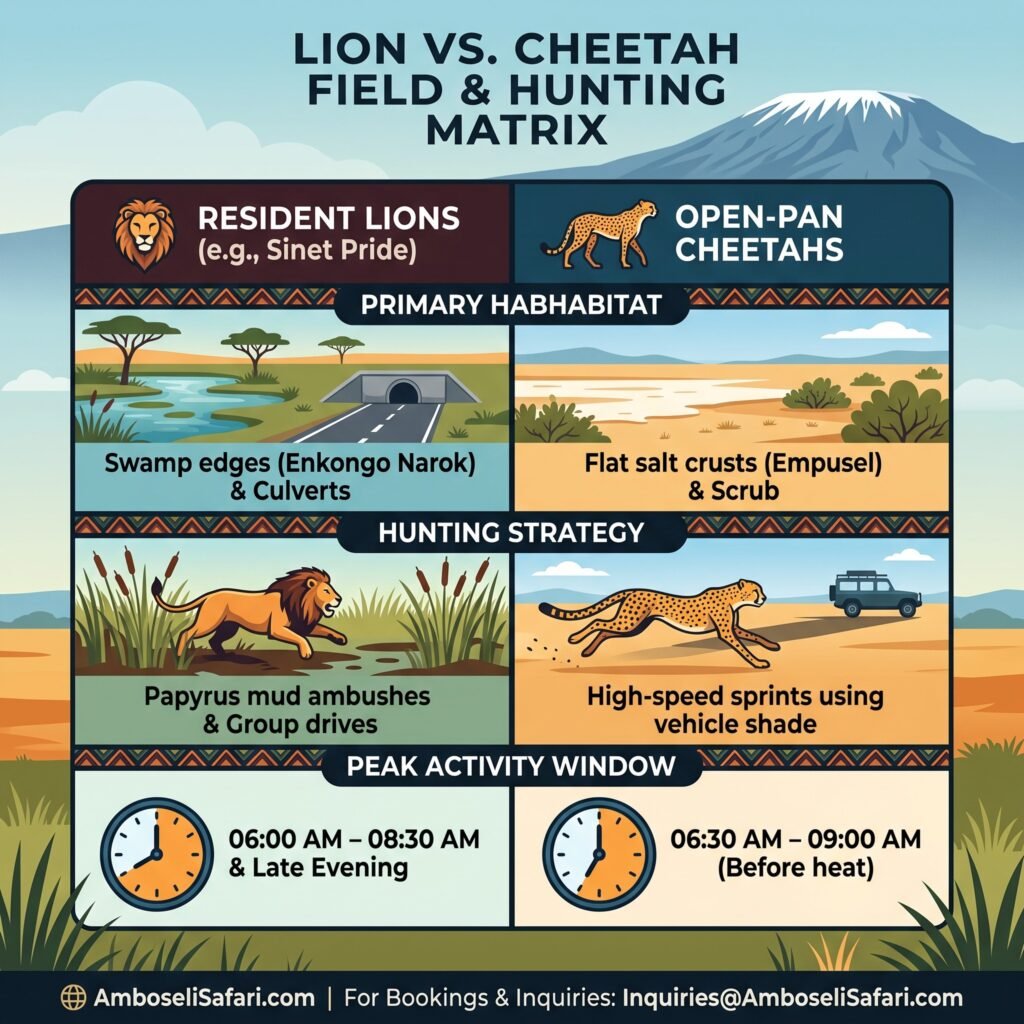
- Alt Tag: Infographic comparing habitats, hunting strategies, and peak activity windows between resident lions and open-pan cheetahs in Amboseli.
- Caption: A comparative field matrix highlighting key differences in habitat, hunting behavior, and active hours for lions and cheetahs.
Cheetahs hunting across the open, sun-baked salt pan—known in Maa as Empusel—have almost zero tall grass or bushes for cover.
They solve this problem by using parked safari vehicles as hunting blinds. A stalking cheetah will walk right up to a stationary 4×4 and crouch inside the vehicle’s cast shadow to hide its outline while watching Thomson’s gazelles.
If a cheetah ducking behind your Land Cruiser uses your shadow, freeze. Don’t turn on the engine or lean out the window. Any sudden movement exposes the cat’s profile and ruins its hunt.
Lion vs. Cheetah Field & Hunting Matrix
Understanding the distinct hunting strategies and habitat preferences of lions and cheetahs in Amboseli is key to predicting their daily movements across the basin. While lions rely on ambush tactics along muddy papyrus channels, cheetahs use high-speed sprints across flat salt crusts. This comparative field matrix outlines primary habitats, hunting hours, and target prey for both big cats. Use these visual parameters to spot both species during early morning game drives.
| Feature / Trait | Resident Lions (e.g., Sinet Pride) | Open-Pan Cheetahs |
| Primary Habitat | Swamp edges (Enkongo Narok) & Culverts | Flat salt crusts (Empusel) & Scrub |
| Hunting Strategy | Papyrus mud ambushes & Group drives | High-speed sprints using vehicle shade |
| Peak Activity Window | 06:00 AM – 08:30 AM & Late Evening | 06:30 AM – 09:00 AM (Before heat) |
Hyena Interference at Normati Sands
Cheetah coalitions use low earth mounds and termite structures around Normati Sands to scan for prey across flat ground.
Because there are no climbable trees on the open pan to haul meat into, spotted hyenas steal over 50% of cheetah kills here within 20 minutes. If you see a successful chase, take your photos right away. Hyena packs converge quickly and muscle cheetahs off their meal before they can finish eating.
Self-drive logistics and road clearance details are mapped out in our Amboseli self-drive tips.
Scrub Nurseries & Maasai Guardian Tracking
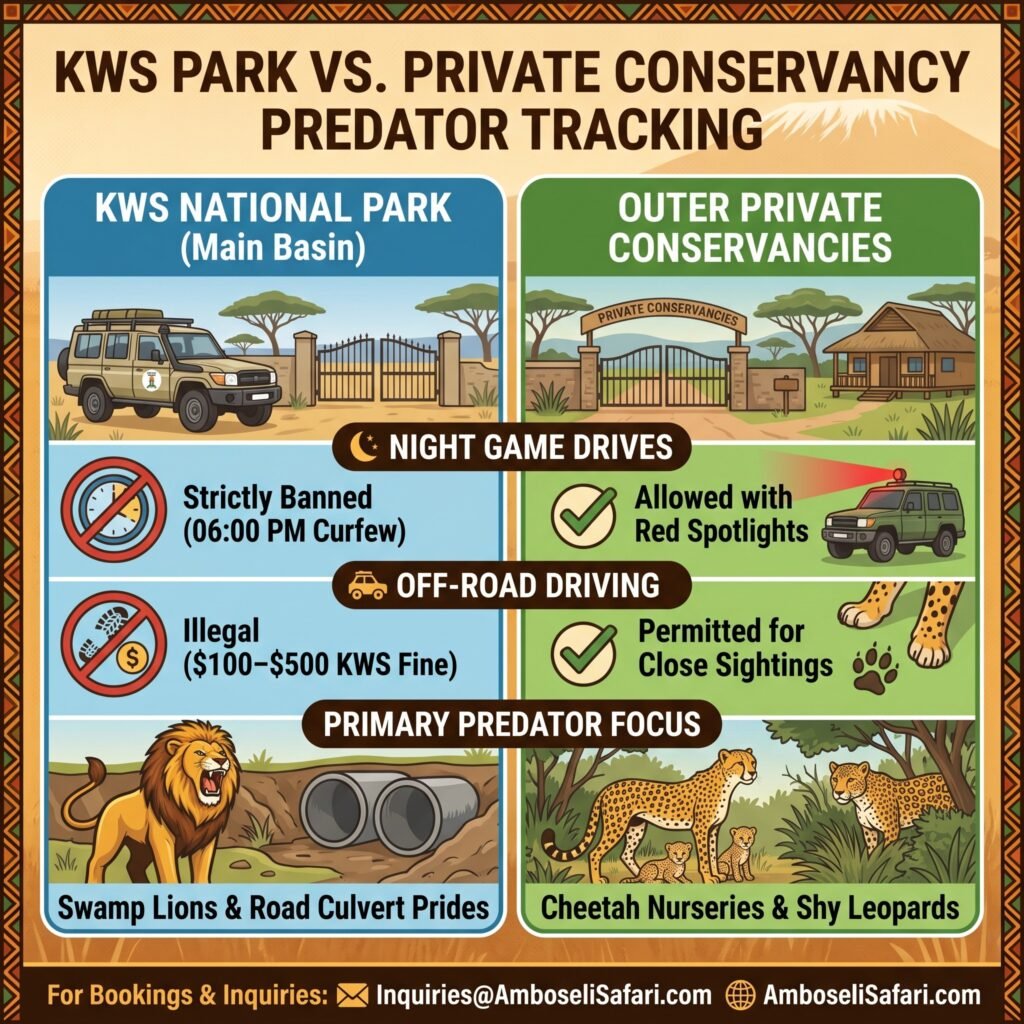
- Alt Tag: Comparison infographic of predator tracking rules, night drives, and sightings between KWS National Park and private conservancies.
- Caption: A visual breakdown comparing game drive rules, off-roading, and predator focus between main park tracks and private conservancies.
Female cheetahs with young cubs avoid the wide-open salt pans to keep their litters safe from lions and hyenas.
Instead, mothers raise cubs in the low acacia scrub near Kitirua Gate in the southwest and Iremito Gate in the north. Thick thorn bushes give good cover and a steady supply of dik-diks and impalas.
KWS Park vs. Private Conservancy Predator Tracking
Big cat behavior shifts noticeably when predators cross from Kenya Wildlife Service (KWS) national park grounds into community-owned conservancies. While the central park hosts well-habituated swamp lions, outer conservancies protect elusive mother cheetahs and nocturnal predators away from main safari tracks. This visual comparison details access rules, tracking methods, and unique predator sightings available across both zones. Use this guide to balance daytime park drives with specialized night tracking.
| Tracking Parameter | KWS National Park (Main Basin) | Outer Private Conservancies |
| Night Game Drives | Strictly Banned (06:00 PM Curfew) | Allowed with Red Spotlights |
| Off-Road Driving | Illegal ($100–$500 KWS Fine) | Permitted for Close Sightings |
| Primary Predator Focus | Swamp Lions & Road Culvert Prides | Cheetah Nurseries & Shy Leopards |
Cross-Border Lions & Maasai Guardians
Lions move freely past official park boundaries into community ranches. The Selenkay Pride frequently wanders across Elerai and Selenkay conservancies.
To protect livestock and stop retaliatory spearing, local Maasai Lion Guardians (Olaji) track prides on foot using spoor and telemetry collars. They warn herders to move cattle away from night kill zones. Organizations like the Big Life Foundation work closely with these community rangers to keep human-wildlife conflict low.
Road Routes & Entrance Gates
Reaching the park from Nairobi takes about 4 hours by road, with two simple highway options:
- Emali Route (A109 Highway): Drive south from Nairobi on paved Mombasa Road to Emali town, then turn right onto the C103 tarmac road straight to northern park gates.
- Namanga Route (A104 Highway): Travel south toward the Tanzania border post at Namanga, turning east onto tarmac and gravel roads toward the western side of the park.
Gate Access by Sector
- Kimana Gate (East): Fastest access to central swamps, Ol Tukai fever-tree groves, and Sinet Stream prides.
- Meshanani Gate (Northwest): Best entry point for western salt flats (Empusel) and Normati Sands cheetah coalitions.
- Kitirua Gate (Southwest): Direct access to southern conservancies and acacia scrub cheetah nurseries.
Route planning details and road condition updates can be found in our Amboseli safari planning guide.
Observation Hill Lookout
Observation Hill—called Noomotio by locals—is the only designated spot in the park where you can legally step out of your Land Cruiser and walk around on foot.
A paved stone path leads to a shaded summit deck. From up here, you get a 360-degree view over Enkongo Narok swamp. Using your binoculars to spot lions buried in papyrus beds from above helps your driver pick the exact track below, saving you hours of guessing.
Entry rules and park maps are detailed in our main Amboseli National Park guide.
Sample 3-Day Field Itinerary
Here is how a typical 3-day predator safari plays out on the ground:
- Day 1: Afternoon Marsh Drive: Arrive by midday, check into camp, and head out at 03:30 PM along Sinet Causeway. Focus on pride lionesses resting near papyrus edges as zebras return to drink.
- Day 2: Salt Flat Tracking: Start at 06:00 AM scanning Normati Sands for hunting cheetahs. Climb Observation Hill around noon to glass deep papyrus beds, then check Ol Tukai road culverts for shaded lions before an afternoon drive through Kitirua scrub.
- Day 3: Mountain Backdrop Drive & Departure: Drive western salt tracks at first light to capture big cats framed against Mount Kilimanjaro before driving back to Nairobi.
Camera Settings & KWS Rules
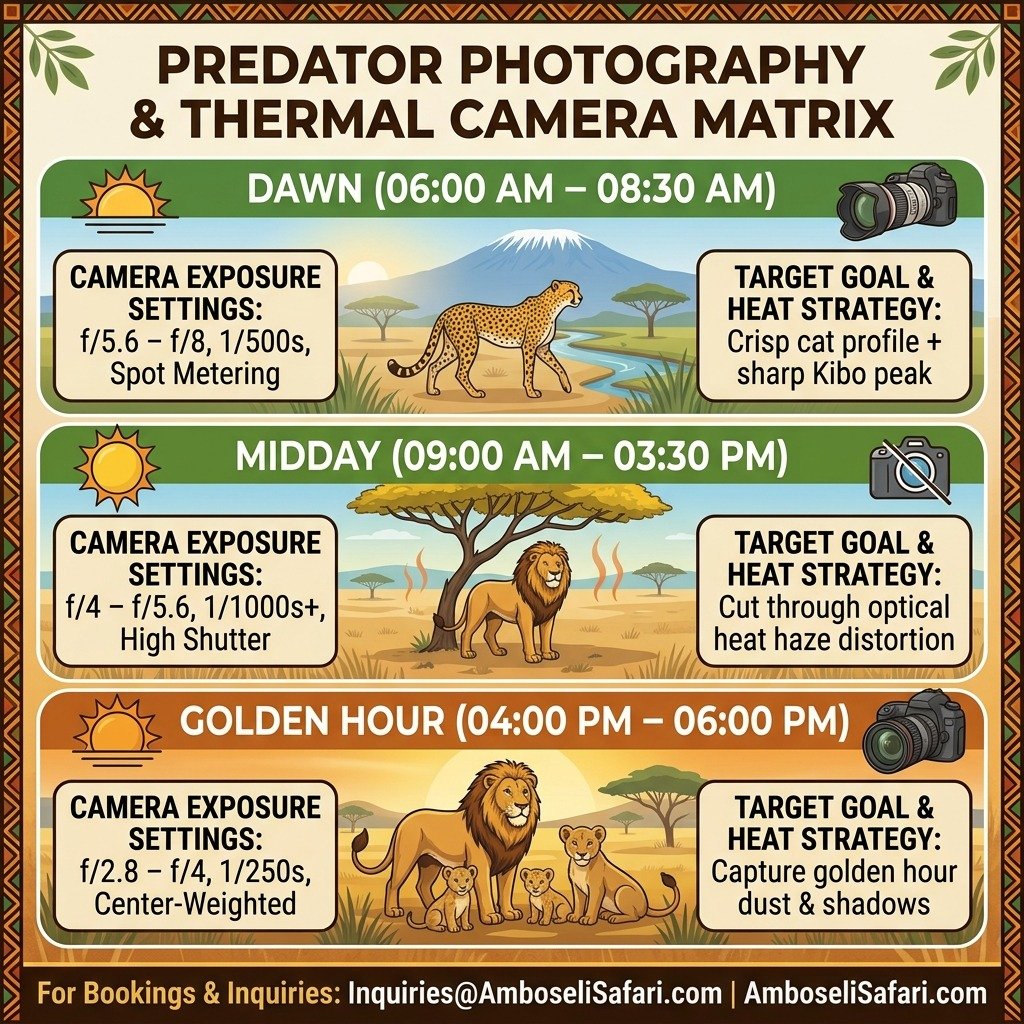
- Alt Tag: Infographic guide detailing camera exposure settings, metering, and shutter strategies for photographing predators in heat shimmer.
- Caption: A quick-reference camera setting matrix for photographing lions and cheetahs across morning, midday, and golden hour light shifts.
Getting clean predator shots against heat haze and bright alkaline light takes a few basic adjustments:
- Kilimanjaro Backdrop Timing: Mountain clouds form over Kibo peak by 09:00 AM as ground heat rises. Position your vehicle on the northern side of a cat, facing south toward the mountain, between 06:00 AM and 08:30 AM.
- Lens Selection: A versatile 100–400mm or 200–600mm zoom lens lets you isolate cats while keeping the mountain background in frame.
- Beating Heat Haze: By 10:00 AM, heat shimmer bouncing off Empusel distorts long lens focus across open distance. Shoot early, keep shutter speeds high, and rest your lens on a canvas beanbag rather than holding it by hand.
Predator Photography & Thermal Camera Matrix
Intense solar radiation and thermal heat shimmer rising off Lake Amboseli’s alkaline flats can severely distort telephoto focus by mid-morning. Balancing shutter speeds and exposure parameters allows photographers to capture sharp predator portraits while preserving mountain background detail. This camera setting reference details recommended lens choices, metering modes, and exposure tweaks across daily light shifts. Adjust your camera body to these baseline values before setting out on morning drives.
| Time Window | Camera Exposure Settings | Target Goal & Heat Strategy |
| 06:00 AM – 08:30 AM | f/5.6 – f/8, 1/500s, Spot Metering | Crisp cat profile + sharp Kibo peak |
| 09:00 AM – 03:30 PM | f/4 – f/5.6, 1/1000s+, High Shutter | Cut through optical heat haze distortion |
| 04:00 PM – 06:00 PM | f/2.8 – f/4, 1/250s, Center-Weighted | Capture golden hour dust & shadows |
KWS Park Rules
- No Off-Road Driving: Driving off marked tracks to chase cats is strictly illegal. It destroys fragile salt crusts and carries immediate fines ($100–$500 USD).
- Cheetah Buffer Space: Keep at least 25 meters back from hunting cheetahs. Crowding a stalking cat alerts its prey and ruins the hunt.
- Gate Curfews: All game drives inside KWS grounds must end by 06:00 PM sharp. Drivers caught on marsh tracks past curfew face permit suspensions.
Our lead driver, Anthony Mule, always tells our guests: “Give a hunting cat room to move, and you’ll get a ten-minute sighting instead of a ten-second flash of tail.”
You can read how researchers monitor big tuskers in our famous elephants guide.
Ready to book a private Land Cruiser and driver-guide for your trip? Send us a message through our safari inquiry form or get an instant rate on Amboselisafari.com via our safari booking form.
Frequently Asked Questions
What is the best time of day to see lions and cheetahs in Amboseli?
First light between 06:00 AM and 08:30 AM. Cats hunt while the air is cool. By 10:00 AM, lions crawl into road culverts or papyrus beds, and cheetahs rest under low bushes.
Are cheetahs common in Amboseli National Park?
Yes, but they move constantly to avoid lions and hyenas. Look for them on the open Normati Sands salt flats or in the scrub near Kitirua and Iremito gates.
Why do lions in Amboseli lie in swamp mud?
To escape biting stable flies (Stomoxys) breeding in wet peat. Lying in shallow mud along Sinet Stream cools them down and coats their skin against insects.
Can you go on night game drives to see predators hunting?
Night drives are strictly banned inside KWS national park boundaries. However, you can book night drives on private conservancies along the border, like Selenkay or Elerai.