
How Many Days to Spend in Amboseli: Trip Lengths, Itineraries & Rates
Overview
Deciding how many days to spend in Amboseli comes down to weather timing and your travel schedule. While visitors confuse local administration with Narok County Council, the Kenya Wildlife Service manages this 392 km² basin where Amboseli Elephant Research Project herds roam.
Fast Navigation Links
- Duration Comparison At A Glance
- 4 Day Package Rates Lodging
- Day By Day Itinerary Outlines
- Transit Logistics Fly vs Drive
- Safari Circuit Guide Combining Amboseli
- DIY Daily Fees Cost Breakdown
Duration Comparison At A Glance
| Duration | Kili Photo Windows | Transit-to-Safari Balance | Best For |
| 1 Night (2 Days) | 1 morning (clouds usually roll in by 9 AM) | Mostly road transit | Quick weekend stops & fly-in travelers |
| 2 Nights (3 Days) | 2 mornings (much better odds) | Mostly safari time | First-time visitors & classic circuits |
| 3+ Nights (4+ Days) | 3+ mornings (best mountain odds) | Almost all safari time | Photographers & split-stay conservancy trips |
Setting your itinerary length requires balancing drive times, park entry permits, and mountain weather. If you cut your stay too short, clouds often hide Mount Kilimanjaro before you get a clear shot. Stay too long in one spot, and you’ll repeat the same dusty road loops every afternoon. At Amboselisafari.com, we help you organize game drives so your time on safari feels well spent.
4-Day Multi-Destination Safari Package (2 Nights Amboseli + 1 Night Lake Nakuru)
Combining big herds with the flamingos and rhino sanctuaries of Lake Nakuru makes a practical safari circuit. We run this trip in private 4×4 Safari Land Cruisers equipped with pop-up roof hatches, high-clearance suspension, and onboard power charging outlets.
Rates below show total costs per person for two adults traveling together in a private vehicle:
4-Day Circuit Rates & Lodging Options
| Package Tier & Accommodations | Included Hotels & Accommodations | Price Range Per Person (Low – Peak)* |
| Budget Tier | Kimana Bush Camp (Amboseli) & Lake Nakuru Lodge (Nakuru) | From USD $1,285 to USD $1,890 |
| Mid-Range Tier | Kibo Safari Camp & Sarova Lion Hill Game Lodge | From USD $1,595 to USD $2,310 |
| Luxury Tier | Amboseli Serena Safari Lodge & The Cliff Nakuru | From USD $2,190 to USD $3,040 |
| Luxury Plus Tier | Tawi Lodge & Loldia House | From USD $3,950 to USD $5,720 |
*Rates cover 2026/2027 travel for two adults sharing a room or tented suite with a private 4×4 Land Cruiser and professional driver-guide. Standard/Low season covers January through May and November. Peak season spans June through October and December. Rates include full-board lodging, private transport, driver allowances, fuel, daily $90 USD KWS park permits, Nakuru sanctuary fees, and chilled vehicle water. Luxury Plus includes domestic flights from Wilson Airport (WIL) on Safarilink or Airkenya.
If you want to view our curated Amboseli National park safari packages or build a custom multi-destination circuit, reach out through our safari inquiry form.
Package Inclusions
- Private 4×4 Safari Land Cruiser equipped with a pop-up roof hatch and padded beanbags.
- Your own dedicated, TRA-certified driver-guide for the full trip who knows these wildlife tracks inside out.
- Full-board accommodation (breakfast, lunch, and dinner included each day).
- Pre-paid KWS park permits ($90 daily rate) plus Lake Nakuru conservation passes.
- Cool drinking water stocked in the vehicle fridge.
Package Exclusions
- International flights, travel insurance, and your digital Kenya eTA pass processed through the government eTA portal.
- Tips for your driver-guide or lodge staff.
- Alcoholic drinks, sodas, or personal laundry.
- Extra activities like a Maasai village visit ($30) or a hot air balloon flight ($450).
Optional Add-Ons
- Local village entry voucher & cultural walkthrough: USD 30 per person
- Night game drive in a private conservancy: USD 50 per person
- Sunrise hot air balloon flight over central marshes: USD 450 per person
For a complete breakdown of vehicle daily fees and permit costs, check our Amboseli safari cost breakdown page.
Why 1-Night Trips Usually Disappoint
Booking a 1-night trip is a common misstep for travelers coming down by road from Nairobi.
On most mornings, heavy cloud cover rolls over Kibo Peak by 09:00 AM. A single night gives you just one short morning window between 06:00 AM and 08:00 AM to photograph wildlife against the snowcap. If clouds hide the summit on that single morning, you miss the mountain view entirely.
Driving down by road for a single night also means spending nearly 10 hours on the highway for roughly 5 hours of actual game viewing inside park gates.
Why 2 Nights (3 Days) Works Best
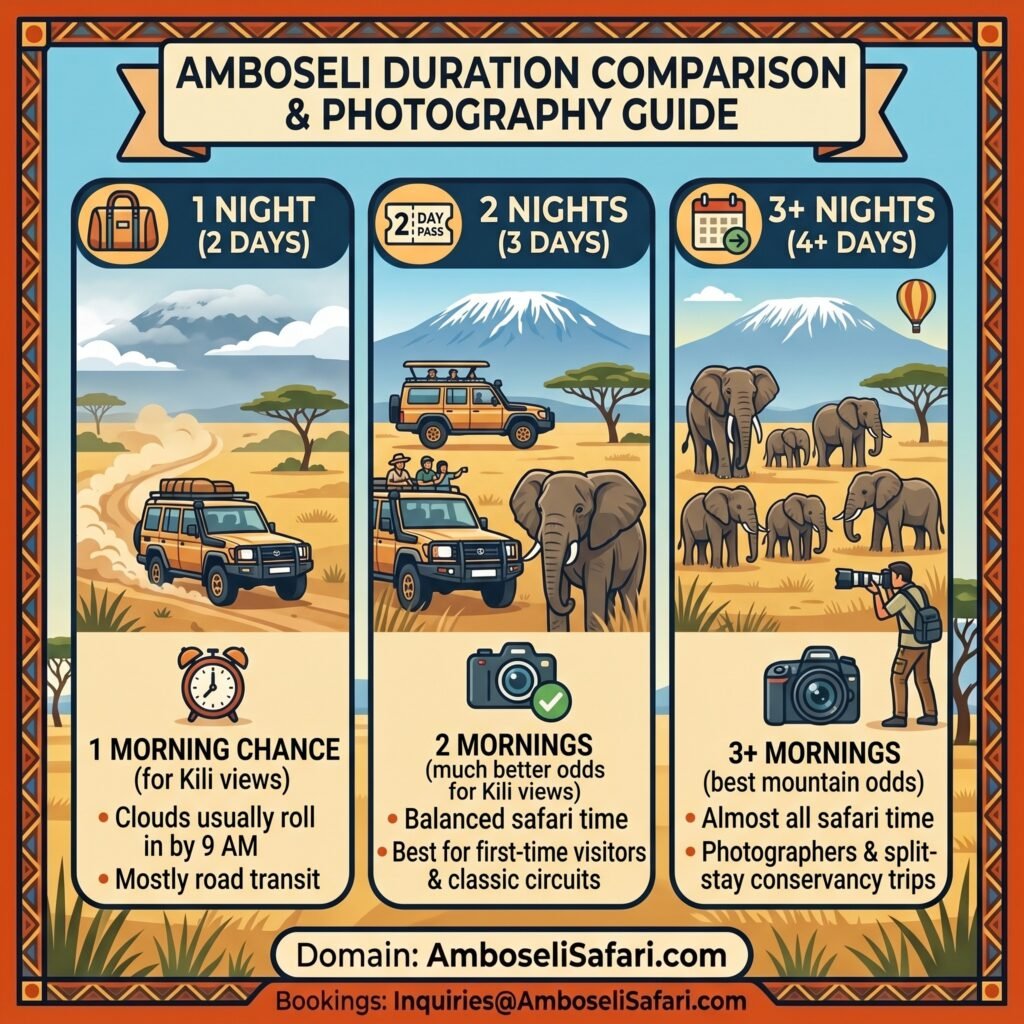
For most travelers, 2 nights gives you two separate morning chances at clear mountain views while keeping total drive time reasonable.
Our senior guide Anthony Mule, who has driven these park tracks for over ten years, finds that guests who stay two nights catch much better morning lighting on Kilimanjaro. Early drives out near Enkongo Narok swamp give you time to sit quietly near the water channels before afternoon gate traffic picks up and dust builds on the main roads.
Because the national park covers a compact 392 square kilometers, you can cover the main water points—Enkongo Narok, Ol Okenya, and Longinye—across four good game drives. Spending more than 48 hours purely inside national park gates can start to feel repetitive, and fine volcanic dust off the lakebed gets tiring after a couple of full days on open tracks.
Stepping up to a 2-night road trip balances your travel time well: 8 hours on the highway gives you over 15 hours of prime game viewing in the bush. You can check complete route options in our Amboseli safari planning guide.
Amboseli Duration Comparison & Photography Guide
Deciding how long to stay is crucial for witnessing Amboseli’s magic. This chart clarifies how different durations affect your chances of seeing Mount Kilimanjaro and provides a clear breakdown of actual game viewing time versus travel logistics. Use this quick reference to select the duration that best aligns with your sightseeing and photography goals.
| Duration | Kili Viewing Windows | Transit/Safari Balance | Recommended For |
| 1 Night (2 Days) | 1 morning chance only | Mostly road transit | Weekend stops & Fly-in travelers |
| 2 Nights (3 Days) | 2 mornings (Good odds) | Balance leans to safari | First-time visitors & Classic circuits |
| 3+ Nights (4+ Days) | 3+ mornings (Best odds) | Almost entirely safari | Photographers & Split-stay specialists |
Day-by-Day Sample Itineraries
3-Day / 2-Night Classic Itinerary Outline
- Day 1: Leave Nairobi early morning (around 07:00 AM) via the Emali tarmac. Arrive at your lodge by noon for lunch, then head out at 03:30 PM for an afternoon game drive around the Ol Tukai palm groves.
- Day 2: 06:00 AM pre-dawn drive when Kilimanjaro usually clears. Track herds crossing Enkongo Narok swamp, enjoy a packed picnic lunch on Observation Hill, and explore Longinye marsh until dusk.
- Day 3: Take a quick sunrise drive along the perimeter tracks, then check out through Kimana Gate by 09:30 AM for your return drive to Nairobi.
4-Day / 3-Night Split-Stay Outline
- Day 1: Arrive inside central park boundaries for an afternoon drive along marsh tracks.
- Day 2: Spend the full day exploring Observation Hill, the Lake Amboseli salt pans, and Ol Okenya springs.
- Day 3: Move to an outer private conservancy like Kimana or Kitirua. Take a guided foot safari with Maasai trackers in the afternoon, followed by a night drive using spotters.
- Day 4: Enjoy a final sunrise conservancy drive before setting off for Nairobi or your fly-out airstrip.
Transit Logistics: Fly vs. Drive Impact
How you travel down to the park changes how many days you need on the ground:
- Road Transit (4.5 to 5 Hours from Nairobi): Driving down the highway takes roughly 4.5 to 5 hours each way depending on Nairobi traffic. Round-trip highway driving eats up nearly 10 hours, making a 2-night minimum stay essential for road safaris.
- Fly-In Option (45 Minutes from Wilson Airport): Flying on Safarilink or Airkenya from Nairobi’s Wilson Airport (WIL) directly into Amboseli Airstrip takes just 45 minutes. Touchdown puts you on game drive tracks by mid-morning. Flying eliminates road fatigue, letting short-stay travelers squeeze maximum viewing hours out of a 2-night or even 1-night fly-in itinerary.
Split-Stay Strategy: Central Lodges vs. Outer Conservancies
If you want to spend 3 nights in the area without repeating the same routes, try a split-stay strategy:
- Night 1 (Central KWS Park): Stay at a central lodge like Ol Tukai or Amboseli Serena. This puts you right next to the central marshes for immediate pre-dawn game drives when big herds move across open corridors.
- Nights 2 & 3 (Outer Conservancies): Move to a camp in an outer private conservancy like Kimana, Selenkay, or Kitirua.
Staying in an outer conservancy unlocks activities that are strictly banned inside national park boundaries, including night game drives with thermal spotters, guided walking safaris alongside Maasai trackers, and off-road tracking across quiet private land.
To weigh location trade-offs and fence boundaries, review our guide on where to stay in Amboseli.
Midday Picnic Pacing at Observation Hill (Noomotio)
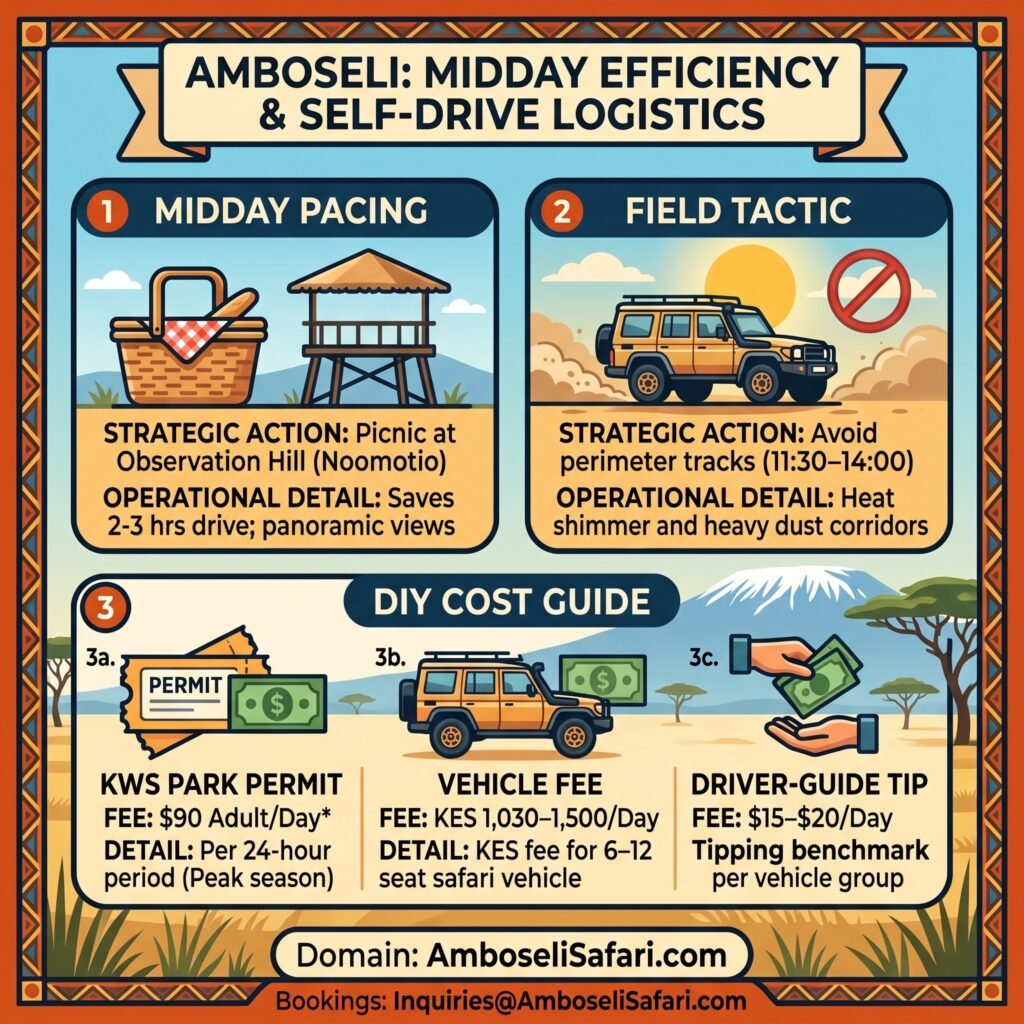
On a 2-night itinerary, you can save 2 to 3 hours of back-and-forth driving to your lodge by ordering a packed picnic lunch from your camp chef.
According to KWS warden notes at the Observation Hill gate, drivers who remain inside the central basin during midday avoid the heaviest dust corridors along perimeter tracks. Instead of burning fuel and battling heat shimmer during the hot 11:30 AM to 02:00 PM window, head to the summit gazebo on Observation Hill (Noomotio).
- Walk up the stone staircase to reach the shaded lookout point.
- Watch elephant herds, hippos, and buffaloes submerged in Enkongo Narok swamp directly below you.
- Eat your lunch while taking in panoramic views across the open plains without driving through midday heat.
If you are planning a self-drive trip, keep our Amboseli self-drive tips handy for navigation around the hill tracks.
Midday Efficiency & Self-Drive Logistics
Managing your time in the field, especially during the hot midday hours, can dramaticially impact your safari quality. This summary tool provides actionable field tactics—like the Observation Hill picnic strategy to avoid dust—and pairs them with standard daily cost benchmarks. Utilize this reference to streamline your day-by-day operations and finalize your independent budget.
| Pacing/Fee Area | Strategic Action / Standard Fee | Operational/Logistical Detail |
| Midday Pacing | Picnic at Observation Hill (Noomotio) | Saves 2-3 hrs drive; panoramic views |
| Field Tactic | Avoid perimeter tracks (11:30–14:00) | Heat shimmer and heavy dust corridors |
| DIY Cost | KWS Park Permit ($90 Adult/Day*) | Per 24-hour period (Peak season) |
| DIY Cost | Vehicle Fee (KES 1,030–1,500/Day) | KES fee for 6–12 seat safari vehicle |
| DIY Cost | Driver-Guide Tip ($15–$20/Day) | Tipping benchmark per vehicle group |
Seasonal Duration Adjustments: Dry vs. Wet Season
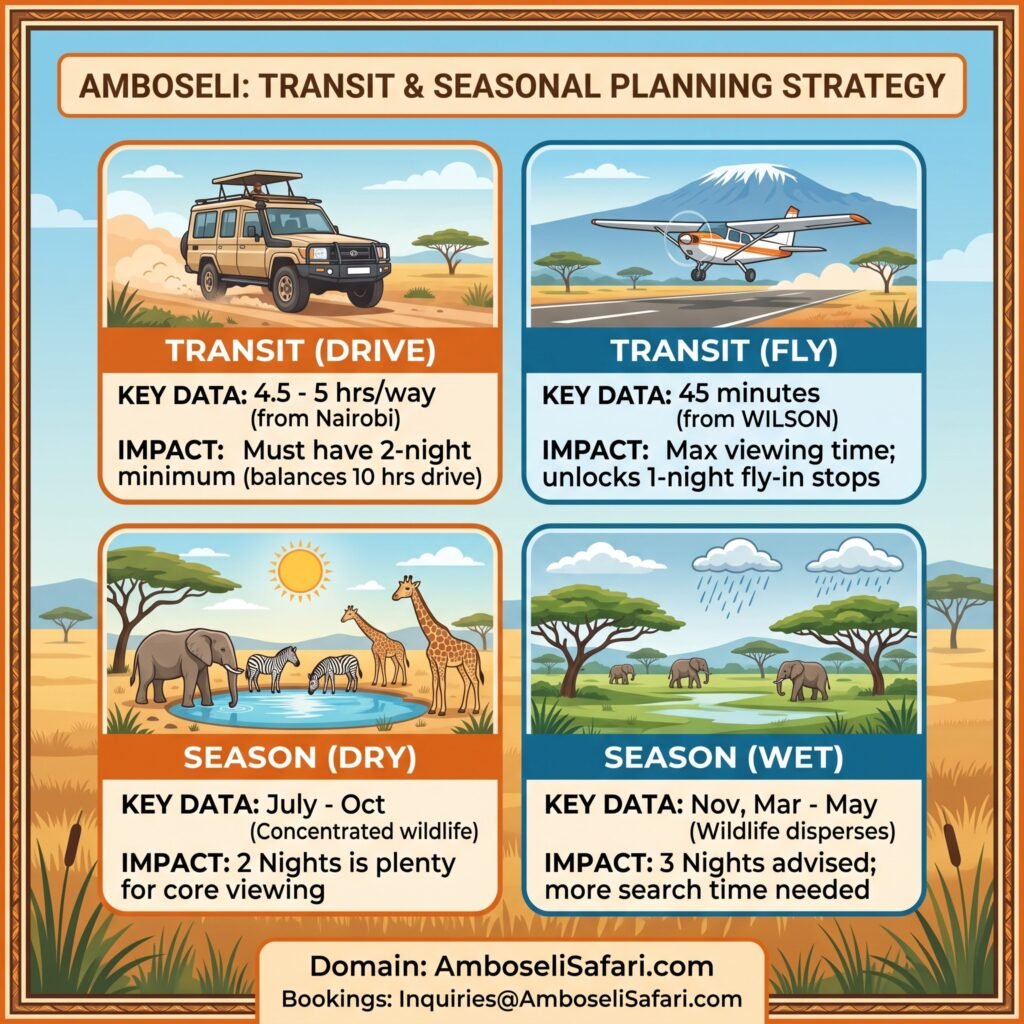
How many days you need depends heavily on seasonal weather cycles:
- Dry Season (July to October): Outer water holes dry up, forcing animals to concentrate tightly around central permanent springs. Because wildlife gathers in high numbers around swamp margins, 2 nights is plenty of time to catch great action.
- Wet Season (November, March to May): Heavy rain turns dry salt pans into shallow lakes and fills seasonal watering holes. Herds disperse widely across outer acacia thickets toward Namelok and the Chyulu foothills.
Visiting during wet months works better with a 3-night stay. You need that extra day to search across muddy perimeter tracks as animals spread out through the fever tree (Acacia xanthophloeia) groves.
You can learn how matriarchs lead their family groups through seasonal corridors in our famous elephants guide.
Transit & Seasonal Planning Strategy
How you arrive and the time of year you visit are critical drivers of your ideal trip length. This cheat sheet synthesizes crucial logistical data, contrasting road fatigue against flying efficiencies, and mapping the dry season animal concentrations against the wet season dispersal. Use these strategic insights to build a travel window that maximizes wildlife encounters.
| Planning Category | Key Planning Data | Impact on Ideal Duration |
| Transit (Drive) | 4.5 – 5 hrs/way (from NBO) | Must have 2-night minimum (balances 10 hrs drive) |
| Transit (Fly) | 45 minutes (from WILSON) | Max viewing time; unlocks 1-night fly-in stops |
| Season (Dry) | July – Oct (Concentrated wildlife) | 2 Nights is plenty for core viewing |
| Season (Wet) | Nov, Mar – May (Wildlife disperses) | 3 Nights advised; more search time needed |
Safari Circuit Guide: Combining Amboseli
Most international travelers don’t visit southern Kenya to see just one park. Combining destinations optimizes travel days:
- The Southern Circuit (5 to 6 Days): Combine Amboseli (2 Nights) with Tsavo West (2 Nights) and Taita Hills / Salt Lick (1 Night). This route takes you from elephant swamps through the Shetani Lava Flow down to red dust plains.
- Classic Kenya Highlights (7 to 10 Days): Combine Amboseli (2 Nights) with Lake Naivasha or Lake Nakuru (1 to 2 Nights) and the Masai Mara (3 Nights). You get Kilimanjaro views, Rift Valley lakes, and Mara big cat action in one trip.
DIY Daily Cost & Fee Breakdown
For independent travelers or self-drivers managing their own expenses, budget using these standard daily fees:
- Daily KWS Park Permits: $90 USD per adult per 24 hours during Peak season (July–December) and $70 USD per adult during Low season (January–June). Children (ages 3–17) pay $35 USD.
- Vehicle Entry Fees: KWS charges KES 1,030 to KES 1,500 ($8–$12 USD) per day for a standard 6–12 seat safari Land Cruiser or tour van.
- Driver-Guide Tipping Benchmarks: Tipping $15 to $20 USD per day per vehicle group directly to your driver-guide is standard practice across Kenyan parks.
Frequently Asked Questions
Is 1 night enough for Amboseli?
A single night gives you very little actual safari time. You spend about 10 hours driving back and forth from Nairobi for roughly 5 hours inside the park. Plus, you get only one early morning chance to see Mount Kilimanjaro before clouds roll in by 9:00 AM.
How many days are ideal for a dedicated photography safari in Amboseli?
Plan for 3 to 4 nights using a split-stay setup between central park tracks and an outer conservancy. This gives you multiple morning light windows for mountain framing plus private conservancy access for low-angle off-road shooting.
Can I visit Amboseli as a day trip from Nairobi?
We strongly advise against it. You’ll spend 8 to 9 hours driving round-trip on the tarmac and arrive right during the hot midday hours when Mount Kilimanjaro is hidden by clouds and wildlife seeks shade deep in papyrus swamps.
Should I combine Amboseli with Lake Nakuru or Masai Mara?
Yes, combining them gives you a far more varied trip. Pairing Amboseli’s big herds and mountain backdrop with Lake Nakuru’s rhino sanctuary or the Masai Mara’s big cat populations creates a well-rounded 6-day or 7-day Kenyan safari circuit.