
Swamp Wildlife in Amboseli: Wetland Species, Field Secrets & Safari Packages
Overview
Sustained by volcanic meltwater filtering down from Mount Kilimanjaro, the Swamp Wildlife in Amboseli forms the central heartbeat of this dry dust basin. Over 2,000 elephants tracked by the Amboseli Elephant Research Project share these permanent wetlands with territorial hippo pods, mud-caked buffaloes, and over 400 species of waterbirds. Surrounding groves of yellow-fever trees (Acacia xanthophloeia) taper off into deep papyrus channels that stay green even when surrounding plains bake dry. Full-board 3-day and 4-day safari packages in a private 4×4 Land Cruiser range from $1,080 per person for budget camps up to $5,950 per person for fly-in luxury lodges on Amboselisafari.com.
Fast Navigation Links
- Wetland Safari Packages & Rates
- Amboseli Swamp Comparison Matrix
- How Kilimanjaro Feeds the Marshes
- Seasonal Shifts: Wet vs Dry
- Warm Springs at Enkongo Narok
- Dodging Hippos at Observation Hill
- Mud-Armored Buffaloes & Canopy Fishing
- Frequently Asked Questions
2027 Wetland Safari Packages & Rates
Driving along wet marsh tracks takes a steady vehicle and a driver who knows where soft peat hides. Working out of a private 4×4 Safari Land Cruiser with a pop-up roof gives you an elevated platform to scan over tall papyrus reeds without vehicle engine vibration ruining your shot.
Package rates cover total per-person costs based on two adults traveling together in a private vehicle.
3-Day & 4-Day Amboseli Wetland Safari Packages
| Package Tier & Accommodations | Standard Season (USD / Person)* | Peak Season (USD / Person)* |
| 3-Day Budget Wetland Safari (Amboseli Bush Camp / Maasai Simba Camp / Kimana Eco Lodge) | $1,080 | $1,820 |
| 3-Day Mid-Range Wetland Safari (Amboseli Sopa Lodge / Tulia Safari Camp / Little Amanya Camp) | $1,280 | $2,050 |
| 3-Day Luxury Wetland Safari (Satao Elerai Camp / Kitirua Plains Lodge / Praro Amboseli Camp) | $1,580 | $2,480 |
| 4-Day Fly-In Luxury Plus Safari (Flight + Angama Amboseli / Ol Donyo Lodge / Finch Hattons) | $3,950 | $5,950 |
*Rates are valid for 2026/2027 based on two adults sharing a room or tented suite with private 4×4 Land Cruiser transport. Standard season covers January through May and November. Peak season spans June through October and December. Packages include full-board lodging, transport, guide allowances, fuel, and daily KWS permits ($90 USD/day). Fly-in options include roundtrip domestic flights from Wilson Airport (WIL) on Safarilink or Airkenya plus airstrip transfers.
To lock in travel dates or build a custom multi-destination itinerary with our team, send a note through our safari inquiry form.
Package Inclusions
- Private 4×4 Safari Land Cruiser with pop-up roof for wildlife viewing
- Services of a TRA-licensed, English-speaking driver-guide
- Full-board lodging (breakfast, lunch, and dinner)
- Pre-paid non-resident KWS park permits ($90 USD per 24 hours)
- Chilled bottled drinking water kept in the vehicle cooler
Package Exclusions
- International flights, visa fees, and entry processing through the official eTA portal
- Driver-guide tips, laundry services, and alcoholic drinks
- Optional Maasai cultural village visits ($30 per person) or balloon safaris ($450 per person)
Optional Add-Ons
- Local Maasai village cultural tour: USD 30 per person
- Sunrise hot air balloon flight over central marshes: USD 450 per person
We lay out every entry permit fee, vehicle day-rate, and fuel calculation on our Amboseli safari cost breakdown page.
Amboseli Swamp Comparison Matrix
Each marsh functions differently depending on water depth, mud thickness, and surrounding grass cover.
| Swamp / Water Source | Primary Wildlife Focus | Best Time & Track Realities |
| Enkongo Narok | Large elephant herds, hippo pods, waterbucks, jacanas | 06:30–09:00 AM; reliable year-round thermal springs along smooth main tracks. |
| Longinye Swamp | Buffalo “mud-packers”, solitary bull elephants, lions | 12:00–16:00 PM; deep black peat channels where you will get stuck without a winch. |
| Sinet Stream | Bohor reedbucks, skulking herons, kingfishers, pythons | 16:00–18:00 PM; narrow dirt tracks squeezing past tall papyrus walls. |
| Ol Okenya | Black Herons (umbrella fishing), flamingos, pelicans | 10:00–12:00 AM; shallow saline crust margins and open water pools. |
How Kilimanjaro Feeds the Marshes Underground
Lake Amboseli looks like an empty, blinding salt pan at noon. Dust devils spin across bare ground. Yet, right beside that white desert sit vast emerald marshes packed with life. No major river feeds this basin.
Rain and melting snow on the upper slopes of Mount Kilimanjaro sink directly into porous volcanic ash and cracked basalt rock. This water travels downhill through underground volcanic channels for miles beneath the dry plains.
Hydraulic pressure forces the water back up to the surface inside the park, emerging as warm, mineral-rich springs at Enkongo Narok and Ol Okenya. The subterranean ash acts as a massive carbon filter, purifying the water before it fills the sedge beds. Extended droughts slowly reduce aquifer pressure over 12 to 18 months, causing outer swamp edges to recede while core springheads stay alive.
Seasonal Shifts: Wet Dispersal vs. Dry Season Collapse
Water dictates where you find animals throughout the year.
Rains in April, May, and November fill temporary clay pans across surrounding community group ranches like Kimana, Olgulului, and Mbirikani. Zebras, wildebeests, and gazelles leave the central park immediately. They spread out over hundreds of square miles of outer acacia scrub to eat fresh grass. Swamp water levels rise, but wildlife density along central tracks drops as animals scatter.
As heat bakes the plains from July to October, outer rain pans dry into hard crust. Thousands of animals fall back toward the central basin in what drivers call the “swamp collapse.”
Elephants, buffaloes, zebras, and waterbucks crowd into Enkongo Narok and Longinye. You can park at a single track junction near Ol Tukai and watch hundreds of animals filing toward the green sedges all morning long. To avoid getting caught in heavy downpours or missing peak herd movements, plan your travel dates around local seasonal weather patterns and migration timing.
Warm Springs at Enkongo Narok
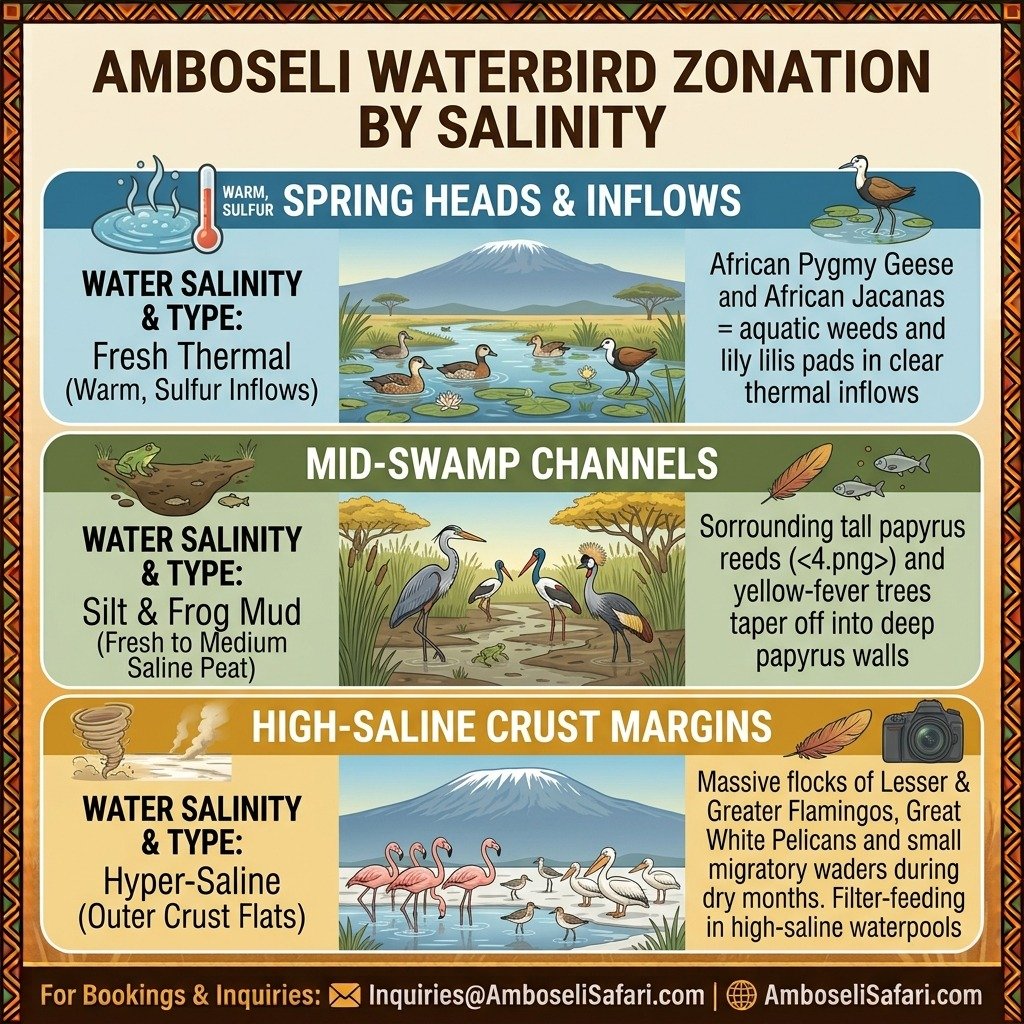
Thermal springheads inside Enkongo Narok swamp bubble up at temperatures between 28°C and 32°C. The sharp smell of sulfur hits your nose the moment you pull up to the water’s edge at 06:30 AM, mixing with the damp chill coming off the marsh.
Waterbird distribution across Enkongo Narok follows a strict salinity gradient as water flows away from the springhead:
- Fresh Thermal Inflows: Sensitive species like African Pygmy Geese and African Jacanas forage exclusively in warm, clear headwaters where fresh aquatic weeds thrive.
- Mid-Swamp Channels: Grey Crowned Cranes, Goliath Herons, and Saddle-billed Storks wade through shallow mud channels hunting frogs and small barbel fish.
- High-Saline Crust Margins: As water spreads onto outer salt flats and evaporates under equatorial sun, mineral concentrations spike. Great White Pelicans and Lesser Flamingos gather on these high-saline crusts during dry months to filter brine shrimp.
You will hear the continuous high-pitched whistling of thousands of White-faced Whistling Ducks long before morning fog lifts off the water.
Amboseli Waterbird Zonation by Salinity
Waterbird distribution across Enkongo Narok follows a strict salinity gradient that changes rapidly as warm volcanic spring water flows away from the headwaters and evaporates onto the outer salt flats. Species that are highly sensitive to mineral concentrations forage exclusively in clear thermal inflows, whereas salt-tolerant filter feeders only appear once mineral counts spike on the arid margins. This ecological zonation matrix breaks down specific marsh sub-habitats, mineral types, and the indicator bird species associated with each zone. Review these indicators to target different avian populations efficiently.
| Ecosystem Zone | Water Salinity & Type | Key Indicator Bird Species |
| Spring Heads & Inflows | Fresh Thermal (Warm, Sulfur Inflows) | African Pygmy Geese, African Jacanas |
| Mid-Swamp Channels | Silt & Frog Mud (Fresh to Medium Saline Peat) | Goliath Herons, Saddle-billed Storks, Grey Crowned Cranes |
| High-Saline Crust Margins | Hyper-Saline (Outer Crust Flats) | Lesser & Greater Flamingos, Great White Pelicans, Migratory Waders |
Dodging Hippos at Observation Hill (Noomotio)
Over 200 hippos spend hot daytime hours submerged in deep papyrus beds choking the base of Observation Hill (Noomotio).
By 17:30 PM, shadows lengthen across the marsh. Hippos start stirring. They emerge using deep mud channels known locally as “hippo highways.” These muddy paths cut directly out of the papyrus toward surrounding grasslands.
Hippos get aggressive once they leave the water. Driving along the western causeway exit track after 17:45 PM takes total focus.
“Get off this causeway before 5:45 PM,” senior guide Anthony Mule often warns guests as the sun drops behind the palms. “A 3,000-pound bull coming out for grass isn’t going to negotiate with a Land Cruiser.” On one afternoon drive near the hill, a vehicle stopped too close to an active exit path, forcing us to rev the engine and back up 50 meters through slick mud to give a nervous bull a wide berth.
If you plan to navigate the park tracks yourself, review clearance rules on our Amboseli self-drive tips page.
Spotting Hidden Reedbucks and Floating Papyrus Islands
Sinet Stream snakes through the northern sector, creating dense thickets of tall papyrus (Cyperus papyrus) and water lettuce.
Thomson’s gazelles run at the first sign of trouble. The Bohor reedbuck (Redunca redunca) does the exact opposite inside Sinet papyrus. When a vehicle approaches, reedbucks freeze and press their bodies flat against dry papyrus stalks. Their reddish coats blend into dead sedge leaves. Spot them by scanning for the flash of a bright white tail underside when a reedbuck flicks its tail to signal nearby danger.
Inside central Enkongo Narok, dense papyrus root mats break off from the main marsh bed during heavy rains, creating floating islands.
These drifting root mats serve as predator-free nesting sanctuaries for:
- Yellow-billed Storks
- Sacred Ibises
- African Skimmers
Lions and spotted hyenas avoid swimming across two-meter-deep peat channels to reach these roosts. This makes the floating papyrus mats one of East Africa’s safest waterbird nurseries during the short rains in November and December.
Mud-Armored Buffaloes and Umbrella-Fishing Herons
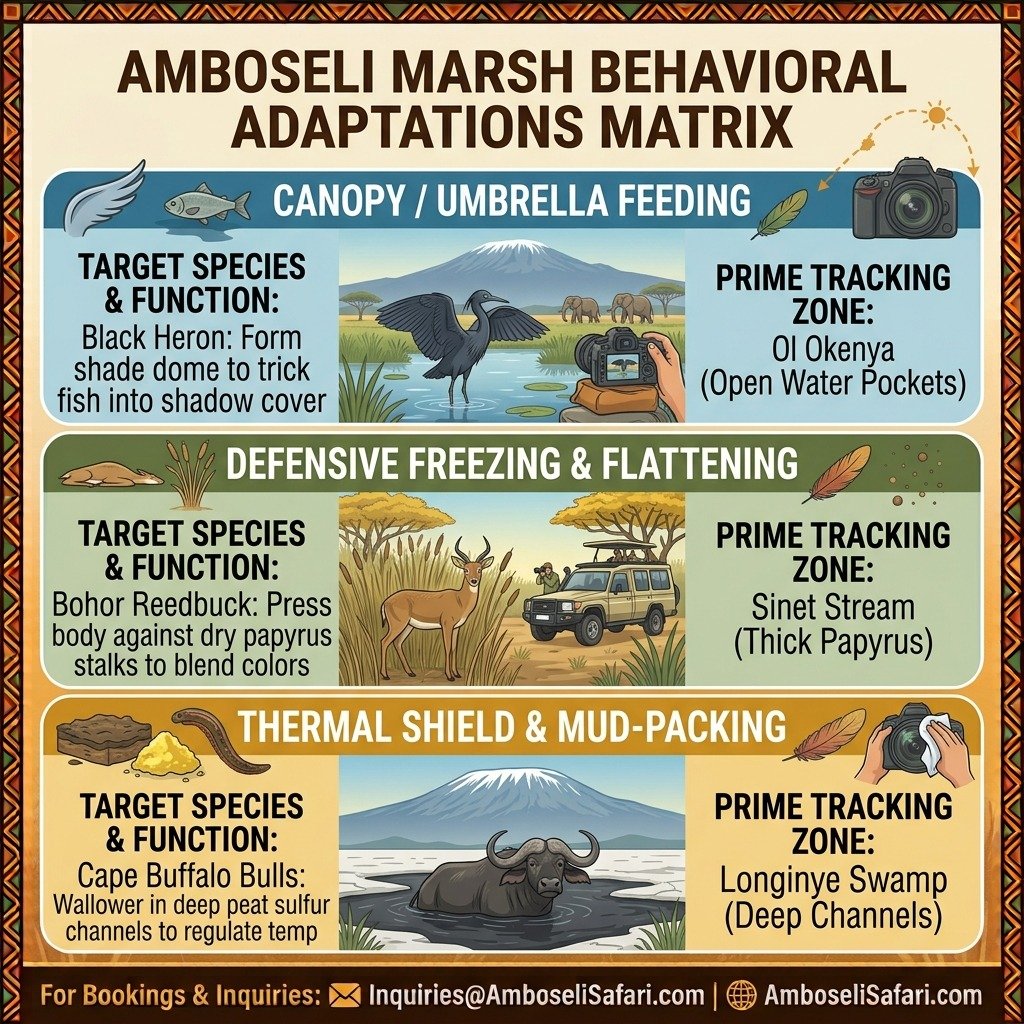
Moving east toward Longinye Swamp and Ol Okenya reveals specialized behaviors shaped by deep swamp mud.
Solitary buffalo bulls—nicknamed “papyrus mud-packers” by local drivers—spend up to six hours a day completely submerged in Longinye’s sulfur channels.
This deep mud wallowing is purely practical:
- Sticky black peat coats their hides, suffocating parasitic aquatic leeches.
- The dried mud crust prevents red-billed oxpeckers from picking open tick wounds on sensitive skin.
- As mud dries under the hot sun, it creates a natural thermal shield that regulates core body temperature.
In the shallow, open water pockets surrounding Ol Okenya swamp, Black Herons (Egretta ardesiaca) use a clever hunting trick called “canopy feeding.”
The heron curves its wings forward 360 degrees, forming a complete umbrella dome over the water surface. Small fish swim into the shade to hide from equatorial glare. Without surface reflections blocking its view, the heron spears the tricked fish with ease. Photograph this behavior between 10:00 AM and 11:30 AM along the shallow eastern pools.
If you want to stay close to these eastern marsh channels, review our recommendations on where to stay in Amboseli before booking.
Amboseli Marsh Behavioral Adaptations Matrix
Surrounding groves of yellow-fever trees and deep papyrus channels hide behaviors shaped by extreme heat competition and soft peat terrain. While large species like elephants and buffaloes dominate the green sedges, specialized waterfowl and antelope utilize distinct adaptive strategies to exploit nutrient-rich niches. This behavioral matrix outlines unique survival tactics, corresponding adaptive functions, and prime tracking zones within the marshes. Use these environmental cues to spot animals engaging in subtle behavioral survival routines.
| Marsh Adaptation | Target Species & Function | Prime Tracking Zone |
| Canopy / Umbrella Feeding | Black Heron: Form shade dome to trick fish into shadow cover | Ol Okenya (Open Water Pockets) |
| Defensive Freezing & Flattening | Bohor Reedbuck: Press body against dry papyrus stalks to blend colors | Sinet Stream (Thick Papyrus) |
| Thermal Shield & Mud-Packing | Cape Buffalo Bulls: Wallower in deep peat sulfur channels to regulate temp | Longinye Swamp (Deep Channels) |
A Quick Checklist for Marsh Birdwatchers
Amboseli’s wetlands host over 400 recorded bird species. Look in these specific micro-habitats:
- Open Water & Spring Heads: African Pygmy Geese, African Jacanas trotting on lily pads, and White-faced Whistling Ducks.
- Papyrus Reeds & Sinet Stream: Goliath Herons, African Fish Eagles perched on dead limbs, and Malachite Kingfishers.
- Mud Flats & Saline Margins: Grey Crowned Cranes, Sacred Ibises, and Saddle-billed Storks probing soft peat.
- Shallow Salt Crust Pools: Flocks of Lesser Flamingos, Great White Pelicans, and migratory waders like Ruff and Little Stints.
Gear Setups and Shooting Tips in the Marsh
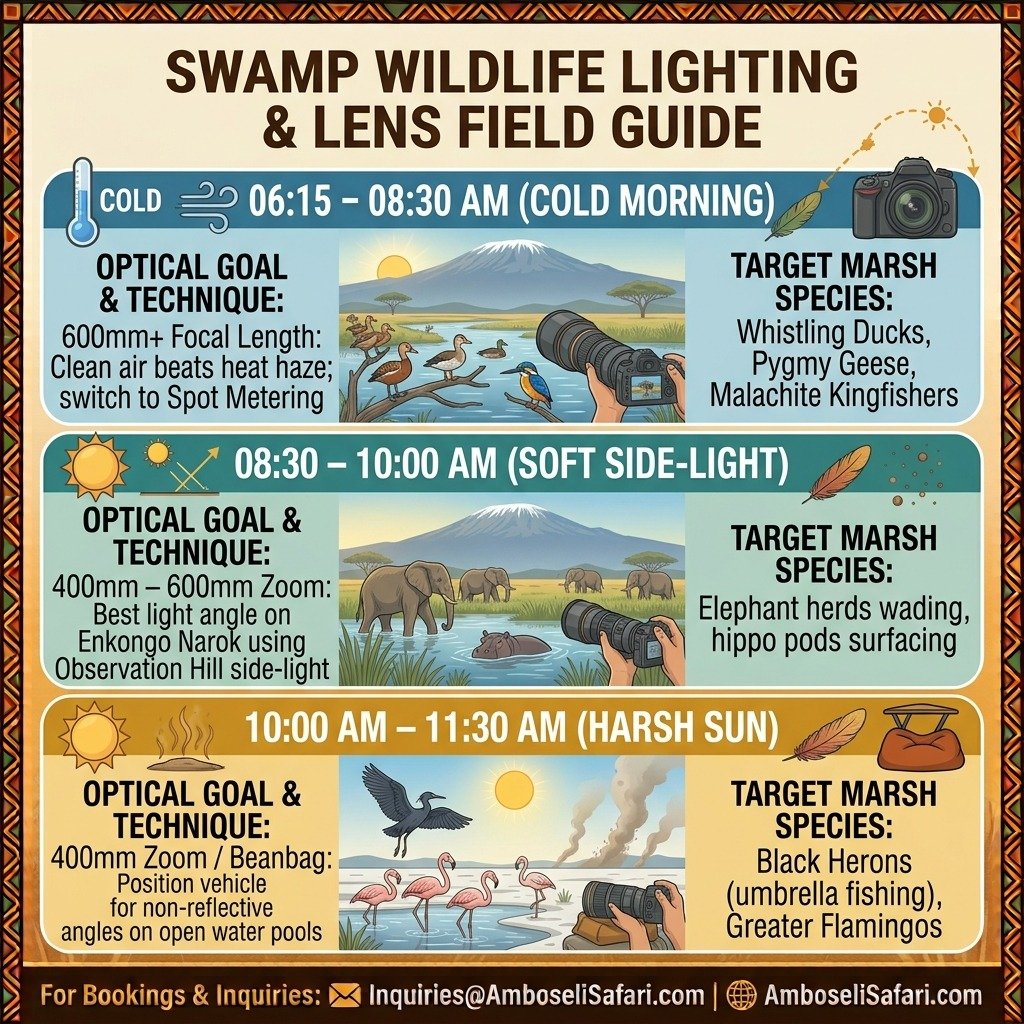
Fine volcanic dust is a constant headache when hand-holding long telephoto lenses. You will spend half your morning using a dry microfiber cloth and blower bulb to clear white silt off a 600mm front element, especially after another truck kicks up dust ahead of you on the Sinet track.
Keep these field rules in mind:
- Recommended Lenses: Pack a 400mm to 600mm telephoto lens. Small waterbirds stay on the far side of papyrus channels where vehicles cannot go.
- Beating Midday Heat Shimmer: Heat waves bouncing off open water and salt crust after 10:30 AM distort telephoto focus. Schedule your critical bird photography between 06:15 AM and 08:30 AM when the morning air is crisp and clear.
- Observation Hill Sun Angles: Position your Land Cruiser along the eastern base tracks of Observation Hill at dawn. The rising sun side-lights elephant herds wading through green sedges with Mount Kilimanjaro towering behind them.
| Bohor Reedbuck: Press body against dry papyrus stalks to blend colors | Sinet Stream (Thick Papyrus) | |
| Thermal Shield & Mud-Packing | Cape Buffalo Bulls: Wallower in deep peat sulfur channels to regulate temp | Longinye Swamp (Deep Channels) |
Swamp Wildlife Lighting & Lens Field Guide
Managing optical clarity along the wetlands requires specific technical adjustments for severe dust haze and heat shimmer distortion. Intense equatorial sun bouncing off shallow water after 10:30 AM can instantly blow out details on light-colored bird species or create focusing issues along dusty causeways. This field-tested technical matrix pairs optimal daily light windows with recommended focal lengths and specific environmental targets. Align your shooting schedule with these core windows to capture sharp marsh wildlife frames.
| Lighting Window | Optical Goal & Technique | Target Marsh Species |
| 06:15 – 08:30 AM (Cold Morning) | 600mm+ Focal Length: Clean air beats heat haze; switch to Spot Metering | Whistling Ducks, Pygmy Geese, Malachite Kingfishers |
| 08:30 – 10:00 AM (Soft Side-Light) | 400mm – 600mm Zoom: Best light angle on Enkongo Narok using Observation Hill side-light | Elephant herds wading, hippo pods surfacing |
| 10:00 AM – 11:30 AM (Harsh Sun) | 400mm Zoom / Beanbag: Position vehicle for non-reflective angles on open water pools | Black Herons (umbrella fishing), Greater Flamingos |
Balancing Water Rights for Wildlife and Maasai Herds
Swamp ecosystems face pressure from surrounding agricultural development and climate variability.
The Amboseli Elephant Research Project monitors how marsh vegetation health directly affects elephant birth rates and calf survival. During dry cycles, matriarchs rely on core swamp sedges to produce milk for young calves.
KWS manages wetland protection alongside surrounding Maasai pastoralist communities:
- During severe droughts, KWS coordinates with local group ranches to allow Maasai herders controlled access to designated watering corridors along outer swamp limits.
- Community ranger teams from the Big Life Foundation patrol swamp borders to prevent agricultural encroachment and clear illegal snare traps.
- Controlled livestock access prevents overgrazing of core marsh vegetation while maintaining peaceful coexistence between pastoralists and wild herds.
Real Risks Along the Swamp Tracks
Exploring wetland habitats requires managing real environmental hazards:
- Deep Peat Traps: Never drive off marked tracks near swamp edges. Beneath the dry surface crust lies soft, black peat mud that can swallow a 4×4 Land Cruiser to its axles in seconds.
- Mosquitoes and Insects: Thermal swamps generate heavy mosquito activity at dusk. Pack strong insect repellent and wear long sleeves during evening lodge dinners.
- Heat Shimmer Distortion: By 11:00 AM, thermal heat waves rising off water margins distort long telephoto lenses. Schedule critical bird and wildlife photography during early morning light.
To see how elephant herds move between these swamps and outer acacia scrub, check out our famous elephants guide.
If you are ready to book a private Land Cruiser and driver-guide for your trip on Amboselisafari.com, send us your travel details through our safari inquiry form or reserve dates via our safari booking form.
Frequently Asked Questions
Which swamp gives you the best chances for wildlife?
Enkongo Narok swamp holds the highest wildlife concentration. Its year-round thermal springs attract large elephant herds, hippo pods, waterbucks, and hundreds of bird species every day.
Are there crocodiles hiding in Amboseli’s marshes?
No. Amboseli National Park lacks Nile crocodiles because its isolated swamp systems do not connect to major permanent river networks like the Mara or Tana Rivers.
When should I go to Observation Hill to see hippos?
Early morning (06:30 AM to 08:30 AM) and late afternoon (16:30 PM to 17:30 PM) offer the best viewing as hippos move along their exit channels.
Can I walk along the swamp edges on foot?
No. Walking outside your safari vehicle near swamp margins is strictly prohibited by KWS rangers due to hidden hippo paths and unpredictable buffaloes. The only elevated walking area is Observation Hill.