
4 Day Amboseli Nakuru Safari: Route Guide, Lodges & Pricing
Overview of 4 Day Amboseli Nakuru Safari
A 4 day Amboseli Nakuru safari (3 nights: 2 nights in Amboseli, 1 night in Lake Nakuru) costs between $1,370 and $6,060 per adult sharing based on two travelers in a private 4×4 Land Cruiser. This route combines big elephant herds beneath Mount Kilimanjaro with rhino tracking and birding in the Great Rift Valley. Packages include full-board lodging, private vehicle transport, driver-guide services, and non-resident KWS park permits.
Jump Ahead
- Escarpment Traffic Hacks & Route Metrics
- Climate Shifts & Baboon Rules
- Southern Sector Rhinos & Flooded Trees
- Complete 4-Day Itinerary
- Seasonality & Package Costs
- Frequently Asked Questions
Pairing an arid elephant sanctuary with a moist Rift Valley rhino crater on a 4 day Amboseli Nakuru safari gives you two starkly different Kenya safari environments in a single road trip. You go from wiping fine red dust off your camera gear on open salt flats to peering through damp morning mist in high-altitude acacia woodlands.
Connecting these two parks means crossing the floor of the Great Rift Valley past Nairobi—a route my guiding team and I drive constantly. Getting through this stretch without wasting half your day comes down to making smart highway choices, using specific back gates to bypass urban bottlenecks, and preparing for sudden weather shifts as you climb from southern plains to central crater rims.
It helps to check seasonal wildlife movements across Kajiado County before picking your dates. If you want us to map out a custom drive for your group, submit a quick note through our safari booking form on Amboselisafari.com and we will handle the ground logistics.
Escarpment Traffic Hacks & Gate Shortcuts
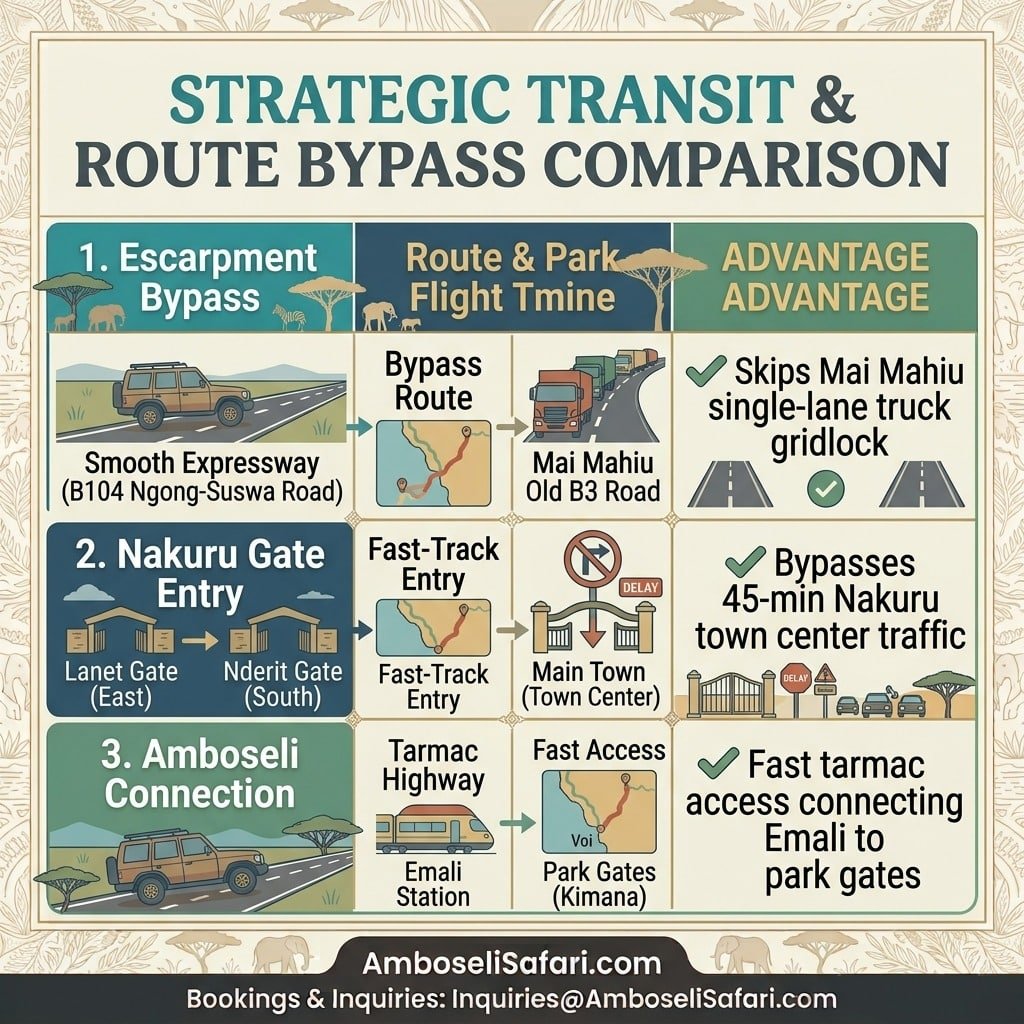
Driving from Amboseli up to Lake Nakuru forces you across the Great Rift Valley escarpment. Most safari drivers take the old B3 Mai Mahiu road—a narrow, grinding stretch of asphalt with tight single-lane S-curves packed with slow-moving freight trucks bound for Uganda.
I once sat stuck on that Mai Mahiu incline for nearly three hours behind an overturned fuel tanker while diesel fumes baked in the midday heat. We avoid that mess entirely now.
When we leave Amboseli, we swing onto the Southern Bypass and take the B104 Ngong-Suswa road instead. It drops down smoothly behind the Ngong Hills directly toward Naivasha. It adds twenty kilometers on the odometer, but it skips the Mai Mahiu truck gridlock completely. If you get peckish along the bypass, skip the formal sit-down restaurants in Naivasha and grab fresh roasted maize from the roadside vendors at the viewpoint—it saves an hour of driving time.
When we reach Lake Nakuru, we avoid the main gate near the town center where local traffic slows you down for forty-five minutes. We head straight for Lanet Gate on the eastern perimeter or Nderit Gate to the south. Lanet Gate drops you directly into quiet acacia woodland near Lion Hill, completely bypassing urban traffic.
Strategic Transit & Route Bypass Comparison
Navigating the transit leg between Amboseli and Lake Nakuru requires strategic highway choices to avoid heavy freight gridlock on the Great Rift Valley escarpment. Steering clear of the single-lane Mai Mahiu road saves hours of travel time while keeping your schedule flexible. Utilizing eastern or southern park gates further bypasses local town traffic upon arrival in Nakuru. Use this route bypass strategy to streamline your travel between these two distinct safari destinations.
| Transit Corridor | Route & Gate Selection | Operational Advantage |
| Escarpment Bypass | B104 Ngong-Suswa Road | Skips Mai Mahiu single-lane truck gridlock |
| Nakuru Gate Entry | Lanet Gate (East) or Nderit Gate (South) | Bypasses 45-min Nakuru town center traffic |
| Amboseli Connection | C103 Highway via Kimana Gate | Fast tarmac access connecting Emali to park gates |
Route Distance & Transit Time Overview
| Transit Leg | Distance (km) | Driving Time | Recommended Highway / Gate |
| Nairobi to Amboseli | 230 km | 4.5 – 5 Hours | C103 Road via Emali & Kimana Gate |
| Amboseli to Lake Nakuru | 380 km | 7.5 – 8 Hours | B104 Ngong-Suswa Bypass via Lanet Gate |
| Lake Nakuru to Nairobi | 160 km | 3.5 – 4 Hours | A104 Nakuru-Nairobi Highway via Main Gate |
You can check current highway updates on our Amboseli road conditions guide before finalizing your travel dates.
Climate Shifts & Baboon Rules
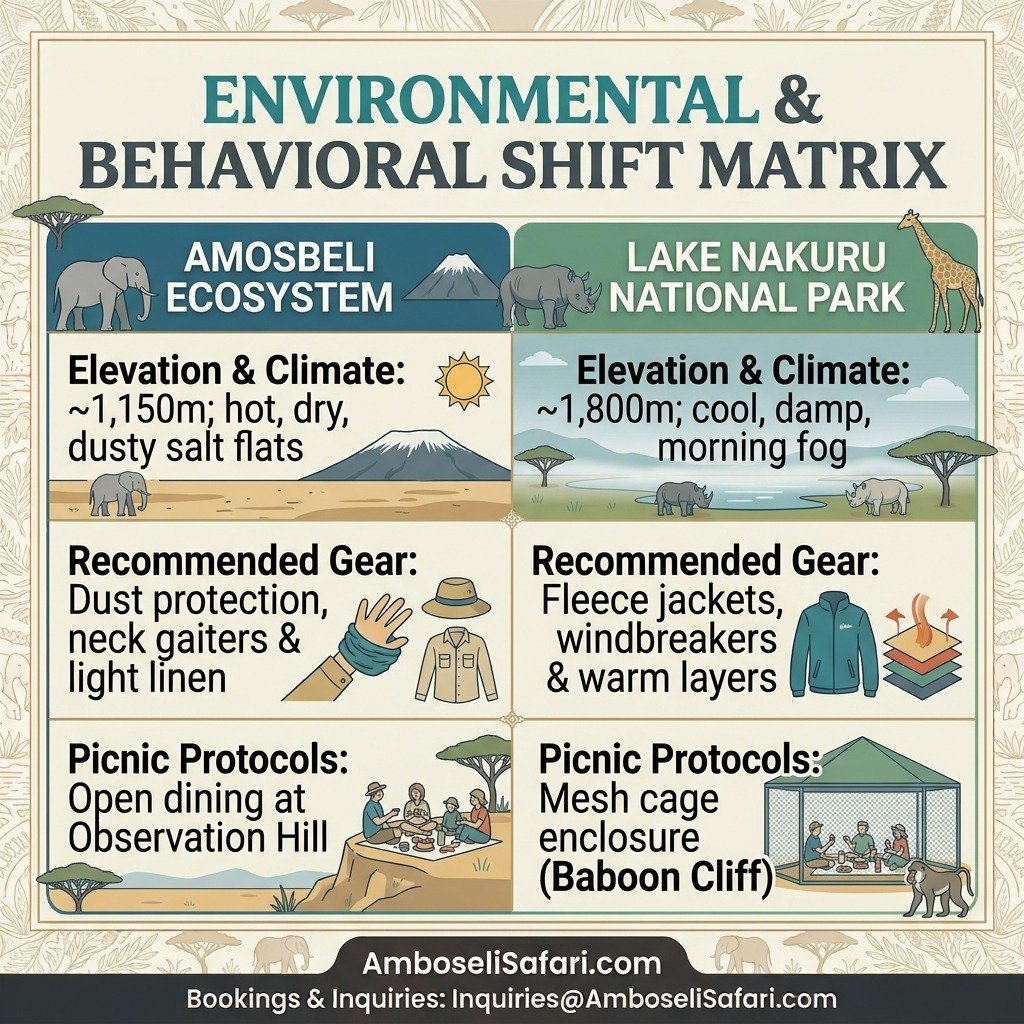
Moving from Amboseli’s dry salt flats at 1,150 meters elevation to Lake Nakuru’s high crater rim at 1,800 meters brings a sharp shift in sensory conditions.
By 11:00 AM in Kimana, powdery volcanic silt coats your clothes, skin, and camera lenses. But as you descend into Nakuru the next day, the air smells sharply of damp eucalyptus and wet earth. Heavy morning fog hangs over Lion Hill until 08:30 AM, and thick dew drips constantly off the fever-tree canopy. You will want a windbreaker in your daypack for that first morning drive in Nakuru—it gets surprisingly cold.
Meal stops are strictly managed under KWS park boundary regulations. While you can eat outside at open wooden tables on Observation Hill (Normatior) in Amboseli, Nakuru is a different story.
At Baboon Cliff overlooking Lake Nakuru, KWS constructed a heavy wire-mesh enclosure for lunch breaks. The local olive baboons are dangerously clever. Unzipping a lunch bag outside that wire cage invites an immediate monkey raid. Keep your vehicle windows cranked up tight when parked at the lookout, as these baboons routinely pull on car door handles and try to slide open vehicle windows looking for food.
Environmental & Behavioral Shift Matrix
Traveling from Amboseli’s dusty lowlands to Lake Nakuru’s elevated crater rim brings a sharp change in altitude, temperature, and wildlife behavior. Preparing for chilly, misty mornings in Nakuru requires warm layers compared to Amboseli’s hot, dusty salt flats. Additionally, strict food safety rules apply at Nakuru picnic sites due to aggressive local baboons. Review this environmental shift matrix to pack and prepare effectively for both parks.
| Location / Feature | Amboseli Ecosystem | Lake Nakuru National Park |
| Elevation & Climate | ~1,150m; hot, dry, dusty salt flats | ~1,800m; cool, damp, morning fog |
| Recommended Gear | Dust protection, neck gaiters & light linen | Fleece jackets, windbreakers & warm layers |
| Picnic Protocols | Open dining at Observation Hill | Mesh cage enclosure required (Baboon Cliff) |
Southern Sector Rhinos & Flooded Trees
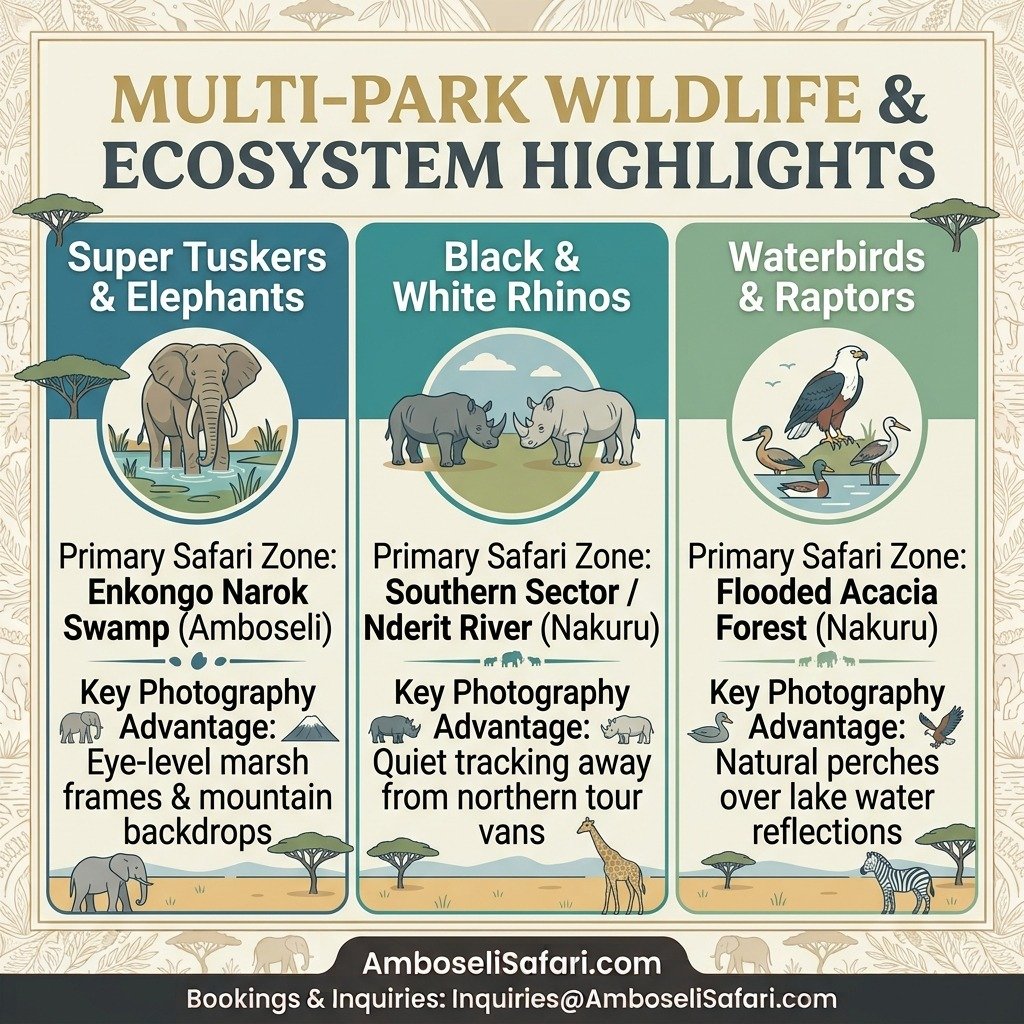
Rising water levels across the Rift Valley over the past decade flooded Lake Nakuru’s old northern mudflats. That ecological change altered water salinity, causing most of the massive flamingo flocks to shift north toward Lake Bogoria.
While standard tour vans still clutter the northern shoreline, we take our Land Cruisers straight to the southern sector around Makalia Falls and the Nderit riverbed. This quieter area provides rich tracking grounds for both White Rhinos and endangered Black Rhinos, as well as Rothschild’s Giraffes.
Near the flooded former park headquarters, rising lake waters drowned hundreds of yellow-fever acacias (Acacia xanthophloeia), similar to those line-feeding zones along Enkongo Narok swamp. This created a stark forest of bare tree trunks standing in the water.
These dead snags give African fish eagles, cormorants, and great white pelicans prime perching spots over water reflections—a fantastic setup for taking photos. Review our camera lens recommendations in our Amboseli wildlife photography guide.
Multi-Park Wildlife & Ecosystem Highlights
Combining Amboseli and Lake Nakuru allows travelers to experience two completely different ecosystems packed with iconic wildlife. While Amboseli excels in large elephant herd interactions beneath Kilimanjaro, Nakuru serves as Kenya’s premier sanctuary for rhino tracking. Exploring Nakuru’s flooded southern sector also presents unique opportunities for waterbird photography among dead acacia snags. Compare these ecosystem highlights to plan your camera setups for each leg of the trip.
| Target Wildlife / Feature | Primary Safari Zone | Key Photography Advantage |
| Super Tuskers & Elephants | Enkongo Narok Swamp (Amboseli) | Eye-level marsh frames & mountain backdrops |
| Black & White Rhinos | Southern Sector / Nderit River (Nakuru) | Quiet tracking away from northern tour vans |
| Waterbirds & Raptors | Flooded Acacia Forest (Nakuru) | Natural perches over lake water reflections |
Complete 4-Day / 3-Night Itinerary Schedule
Day 1: Nairobi to Amboseli & Afternoon Game Drive
Depart Nairobi at 06:00 AM in a private 4×4 Safari Land Cruiser, driving south through Emali to reach your lodge near Kimana Gate for lunch. At 3:30 PM, enter through Kimana Gate for an afternoon game drive along Ol Okenya swamp to watch elephant families feeding near yellow-fever tree groves.
Day 2: Full Day Swamps & Mount Kilimanjaro
Start drives at 06:00 AM sharp to catch clear views of Mount Kilimanjaro before thermal clouds blanket Kibo peak around 09:30 AM. Track bull elephants along research paths monitored by the Amboseli Elephant Research Project. Eat your packed picnic lunch at Observation Hill, spend the afternoon exploring western salt flats, and return to camp by 6:00 PM.
Day 3: Amboseli to Lake Nakuru via Ngong-Suswa Bypass
Depart Amboseli after breakfast at 07:00 AM. Drive north toward Nairobi, switching onto the B104 Ngong-Suswa bypass road to skip escarpment truck traffic. Enter Lake Nakuru National Park via Lanet Gate. Enjoy a late-afternoon game drive tracking rhinos along southern acacia woodlands before checking into your lodge.
Day 4: Breakfast & Return Transfer to Nairobi
Enjoy a relaxed morning breakfast at your Lake Nakuru lodge while looking out over the misty lake basin. There are no game drives scheduled on this final morning. Pack your luggage, check out by 09:00 AM, and start your road transfer back to Nairobi, arriving in the city by 1:00 PM.
Seasonality & Package Costs
Understanding seasonal shifts helps you plan around track conditions and mountain visibility:
| Season & Months | Track Conditions | Wildlife Viewing Quality |
| Peak Dry Season<br>(July – October) | Clear, dusty roads; smooth driving | Exceptional<br>Elephants concentrate heavily around Amboseli swamps |
| Short Rains<br>(November – December) | Occasional afternoon showers | Very Good<br>Lush green scenery, newborn animals, migrating birds |
| High Dry Season<br>(January – March) | Warm, dry conditions; clear skies | Excellent<br>Unobstructed views of Mount Kilimanjaro at sunrise |
| Long Rains<br>(April – May) | Heavy rainfall; muddy park tracks | Moderate<br>Lower rates, but higher chance of getting stuck off-road |
Safari Package Costs & Hotel Tiers
Our 4-day road package covers a private 4×4 Safari Land Cruiser for all 4 days (including driver-guide fees, vehicle transit, and fuel), 3 nights full-board accommodation (2 nights Amboseli, 1 night Lake Nakuru), and pre-paid non-resident KWS park permits ($90/day Amboseli, $80/day Nakuru).
Vehicle, fuel, and guide fees run USD 190 per person sharing per day during standard months, rising to USD 400 per person sharing per day during peak dry season (July to October). Rates are based on two adults traveling together.
Lodge choices come with distinct trade-offs. Budget options like AA Lodge in Amboseli are fine if you just need a functional bed and clean shower, but their strict 10:00 PM generator shutoff gets sticky and hot in February. Stepping up to mid-range options like Sarova Lion Hill in Nakuru gives you reliable 24-hour power and piping hot showers right after cold, misty morning drives.
| Package Tier & Included Hotels* | Normal Season<br>(Jan–Jun, Nov–Dec) | Peak Season<br>(Jul–Oct) |
| Budget Tier<br>AA Lodge (Amboseli) / Lake Nakuru Lodge | USD 1,370 per person | USD 2,360 per person |
| Mid-Range Tier<br>Ol Tukai Lodge (Amboseli) / Sarova Lion Hill (Nakuru) | USD 1,640 per person | USD 2,700 per person |
| Luxury Tier<br>Tortilis Camp (Amboseli) / The Cliff (Nakuru) | USD 2,370 per person | USD 3,660 per person |
| Luxury Plus Tier<br>Angama Amboseli / The Cliff Luxury Tent (Nakuru) | USD 4,020 per person | USD 6,060 per person |
*Prices assume two adults sharing a private 4×4 Land Cruiser. Budget properties run generator power on fixed hours (off 10 PM – 5 AM).
Submit a booking enquiry on Amboselisafari.com to check exact room availability and hold a private Land Cruiser for your dates.
Package Inclusions:
- Private 4×4 Safari Land Cruiser with pop-up roof for all game drives and transfers.
- Services of a TRA-licensed, English-speaking driver-guide.
- 3 nights full-board accommodation across selected lodge tiers.
- Non-resident KWS park entry permits (Amboseli and Lake Nakuru).
- Bottled drinking water in vehicle coolers and emergency medical evacuation insurance.
Package Exclusions:
- International airfare and Electronic Travel Authorization (eTA) fees.
- Personal expenses such as driver tips, laundry, or alcoholic beverages.
- Optional Maasai cultural village visits or boat rides on Lake Naivasha.
Optional Add-Ons:
- Authentic Maasai cultural village visit in Amboseli: USD 30 per person.
- Lake Naivasha boat ride and walking safari on Crescent Island: USD 50 per person.
- Sunrise hot air balloon safari over Amboseli: USD 450 per person.
To weigh up camp locations across the ecosystem, read our guide on where to stay in Amboseli.
Cash, Gear & Travel Logistics
- US Dollar Notes: Bank tellers and lodge cashiers in Kenya reject pre-2013 USD notes due to counterfeit rules. Bring clean bills printed in 2013 or later.
- Driver Tipping: Plan on tipping your private driver-guide $15 to $20 USD per day total from your travel group.
- Lodge Tip Boxes: Leave $10 USD per day in the reception tip box for room stewards and kitchen staff.
- Kenya Shillings (KES): Keep KES 5,000 to 10,000 ($35 to $70 USD equivalent) in small notes for roadside fruit or curio stops along the escarpment.
- eTA Rules: Apply for an Electronic Travel Authorization at the official Kenyan eTA portal before departure. Carry a Yellow Fever card if transiting through endemic zones.
If your travel plan continues west into Narok County Council jurisdictions like the Masai Mara, separate regional park fees apply. You can review complete permit rules on our Amboseli safari cost guide.
Frequently Asked Questions
Is 4 days enough time for both Amboseli and Lake Nakuru?
Yes. Having 4 days gives you two full nights in Amboseli for elephant viewing and Mount Kilimanjaro photography, plus a full night and game drive in Lake Nakuru for rhino tracking before returning to Nairobi.
Can we add Lake Naivasha to this 4-day safari?
Yes. Lake Naivasha sits right along the route between Nairobi and Lake Nakuru. We can schedule a 1-hour boat ride to see hippos or a walking safari on Crescent Island during your drive on Day 3.
What should we wear for the temperature difference between the two parks?
Pack light linen or cotton clothes for Amboseli’s hot dry days, but make sure to include a fleece jacket or windbreaker for Lake Nakuru’s chilly, misty mornings.
Is a 4×4 Land Cruiser required, or can a 2WD Safari Van make this trip?
While safari vans can navigate main highways, a 4×4 Land Cruiser is strongly recommended due to high ground clearance needed for muddy sections in Nakuru’s southern sector and rough tracks around Kimana Gate.
Can we see the Big Five on this 4-day combination?
You will likely see four of the Big Five (Elephants, Rhinos, Lions, and Buffaloes/Leopards). Buffaloes and lions inhabit both parks, but rhinos are absent in Amboseli and must be tracked in Lake Nakuru.
Written by Patrick Mulei. Reviewed by Anthony Mule, Senior Safari Guide with over a decade of field experience in Amboseli.