
Amboseli Weather by Month: Complete Climate & Seasonal Guide
Overview
Amboseli National Park experiences a semi-arid climate shaped by Mount Kilimanjaro’s rain shadow, with daytime temperatures averaging 25°C to 30°C (77°F to 86°F) year-round. The year breaks into two dry windows (January–February and June–October) and two rainy seasons (March–May and November–December). Early morning temperatures in June and July regularly plunge to 10°C (50°F) as mountain winds roll down the peak, while October brings the highest heat of the year above 33°C (91°F).
Fast Navigation Links
- Jan & Feb: Short Dry Window
- Mar to May: Long Rains
- Jun & Jul: Mountain Winds
- Late Dry Season (Aug–Oct)
- Nov & Dec: Short Rains
- Packages & Seasonal Rates
- Frequently Asked Questions
Amboseli Monthly Weather Summary
| Month | Avg High (°C / °F) | Avg Low (°C / °F) | Rain (mm) | Kilimanjaro Views | Best For |
| Jan–Feb | 30°C / 86°F | 16°C / 61°F | 45 mm | Moderate | Swamps & Wildlife Compression |
| Mar–May | 29°C / 84°F | 16°C / 61°F | 120 mm | Crisp (Mornings) | Flamingos & Peak Clarity |
| Jun–Jul | 25°C / 77°F | 10°C / 50°F | 8 mm | High | Sunny Days & Cold Mornings |
| Aug–Oct | 31°C / 88°F | 15°C / 59°F | 15 mm | Dusty | Massive Elephant Gatherings |
| Nov–Dec | 28°C / 82°F | 16°C / 61°F | 100 mm | Afternoon Clouds | Lush Scenery & Migratory Birds |
Standard weather apps show warm temperatures in Amboseli year-round, but conditions on the ground shift constantly. Local mountain winds, underground water flows from Mount Kilimanjaro, and seasonal rain patterns across Kajiado and neighboring Narok County Council borders completely change what you see on game drives.
The rules of Amboseli National Park are set and enforced by the Kenya Wildlife Service (KWS).
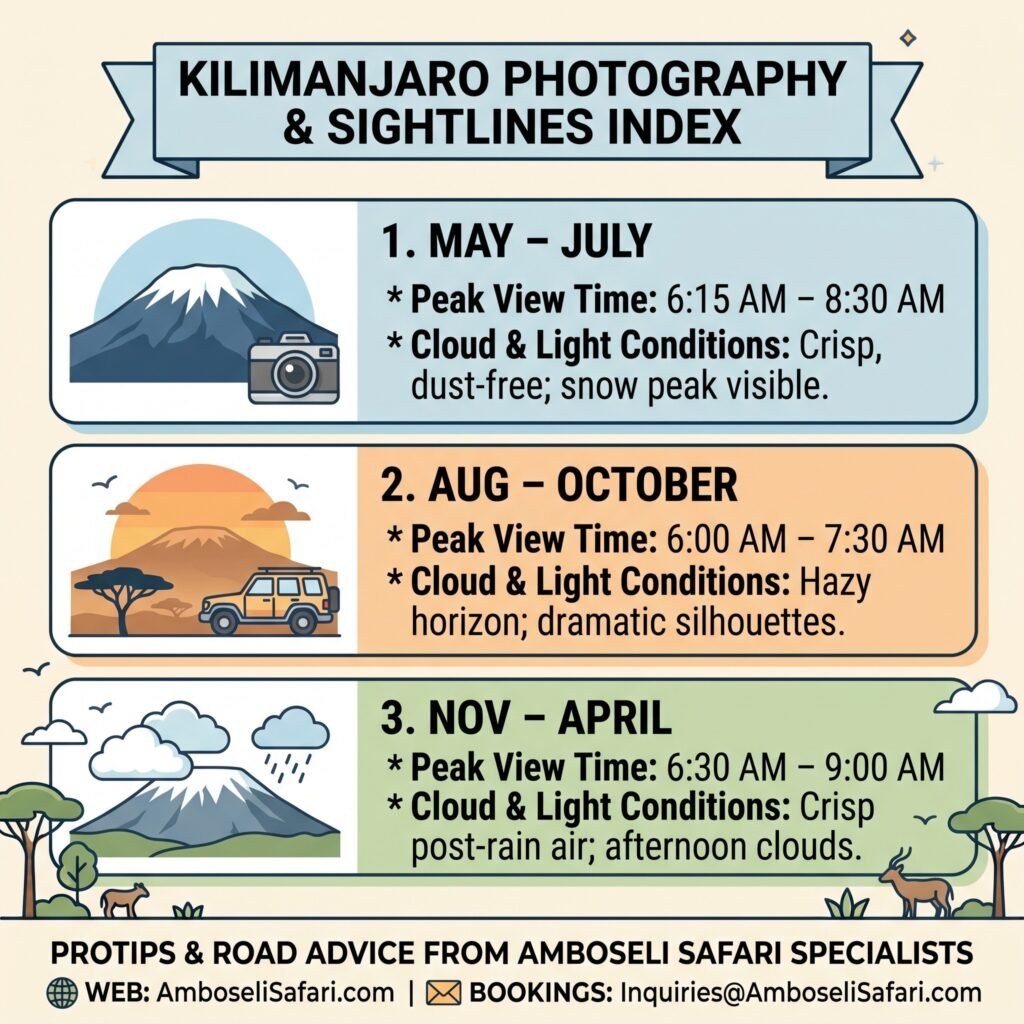
Kilimanjaro Photography & Sightlines Index
Capturing Mount Kilimanjaro’s iconic snow-capped peak behind Amboseli’s elephant herds depends heavily on cloud dynamics and atmospheric dust. Seasonal rain patterns wash away heat haze, while cold mountain winds shift morning cloud cover over the summit. The matrix below outlines the exact morning windows for clear peak visibility and optimal photography light across each season.
| Season Window | Peak View Time | Cloud & Light Conditions |
| May–July | 6:15 AM – 8:30 AM | Crisp, dust-free; snow peak visible. |
| Aug–October | 6:00 AM – 7:30 AM | Hazy horizon; dramatic silhouettes. |
| Nov–April | 6:30 AM – 9:00 AM | Crisp post-rain air; afternoon clouds. |
January & February: The Short Dry Window
January and February bring warm, dry days with afternoon temperatures hovering around 29°C to 30°C (84°F–86°F). As the intense sun beats down on the baked crust of Lake Amboseli, shimmering heat haze and mirages ripple across the dry lakebed between 11:30 AM and 2:30 PM.
The surface looks completely dry, yet the central marshes at Longinye and Enkongo Narok remain full. Springs take weeks to react to mountain rain because rainwater and melted snow from Kilimanjaro soak deep into underground volcanic rock layers, slowly filtering down through the stone before bubbling up at spring outlets inside the park weeks later.
Wildlife viewing during these months is outstanding. Elephants, zebras, and wildebeests pack into the marsh edges because rainwater pools outside the park boundaries have dried up completely.
March to May: The Long Rains
Mid-March marks the start of the long rains, with April seeing the heaviest downpours (averaging 100mm to 150mm).
When April’s heavy rains hit, the dry salt pan of Lake Amboseli transforms into a wide, shallow lake. Dirt tracks near the wetlands turn into slick mud, but the temporary lake draws in thousands of lesser flamingos, pelicans, and Eurasian migratory birds.
Heavy cloud cover begins breaking in May as the rains taper off. April downpours wash dust particles completely out of the atmosphere, leaving exceptionally clear air. Early May mornings deliver crisp, high-contrast views of Mount Kilimanjaro’s ice cap between 6:15 AM and 7:30 AM before clouds build over the summit.
Booking a direct flight from Nairobi to Amboseli bypasses muddy highway drives altogether, landing at the park airstrip in under an hour.
June & July: Mountain Winds & Dawn Cold
By June, the rains drop off and dry weather settles across the basin. Midday temperatures are comfortable, averaging 23°C to 25°C (73°F–77°F), but sunrise temperatures drop sharply to 10°C (50°F) or lower.
Overnight, cold air cools on Kilimanjaro’s glaciers and sinks down into the valley floor. On a 6:00 AM open-top game drive, that mountain wind-chill hits immediately. Adding thermal layers and a windbreaker to your Amboseli safari packing list ensures comfort during early morning starts.
Late Dry Season (August–October)
By August and September, the open plains (Empusel) are grazed down to bare dirt. Mid-afternoon thermal winds whipping across the basin between 2:00 PM and 4:30 PM kick up towering white-grey dust plumes across the dry lakebed.
Elephants handle the heat by wading deep into drying swamp borders and mud-bathing. They coat themselves in pale alkaline silt, giving them their famous “ghost elephant” look under the harsh afternoon sun.
October is the hottest month of the year, with temperatures regularly topping 33°C (91°F) as humidity builds. With surface water outside the park gone, herds pack tightly into the central Ol Tukai and Enkongo Narok swamp channels. Our Amboseli wildlife photography guide details how to manage this harsh midday glare and dust.
Wildlife Dispersal & Safari Sighting Rates
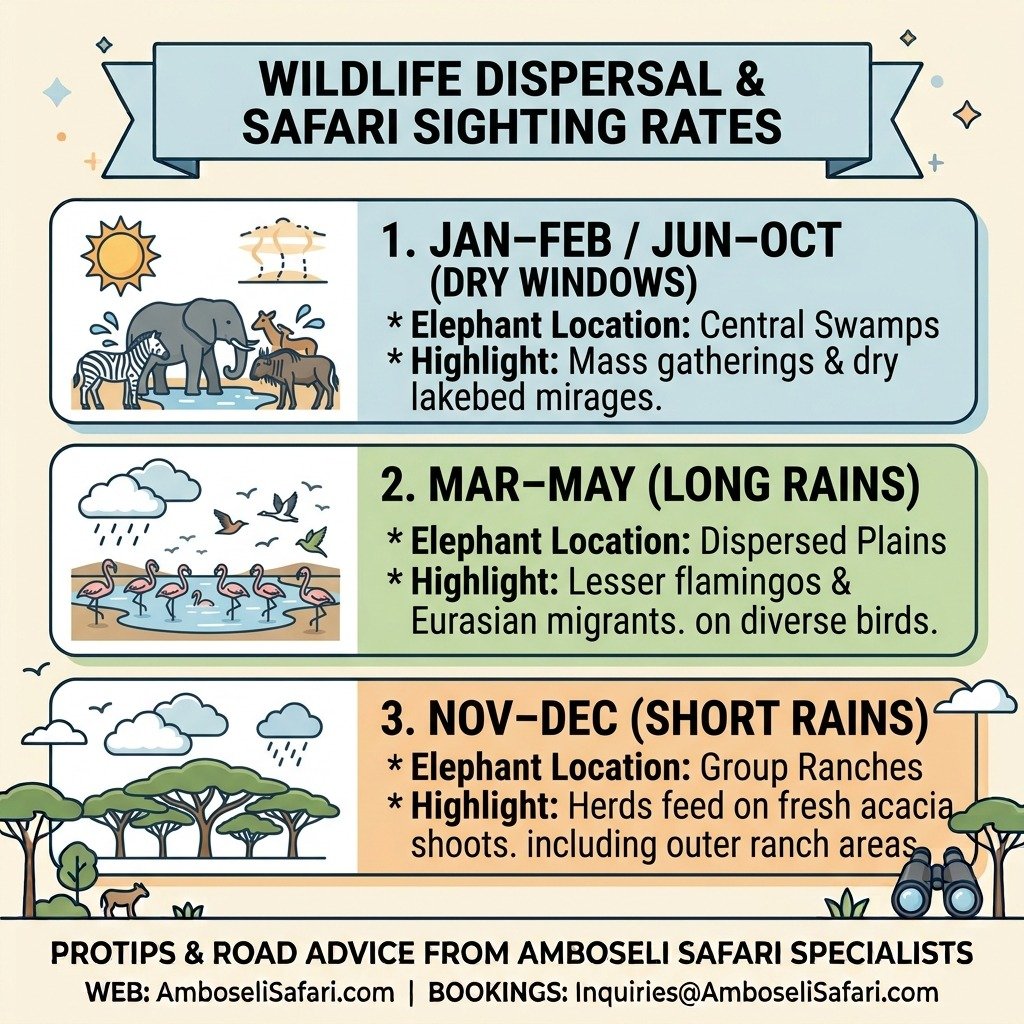
Wildlife movement in Amboseli follows underground water springs and rain pools rather than basic temperature changes. During dry windows, animals pack tightly into central swamp channels, whereas rains trigger rapid herd dispersal into surrounding conservancies. Review this seasonal sighting guide to understand where game concentrates throughout the year.
| Season / Months | Elephant Location | Highlight / Wildlife Activity |
| Jan–Feb / Jun–Oct | Central Swamps | Mass gatherings; dry lakebed mirages. |
| Mar–May (Rains) | Dispersed Plains | Lesser flamingos & Eurasian migrants. |
| Nov–Dec (Rains) | Group Ranches | Herds feed on fresh acacia shoots. |
November & December: The Short Rains
The short rains usually arrive in early November as brief, dramatic late-afternoon thunderstorms. Early mornings are typically clear and fresh.
Wildlife moves quickly once the rain starts. Within two or three days of the first heavy downpour, temporary drinking pools fill up on outer group ranches like Kimana and Selenkay conservancies. Elephant herds fan out beyond the park boundaries to feed on fresh green shoots on yellow-fever trees (Acacia xanthophloeia).
Visiting nearby Amboseli conservancy areas provides access to these roaming herds when central park tracks quiet down.
Terrain Notes & Driving Challenges
Seasonal weather shifts create specific operational hazards across the park:
- Black-Cotton Mud: In April and May, soil near swamp borders turns into sticky clay that clogs tire treads instantly. High-clearance 4×4 vehicles with low-range gearing are mandatory.
- July Temperature Drops: Packing only warm-weather clothing is a frequent error. Early morning game drives in July feel freezing until the sun climbs higher around 8:30 AM.
- November Dispersal Patterns: Right after the short rains break, central swamp loops often appear quiet. The elephants remain in the ecosystem but spread out into outer conservancies to drink from fresh rain pools.
Seasonal Packing & Tactical Gear Matrix
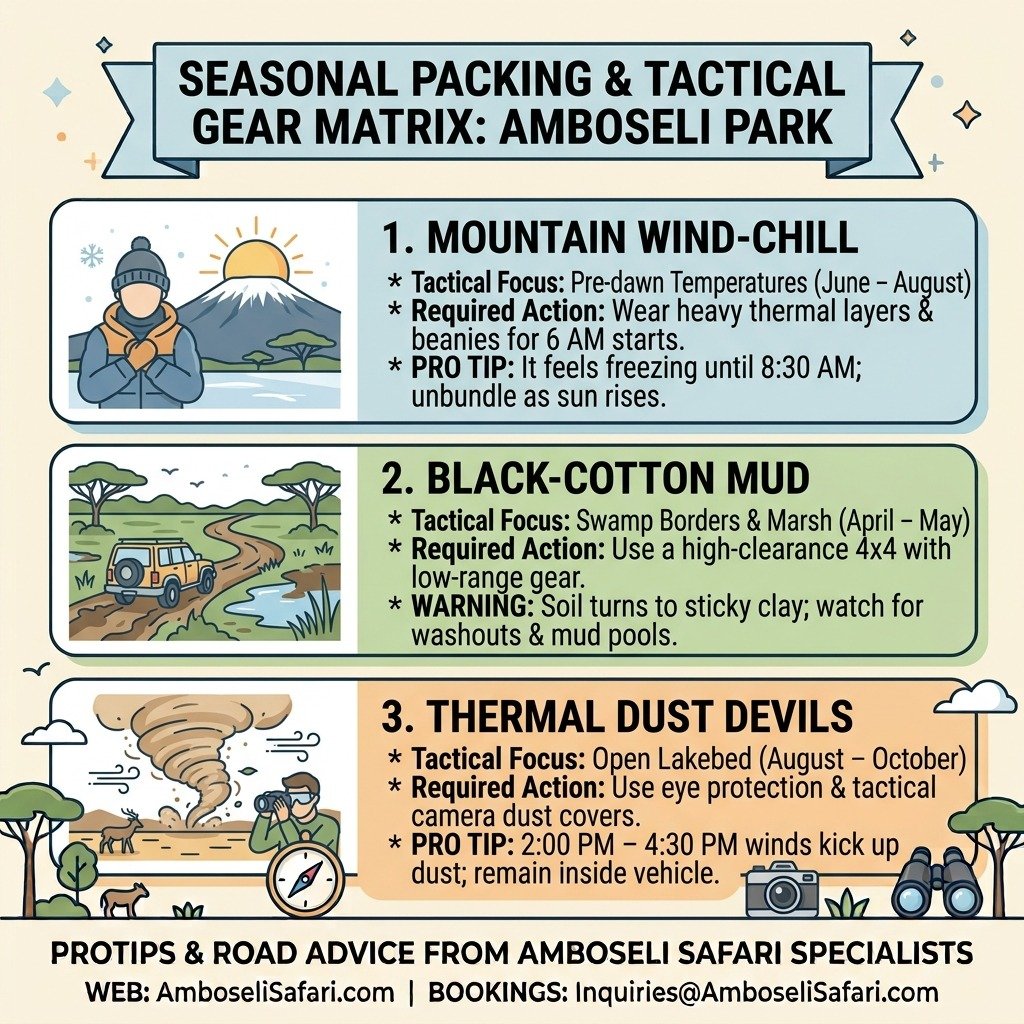
Preparing for Amboseli’s climate requires planning for extreme morning cold, alkaline dust, and heavy clay tracks. While afternoon temperatures remain warm, dawn wind-chills off Mount Kilimanjaro and sudden mud hazards present real challenges for unprepared travelers. Use this tactical packing and gear matrix to gear up correctly for your safari dates.
| Weather Factor | Affected Months | Required Action / Gear |
| Mountain Wind-Chill | June – August | Heavy thermal layers & beanies for 6 AM. |
| Black-Cotton Mud | April – May | High-clearance 4×4 with low-range gear. |
| Thermal Dust Devils | Aug – October | Eye protection & camera dust covers. |
Safari Package Costs & Seasonal Itineraries
Bundling transport, local guide services, park permits, and lodge stays into a complete itinerary eliminates the administrative friction of managing separate eCitizen park tickets ($90 USD per 24 hours for non-resident adults) and vehicle permits.
Package rates reflect two adults traveling together in a private 4×4 Safari Land Cruiser. Vehicle and guide logistics run USD 190 per person sharing per day during standard months and USD 400 per person sharing per day during peak dry season (July to October).
Pairing Amboseli with Tsavo West creates a balanced 4-day route across two distinct landscapes without long driving hours.
4-Day Amboseli & Tsavo West Safari Packages
Prices are total per person based on two adults sharing accommodation and a private 4×4 Land Cruiser.
| Season & Tier | Included Lodges | Price Per Person (USD) | Reserve Your Spot |
| Normal – Budget | AA Lodge Amboseli & Rhino Valley Lodge | USD 1,370 | Book Now |
| Normal – Mid-Range | Ol Tukai Lodge & Kilaguni Serena Lodge | USD 1,610 | Book Now |
| Normal – Luxury | Tortilis Camp & Severin Safari Camp | USD 2,150 | Book Now |
| Normal – Luxury Plus | Angama Amboseli & Finch Hattons | USD 3,560 | Book Now |
| Peak – Budget | AA Lodge Amboseli & Rhino Valley Lodge | USD 2,300 | Book Now |
| Peak – Mid-Range | Ol Tukai Lodge & Kilaguni Serena Lodge | USD 2,600 | Book Now |
| Peak – Luxury | Tortilis Camp & Severin Safari Camp | USD 3,250 | Book Now |
| Peak – Luxury Plus | Angama Amboseli & Finch Hattons | USD 5,050 | Book Now |
Our team can build a custom Amboseli safari package tailored around your specific travel dates.
Package Inclusions:
- Private 4×4 Safari Land Cruiser with pop-up roof for wildlife viewing.
- Services of a TRA-licensed, English-speaking driver-guide.
- All KWS park entry and vehicle fees for Amboseli and Tsavo West.
- Full board accommodation (breakfast, lunch, dinner) at listed properties.
- Unlimited bottled drinking water in the vehicle during game drives.
- Emergency medical evacuation insurance cover.
Package Exclusions:
- International flights and Kenyan electronic Travel Authorization (eTA) fees.
- Driver-guide tips, alcoholic drinks, and personal laundry.
- Optional activities such as hot air balloon flights or cultural village visits.
Optional Add-Ons:
- Maasai Cultural Village Visit: USD 30 per person.
- Amboseli Hot Air Balloon Safari: USD 450 per person.
- One-Way Flight Upgrade (Wilson Airport to Amboseli Airstrip): USD 540 per person (Includes base airline ticket, rate protection cushion, and operator service fee).
Frequently Asked Questions
What is the best month to visit Amboseli for clear Kilimanjaro views?
May, June, and July offer the clearest views of Mount Kilimanjaro. May mornings bring crisp air right after the long rains wash dust out of the atmosphere, while June and July deliver clear, sunny skies throughout the dry season.
Does it rain all day during the wet season in Amboseli?
No. Rain usually falls as heavy afternoon thunderstorms or late-night downpours rather than continuous drizzles. Mornings are often clear, allowing for great game viewing even during rainy months.
Is Amboseli cold at night?
Yes. Night and early morning temperatures regularly drop to 10°C to 13°C (50°F–55°F) between June and August. Cold mountain air blowing off Kilimanjaro makes warm coats, beanies, and layers necessary for sunrise game drives.