
Famous Elephants of Amboseli: Super Tusker Lineages, Field Habits & Rates
Overview
Tracking the Famous Elephants of Amboseli requires looking beyond standard game drives to locate specific matriarchal families and giant bulls across the basin. While many travelers assume the park falls under Narok County Council, the national park sits entirely inside Kajiado County under Kenya Wildlife Service (KWS) jurisdiction. Over 2,000 free-roaming elephants studied by the Amboseli Elephant Research Project share these central swamps with lion prides and buffalo herds. From old bulls wallowing in mineral peat at Longinye Swamp to young tuskers protected in community corridors, understanding their habits makes your safari far richer. Full-board 3-day and 4-day safari packages in a private 4×4 Land Cruiser range from $1,080 per person for budget lodging up to $5,950 per person for fly-in luxury trips on Amboselisafari.com.
Fast Navigation Links
- Safari Packages & Rates
- Super Tusker Biology & Traits
- Echo & Cynthia Moss Research
- Askari Escort Dynamics
- Cross-Border Hunting & Photography
2027 Elephant Safari Packages & Rates
Tracking famous tuskers across open salt flats takes patience and steady viewing setups. A private 4×4 Safari Land Cruiser with a pop-up roof gives you an elevated vantage point to scan tusk curves and ear notches over tall papyrus without vehicle engine vibration shaking your lens.
Rates below reflect total per-person costs based on two adults traveling together in a private 4×4 Land Cruiser.
3-Day & 4-Day Amboseli Elephant Safari Packages
| Package Tier & Accommodations | Standard Season (USD / Person) | Peak Season (USD / Person) |
| 3-Day Budget Elephant Safari (Sentrim Amboseli / AA Lodge / Amboseli Eco Camp) | $1,080 | $1,820 |
| 3-Day Mid-Range Elephant Safari (Kibo Safari Camp / Zebra Plains / Kilima Safari Camp) | $1,280 | $2,050 |
| 3-Day Luxury Elephant Safari (Ol Tukai Lodge / Amboseli Serena / Tawi Lodge) | $1,580 | $2,480 |
| 4-Day Fly-In Luxury Plus Safari (Safarilink Flight + Elewana Tortilis / Sanya Camp / Porini) | $3,950 | $5,950 |
Rates valid for 2026/2027 based on two adults sharing a room or tented suite with private 4×4 Land Cruiser transport.
Standard season covers January through May and November; peak season spans June through October and December.
Price includes full-board lodging, private transport, driver-guide allowances, fuel, and daily $90 USD KWS entry permits. Fly-in packages include roundtrip domestic flights from Wilson Airport (WIL) on Safarilink or Airkenya plus airstrip transfers.
Package Inclusions
- Private 4×4 Safari Land Cruiser with pop-up roof for game viewing
- Services of a TRA-licensed, English-speaking driver-guide
- Full-board lodging (breakfast, lunch, and dinner)
- Pre-paid non-resident KWS park permits ($90 USD per 24 hours)
- Chilled bottled drinking water kept in the vehicle cooler
Package Exclusions
- International flights, visa fees, and processing through the official eTA portal
- Driver-guide tips, laundry, and alcoholic drinks
- Optional Maasai cultural village visits ($30 per person) or balloon safaris ($450 per person)
Optional Add-Ons
- Authentic Maasai cultural village tour: USD 30 per person
- Sunrise hot air balloon flight over central marshes: USD 450 per person
Complete transport logistics, vehicle fuel rates, and permit details are updated on our Amboseli safari cost breakdown page.
Super Tusker Biology & Traits
A Super Tusker is a male African elephant carrying genetic traits that produce ivory tusks weighing at least 100 pounds (45 kilograms) each, often long enough to drag along the ground. Fewer than 30 of these mature breeding bulls survive across the entire African continent.
The Amboseli ecosystem currently hosts roughly 10 remaining Super Tuskers. Managing this population has involved tracking the natural mortality of several legendary icons over recent years:
- Craig: Passed away at age 54 from natural causes on Olgulului community land. Post-mortem findings confirmed severe wear on his sixth and final set of molars, preventing him from grinding tough acacia bark and grass.
- Big Tim: Died of natural causes in 2020 at age 50. His preserved taxidermy mount is displayed at the Nairobi National Museum as an educational exhibit.
- Tolstoy: Died in 2022 after sustaining a spearing wound during a human-wildlife conflict incident along agricultural border plots near Kimana.
Surviving bulls like Kingfoot, Tee-Jay, and One Ton carry immense genetic value. You can read historical research profiles in our famous elephants guide.
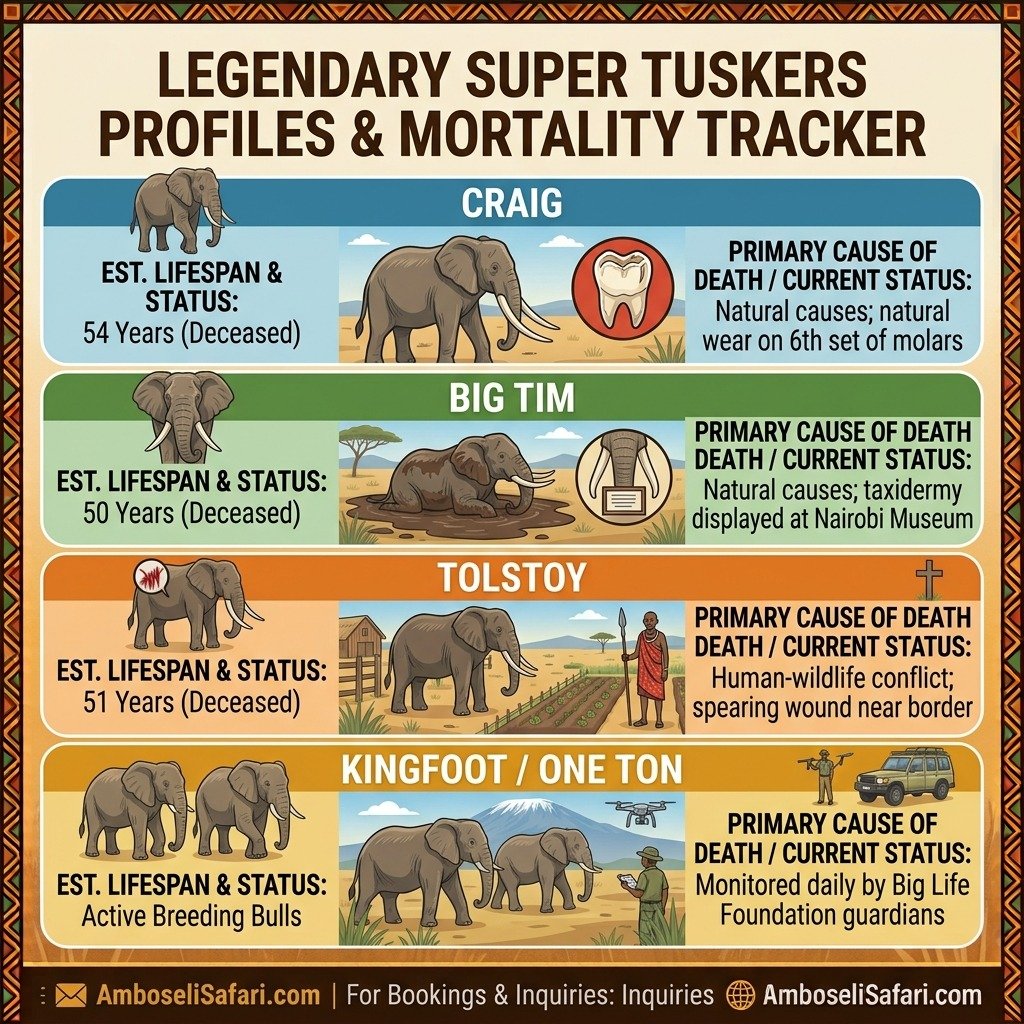
Legendary Super Tuskers Profiles & Mortality Tracker
Tracking Amboseli’s legendary Super Tuskers requires understanding the natural life cycles, dental wear patterns, and conservation hazards of these giant bulls. Carrying tusks that weigh over 100 pounds each, only a small number of these breeding males survive across the ecosystem today. This historical tracking matrix details the profiles, lifespans, and causes of mortality for famous tuskers alongside surviving icons. Use these baseline records to understand the immense genetic value carried by remaining bulls across Kajiado County.
| Super Tusker Name | Est. Lifespan & Status | Primary Cause of Death / Current Status |
| Craig | 54 Years (Deceased) | Natural causes; natural wear on 6th set of molars |
| Big Tim | 50 Years (Deceased) | Natural causes; taxidermy displayed at Nairobi Museum |
| Tolstoy | 51 Years (Deceased) | Human-wildlife conflict; spearing wound near border |
| Kingfoot / One Ton | Active Breeding Bulls | Monitored daily by Big Life Foundation guardians |
Echo & Cynthia Moss Research
Cynthia Moss founded the Amboseli Elephant Research Project (AERP) in 1972, establishing the longest-running continuous study of wild land mammals in history.
Echo, the matriarch of the ‘EB’ family, became the most thoroughly documented elephant in conservation history. Moss tracked Echo for over 30 years, capturing her leadership during severe droughts and calf protection efforts in the BBC documentary series Echo of the Elephants.
When Echo died of natural causes in 2009 at age 65, her daughter Enid assumed leadership of the ‘EB’ family. Observing Echo’s relatives today along marsh channels provides a direct link to five decades of unbroken field science documented by the Amboseli Trust for Elephants.
Askari Escort Dynamics
An Askari—derived from the Swahili word for guard—is a younger satellite male that accompanies a senior Super Tusker bull. These younger bulls provide social company and act as a protective buffer around older, slower-moving tuskers.
While standard tour traffic concentrates around Enkongo Narok swamp, solitary tuskers prefer the eastern channels of Longinye Swamp and Ol Okenya between 07:00 AM and 09:30 AM. Bulls frequent Longinye Swamp early in the morning to bathe in mineral mud, which cools their skin, protects joint sockets, and deters biting insects.
Field Note (Anthony Mule, Senior Guide): Watch the lead Askari’s stance before dropping your camera angle—if he shifts his weight toward the truck or shakes his ears, give the group space.
Self-drive travelers can review vehicle clearance rules on our Amboseli self-drive tips page.
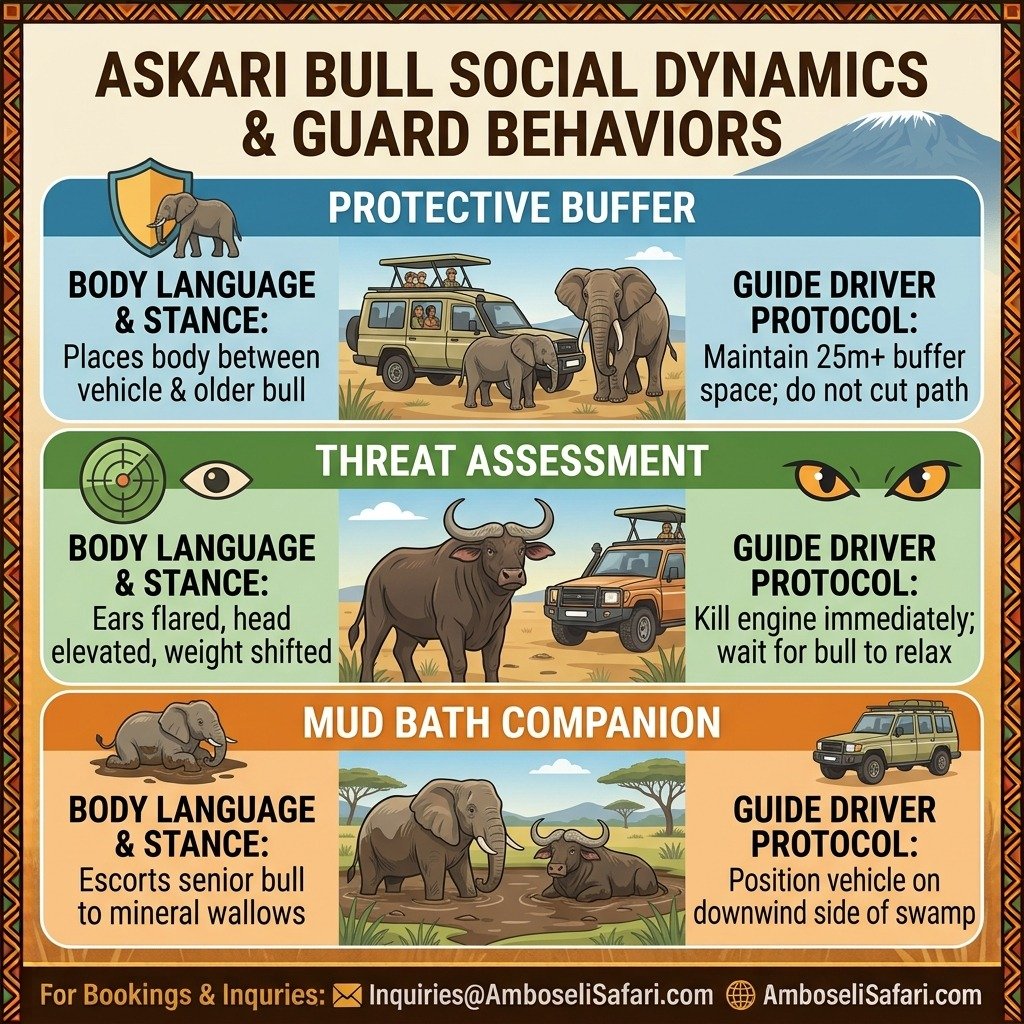
Askari Bull Social Dynamics & Guard Behaviors
Super Tusker bulls rarely roam the Amboseli basin alone; they are frequently accompanied by younger satellite males known as Askaris. Derived from the Swahili word for guard, these younger bulls provide vital social interaction and physical protection for older, slower-moving tuskers. This behavioral matrix outlines the specific roles, body language indicators, and vehicle positioning rules when encountering an Askari-Tusker pair near Longinye Swamp. Review these cues to ensure respectful, safe observations during early morning drives.
| Askari Behavioral Role | Body Language & Stance | Guide Driver Protocol |
| Protective Buffer | Places body between vehicle & older bull | Maintain 25m+ buffer space; do not cut path |
| Threat Assessment | Ears flared, head elevated, weight shifted | Kill engine immediately; wait for bull to relax |
| Mud Bath Companion | Escorts senior bull to mineral wallows | Position vehicle on downwind side of swamp |
Cross-Border Migration & Hunting Hazards
Amboseli’s elephants do not remain within fenced boundaries. Herds regularly migrate south across the Tanzanian border into the Enduimet Wildlife Management Area on the lower slopes of Mount Kilimanjaro.
For nearly three decades, an informal cross-border moratorium protected these habituated tuskers from sport hunting. Recent trophy hunting permits issued in Tanzania resulted in the loss of several habituated bulls that wandered out of KWS protection.
Because these tuskers have been studied by AERP researchers for decades and view vehicles as non-threatening, they are vulnerable to hunting outside Kenya. Conservation teams at Big Life Foundation and ATE continue lobbying regional authorities to reinstate cross-border hunting bans.
Matriarchal Bloodlines of the T-Family and CB-Family
Super Tusker genetics are passed down through specific matriarchal lines monitored for decades by field teams.
Big Tim belonged to the T-Family (son of the matriarch Teresia), while Craig belonged to the CB-Family (born to Cassandra in 1972). Biologists monitor young bulls within the T and CB lines as prime candidates for developing ground-sweeping ivory over the next two decades.
Observing family groups feeding near yellow-fever tree groves (Acacia xanthophloeia) reveals how calves learn feeding habits from mature females. Matriarchs use their forefeet to kick up sedge roots, washing off dry dirt in swamp water before eating.
Seasonal weather patterns and migration windows are detailed in our Amboseli safari planning guide.
Mount Kilimanjaro Elephant Photography Spots
Capturing tuskers with Mount Kilimanjaro rising in the background requires positioning your vehicle at key locations before morning cloud cover builds around 09:00 AM:
- Observation Hill (Noomotio) Slopes: Eastern tracks near Observation Hill provide an elevated vantage point to photograph family herds marching single-file across green swamps with Kibo peak behind them.
- Kitirua Swamps (Southwest Sector): Open water channels in Kitirua offer quiet mirror reflections of drinking elephants away from busy central tracks.
- Enkongo Narok Causeway: Excellent for low-angle shots of tuskers walking through yellow-fever tree groves as early light hits the mountain ice fields.
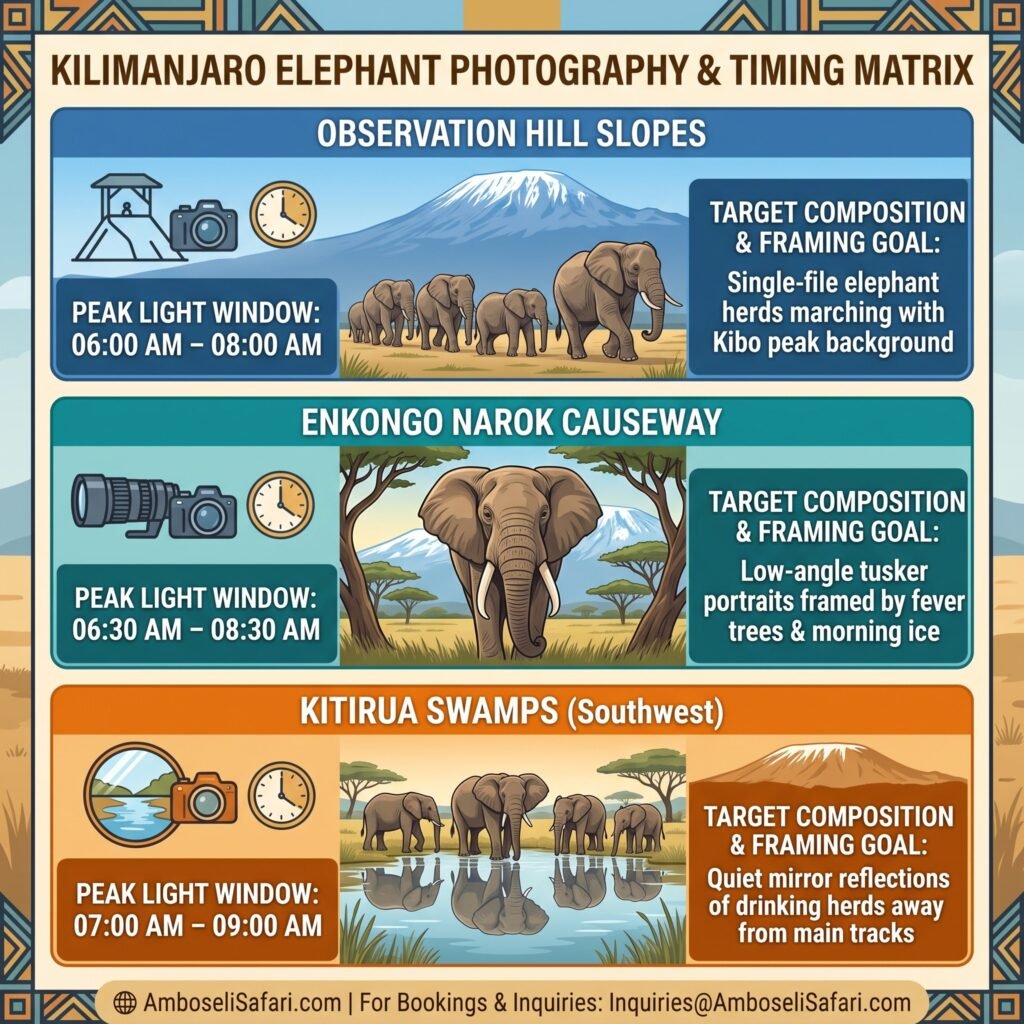
Kilimanjaro Elephant Photography & Timing Matrix
Framing Amboseli’s giant tuskers against Mount Kilimanjaro requires precise vehicle positioning before thermal heat clouds obscure Kibo peak around 09:00 AM. Distinct sectors across the park offer unique lighting angles, water reflections, and low-angle vantage points during early morning hours. This location matrix details prime tracking spots, optimal shooting windows, and target framing goals for capturing iconic tusker portraits. Plan your morning driver route around these key photography zones.
| Photography Location | Peak Light Window | Target Composition & Framing Goal |
| Observation Hill Slopes | 06:00 AM – 08:00 AM | Single-file elephant herds marching with Kibo peak background |
| Enkongo Narok Causeway | 06:30 AM – 08:30 AM | Low-angle tusker portraits framed by fever trees & morning ice |
| Kitirua Swamps (Southwest) | 07:00 AM – 09:00 AM | Quiet mirror reflections of drinking herds away from main tracks |
Olgulului Community Corridors & Tembo Naming
Over 80% of Amboseli’s named tuskers spend significant time outside official KWS park fences on community land governed by the Olgulului-Ololarashi Group Ranch (OOGR).
When herds cross park boundaries in search of seasonal pasture, they enter agricultural border zones near Kimana. To prevent crop raiding and retaliatory conflict, dedicated “Tusker Guardians” from Big Life Foundation track individual bulls on foot 24 hours a day. Mobile ranger units maintain communication with local Maasai farmers, herding bulls away from night crop plots.
Each year near Kimana Gate, KWS hosts the Tembo Naming Festival (Nkarikisho). This event allows supporters and safari guests to purchase official naming rights for newborn calves and key matriarchs. Funds raised directly subsidize local Maasai ranger outposts, community borehole maintenance, and mobile veterinary units.
Property options near Kimana Gate are reviewed in our guide on where to stay in Amboseli.
Field Disclaimers & Practical Expectations
Planning a safari focused on famous elephants requires realistic expectations:
- Tuskers Cover Huge Ranges: Super Tuskers move across hundreds of square miles. Expecting to see a specific named bull on a short 2-day trip is unrealistic.
- Strict Off-Road Regulations: KWS wardens strictly enforce off-road driving bans. Vehicles must stay on marked tracks regardless of where a herd is grazing.
- Midday Heat Shimmer: By 10:30 AM, heat waves bouncing off the salt pan (Empusel) distort telephoto focus. Schedule critical elephant photography between 06:00 AM and 09:00 AM.
If you are ready to book a private Land Cruiser and driver-guide for your trip, send us a note through our safari inquiry form or reserve your dates on Amboselisafari.com via our main safari booking form.
Frequently Asked Questions
How many Super Tuskers are left in Amboseli?
The Amboseli ecosystem currently hosts approximately ten remaining Super Tuskers carrying 100-pound ivory tusks.
Who was the most famous elephant in Amboseli National Park?
Big Tim and Echo (matriarch of the ‘EB’ family) are the most famous historical elephants. Tim was known worldwide for his massive ivory, while Echo was featured in decades of wildlife documentaries.
Where is the best place to spot old bull elephants in Amboseli?
Search the eastern channels of Longinye Swamp and Ol Okenya early in the morning. Older bulls gather in these quiet mineral mud baths to soothe worn joints away from heavy vehicle traffic.
What is an Askari bull elephant?
An Askari is a younger male elephant that accompanies an older Super Tusker. Askaris provide social company and act as security, often placing themselves between safari vehicles and the older bull.