
Rules of Amboseli National Park: Complete Guide to KWS Regulations
Overview
The Rules of Amboseli National Park are legally enforced guidelines established by the Kenya Wildlife Service (KWS) under the Wildlife Conservation and Management Act. Operating directly under Mount Kilimanjaro, these regulations govern digital eCitizen gate payments, vehicle speed limits, strict disembarkation zones, and total drone prohibitions. Managed in partnership with local community group ranches under the Kajiado County Government, compliance inside the reserve is monitored by mobile KWS ranger patrols. Breaking park rules results in heavy fines, vehicle impoundment, or immediate eviction from the park.
Fast Navigation Links
- Park Rules Quick Summary
- eCitizen Gate Entry and the 5:00 PM Cut-Off
- Stepping Out of Your Vehicle: The Only Two Legal Spots
- Speed Limits and Where the Radar Traps Sit
- Drones: Leave Them at the Gate
- Plastics Ban and Keeping Trash in the Cabin
- Respecting Elephants: Giving Herds Room to Move
- Safari Itineraries and Planning Costs
- Frequently Asked Questions
Passing through Amboseli National Park gates is straightforward, but KWS wardens check digital permits thoroughly before lifting the barrier. Wardens inspect dashboards for single-use plastic water bottles and check luggage for unapproved drones. Out on the salt flats, the plain looks open and unpoliced, but mobile patrols monitor primary routes daily. Hopping out of a vehicle for a quick photograph along a swamp track can result in steep fines or immediate removal from the reserve.
Park Rules Quick Summary
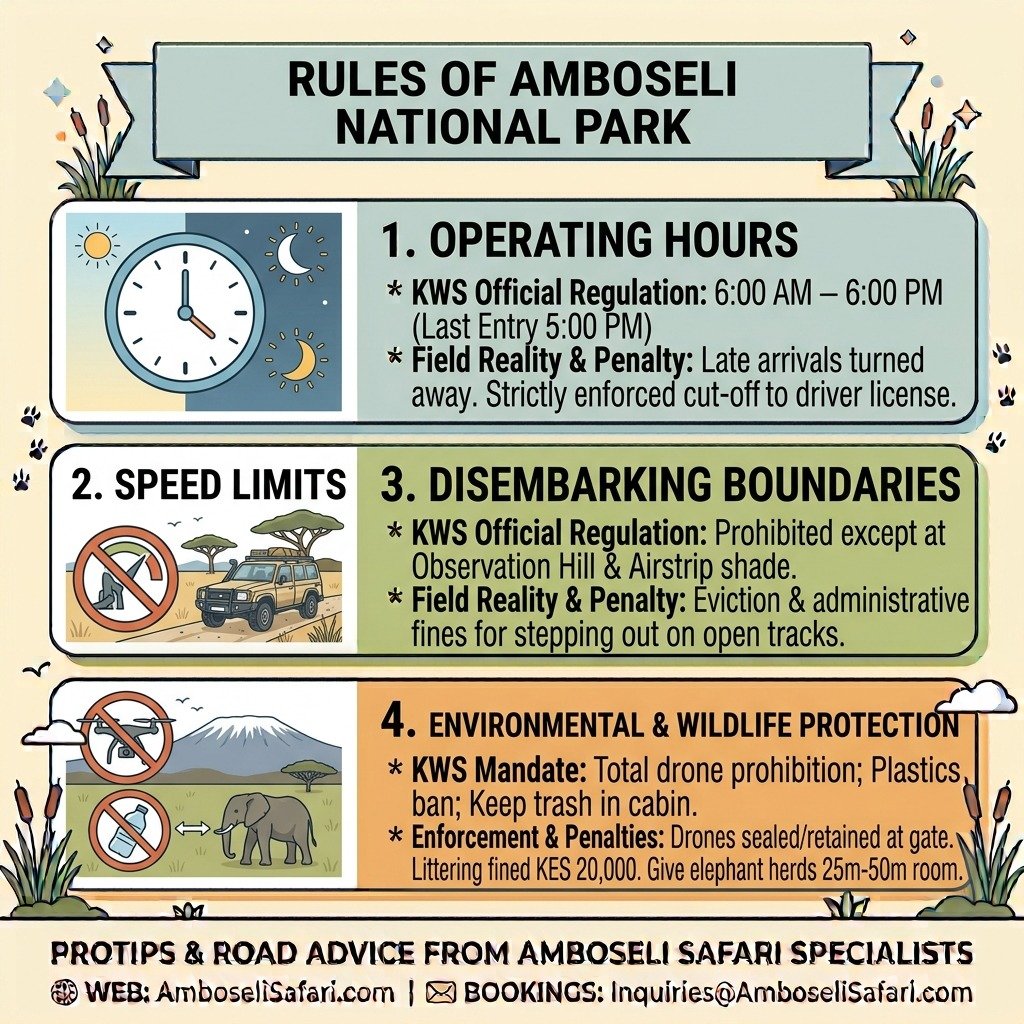
| Category | KWS Official Rule | Practical Field Reality |
| Operating Hours | 6:00 AM – 6:00 PM (Last entry: 5:00 PM) | Gates close at 5:00 PM for transit. Vehicles arriving late are turned away. |
| Speed Limits | 50 km/h main roads; 30 km/h side tracks | Wardens run handheld radar guns near Ol Tukai. Fines apply directly to driver licenses. |
| Drones | Banned without KWS and KCAA permits | Rangers inspect luggage at gates and apply security seals to unpermitted drone cases. |
| Disembarking | Prohibited except Observation Hill & Airstrip | Leaving vehicles on open tracks triggers park eviction and KWS administrative fines. |
Park Rules & Official Regulation Summary
Adhering to Kenya Wildlife Service regulations ensures both visitor safety and the preservation of Amboseli’s fragile ecosystem. Mobile ranger patrols actively monitor main transit routes and swamp tracks to enforce speed limits and vehicle boundaries. Understanding these core rules helps prevent unexpected delays or administrative penalties during your safari. Review the summary matrix below for key KWS operational guidelines.
| Rule Category | KWS Official Regulation | Field Reality & Penalty |
| Operating Hours | 6:00 AM – 6:00 PM (5:00 PM cutoff) | Late arrivals turned away; non-compliance triggers KWS fines. |
| Speed Limits | 50 km/h main roads; 30 km/h tracks | Radar traps near Ol Tukai; fines applied to driver licenses. |
| Vehicle Boundaries | Prohibited from disembarking or off-roading | Allowed only at Observation Hill & Airstrip; off-roading fined. |
eCitizen Gate Entry and the 5:00 PM Cut-Off
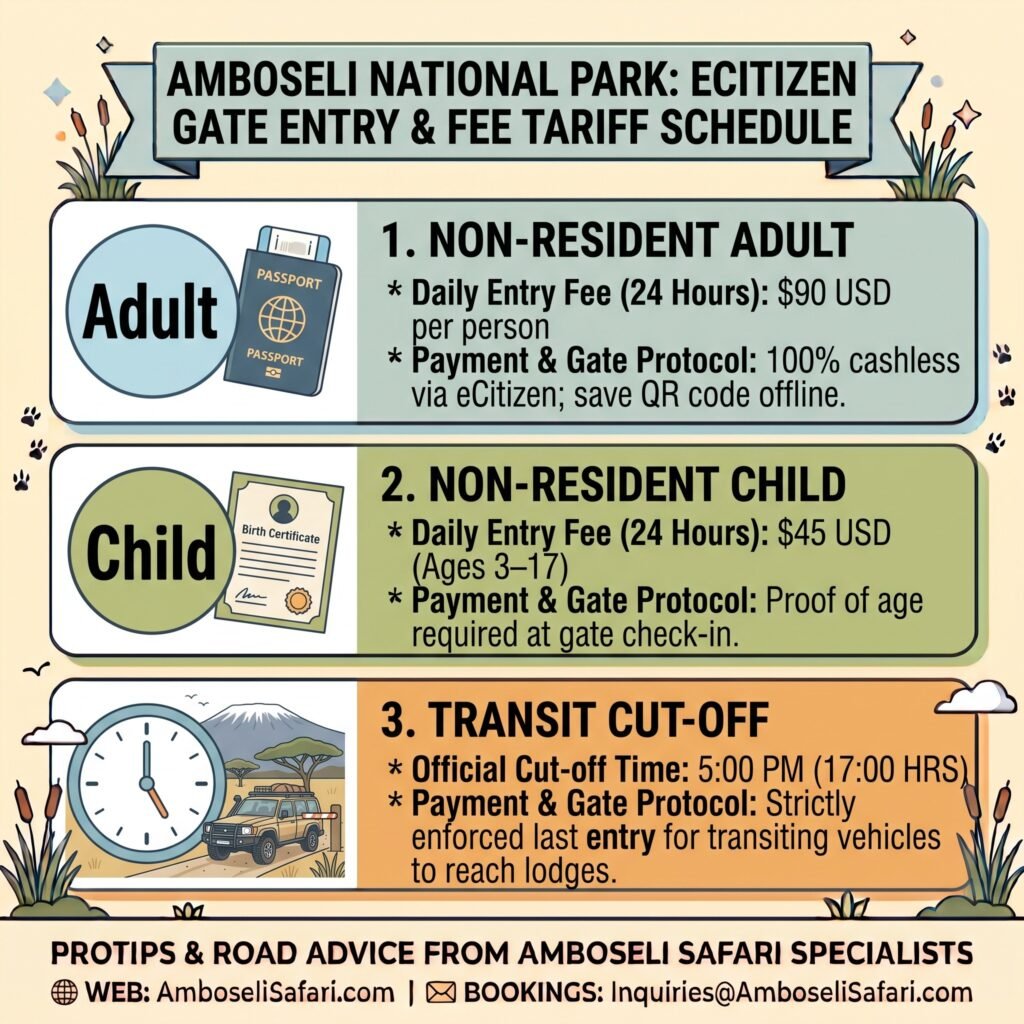
Every gate—including Kimana, Iremito, and Meshanani—operates on a cashless system. The Kenya Wildlife Service requires non-resident travelers to purchase entry permits ($90 USD per adult for 24 hours) through the official eCitizen portal prior to arrival. Cash and credit card swipes are not accepted at gate counters.
Cell service drops 5 km before Kimana Gate. Save your eCitizen QR code offline in Emali or Nairobi—otherwise, you’ll be stranded on the shoulder watching other vehicles file past. Save the ticket PDF directly to offline storage or print a physical copy before turning off the tarmac.
Official gate hours run from 6:00 AM to 6:00 PM, but wardens enforce a 5:00 PM (17:00 HRS) last-entry cut-off for transiting traffic. This allows drivers sufficient time to reach internal accommodations like Ol Tukai or Serena before the 6:00 PM night curfew. Arriving at Meshanani Gate at 5:15 PM expecting to cross to the eastern sector will result in turn-around. Anyone planning an Amboseli self-drive should leave early and check current Amboseli road conditions to avoid gate lockouts.
eCitizen Gate Entry & Fee Tariff Schedule
Entering Amboseli National Park requires digital pre-authorization, as all KWS gates operate on a completely cashless system. Standard entry permits grant 24-hour access from the moment of check-in but must be secured via the eCitizen portal before reaching remote gate areas with poor cellular service. Additionally, a strict 5:00 PM entry cut-off is enforced for transiting visitors to ensure all vehicles reach their destinations prior to nightfall. The matrix below breaks down current tariff rates and entry protocols.
| Visitor Category | Daily Entry Fee (24 Hours) | Payment & Gate Protocol |
| Non-Resident Adult | $90 USD per person | 100% cashless via eCitizen; save QR code offline. |
| Non-Resident Child | $45 USD (Ages 3–17) | Proof of age required at gate check-in. |
| Transit Cut-Off | 5:00 PM last entry enforcement | Ensures vehicles reach lodges before 6:00 PM curfew. |
Stepping Out of Your Vehicle: The Only Two Legal Spots
Across the 392-square-kilometer reserve, stepping out of a vehicle onto open ground is allowed in only two designated, ranger-monitored zones:
- Observation Hill (Normatior): Visitors may disembark to climb the hill. Rangers at the base enforce a rule requiring everyone to stay on the paved stone pathway to prevent soil erosion. At the summit shelter, feeding yellow baboons or vervet monkeys is strictly forbidden. Leaving food boxes open or tossing fruit scraps to wildlife brings immediate warnings and fines.
- Amboseli Airstrip (ASV): Passengers taking bush flights can disembark near the shade hut. Walking onto the gravel runway itself is prohibited. Rangers clear zebras and giraffes off the airstrip before aircraft land, and safari vehicles must wait behind white boundary markers until propellers stop.
Stepping out on open tracks or along the edge of Enkongo Narok swamp to take photos is treated as a major security violation.
Speed Limits and Where the Radar Traps Sit
Speed limits vary depending on the track zone:
Main transit dirt corridors—such as the long run between Iremito Gate and KWS headquarters—have a 50 km/h cap. Once you turn onto secondary tracks around Enkongo Narok and Ol Okenya swamps, the speed limit drops to 30 km/h.
KWS patrols deploy handheld radar guns along shaded stretches near Ol Tukai Lodge. Speeding fines are issued on the spot, and infractions committed by commercial drivers are logged directly against their operator license.
Drones: Leave Them at the Gate
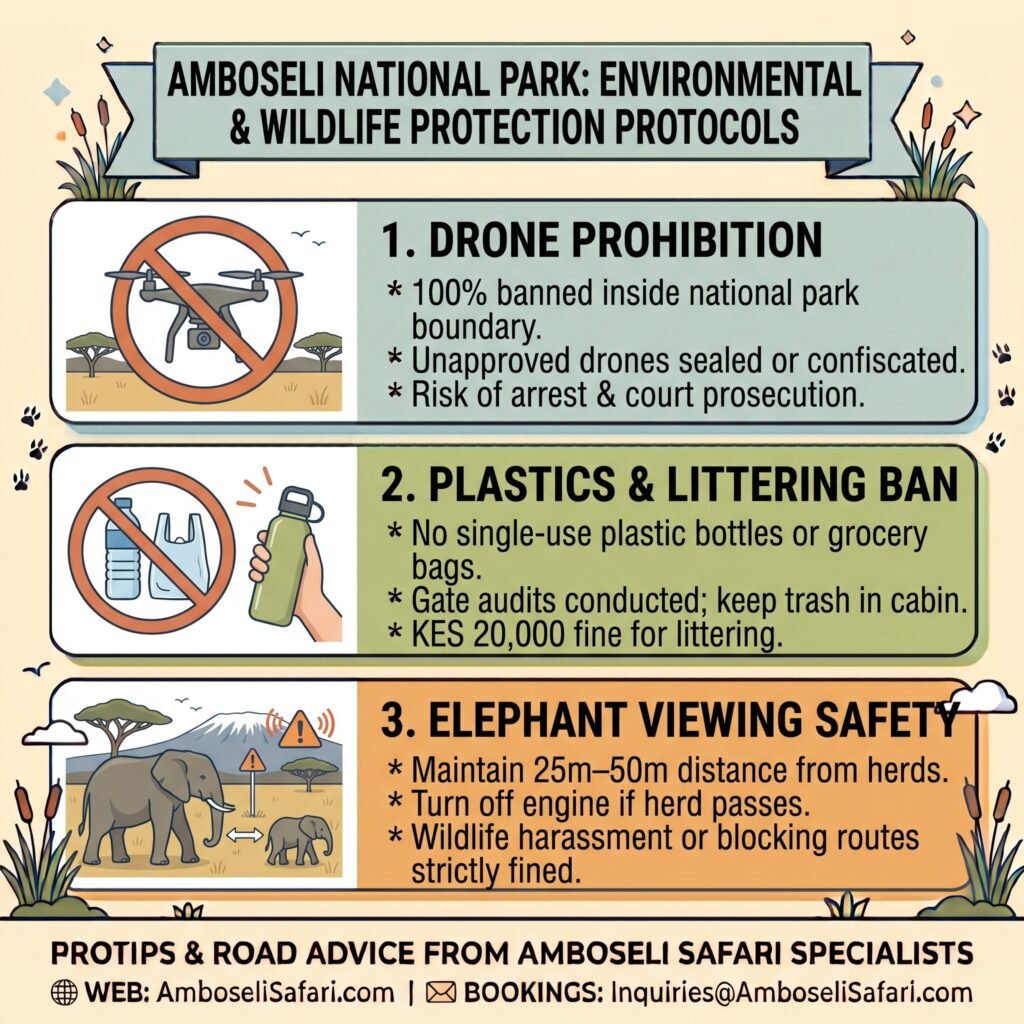
Drones are prohibited inside national park boundaries. Propeller noise stresses elephant herds and disturbs nesting waterbirds throughout the marshes.
Holding a pilot license from the Kenya Civil Aviation Authority does not override KWS park regulations. Rangers inspect bags at gate checkpoints. If an unpermitted drone is found, wardens seal the case with security tags or retain it at the gate office until departure. Flying a drone covertly over the marsh risks arrest, gear confiscation, and court prosecution.
Environmental & Wildlife Protection Protocols
Strict environmental safeguards are maintained across Amboseli to protect free-ranging wildlife and prevent habitat degradation. From total bans on aerial drones that disturb elephant herds to audits on single-use plastics at entry gates, compliance is strictly enforced by park wardens. Visitors must also maintain respectful viewing distances when approaching large mammal family groups. The breakdown below outlines key environmental mandates and their respective penalties.
| Protection Protocol | KWS Mandate & Boundary | Enforcement & Penalties |
| Drone Prohibition | 100% banned inside national park | Unapproved drones sealed/confiscated; risk of prosecution. |
| Plastics Ban | No single-use plastic bottles/bags | Gate audits conducted; KES 20,000 fine for littering. |
| Elephant Safety | Maintain 25m–50m distance from herds | Harassment or blocking routes triggers ranger intervention. |
Plastics Ban and Keeping Trash in the Cabin
Kenya’s national ban on single-use plastics inside protected conservation areas is actively audited at gate entry points. Wardens check safari vehicles for disposable plastic water bottles, grocery bags, and plastic lunch wrapping before granting access.
Tour vehicles and private cars must carry a dedicated trash container inside the cabin. Tossing garbage out a window carries a fine of KES 20,000 (~$150 USD) or eviction from the park. Travelers should bring reusable water flasks that can be refilled at lodge filtration stations.
Respecting Elephants: Giving Herds Room to Move
Standard park regulations require maintaining a 25-meter distance from wildlife. Around elephant family groups with young calves, field guidelines expand that distance to 50 meters.
When a matriarch gives warning signals—flapping her ears, shaking her head, or trumpeting—turn off the engine or reverse slowly to give the herd clear passage.
Blocking an elephant crossing route near yellow-fever trees (Acacia xanthophloeia) or crowding a family against deep marsh mud is classified as wildlife harassment. Seasonal migration paths and elephant behavior are covered in detail in our Amboseli wildlife viewing guide.
Safari Itineraries and Planning Costs
Organizing a trip that complies with KWS guidelines is straightforward when booking through Amboselisafari.com. Private itineraries include custom 4×4 Land Cruiser transport, TRA-licensed driver-guides, lodge bookings, and non-resident park entry permits ($90 USD per 24 hours for adults).
Planning a visit? View our Amboseli Safari Itineraries to explore multi-day packages, seasonal tier options, and custom route details.
Rules applying to neighboring community sanctuaries are detailed in our guide to Amboseli conservancy areas. If you are mapping out park fees versus vehicle fuel, check our Amboseli safari cost guide before finalizing your budget.
Frequently Asked Questions
Can I pay cash for my park entry tickets at the gate?
No, cash and card swipes at gate counters are completely phased out. All entry permits must be purchased online through Kenya’s eCitizen platform prior to arrival. Download your ticket PDF to your phone beforehand because gate cellular reception is spotty.
What happens if I bring a drone into Amboseli?
Drones are strictly prohibited inside all Kenya national parks. KWS wardens check vehicles at entry gates, and any unapproved drone will be sealed in security bags or impounded at the gate until you exit the park.
Are night game drives allowed inside Amboseli National Park?
Night game drives aren’t allowed inside the main park, where a 6:00 PM to 6:00 AM curfew is enforced. If you want to head out after dark with spotlights, stay in private conservancies outside the main fence like Selenkay or Kitirua.