
Amboseli Eco Lodges: Safari Reviews, Solar Specs & Package Rates
Overview
Booking Amboseli eco lodges lets you track Kenya’s big herds while keeping your environmental impact low. Properties scattered around the park borders—including Porini Amboseli Camp, Campi ya Kanzi, Tulia Amboseli Safari Camp, Kibo Villa, Maasai Simba Camp, and Elerai Conservancy Eco-Tents—run on solar power arrays, rainwater storage systems, and local gray-water filtration. Full-board 3-day and 4-day safari packages in a private 4×4 Land Cruiser range from $1,020 per person for budget eco setups to $5,950 per person for fly-in luxury options.
Fast Navigation Links
- Solar Power & Water Technologies
- Eco-Lodge Spotlight Cards
- Location & Gate Breakdown
- Private Conservancies & Night Drives
- Best Time for Off-Grid Safaris
- Off-Grid Eco Packing Checklist
- Farm-to-Table Gardens & Canopy Walkways
- Dust, Solar Drops & What Nobody Tells You
- 2027 Safari Package Pricing
- Frequently Asked Questions
Solar Power & Water Technologies
Running an off-grid lodge near Mount Kilimanjaro takes serious engineering. Out here in the dry savanna, managing power and saving water aren’t marketing buzzwords—they’re daily necessities.
Porini Amboseli Camp operates inside the private Selenkay Conservancy with zero permanent concrete foundations. Their solar system uses 220V step-up transformers hooked into deep-cycle battery banks. You can charge heavy camera batteries or run a medical CPAP machine all night without listening to a noisy diesel generator chug outside your tent.
To eliminate single-use plastic, our private Land Cruisers carry built-in water tanks for filling up canteens. In your tent, drinking water comes in sanitized, upcycled glass bottles.
Further east in the Chyulu Hills, Campi ya Kanzi holds a Gold Eco-Rating from Ecotourism Kenya. The camp collects its entire water supply off a 15,000-square-foot canvas roof setup, draining rainwater straight into underground PVC bladders. When you take a hot shower, the water is heated using compressed coffee-husk briquettes from Kenyan farms rather than burning local acacia trees.
Checking these utility details is crucial when choosing where to stay in Amboseli to make sure your stay directly funds habitat preservation on our Amboseli safari planning guide.
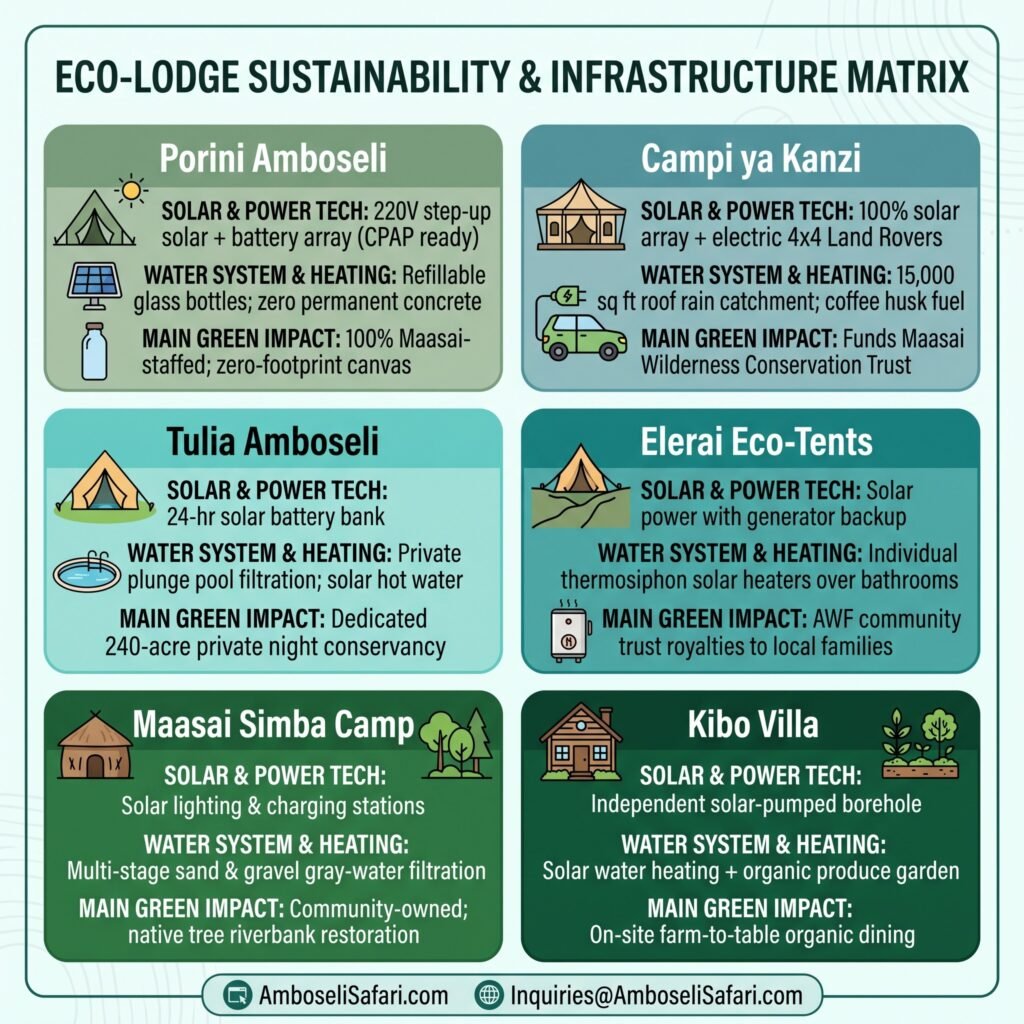
Eco-Lodge Sustainability & Infrastructure Matrix
Amboseli Eco Lodges: Green Tech & Sustainability Matrix
Choosing a truly sustainable eco-lodge in Amboseli involves looking at exact utility systems, from solar voltage setups to water sourcing. While all featured properties prioritize eco-friendly stays, their off-grid capabilities—such as medical CPAP compatibility and water heating methods—vary by location. Use this breakdown to evaluate the green infrastructure supporting each eco-lodge before reserving your 4×4 safari package.
| Eco-Lodge / Camp | Solar & Power Tech | Water System & Heating | Main Green Impact |
| Porini Amboseli | 220V step-up solar + battery array (CPAP ready) | Refillable glass bottles; zero permanent concrete | 100% Maasai-staffed; zero-footprint canvas |
| Campi ya Kanzi | 100% solar array + electric 4×4 Land Rovers | 15,000 sq ft roof rain catchment; coffee husk fuel | Funds Maasai Wilderness Conservation Trust |
| Tulia Amboseli | 24-hr solar battery bank | Private plunge pool filtration; solar hot water | Dedicated 240-acre private night conservancy |
| Elerai Eco-Tents | Solar power with generator backup | Individual thermosiphon solar heaters over bathrooms | AWF community trust royalties to local families |
| Maasai Simba Camp | Solar lighting & charging stations | Multi-stage sand & gravel gray-water filtration | Community-owned; native tree riverbank restoration |
| Kibo Villa | Independent solar-pumped borehole | Solar water heating + organic produce garden | On-site farm-to-table organic dining |
Eco-Lodge Spotlight Cards
Porini Amboseli Camp (Selenkay Conservancy)
- Certifications: Gold Eco-Rated (Ecotourism Kenya)
- Access: Iremito Gate sits 45 minutes north via a dry dirt track.
- The Setup: A quiet wilderness camp capped at just 10 canvas tents inside a private 15,000-acre reserve. Night game drives and guided walks with local Maasai trackers come included in your daily rate.
Campi ya Kanzi (Chyulu Hills / Kuku Conservancy)
This ultra-luxury tented lodge runs on 100% solar power and uses custom electric 4×4 Land Rovers for game drives. You get sweeping, unblocked views of Kibo peak across private community land. Guests fly in directly to the camp’s private airstrip, and room fees directly support the Maasai Wilderness Conservation Trust.
Tulia Amboseli Safari Camp (Kimana Corridor)
- Vibe: Private plunge pools & nocturnal tracking.
- The View: Open mountain sightlines right from your tent deck.
- Location: 10 minutes from Kimana Gate.
- Details: Tulia features ten deluxe canvas tents built with private plunge pools sunken into the verandas. The camp manages its own 240-acre private reserve dedicated to night game drives.
Elerai Conservancy Eco-Tents (Elerai Ridge)
- Certifications: Silver Eco-Rated
- Kili Sightline: Panoramic views of Kibo peak and Mount Longido across the Tanzanian border.
- Why Stay Here: Uses individual thermosiphon solar heaters mounted over rear bathroom blocks. You get steady hot water without burning firewood, making this a top choice for mid-range travelers on a budget.
Maasai Simba Camp (Kiboko River)
A community-owned camp positioned 25 minutes from Kimana Gate. It uses a multi-stage sand-and-gravel gray-water filtration system to irrigate native trees planted along the riverbank.
Kibo Villa Amboseli (Central Park Boundary)
Tucked into an acacia grove near Ol Tukai, this three-bedroom timber house runs on an independent solar-pumped borehole. It includes a private organic kitchen garden where a personal chef harvests fresh vegetables for your meals.
Location & Gate Breakdown
Picking the right location saves you from long, bumpy transit drives before your morning game drives:
- Eastern Corridor (Kimana Gate Area): Tulia Amboseli, Elerai Eco-Tents, and Maasai Simba Camp sit along this eastern belt. Drive times from Nairobi are reasonable, and you’re just minutes from Kimana Gate for early morning entry.
- Northern Sector (Iremito Gate & Selenkay): Porini Amboseli Camp sits 10 miles north of Iremito Gate inside Selenkay Conservancy. You’ll fly into Selenkay Airstrip or enter the park through Iremito Gate.
- Southeastern Foothills (Kuku Group Ranch): Campi ya Kanzi sits east of the park in the Chyulu Hills. Most guests fly into the camp’s private bush strip to explore 275,000 acres of private Maasai land.
- Central Basin (Inside Park Boundary): Kibo Villa sits near Ol Tukai right inside the park, cutting out gate commute times entirely while running on its own solar water system.
Understanding how these locations affect park fee calculations helps clarify your total Amboseli safari cost breakdown.
Private Conservancies & Night Drives
Private conservancies bordering the main park sit on community land managed alongside local Maasai group ranches under Kajiado County guidelines. Because they sit outside national park boundaries, these sanctuaries allow night game drives and off-road tracking strictly forbidden inside land managed by the Kenya Wildlife Service (KWS).
Tulia Amboseli Safari Camp manages a private 240-acre conservancy near Kimana Gate. Head out on a night drive here with a spotlight, and you’ll often spot nocturnal animals like aardvarks, honey badgers, and bat-eared foxes that stay hidden during daytime heat.
Over at Elerai, individual thermosiphon solar units sit above every tent’s rear bathroom block to supply hot shower water. Nightly conservancy fees charged per guest go directly into an African Wildlife Foundation (AWF) community trust fund, paying annual land lease royalties to local Maasai families for keeping wildlife corridors open.
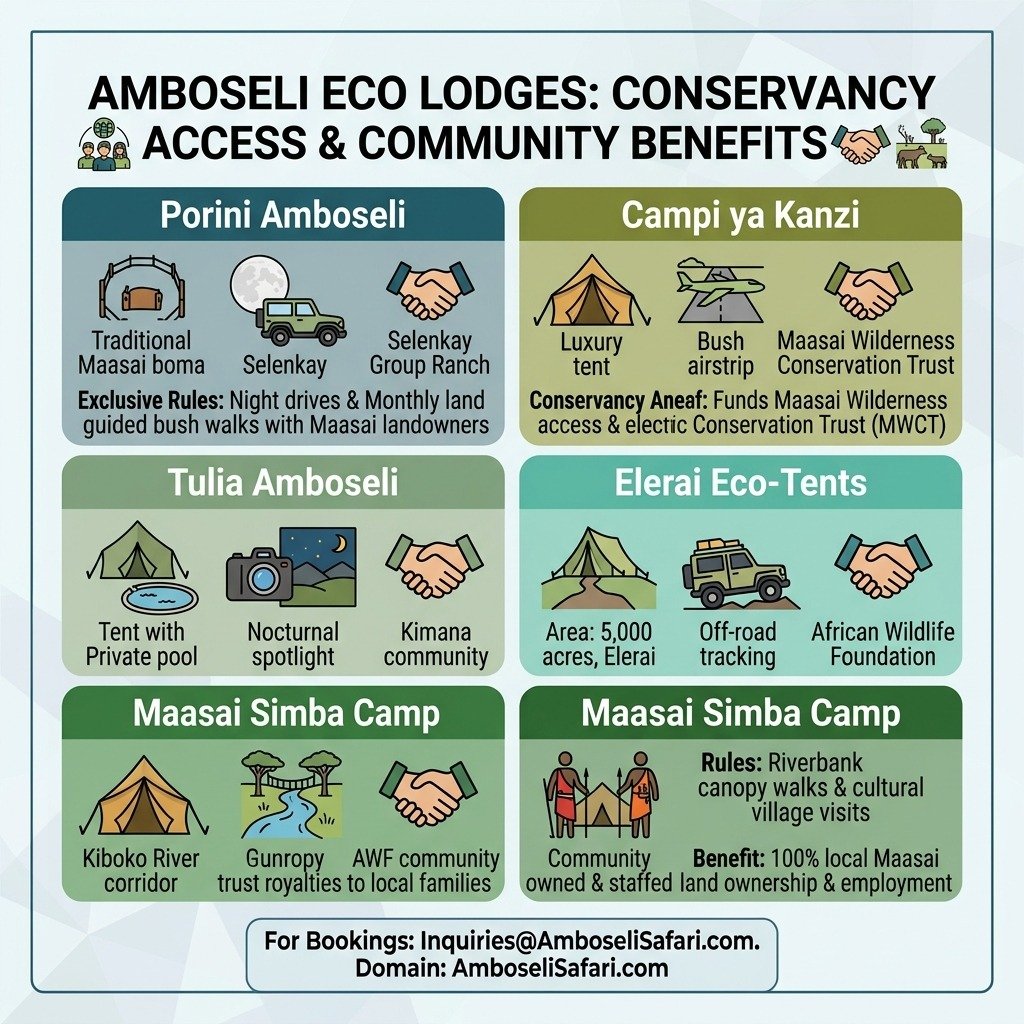
Conservancy Access & Community Impact Comparison
Amboseli Eco Lodges: Conservancy Access & Community Benefits
Staying at an eco-lodge outside the main national park boundary directly funds local land preservation while unlocking exclusive safari activities. Comparing conservancy sizes, partner land trusts, and allowed game drive rules helps you select the right balance between wildlife access and community support. The matrix below highlights the operational advantages and local impact of each eco-property.
| Eco-Lodge | Conservancy / Land Area | Exclusive Safari Rules | Partnered Eco-Trust / Benefit |
| Porini Amboseli | Selenkay Conservancy (15,000 acres) | Night drives & guided bush walks with armed rangers | Selenkay Maasai Group Ranch lease payments |
| Campi ya Kanzi | Kuku Group Ranch (275,000 acres) | Private airstrip access & electric vehicle tracking | Maasai Wilderness Conservation Trust (MWCT) |
| Tulia Amboseli | Kimana Corridor (240 acres) | Nocturnal spotlight tracking & plunge pool views | Local Kimana community land protection |
| Elerai Eco-Tents | Elerai Conservancy (5,000 acres) | Off-road tracking & red-spotlight night drives | African Wildlife Foundation (AWF) trust fund |
| Maasai Simba Camp | Kiboko River corridor | Riverbank canopy walks & cultural village visits | 100% local Maasai land ownership & employment |
Best Time for Off-Grid Safaris
Weather dictates both game movements and how off-grid solar systems perform:
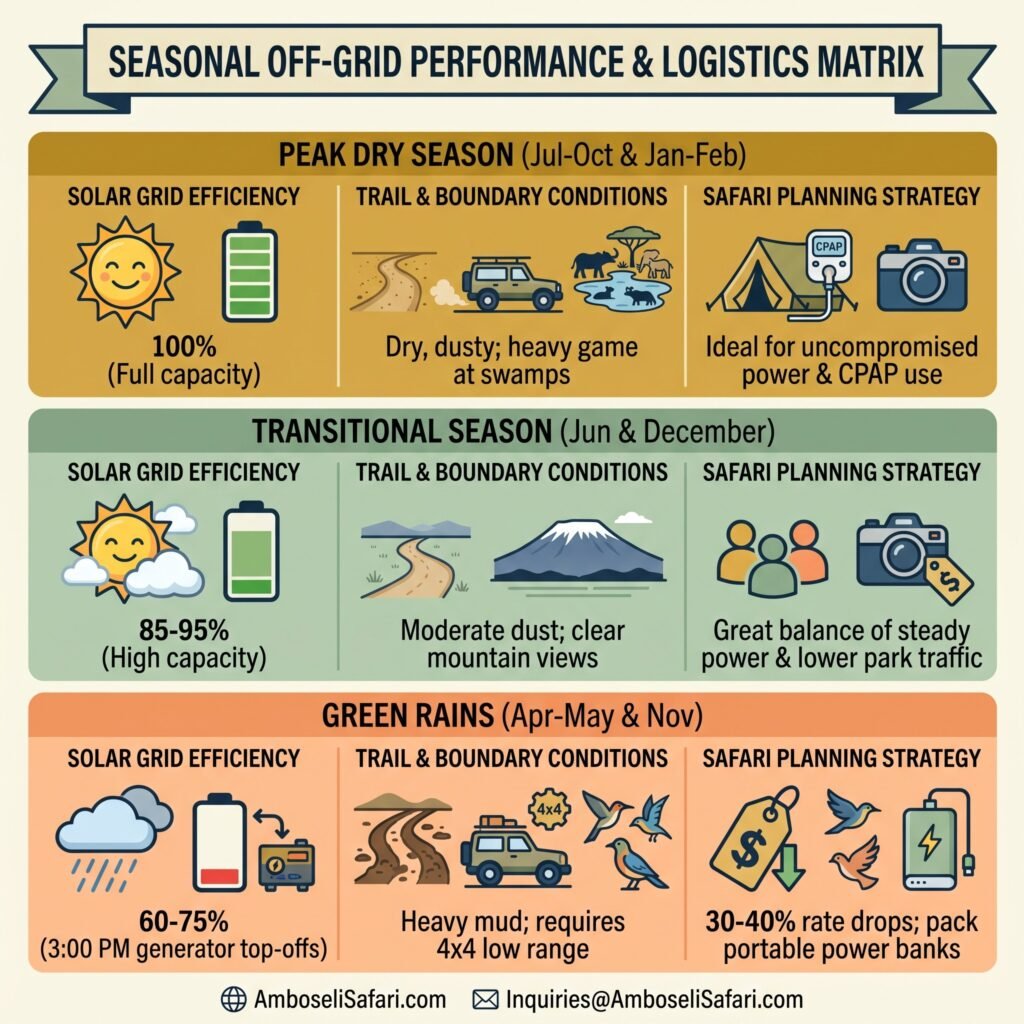
- Peak Dry Season (July – October & January – February): Clear skies keep solar battery arrays charged to 100%. Elephants and zebras crowd around central park swamps, though dust on dirt tracks gets thick.
- Green / Rainy Season (April – May & November): Heavy rains bring green scenery and migratory birdlife. Anthony notes that during November rains, cloud cover drains solar batteries faster, so most camps run quiet backup power around 3:00 PM to top off the grid. Lodges drop rates by 30% to 40%, but muddy boundary tracks require a 4×4 in low range.
- Transitional Season (June & December): Clear skies, lower dust, and steady wildlife activity around conservancy waterholes.
Seasonal Off-Grid Performance & Logistics Matrix
Amboseli Eco Lodges: Seasonal Power & Travel Logistics
Seasonal weather shifts in Amboseli affect more than just game viewing—they directly dictate solar battery charging times and boundary road conditions. Understanding how cloud cover impacts off-grid utilities allows you to prepare for generator top-offs and select the ideal vehicle setup. This logistics chart matches seasonal weather patterns with off-grid performance expectations.
| Season Window | Solar Grid Efficiency | Trail & Boundary Conditions | Safari Planning Strategy |
| Peak Dry (Jul–Oct & Jan–Feb) | 100% (Full solar battery capacity) | Dry, dusty tracks; heavy game at swamps | Ideal for uncompromised off-grid power & CPAP use |
| Transitional (Jun & Dec) | 85–95% (High solar capacity) | Moderate dust; clear mountain views | Great balance of steady power & lower park traffic |
| Green Rains (Apr–May & Nov) | 60–75% (3:00 PM generator top-offs) | Heavy mud; requires 4×4 low range | 30–40% room rate drops; pack portable power banks |
Off-Grid Eco Packing Checklist
Packing correctly saves you headaches on bush flights and keeps you compliant with local environmental rules:
- Soft-Sided Duffel Bags: Mandatory for fly-in safaris. Bush planes landing at Kimana or Selenkay airstrips enforce a strict 15 kg (33 lbs) weight limit in soft duffels without rigid frames.
- Portable Power Bank (10,000 – 20,000 mAh): Camps like Porini and Tulia provide 220V tent sockets, but a small battery bank ensures your phone stays charged on full-day game drives.
- Biodegradable Toiletries: Essential for camps using sand-and-gravel gray-water filtration. Bring chemical-free soaps and organic shampoos to protect the soil and trees.
- Reusable Water Canteen: Most eco-lodges provide filtered water stations. Bringing a simple metal canteen cuts down on single-use plastic bottles.
Farm-to-Table Gardens & Canopy Walkways
Smart layout planning protects delicate riverbank soils and vegetation.
Kibo Villa Amboseli operates a solar-pumped borehole with on-site water filtration near Ol Tukai. You can walk through the villa’s private organic garden with your chef to pick fresh herbs and vegetables for dinner on the veranda.
Down on the Kiboko River, Maasai Simba Camp filters all kitchen and bathroom gray-water through a multi-stage sand-and-gravel system to water native trees. Elevated wooden walkways keep guests off the ground, preventing soil erosion along the riverbank.
Walking out onto canopy footpaths at dawn brings the cool scent of yellow-fever acacias (Acacia xanthophloeia). As morning fog lifts over Enkongo Narok swamp, you can hear elephant herds splashing through papyrus beds—animals tracked continuously by the Amboseli Elephant Research Project.
Our licensed senior guide, Anthony Mule, brings over ten years of field experience across these routes, helping guests spot wildlife while respecting local community land rules.
Dust, Solar Drops & What Nobody Tells You
Zip your camera in a dust bag—the lakebed silt gets into everything. Wind blowing across the dry lakebed drives fine white dust right through vehicle windows, coating lenses and zippers in minutes.
Rainy weather in April or November reduces solar battery charging. Room lights and phone chargers work fine, but high-draw items like hair dryers aren’t allowed on off-grid solar grids.
KWS park entry permits run on a strict 24-hour clock ($90 USD per non-resident adult). If you enter Kimana Gate at 08:00 AM on Day 1, your ticket expires at 08:00 AM on Day 3. Staying inside past your cutoff triggers an automatic extra day fee per person.
Checking vehicle ground clearance and route timings in our Amboseli self-drive tips ensures a smooth road transfer down from Nairobi.
2027 Safari Package Pricing
Our road packages cover a private 4×4 Safari Land Cruiser, full-board eco-lodge accommodation, driver-guide allowances, fuel, vehicle park entry, chilled bottled water, conservancy fees, and pre-paid KWS non-resident park permits ($90 USD per adult per 24 hours).
All transport, guide fees, and hotel costs are bundled into the per-person rates below based on two adults traveling together in a private vehicle.
3-Day & 4-Day Amboseli Eco Safari Packages (2027)
| Package Tier & Eco Lodges | Standard Season (USD / Person)* | Peak Season (USD / Person)* | Action |
| 3-Day Budget Eco Safari (Maasai Simba Camp) | $1,020 | $1,750 | Book Now |
| 3-Day Mid-Range Eco Safari (Tulia Camp / Elerai Eco-Tents) | $1,290 | $2,150 | Book Now |
| 3-Day Luxury Eco Safari (Porini Amboseli Camp) | $1,850 | $2,980 | Book Now |
| 4-Day Fly-In Luxury Plus Eco Safari (Safarilink Flight + Campi ya Kanzi / Kibo Villa) | $3,950 | $5,950 | Book Now |
*Prices reflect total per-person costs for two adults sharing a room/tent and a private 4×4 Safari Land Cruiser. Standard Season covers January to May and November. Peak Season covers June to October and December. Includes full-board lodging, private transport, guide allowances, fuel, conservancy fees, and KWS permits. Fly-in packages include roundtrip flights from Wilson Airport (WIL) on Safarilink or Airkenya. Tip: Standard season offers the best trade-off between lower package rates and smaller park crowds.
Ready to lock in your private vehicle and reserve your lodge? You can hold vehicle dates with our team or use our main safari booking form on Amboselisafari.com to confirm your travel dates.
Package Inclusions:
- Private 4×4 Safari Land Cruiser with pop-up roof for all game drives and transfers.
- Services of a TRA-licensed, English-speaking driver-guide.
- Full-board accommodation at your chosen eco-lodge or camp.
- Pre-paid non-resident KWS park entry permits ($90 USD per 24 hours) and conservancy fees.
- Chilled bottled drinking water inside the vehicle cooler.
Package Exclusions:
- International airfare, entry visas, and Electronic Travel Authorization (eTA portal) fees.
- Personal expenses like driver tips, spa treatments, or alcoholic drinks.
- Optional Maasai cultural village visits or hot air balloon safaris.
Optional Add-Ons:
- Authentic Maasai cultural village visit: USD 30 per person.
- Sunrise hot air balloon safari over Amboseli: USD 450 per person.
Seasonal weather patterns and animal migrations are mapped out across our Amboseli National Park guide to assist with trip scheduling.
Frequently Asked Questions
How do eco-lodges in Amboseli handle power during cloudy days?
Camps like Porini Amboseli Camp and Campi ya Kanzi run on large solar battery banks. On extended overcast days during the rainy season, quiet backup generators run briefly during the afternoon to top off battery banks for nighttime lights and CPAP sockets.
Are night game drives allowed at all eco-lodges in Amboseli?
Night game drives are allowed at eco-lodges located inside private conservancies—such as Tulia, Porini, Campi ya Kanzi, and Elerai. Night drives are strictly banned inside the main national park boundaries managed by KWS.
How do eco-lodges directly support local Maasai communities?
Eco-lodges pay monthly land lease royalties and per-guest conservancy fees to local Maasai landowners. They also employ local staff, fund primary schools, and work with non-profits like the Big Life Foundation, African Wildlife Foundation (AWF), and Maasai Wilderness Conservation Trust (MWCT).
What is the advantage of flying to an eco-lodge versus driving from Nairobi?
Flying from Wilson Airport (WIL) to Amboseli Airstrip or Kimana Airstrip takes just 40 minutes, compared to a 4-to-5-hour drive (~230 km). Flying saves time and drops you directly into conservancy airstrips near your lodge.