
Amboseli Elephants: Super-Tuskers, Tracking Routes & Safari Packages
Overview
After ten years of driving these tracks, watching Amboseli Elephants cross beneath Kibo at sunrise still doesn’t get old. While many assume this basin falls under Narok County Council, it sits entirely in Kajiado County under Kenya Wildlife Service (KWS) management. Over 1,500 elephants roam here, monitored for five decades by the Amboseli Elephant Research Project (AERP). Full-board 3-day and 4-day safari packages in a private 4×4 Land Cruiser run from $1,080 per person for budget stays up to $5,950 per person for fly-in luxury options.
Fast Navigation Links
2027 Elephant Safari Packages & Rates
Our road trips include a private 4×4 Land Cruiser with a pop-up roof, full-board accommodation, guide allowances, fuel, vehicle entry, bottled water, and pre-paid non-resident KWS park permits ($90 USD per adult every 24 hours).
3-Day & 4-Day Amboseli Elephant Safari Packages
| Package Tier & Accommodations | Standard Season (USD / Person)* | Peak Season (USD / Person)* | Booking Option |
| 3-Day Budget Elephant Safari (Sentrim Amboseli / AA Lodge) | $1,080 | $1,820 | Best Budget Deal |
| 3-Day Mid-Range Elephant Safari (Kibo Safari Camp / Zebra Plains) | $1,280 | $2,050 | Most Popular Choice |
| 3-Day Luxury Elephant Safari (Ol Tukai Lodge / Amboseli Serena) | $1,580 | $2,480 | Prime Swamp Access |
| 4-Day Fly-In Luxury Plus Safari (Safarilink Flight + Elewana Tortilis / Angama) | $3,950 | $5,950 | Fly-In Option |
*Prices cover two adults sharing a room and a private Land Cruiser. Standard season runs January through May and November. Peak season spans June through October and December. Includes lodging, transport, fuel, driver fees, and daily $90 USD KWS entry passes. Fly-in options include roundtrip flights from Wilson Airport (WIL) on Safarilink or Airkenya plus airstrip transfers.
Package Inclusions
- Private 4×4 Land Cruiser with pop-up roof for photography
- TRA-licensed, English-speaking driver-guide
- Full-board lodging (breakfast, lunch, dinner included)
- Pre-paid non-resident KWS park permits ($90 USD per 24 hours)
- Cold bottled water inside the vehicle cooler
Package Exclusions
- International flights, visa fees, and processing via the official eTA portal
- Alcoholic drinks, laundry, or driver-guide tips
- Extra activities like Maasai village visits ($30/person) or hot air ballooning ($450/person)
Optional Add-Ons
- Local Maasai village tour: USD 30 per person
- Dawn hot air balloon flight over the swamps: USD 450 per person
Check complete vehicle and fee breakdowns on our Amboseli safari cost breakdown page.
Photographing Kibo: Mountain Weather & Peak Hours
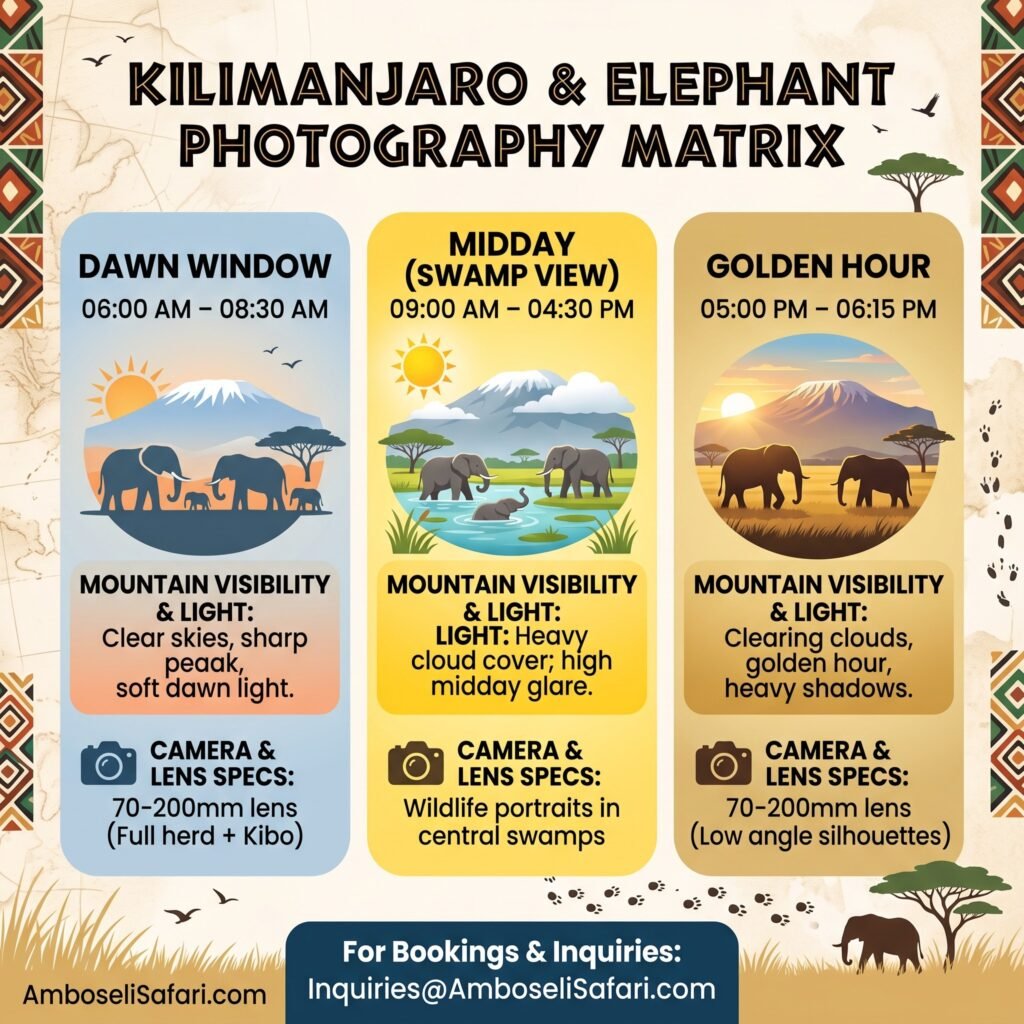
Kibo hides behind clouds by 09:00 AM on most days. Rising thermal heat off the salt flats builds up cloud cover over the snowcapped peak quickly, so you need to shoot early or wait for evening light.
- 06:00 AM – 08:30 AM: You get sharp, clear skies as herds walk out of dry bush toward morning water holes.
- 05:00 PM – 06:15 PM: As temperatures drop, clouds break around the summit, giving you golden light and heavy shadows behind moving tuskers.
Use a 70–200mm lens. It lets you capture the full scale of Mount Kilimanjaro in the background without cropping off an elephant’s legs or trunk.
Kilimanjaro & Elephant Photography Matrix
Capturing Amboseli’s iconic elephants against the backdrop of Mount Kilimanjaro requires syncing your game drive with daily thermal weather cycles. Kibo’s peak regularly disappears behind thick cloud cover by mid-morning as heat rises off the salt flats. This visual photographic timetable breaks down the exact hours, optimal lighting conditions, and recommended focal ranges for crisp mountain compositions. Plan your morning and afternoon departure times around these specific visual windows.
| Time Window | Mountain Visibility & Light | Camera & Lens Specs |
| 06:00 AM – 08:30 AM | Clear skies, sharp peak, soft dawn light | 70–200mm lens (Full herd + Kibo) |
| 09:00 AM – 04:30 PM | Heavy cloud cover; high midday glare | Wildlife portraits in central swamps |
| 05:00 PM – 06:15 PM | Clearing clouds, golden hour, heavy shadows | 70–200mm lens (Low angle silhouettes) |
Seasonal Wildlife Breakdown: Best Time to Visit
| Season / Months | Weather & Terrain | Wildlife & Viewing Experience |
| Long Dry Season (June – October) | Dry salt tracks, high dust, sunny days | Herds crowd central swamps; thin bush makes tracking simple. |
| Short Dry Season (January – February) | Warm, clear skies, short grass | High animal numbers at Enkongo Narok; sharpest dawn mountain views. |
| Green Rains (March – May & Nov – Dec) | Afternoon showers, slick tracks | Newborn calves and fawns; 400+ bird species; herds disperse into bush. |
During dry months, water holes out on the plains dry up. Hundreds of elephants stream into central marshes every morning. Wet months let herds disperse across community ranches, but lower room rates and newborn calves make green-season drives worth the trip.
The Big 5 Gap: Rhinos, Leopards & Open Salt Flats
You won’t find black rhinos here—KWS relocated them to protected sanctuaries years ago.
Leopards are extremely rare, too. The central basin consists mostly of open salt flats and thin acacia brush, which doesn’t offer enough cover for secretive stalkers.
Instead, you’ll see large prides of lions, spotted hyenas, and cheetahs hunting across Normati Sands. Swamps hold big hippo pods, while Maasai giraffes feed among groves of yellow-fever trees (Acacia xanthophloeia).
Observation Hill (Noomotio)
Observation Hill—called Noomotio locally—is the only spot in the park where you can legally step out of your Land Cruiser without a ranger.
A stone staircase leads to a shaded look-out deck. From the top, you get a clear view over Enkongo Narok swamp. It is the best spot in the park for wide-angle shots of herds wading through green papyrus beds below.
Review park entry tracks in our Amboseli National Park guide.
Volcanic Ash Dust Baths vs. Tsavo Red Clay
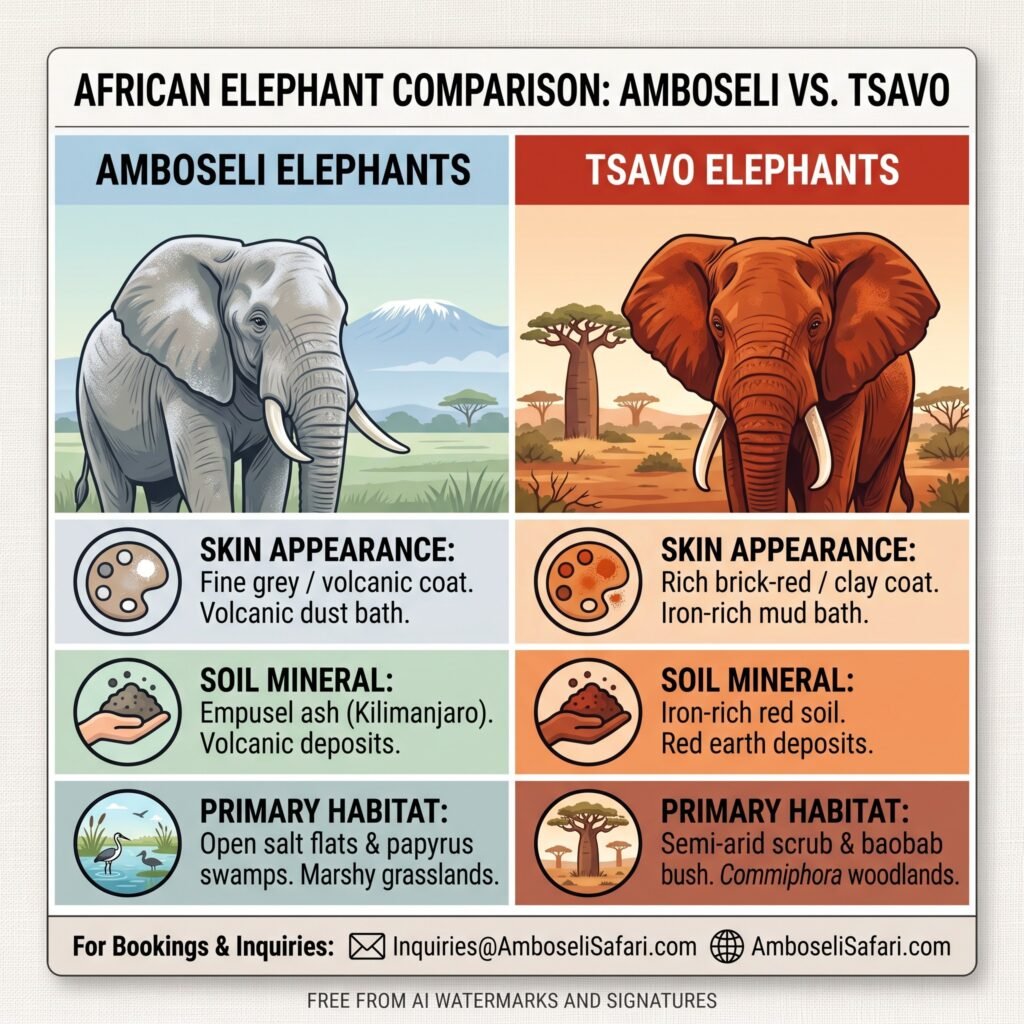
The elephants here look dusty grey because they spray volcanic ash (Empusel dust) over their skin. Deposited by ancient eruptions of Mount Kilimanjaro, this fine grey powder acts as a natural bug spray and shields their skin from heat.
It looks completely different from the dark red mud baths elephants use in Tsavo East. As you drive past yellow-fever trees, you’ll see matriarchs kicking up grey dust clouds to shower their calves.
Amboseli vs. Tsavo Elephant Comparison
First-time safari visitors are often surprised by the dramatic color differences between Kenya’s major elephant populations. While Amboseli’s herds display a dusty grey coat, nearby Tsavo elephants appear striking brick-red due to local mineral compositions. The comparison table below highlights how distinct geological features, water sources, and vegetation shape the appearance and daily habits of these two famous herds.
| Feature | Amboseli Elephants | Tsavo Elephants |
| Skin Appearance | Fine grey / volcanic coat | Rich brick-red / clay coat |
| Soil Mineral | Empusel ash (Kilimanjaro) | Iron-rich red soil |
| Primary Habitat | Open salt flats & papyrus swamps | Semi-arid scrub & baobab bush |
Super-Tuskers, Musth Bulls & Longinye Swamp
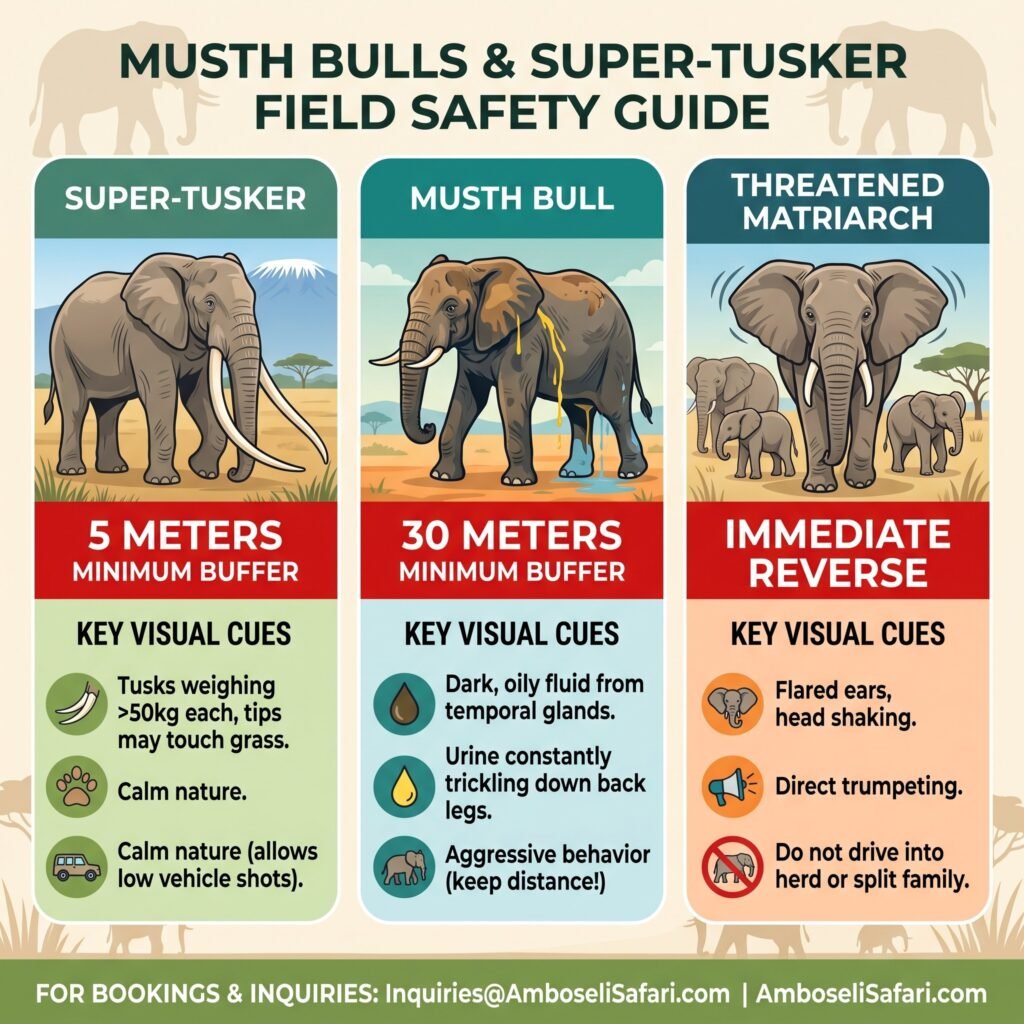
Amboseli remains one of the last places in Africa where you can see super-tuskers carrying ivory that weighs over 50 kilograms per side.
Craig’s Legacy
Craig, born in 1972 from the CB family line, was the park’s most famous super-tusker before passing away naturally of old age. His long tusks curved down to touch the grass. His calm nature allowed drivers to set up low vehicle shots when he approached water holes.
When you encounter big tuskers, our lead guide, Anthony Mule, keeps a strict 5-meter vehicle buffer. Even a calm bull needs room so his tusks don’t catch your vehicle body.
Musth Bulls
Mature bulls in “musth”—a period of high testosterone—gather along the water channels of Longinye Swamp during dry months.
Spotting a musth bull is easy:
- Dark, oily fluid runs down temporal glands on the side of his head.
- Urine constantly trickles down his back legs as he walks.
Give musth bulls at least 30 meters of room. Their hormone levels make them aggressive, and they’ll charge or hit a bumper if you crowd them.
Compare nearby lodging choices in our guide on where to stay in Amboseli.
Musth Bulls & Super-Tusker Field Safety Guide
Navigating encounters with Amboseli’s massive tuskers requires recognizing critical behavioral cues and maintaining precise distance buffers. While calm super-tuskers often permit closer vehicle approaches, bulls in musth exhibit unpredictable aggression driven by extreme testosterone levels. The field visual guide below outlines the vital physical markers and recommended safety margins for safari drivers and photographers. Use these indicators to ensure a safe, respectful sighting in the swamp tracks.
| Identifier / Bull Type | Key Visual Cues | Required Safety Buffer |
| Super-Tusker | Tusks weighing >50kg each; tips may touch grass | 5 Meters minimum |
| Musth Bull | Dark temporal gland fluid; constant urine trickle | 30 Meters minimum |
| Threatened Matriarch | Flared ears, head shaking, direct trumpeting | Immediate Reverse |
Kimana Corridor, Transit Routes & Gate Map
Driving down from Nairobi covers 240 km and takes 4 to 5 hours. Head south on the paved Mombasa Road (A109) to Emali, then turn right onto the C103 tarmac road straight to the gates. Flying takes 45 minutes from Wilson Airport (WIL) to Amboseli Airstrip (AMB).
Gate Options
- Meshanani Gate (Northwest): Main entry for vehicles arriving from Nairobi or Namanga.
- Kimana Gate (East): Fastest access to eastern lodges and Enkongo Narok swamp.
- Kitirua Gate (Southwest): Serves southern conservancy camps near Kitirua Hill.
Kimana Migration Choke Points
In late May and early November, herds migrate between the central swamps and the Chyulu Hills along the 24-kilometer Kimana Corridor. Farming along the border forces massive family groups through narrow electric-fenced choke points near Kimana Gate.
Pulling up near Kimana Gate around 05:00 PM puts you right where bull groups gather along the fences, waiting for sunset before crossing into community lands.
For road navigation advice, check our Amboseli self-drive tips guide.
AERP Field Vehicles & Research Access
While driving near Ol Tukai, you’ll pass green, open-sided Land Rovers with research plates and Amboseli Trust for Elephants (ATE) decals.
These belong to field biologists from the Amboseli Elephant Research Project (AERP). Founded in 1972 by Dr. Cynthia Moss, AERP is the longest-running wild mammal study on earth, tracking over 2,000 individual elephants across five decades.
Following an AERP Land Rover from a respectful distance often leads you straight to newborn calves or matriarch reunions before other safari vehicles arrive.
The Cynthia Moss Research Centre sits inside the Ol Tukai Orok palm grove. It holds 50 years of field logs and skull specimens. The station is closed to walk-in tourists, but travelers who adopt an elephant through the Amboseli Trust for Elephants can book a private tour and briefing with research staff.
Learn how to arrange research visits in our famous elephants guide.
Dust, Curfews & Daily Pitfalls
Fine volcanic dust gets driven into camera gears and vehicle zips by afternoon winds. Keep camera bodies wrapped in sealed dry bags when driving between sightings.
Never drive your vehicle into the middle of a crossing herd or split a calf from its mother. If a matriarch spreads her ears, shakes her head, or trumpets, reverse immediately.
All game drives inside KWS boundaries must end by 06:00 PM sharp. Drivers caught on marsh tracks past curfew face immediate fines from KWS wardens.
If you’re ready to set up a private game drive schedule or want to check open Land Cruiser dates with our team, drop us a line via our safari inquiry form or request a price on Amboselisafari.com.
Frequently Asked Questions
How many elephants live in Amboseli National Park?
Between 1,500 and 1,800 free-roaming elephants live in the greater ecosystem. Numbers keep growing thanks to community conservancies and constant research monitoring.
What is the best time of day to see elephant herds?
Head out between 10:00 AM and 12:30 PM. Herds march out of dry scrub to cross open ground and feed in Enkongo Narok and Longinye swamps.
Can you visit the Amboseli Elephant Research Project station?
It isn’t open to walk-in drop-ins. But if you foster an elephant through the Amboseli Trust for Elephants, you can arrange a tour and educational briefing with researchers in advance.
Why are Amboseli elephants grey while Tsavo elephants are red?
Amboseli elephants dust-bathe in fine grey volcanic ash (Empusel dust) from Mount Kilimanjaro. Tsavo elephants spray themselves with iron-rich red soil, which dyes their skin reddish-brown.