
Best Time to Visit Amboseli National Park
Summary
The best time to visit Amboseli National Park is during the dry season from June to October and January to March. During these months, sparse vegetation and dry plains force large elephant herds to gather around the permanent freshwater swamps, making wildlife viewing very easy. However, the wet season offers excellent bird watching and clear morning views of Mount Kilimanjaro, though seasonal mud and heavy road conditions require a proper 4×4 safari vehicle.
Fast Navigation Links
- Why Timing Matters
- Seasons at a Glance
- Month-by-Month Climate Matrix
- The Dry Season Guide
- The Wet Season Secrets
- Goal-Based Timing Guide
- Real Seasonal Safari Costs
- Packing For Temperature Swings
- Frequently Asked Questions
Why Timing Matters in Amboseli
Choosing when to book your trip to Amboseli National Park is the most important decision you will make. This high-altitude basin sits directly on the Kenya-Tanzania border. It has a delicate water system that changes dramatically throughout the year. If you arrive at the wrong time, you might face heavy dust storms that choke your camera, or seasonal rains that turn the soil into sticky clay.
Our lead guide Moses, a licensed safari guide with 10 years of experience, explains that animals here do not follow a massive migration like they do in the Masai Mara, which is managed by the Narok County Council. Instead, wildlife in Amboseli moves locally. They shift between the dry volcanic plains and the central marshes based on how much water is available.
If you are just starting to plan your drive or flight routes, we suggest looking at our Amboseli National Park map to see where the gates and water sources sit.
Amboseli Seasons at a Glance
| Season | Months | Wildlife Spotting | Mount Kilimanjaro Visibility | Safari Rates |
| Peak Dry Season | June to October | Outstanding (Animals pack the central swamps) | Excellent (Crisp, clear morning views) | Peak Rates |
| Short Dry Season | January & February | High (Dry plains, easy movement) | Excellent (Superb morning photography) | Mid to High Rates |
| Short Rains | November & December | Good (Lush plains, active birdlife) | Moderate (Dramatic afternoon clouds) | Low to Mid Rates |
| Long Rains | March to May | Moderate (Animals scatter across the basin) | Poor (Frequent cloud cover) | Low Season Discounts |
Amboseli Month-by-Month Weather & Wildlife Matrix
To help you plan your travel dates down to the exact week, here is the official historical climate data for the Amboseli basin. For deeper rainfall and temperature detail on any single month, see our full Amboseli weather by month guide.
| Month | Avg Day Temp | Avg Night Temp | Avg Rainfall | Kilimanjaro Visibility | Wildlife Density Meter |
| January | 30°C (86°F) | 14°C (57°F) | 25 mm | Excellent (5:30 AM – 8:30 AM) | 85% — Swamps highly active |
| February | 30°C (86°F) | 14°C (57°F) | 35 mm | Excellent (5:30 AM – 8:30 AM) | 90% — Extreme heat mirages |
| March | 31°C (88°F) | 15°C (59°F) | 60 mm | Moderate | 75% — Transitional movement |
| April | 28°C (82°F) | 16°C (61°F) | 110 mm | Poor (Cloudy peaks) | 50% — Animals scatter widely |
| May | 27°C (81°F) | 15°C (59°F) | 85 mm | Poor (Cloudy peaks) | 50% — High grass, tough spotting |
| June | 26°C (79°F) | 12°C (54°F) | 5 mm | Very Good | 80% — Winds bring animals back |
| July | 25°C (77°F) | 11°C (52°F) | 2 mm | Outstanding (Clean air) | 95% — Crowded around marshes |
| August | 26°C (79°F) | 11°C (52°F) | 1 mm | Outstanding (Clean air) | 100% — Absolute peak density |
| September | 28°C (82°F) | 12°C (54°F) | 3 mm | Very Good | 100% — Heavily dry plains |
| October | 30°C (86°F) | 14°C (57°F) | 15 mm | Good (Hazy afternoons) | 90% — Warm & transitional |
| November | 29°C (84°F) | 15°C (59°F) | 65 mm | Moderate (Stunning post-rain) | 70% — Birding explosion |
| December | 29°C (84°F) | 14°C (57°F) | 55 mm | Good | 80% — Fresh green landscape |
The Dry Season Guide: June to October and January to March
Most safari operators will tell you that the dry season is the only time worth visiting. While it is the easiest time to spot animals, the reality is more complicated. Here is what you will actually experience on the ground during the dry months.
The Delayed Swamp Hydro-Logic Gap (August and September)
Many travelers think that the water levels in the park’s main wetlands depend on local rainfall. This is a common mistake.
Scientific Hydrology Fact: According to the hydrologists at the Amboseli Elephant Research Project, the water in the central marshlands does not come from local rains. Instead, it is fed by the melting glaciers of Mount Kilimanjaro. This water takes roughly four to five months to seep through the volcanic basalt rock of the mountain before bubbling up as fresh springs in the park.
Because of this natural delay, the Enkongo Narok swamp and Longinye swamp are actually at their highest water levels in August and September. This happens right when the surrounding Maasai community lands are completely dry. As a result, thousands of elephants, buffaloes, and zebras are forced to gather in the center of the park. It creates some of the most concentrated wildlife viewing on Earth.
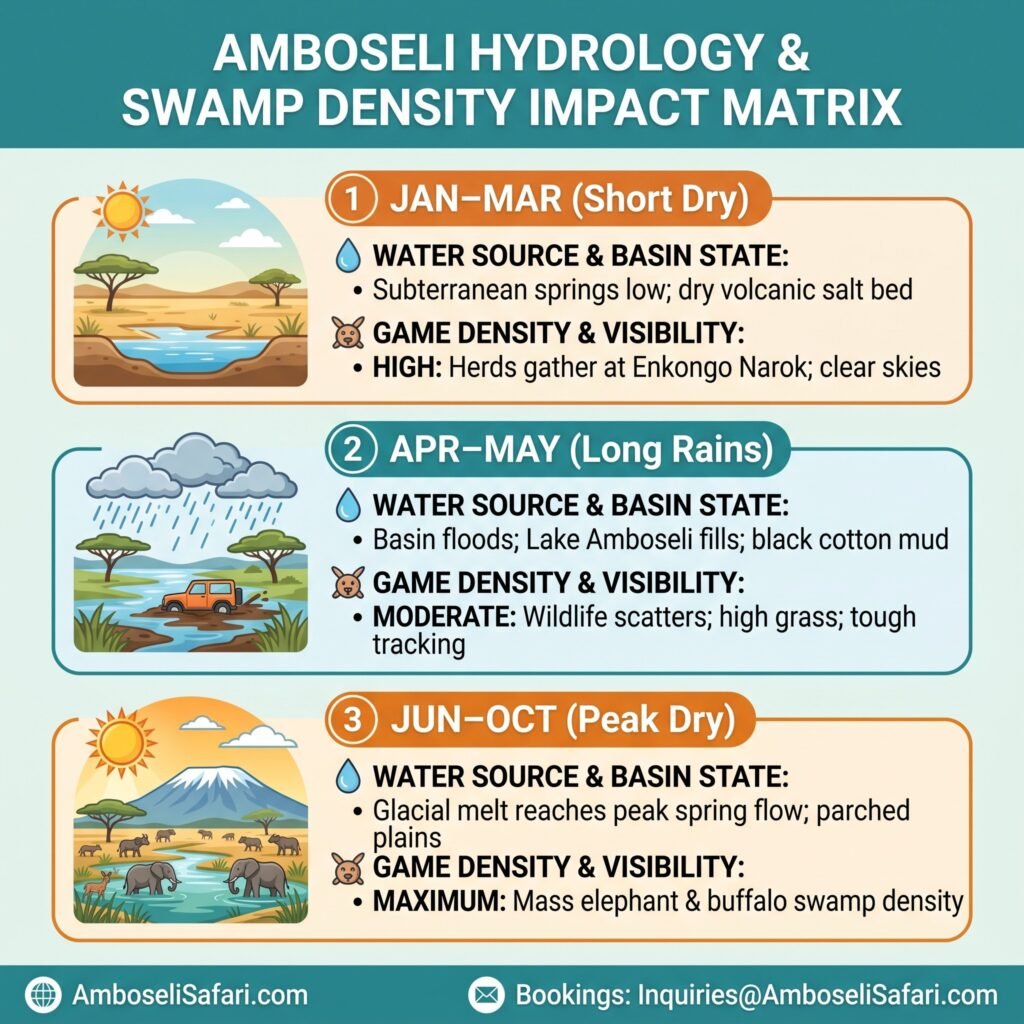
Hydrology & Swamp Density Impact Matrix
Understanding Amboseli’s water cycle reveals why peak wildlife density occurs months after local rains stop. Because the central swamps are fed by glacial melt filtering through subterranean Kilimanjaro basalt, surface water reaches its peak during the driest months. Use this hydrological timeline to anticipate animal crowding and swamp accessibility across different quarters.
| Period / Window | Water Source & Basin State | Game Density & Visibility |
| Jan – Mar (Short Dry) | Subterranean springs low; dry volcanic salt bed | High: Herds gather at Enkongo Narok; clear skies |
| Apr – May (Long Rains) | Basin floods; Lake Amboseli fills; black cotton mud | Moderate: Wildlife scatters; high grass; tough tracking |
| Jun – Oct (Peak Dry) | Glacial melt reaches peak spring flow; parched plains | Maximum: Mass elephant & buffalo swamp density |
The Siyankapa Whirlwind Storms (September and October)
By the end of the long dry season, the volcanic soil of the park turns into a fine, white powder.
Local Driver Warning: Local drivers on the Ol Tukai route advise that the intense midday heat in September and October creates powerful, fast-moving dust devils. The local Maasai people call these swirling wind columns Siyankapa.
If you are traveling in an open-sided vehicle between 11:30 AM and 2:30 PM, these dust devils can easily sweep across the track. They will fill your vehicle with stinging, highly alkaline sand. We always advise our guests to keep their vehicle windows zipped during these hot midday hours to protect their eyes and gear. You can check our Amboseli safari packing list for tips on how to protect your cameras from this dust.
The Mid-June “Ice Winds”
Do not assume that Africa is always hot.
Warden Weather Note: According to the Kenya Wildlife Service (KWS) ranger logs at the Kimana Gate, freezing katabatic winds blow directly off the glaciers of Mount Kilimanjaro in June and July. These cold winds sweep down across the flat Amboseli plains, creating freezing conditions at dawn.
If you go on a morning game drive at 6:00 AM in an open safari cruiser, the wind chill is biting. You will need a heavy, fleece-lined windbreaker and a warm hat. Otherwise, you will be too cold to enjoy watching the early morning wildlife.
Midday “Water-Walking” Mirages (February and September)
During the hottest days of the short dry season in February, the flat dry bed of Lake Amboseli becomes a furnace.
Photographic Guide Tip: Professional photographers staying at the Amboseli Serena Safari Lodge note that the midday heat waves create extreme optical illusions on the dry lakebed.
Between 12:00 PM and 2:00 PM, giant bull elephants crossing the salt flats look as if they are floating in the sky or walking across deep blue water. It is a stunning visual phenomenon that you can only see during these hot, dry months.
The Wet Season Secrets: November to December and April to May
The wet season is often called the “green season.” While many roads become muddy and difficult, traveling during these months has some real advantages that standard guidebooks ignore.
The Rain-Wash Visibility Paradox (Late November)
During the late dry season, the air is filled with a thick brown haze of suspended volcanic dust. This dust can completely block your view of Mount Kilimanjaro for weeks, even on cloudless days.
Ranger Field Report: According to KWS guides at the Observation Hill post, the first heavy rains of November instantly wash this suspended dust out of the atmosphere.
The sunny mornings right after a November storm offer the sharpest, clearest views of the mountain’s glaciers. If your main goal is to photograph giant elephants beneath the mountain, the late November shoulder season is often better than the dusty dry season.
Migratory Birds and Changing Swamps
During the long rains of April and May, the parched volcanic soils turn into a green oasis. Seasonal yellow fever trees (Acacia xanthophloeia) burst into leaf. Thousands of migratory birds arrive, and the flooded lakebed fills with pink lesser flamingos.
However, the park’s black cotton clay becomes extremely slick. If you do not have a heavy 4×4 Safari Land Cruiser with mud-terrain tires, you will easily get stuck. If you plan to travel during these green months, make sure you understand the Amboseli National Park entry fees and vehicle rules before setting off.
Best Time to Visit Amboseli by Travel Goal
Depending on what you want to experience, the ideal booking window shifts:
- For the Classic Kilimanjaro & Elephant Photo: Book July, August, or January. The air is crisp, convective clouds build slower, and the early mornings offer clean, blue-sky panoramas behind giant elephant families.
- For Birding & Lake Wetland Energy: Book November through April. Migratory birds from Europe and Asia arrive in massive numbers, and the flooded salty basin hosts thousands of pink lesser flamingos.
- For Budget Safaris & Solitude: Book April, May, or November. Most high-end luxury camps slash their nightly rates by 30% to 50%, and you can view wildlife without dozens of other safari vehicles crowding the marshes.
Real Seasonal Safari Costs
The price of your safari changes based on the season you choose. During the peak dry months (July to October), lodge rates increase, and vehicle hire is at its highest. During the green or shoulder seasons, you can get great discounts.
To help you plan, we calculate our tour packages using two people traveling together in a private 4×4 Safari Land Cruiser. This vehicle includes a professional guide, fuel, and all daily park fees. The vehicle rate is USD 190 per person sharing per day during the normal season and USD 400 per person sharing per day during the peak season.
We do not suggest spending more than three nights in the area. A 3-night multi-destination trip that includes Tsavo West National Park is logistically perfect. It lets you see two very different volcanic landscapes without spending all your time driving.
4-Day Amboseli & Tsavo West Safari Packages (2027 Rates)
Prices are per person sharing, based on two adults traveling together.
| Travel Season | Comfort Level | Included Lodges | Total Price Per Person (USD) | Book Your Tour |
| Normal Season (Jan-Mar, Nov-Dec) | Budget | Sentrim Amboseli Lodge & Rhino Valley Lodge | USD 1,190 | Book Now |
| Normal Season (Jan-Mar, Nov-Dec) | Mid-Range | Amboseli Serena Safari Lodge & Kilaguni Serena | USD 1,490 | Book Now |
| Normal Season (Jan-Mar, Nov-Dec) | Luxury | Tortilis Camp Amboseli & Severin Safari Camp | USD 2,180 | Book Now |
| Peak Season (July to October) | Budget | Sentrim Amboseli Lodge & Rhino Valley Lodge | USD 1,980 | Book Now |
| Peak Season (July to October) | Mid-Range | Amboseli Serena Safari Lodge & Kilaguni Serena | USD 2,490 | Book Now |
| Peak Season (July to October) | Luxury | Tortilis Camp Amboseli & Severin Safari Camp | USD 3,480 | Book Now |
Package Inclusions:
- Full transport in a customized 4×4 Safari Land Cruiser.
- Services of a professional, licensed safari guide.
- Two nights accommodation in the Amboseli lodges listed above.
- One night accommodation in the Tsavo West lodges listed above.
- All daily park conservation fees for Amboseli and Tsavo West.
- Daily game drives and bottled drinking water in the vehicle.
Package Exclusions:
- International flights and Kenyan entry visas.
- Drinks, laundry, and guide tips.
- Optional activities (like balloon safaris).
Optional Add-ons:
- Maasai Manyatta Village Visit: USD 30 per person.
- Amboseli Hot Air Balloon Ride: USD 450 per person.
- One-way flight from Wilson Airport to Amboseli Airstrip: USD 540 per person (This includes the base ticket rate from the airline’s official site, a safety cushion, and our local operational margin).
If you want to travel in the peak months, you can check our 3-day Amboseli safari package. To get a custom price for your exact travel dates, please enquire now and our local experts will design your Amboseli safari.
Packing for Amboseli’s Daily Temperature Swings
The biggest surprise for first-time safari travelers is the extreme daily temperature change. During the dry season, daytime temperatures can reach a hot 32°C (90°F), but night temperatures can drop to a chilly 10°C (50°F). This is because of the high altitude and the cold winds blowing off Mount Kilimanjaro.
If you pack only light summer clothes, you will freeze during your early morning and late evening game drives. If you pack only heavy winter gear, you will overheat by 10:00 AM.
The secret is to wear layers. Start with a light t-shirt, add a long-sleeved shirt, and top it with a windproof jacket. As the sun rises and warms the plains, you can peel off the outer layers. Always bring a wide-brimmed hat, polarized sunglasses to cut the harsh alkaline glare, and a light scarf to protect your face from the swirling dust.
Environmental & Driving Conditions Guide
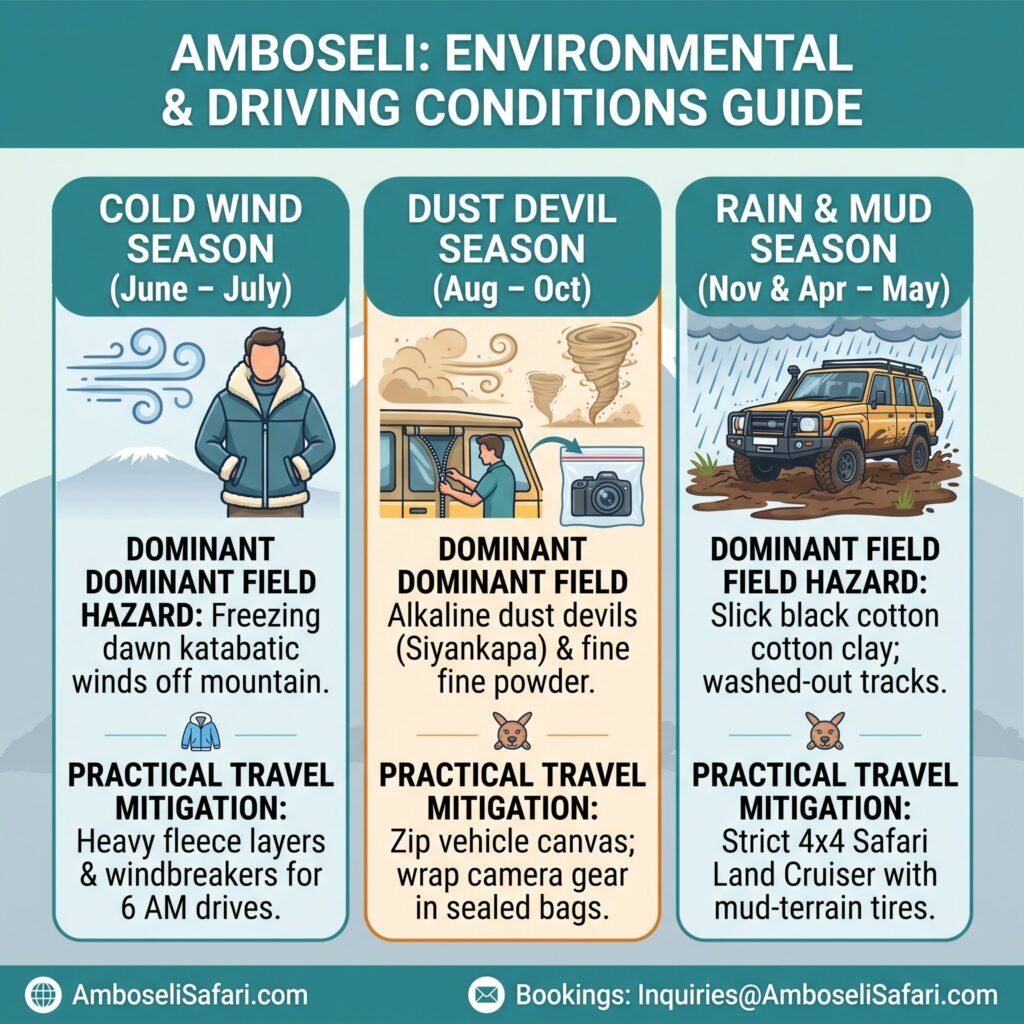
Navigating Amboseli safely requires preparing for dramatic seasonal shifts in weather and track conditions. From biting early morning katabatic winds to suffocating alkaline dust devils and impassable mud, each season presents distinct driving challenges. This practical field checklist outlines what gear and vehicle configurations are necessary throughout the year.
| Season Window | Dominant Field Hazard | Practical Travel Mitigation |
| June – July | Freezing dawn katabatic winds off mountain | Heavy fleece layers & windbreakers for 6 AM drives |
| Aug – Oct | Alkaline dust devils (Siyankapa) & fine powder | Zip vehicle canvas; wrap camera gear in sealed bags |
| Nov & Apr – May | Slick black cotton clay; washed-out tracks | Strict 4×4 Safari Land Cruiser with mud-terrain tires |
Frequently Asked Questions
What is the worst time to visit Amboseli?
The worst time to visit is during the peak of the long rains in April and May. During these weeks, heavy downpours can wash out the dirt tracks, and the volcanic black cotton soil becomes incredibly muddy. Many of the budget mobile camps close down during this period for maintenance.
Can I see the snow on Mount Kilimanjaro year-round?
Yes, the glaciers remain on the peak year-round. However, clouds usually cover the mountain during the middle of the day. Your best chance to see the peak clearly is at sunrise (6:00 AM to 8:00 AM) or sunset (5:30 PM to 6:30 PM), especially during the dry months or right after a rainstorm in November.
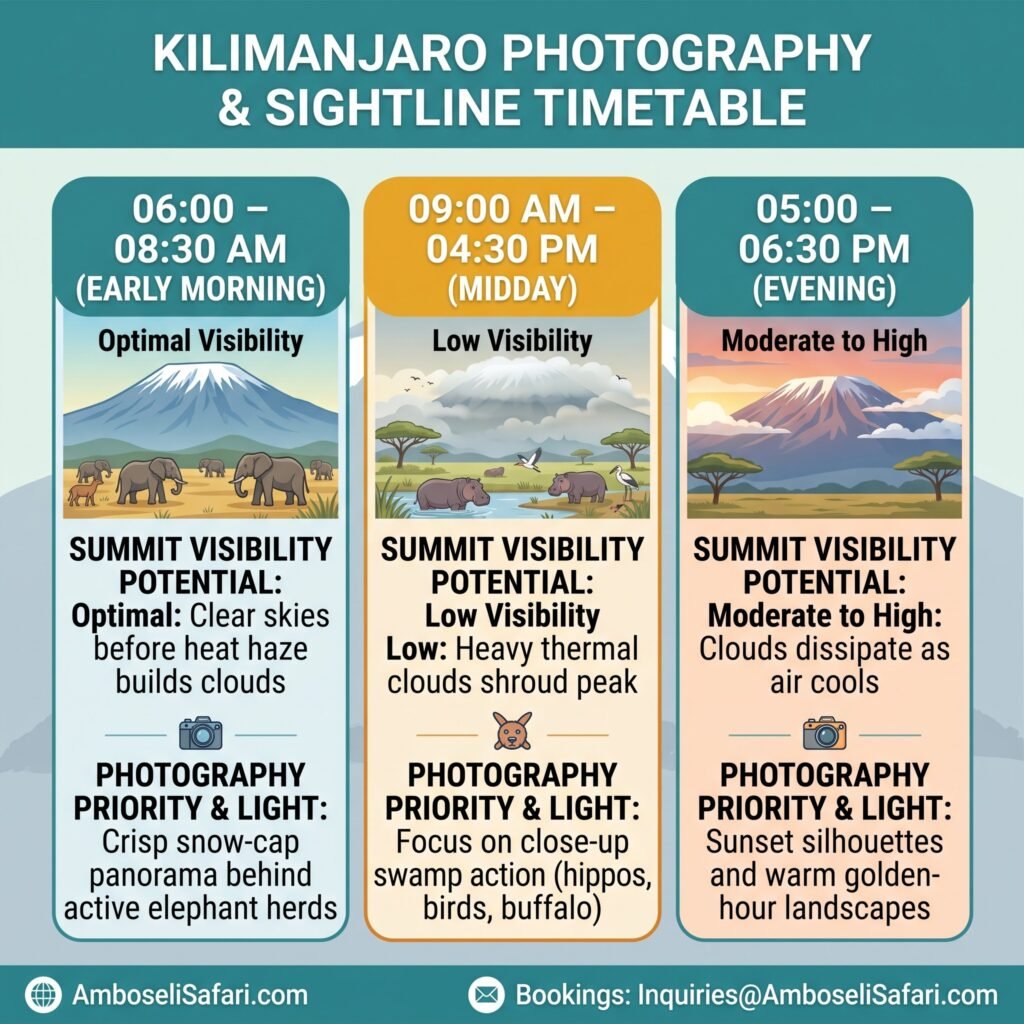
Kilimanjaro Photography & Sightline Timetable
Capturing the iconic image of elephants beneath Mount Kilimanjaro requires precise daily timing rather than relying on the calendar month alone. Daily convection currents routinely build dense cloud cover around the summit by mid-morning regardless of the season. Use this hourly visibility timetable to schedule morning and evening game drives for optimal photography conditions.
| Daily Time Slot | Summit Visibility Potential | Photography Priority & Light |
| 06:00 – 08:30 AM | Optimal: Clear skies before heat haze builds clouds | Crisp snow-cap panorama behind active elephant herds |
| 09:00 AM – 04:30 PM | Low: Heavy thermal clouds shroud peak | Focus on close-up swamp action (hippos, birds, buffalo) |
| 05:00 – 06:30 PM | Moderate to High: Clouds dissipate as air cools | Sunset silhouettes and warm golden-hour landscapes |
How many days do I need in Amboseli National Park?
We recommend spending two nights in Amboseli. This gives you two morning game drives and two evening game drives, which is the perfect amount of time to see the main swamps, find the big elephant herds, and get your photos of the mountain. If you stay longer, the small size of the park means you will end up driving the same routes repeatedly — we break down the full logic in our guide on how many days to spend in Amboseli. If you have more time, enquire now and our team will design a custom safari that includes Lake Nakuru or Ol Pejeta.