
Amboseli and Tsavo West Safari: 5-Day Road Itinerary & Cost
Overview of Amboseli & Tsavo West Safari
An Amboseli and Tsavo West safari combining 2 nights in Amboseli and 2 nights in Tsavo West costs between $1,870 and $9,320 per person for a 5-day private 4×4 trip. Driving overland connects Mount Kilimanjaro’s elephant swamps with Tsavo’s red volcanic hills and lava caves without needing domestic flights.
Jump Ahead
- Driving Logistics & Gates: Distance Matrix | Refueling in Kimana | Kimana Gate Exit | Timing Your KWS Gate Exit | Ngulia Cutoff
- Ecosystem Comparison: Park Differences | Seasonal Conditions | Red vs Grey Elephants | Mzima Springs & Caves
- 5-Day Itinerary: Day-by-Day Schedule | Coast Drop-Off Option
- Costs & Gear: Package Pricing | Cash & Logistics | Client FAQs
Linking Amboseli and Tsavo West by road gets you across two completely different ecosystems in five days. You leave Nairobi at dawn, spend two days tracking big tuskers beneath Mount Kilimanjaro, then cross the volcanic Chyulu Hills into the red-dust wilderness of Tsavo West before returning to the city or heading down to the coast.
Managing an Amboseli and Tsavo West safari smoothly comes down to small ground decisions—like which park gate you exit, where you top off your diesel tank, and how you handle the sharp lava rocks along the backroads.
If you’re mapping out trip dates, check our guide on seasonal wildlife movements in Amboseli to see how weather affects animal sightings. You can also send us a note through our trip planner on Amboselisafari.com to build a custom road itinerary.
Distance & Drive-Time Matrix
Planning your transit legs accurately keeps you from arriving at park gates after dark.
| Leg | Distance (km) | Average Drive Time | Road Surface Type |
| Nairobi to Amboseli (Kimana Gate) | ~215 km | 4.0 – 4.5 Hours | Paved Tarmac (A109 / C102) |
| Amboseli (Kimana) to Tsavo West (Chyulu Gate) | ~95 km | 2.5 – 3.0 Hours | Rough Dirt / Basalt Lava (C103) |
| Tsavo West (Kilaguni) to Mtito Andei Gate | ~50 km | 1.5 – 2.0 Hours | Unpaved Dirt & Volcanic Gravel |
| Mtito Andei to Nairobi | ~240 km | 4.5 – 5.0 Hours | Heavy Commercial Tarmac (A109) |
Amboseli vs. Tsavo West Comparison
| Feature | Amboseli National Park | Tsavo West National Park |
| Landscape | Open alkaline dust flats, yellow-fever acacia groves, and central swamps beneath Kilimanjaro. | Rolling volcanic hills, black cinder cones, dense bushland, and freshwater springs. |
| Signature Wildlife | Massive elephant herds, big swamp tuskers, plains game. | “Red elephants”, endangered black rhinos, hippos, leopards. |
| Key Attraction | Views of Mount Kilimanjaro & Observation Hill (Normatior). | Mzima Springs underwater observatory, Shetani Lava Flow, Ngulia Sanctuary. |
| Vehicle Density | Moderate to heavy near central swamps; higher Land Cruiser traffic. | Light vehicle density; vast open wilderness feel. |
Seasonal Route & Weather Conditions
The C103 lava corridor behaves completely differently depending on the month you drive it.
Dry Season (July–October & January–February): Unpaved tracks stay dry, but fine volcanic dust works its way into every bag in open vehicles. Morning views of Mount Kilimanjaro stay sharp until thermal haze builds around mid-morning.
Wet Season (April–May & November): Heavy rains bring seasonal mud in Kimana that traps 2WD vehicles quickly. Low cloud cover masks the mountain peak most days, though lodge rates drop significantly.
Refueling & Tire Repairs in Kimana
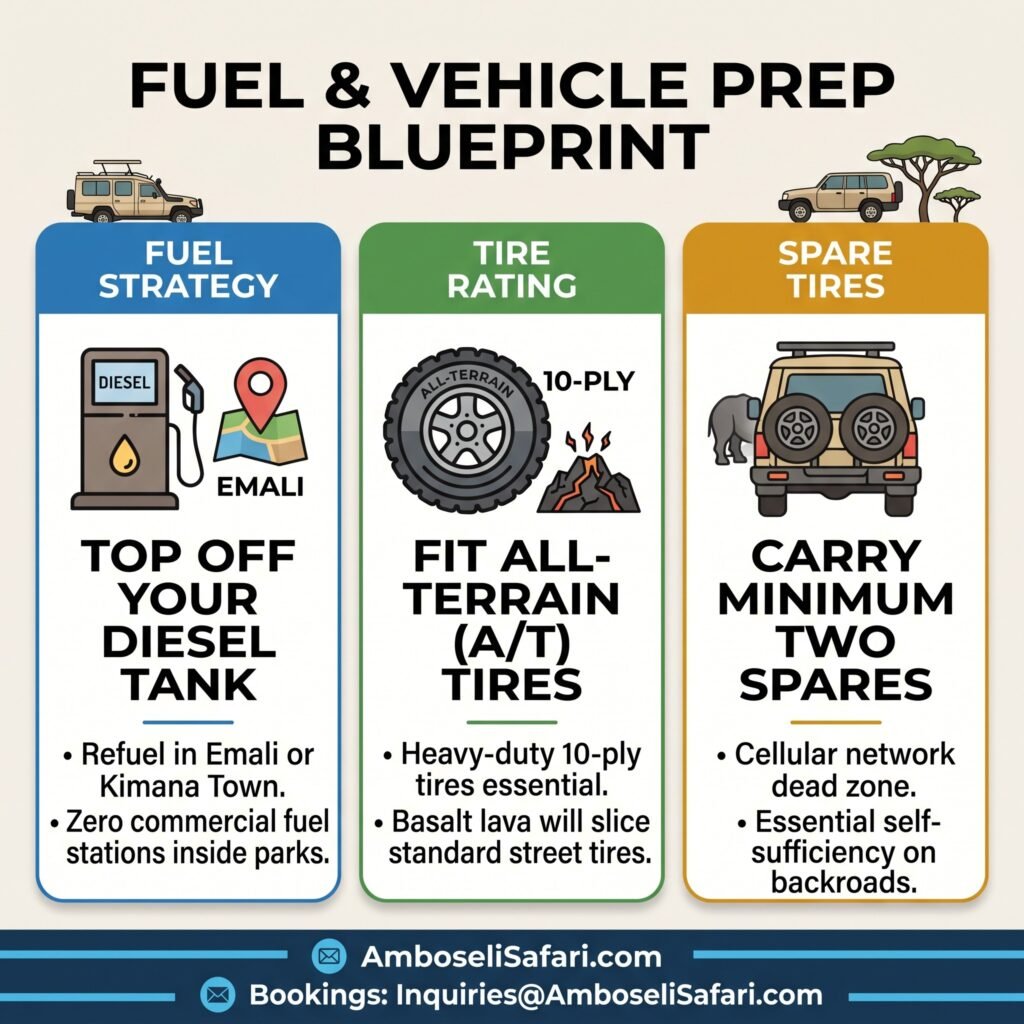
There are zero commercial fuel stations along the 95-kilometer C103 backroad between Kimana Gate and Kilaguni inside Tsavo West.
Top off your diesel tank in Emali or at the Kimana Town petrol station before turning onto the dirt track. Kimana Town is also the last spot for local tire repair shops (fundis). Have your driver check tire pressure and inspect for slow leaks before taking on the lava fields.
Fuel & Vehicle Prep Blueprint
Traversing the volcanic backroads connecting Amboseli and Tsavo West requires strict mechanical preparation to avoid breakdowns in network dead zones. We’ve summarized the essential vehicle checks, fuel stops, and tire specs for the C103 corridor into a quick reference guide. Following these pre-departure steps ensures your 4×4 handles sharp basalt lava and unpaved tracks smoothly.
| Checkpoint / Task | Recommended Spec / Location | Critical Reason |
| Fuel Strategy | Fill full tank at Emali or Kimana Town | Zero fuel stations along 95 km C103 backroad. |
| Tire Rating | Heavy-duty 10-ply All-Terrain (A/T) | Standard 4-ply tires slice on Shetani basalt lava. |
| Spare Tires | Minimum 2 functional full-size spares | Cellular dead zone prevents roadside recovery calls. |
Kimana Gate Exit & The C103 Shetani Lava Corridor
When you leave Amboseli bound for Tsavo West along the C103 backroad, exit strictly through Kimana Gate.
Exiting through Iremito Gate forces you onto 25 kilometers of corrugated washboard gravel through local community lands before you even reach the main junction. Leaving via Kimana Gate puts your Land Cruiser straight onto paved access roads leading toward Chyulu Gate.
Once you pass Chyulu Gate, you cross the Shetani Lava Flow—a 50-kilometer stretch of raw basalt and volcanic obsidian rock.
Basalt lava along C103 slices standard 4-ply street tires; carry two spares. We fit our 4×4 Land Cruisers with heavy-duty 10-ply All-Terrain (A/T) tires for this exact leg.
Cellular network coverage drops to zero between Kimana Gate and Chyulu Gate. The Kenya Wildlife Service wardens at Chyulu Gate require printed paper copies of your digital eCitizen receipts to clear your entry into Tsavo West.
Timing Your KWS Gate Exit
Both reserves run under KWS digital permits ($90 USD per day for Amboseli; $70 USD per day for Tsavo West). Each ticket tracks your time down to the minute on warden tablets.
Timing your gate exits keeps your ticket costs on budget:
- Day 3 Exit (10:00 AM): Leaving Amboseli’s Kimana Gate at 10:00 AM finishes your 24-hour Amboseli permit cycle.
- Day 3 Entry (11:30 AM): Passing Chyulu Gate into Tsavo West at 11:30 AM starts your fresh $70 USD Tsavo ticket.
- Day 4 Coverage: That 11:30 AM stamp covers your afternoon drive, your night at camp, and your morning walk at Mzima Springs without hitting late-exit penalties when leaving Tsavo West.
Crossing into Tsavo West reveals a noticeable shift in animal coats. In Amboseli, herds wade through central marshes coated in pale alkaline mud and white volcanic dust. Two hours east in Tsavo West, those same animals dust-bathe in iron-rich volcanic soil, turning rust-red. Seeing that shift across a single morning shows how local soil geology shapes marsh feeding patterns and coat colors. You can check updated KWS permit fees or review standard gate rules before setting out.
Mzima Springs, Shetani Caves & Poacher’s Lookout
Walking inside Amboseli is restricted to Observation Hill (Normatior), but Tsavo West lets you get out on foot with an armed KWS ranger.
At Mzima Springs, fifty million gallons of fresh water filter up daily through volcanic rock from the Chyulu Hills. You walk shaded trails down to a sunken glass observatory to watch hippos and crocodiles swim past in clear water.
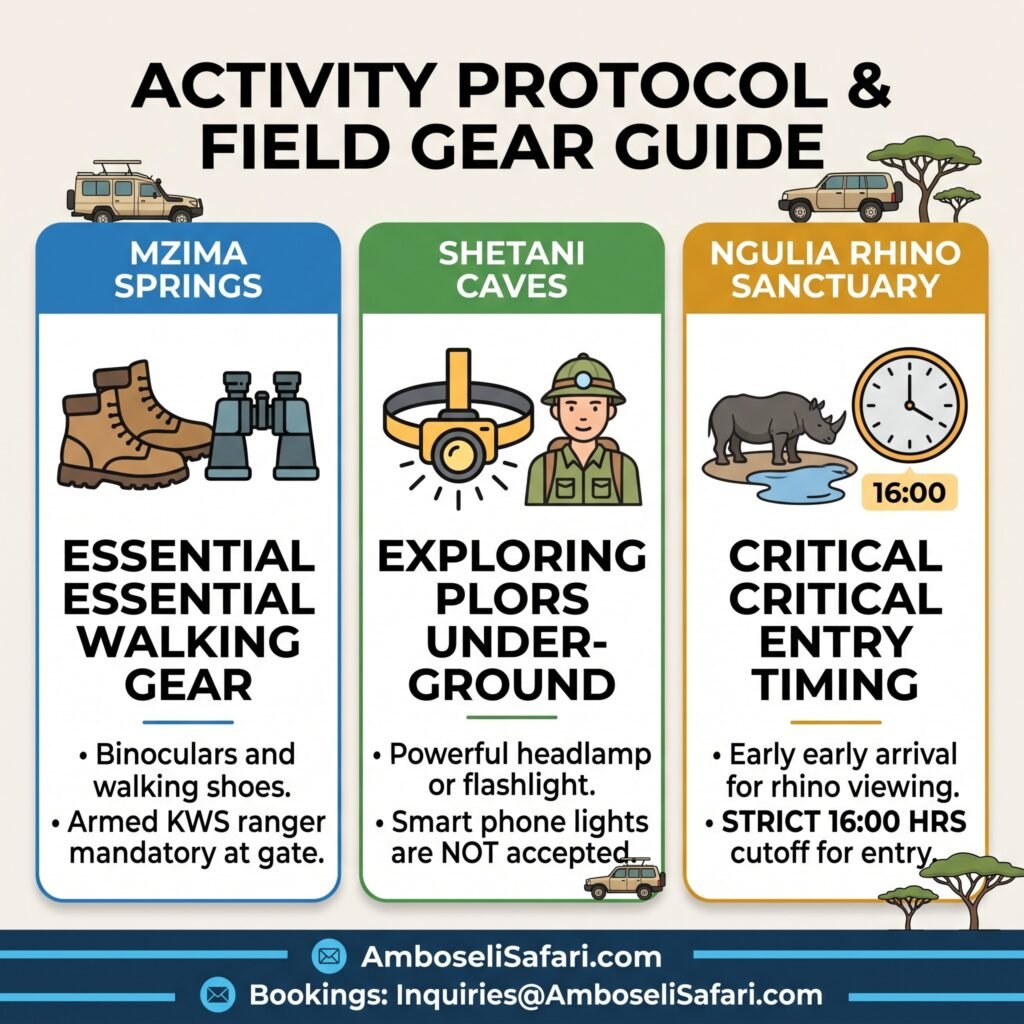
Near the lava flow, you can explore the Shetani Caves—underground volcanic tubes formed during historical eruptions. There is zero light inside the cavern network. You need a bright headlamp or high-lumen flashlight in your daypack, as smartphone lights barely scratch the darkness.
Late in the afternoon, we drive up to Poacher’s Lookout. It’s a hilltop spot with 360-degree views across the volcanic plains toward Mount Kilimanjaro in the distance. While Amboseli gives you close-up views right at the mountain’s foot, Poacher’s Lookout offers a wide-angle perspective. As afternoon thermal haze settles, clear weather often returns right before sunset, making it a great spot for coffee or a sundowner drink.
Along the boundary tracks, you’ll pass the Five Sisters—a cluster of symmetrical volcanic cinder cones. The surrounding Acacia-Commiphora bushland is a good area for spotting gerenuks standing on their hind legs to browse high acacia branches. You can adjust your manual camera settings for landscape photography when shooting wide views across the volcanic ridges.
Activity Protocol & Field Gear Guide
Exploring Tsavo West’s volcanic features requires specific field gear and adherence to KWS safety protocols that differ from standard vehicle game drives. From mandatory armed escorts to specialized lighting for underground caverns, here is what you need to prepare before stepping out of your 4×4. Review this operational guide to make the most of your walking and site visits.
| Excursion Site | Essential Gear Required | Mandatory KWS Protocol |
| Mzima Springs | Walking shoes & binoculars | Armed KWS ranger escort mandatory at gate. |
| Shetani Caves | High-lumen flashlight / headlamp | Zero light inside; phone lights are insufficient. |
| Ngulia Sanctuary | Binoculars for dusk waterhole views | Strict 16:00 HRS gate entry cutoff enforced. |
Ngulia Sanctuary Cutoffs & Lake Jipe Detours
Tsavo West houses the 90-square-kilometer fenced Ngulia Rhino Sanctuary, built specifically to safeguard endangered black rhinos.
KWS wardens enforce an entry cutoff at 16:00 HRS (4:00 PM) and lock the electric gates at 18:00 HRS (6:00 PM). Show up at 4:05 PM and wardens will turn your Land Cruiser away. Rhinos move toward water troughs during the cool hour right before dusk, so getting to the gate early is essential.
If you stay at Kilaguni Serena Safari Lodge, the property features a waterhole lit by green floodlights right in front of the dining deck. Night game drives are prohibited inside KWS park boundaries, but this floodlit setup lets you watch leopards, hyenas, and bull elephants drink while you eat dinner.
A detour down to Lake Jipe along the Tanzania border offers motorized boat safaris. Unlike Amboseli’s shallow, seasonal alkaline bed, Lake Jipe is a deep freshwater lake where you can cruise past hippos and elephant herds feeding in tall reed beds. Keep track of unpaved road updates before taking secondary dirt tracks toward the lake.
Kenya Coast Drop-Off Option (Route Extension)
Many travelers prefer finishing their safari on the beach rather than returning to Nairobi’s traffic.
On Day 5, instead of driving north back to Nairobi, you can exit Tsavo West through Mtito Andei Gate or Tsavo River Gate and head straight down to Mombasa, Diani Beach, or Watamu.
- SGR Express Train Option: Exit via Mtito Andei Gate and head to Mtito Andei SGR Railway Station. You can catch the afternoon Madaraka Express train straight to Mombasa in about 3 hours, skipping highway traffic completely.
- Direct Road Transfer: Drive south along the paved A109 highway through Voi down to the coast in roughly 4.5 to 5 hours.
Complete 5-Day / 4-Night Road Itinerary
Day 1: Nairobi to Amboseli & Sunset Drive
Depart Nairobi at 6:00 AM in a private 4×4 Safari Land Cruiser to beat Mombasa Road highway traffic. Arrive at camp in time for lunch. At 3:30 PM, head out along Ol Okenya swamp to watch elephant families feed near yellow-fever tree groves (Acacia xanthophloeia).
Day 2: Full Day Amboseli Swamps & Mount Kilimanjaro
Start engines at 6:00 AM sharp to catch pre-dawn views of Mount Kilimanjaro before thermal clouds cover Kibo peak around 9:30 AM. Track bull elephants in Enkongo Narok swamp along research routes monitored by the Amboseli Elephant Research Project, then climb Observation Hill for views over the central marshes.
Day 3: Amboseli to Tsavo West via Shetani Lava Flow
Check out after breakfast and exit through Kimana Gate. Drive east along the unpaved C103 backroad through Chyulu Gate, crossing the Shetani Lava Flow. Arrive at your Tsavo West lodge for lunch. Enjoy an afternoon game drive around Kilaguni heading toward Roaring Rocks.
Day 4: Mzima Springs & Ngulia Rhino Sanctuary
Take a morning walking safari at Mzima Springs escorted by an armed KWS ranger. Explore the Shetani Caves before returning to camp for lunch. At 3:00 PM, drive to Ngulia Rhino Sanctuary, entering before the strict 16:00 HRS cutoff to track black rhinos.
Day 5: Tsavo West to Nairobi or Coast Drop-Off
Enjoy an early morning game drive around the Five Sisters volcanic cones. After breakfast, exit Tsavo West through Mtito Andei Gate and join the paved A109 Mombasa Road back to Nairobi (arriving by 4:30 PM) or board the SGR train to Mombasa.
Safari Package Costs & Accommodation Tiers
Our 5-day overland package covers a private 4×4 Safari Land Cruiser for all 5 days (including driver-guide fees and fuel), 4 nights full-board accommodation (2 nights Amboseli + 2 nights Tsavo West), and pre-paid non-resident KWS park permits for both reserves.
Ground transport, fuel, and guide fees run USD 190 per person sharing per day during standard months, rising to USD 400 per person sharing per day during peak season (July to October).
| Package Tier | Included Lodges (Amboseli / Tsavo West)* | Normal Season (Jan–June, Nov–Dec) | Peak Season (July–Oct) |
| Budget Tier | AA Lodge Amboseli / Rhino Valley Lodge | USD 1,870 per person | USD 3,120 per person |
| Mid-Range Tier | Ol Tukai Lodge / Kilaguni Serena Safari Lodge | USD 2,270 per person | USD 3,720 per person |
| Luxury Tier | Tortilis Camp / Severin Safari Camp | USD 3,270 per person | USD 5,120 per person |
| Luxury Plus Tier | Angama Amboseli / Finch Hattons | USD 6,070 per person | USD 9,320 per person |
*Prices assume two adults sharing a private 4×4 Land Cruiser. Budget camps run on generator hours (power off 10 PM – 5 AM). Wi-Fi at mid-range lodges is mostly restricted to main lounge areas.
Book Your Safari Now on Amboselisafari.com to confirm your 4×4 Land Cruiser and lock in lodge reservations.
Package Inclusions:
- Private 4×4 Safari Land Cruiser with pop-up roof for all 5 days.
- Services of a TRA-licensed, English-speaking driver-guide for the full circuit.
- 4 nights full-board accommodation (breakfast, lunch, dinner) at selected lodges.
- Non-resident KWS park permits (2 x 24-hr Amboseli permits + 2 x 24-hr Tsavo West permits).
- Unlimited bottled drinking water in vehicle cooler and emergency medical evacuation insurance.
Package Exclusions:
- International airfare and Kenyan Electronic Travel Authorization (eTA) fees.
- Personal expenses such as driver tips, souvenirs, laundry, and alcoholic beverages.
- Optional activities like night game drives or Lake Jipe boat safaris.
Optional Add-Ons:
- Lake Jipe boat safari detour: USD 80 per person.
- Night game drive in Tsavo West private conservancy: USD 120 per person.
- Authentic Maasai cultural village visit: USD 30 per person.
To review lodge layouts before choosing your accommodation, explore our guide on where to stay in Amboseli.
Cash, Gear & Travel Logistics
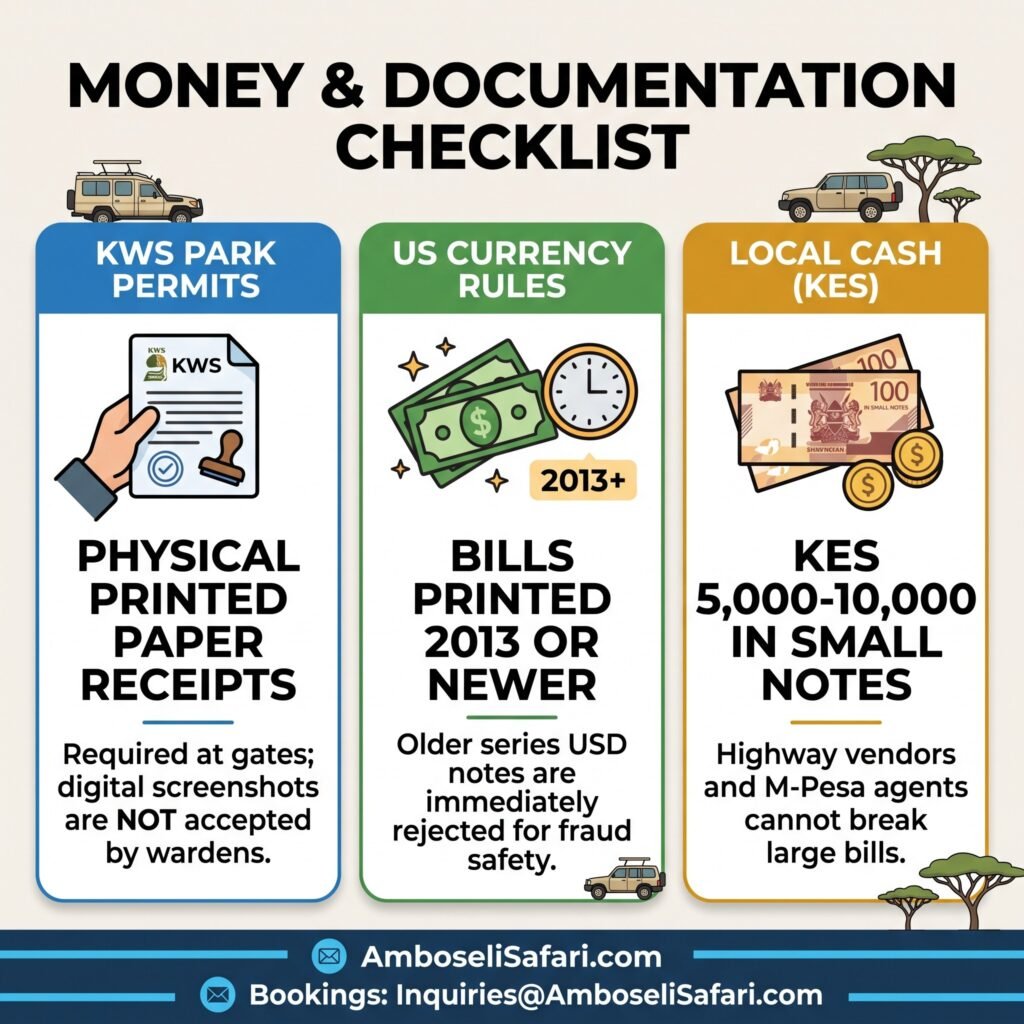
- Bring crisp US Dollar bills printed in 2013 or later. Bank tellers and lodge cashiers reject pre-2013 USD notes immediately due to old counterfeit scares.
- Keep KES 5,000 to 10,000 ($35 to $70 USD equivalent) in small Kenya Shillings notes. Local fruit stands in Kimana or M-Pesa agents along the highway cannot break a $50 or $100 bill.
- Tipping your 4×4 driver-guide runs $15 to $20 USD per day total from your group.
- Reception tip boxes cover back-of-house staff; $10 USD per day is standard for room stewards and kitchen crew.
- Apply for your Electronic Travel Authorization at etakenya.go.ke at least a week before flying. Carry a physical Yellow Fever card if transiting through endemic countries, and pack malaria pills for Tsavo West’s lower elevation.
Money & Documentation Checklist
Managing administrative details, entry permits, and cash reserves accurately prevents unexpected gate delays or payment rejections on safari. KWS wardens and local vendors follow rigid transaction rules that catch unprepared travelers off guard. Keep this administrative checklist handy to ensure hassle-free entry and tipping across both parks.
| Requirement | Correct Format / Amount | Gate / Vendor Rule |
| KWS Permits | Physical printed paper receipts | Digital screenshots strictly rejected by wardens. |
| US Currency | Bills printed in 2013 or newer | Older series USD notes are rejected for fraud safety. |
| Local Cash | KES 5,000–10,000 in small notes | Highway M-Pesa agents & stands cannot break 50/100. |
Frequently Asked Questions About Circuit
Can I attempt the C103 in a rented RAV4 or sedan?
No. The unpaved C103 backroad through Chyulu Gate crosses the Shetani Lava Flow, which features sharp volcanic rock, deep dust, and sand patches. A high-clearance 4×4 vehicle equipped with All-Terrain tires is required.
What happens if traffic delays us and we hit Ngulia Sanctuary after 4:00 PM?
KWS wardens strictly enforce the 16:00 HRS gate cutoff and lock the entrance barriers. If you arrive late, wardens will turn your vehicle away, and you will miss the late-afternoon window when rhinos visit the water troughs.
Are walking safaris at Mzima Springs and Shetani Caves actually safe?
Yes, provided you follow KWS rules. All walking safaris at Mzima Springs and Shetani Caves require an armed KWS ranger escort to ensure safety around hippos, crocodiles, and wild bush animals.
How long does the drive between Amboseli and Tsavo West take?
It is roughly 100 kilometers (62 miles) from Kimana Gate to Kilaguni inside Tsavo West via the C103 road. The drive takes about 2.5 to 3 hours in a 4×4 Land Cruiser due to slow speeds across the Shetani lava section.