
Amboseli Cheetahs: Field Habits, Hidden Corridors & Safari Packages
Overview
Tracking Amboseli Cheetahs across open salt flats and acacia scrub takes patience and an understanding of how big cat competition shapes their daily routines. Many travelers assume the ecosystem falls under Narok County Council, but the national park sits entirely inside Kajiado County under Kenya Wildlife Service (KWS) jurisdiction. Resident cheetahs share this landscape with large lion prides and elephant herds monitored by the Amboseli Elephant Research Project. From females raising cubs in private community corridors to coalitions hunting along volcanic pumice slopes, finding these swift cats requires knowing where to look when central park tracks get busy. Full-board 3-day and 4-day safari packages in a private 4×4 Land Cruiser range from $1,080 per person for budget stays up to $5,950 per person for fly-in luxury options on Amboselisafari.com.
Fast Navigation Links
- Cheetah Packages & 2027 Rates
- Conservancies vs KWS Off-Road Rules
- Seasonal Tracking Calendar
- Optics & Photography Field Guide
- Citizen Science Spot Submissions
- Frequently Asked Questions
2027 Cheetah Safari Packages & Rates
Tracking cheetahs across sun-baked plains requires a flexible vehicle setup. Operating from a private 4×4 Safari Land Cruiser with a pop-up roof gives you an elevated vantage point to spot a cat resting behind low scrub without vehicle engine vibration shaking your camera lens.
Package rates below reflect total per-person costs based on two adults traveling together in a private 4×4 Land Cruiser. Rates cover full-board accommodation, private transport, guide allowances, fuel, vehicle entry fees, chilled bottled water, and pre-paid non-resident KWS park permits ($90 USD per adult per 24 hours).
3-Day & 4-Day Amboseli Cheetah Safari Packages
| Package Tier & Accommodations | Standard Season (USD / Person)* | Peak Season (USD / Person)* | Booking Action |
| 3-Day Budget Cheetah Safari (Sentrim Amboseli / AA Lodge / Amboseli Eco Camp) | $1,080 | $1,820 | Book Budget Safari |
| 3-Day Mid-Range Cheetah Safari (Kibo Safari Camp / Zebra Plains / Kilima Safari Camp) | $1,280 | $2,050 | Book Mid-Range Safari |
| 3-Day Luxury Cheetah Safari (Ol Tukai Lodge / Amboseli Serena / Tawi Lodge) | $1,580 | $2,480 | Book Luxury Safari |
| 4-Day Fly-In Luxury Plus Safari (Safarilink Flight + Elewana Tortilis / Sanya Camp / Porini) | $3,950 | $5,950 | Book Fly-In Package |
*Rates are valid for 2026/2027 based on two adults sharing a room or tented suite with private 4×4 Land Cruiser transport. Standard season covers January through May and November. Peak season spans June through October and December. Packages cover full-board lodging, transport, guide allowances, fuel, and daily KWS permits ($90 USD/day). Fly-in options include roundtrip domestic flights from Wilson Airport (WIL) on Safarilink or Airkenya plus airstrip transfers.
Package Inclusions
- Private 4×4 Safari Land Cruiser with pop-up roof for viewing and photography
- Services of a TRA-licensed, English-speaking driver-guide
- Full-board lodging (breakfast, lunch, and dinner)
- Pre-paid non-resident KWS park permits ($90 USD per 24 hours)
- Chilled bottled drinking water kept in the vehicle cooler
Package Exclusions
- International flights, visa fees, and processing through the official eTA portal
- Driver-guide tips, laundry services, and alcoholic drinks
- Optional Maasai cultural village visits ($30 per person) or balloon safaris ($450 per person)
Optional Add-Ons
- Authentic Maasai cultural village tour: USD 30 per person
- Sunrise hot air balloon flight over central marshes: USD 450 per person
We break down every park permit fee, transport allowance, and fuel cost on our Amboseli safari cost breakdown page.
KWS Off-Roading Regulations vs. Private Conservancies
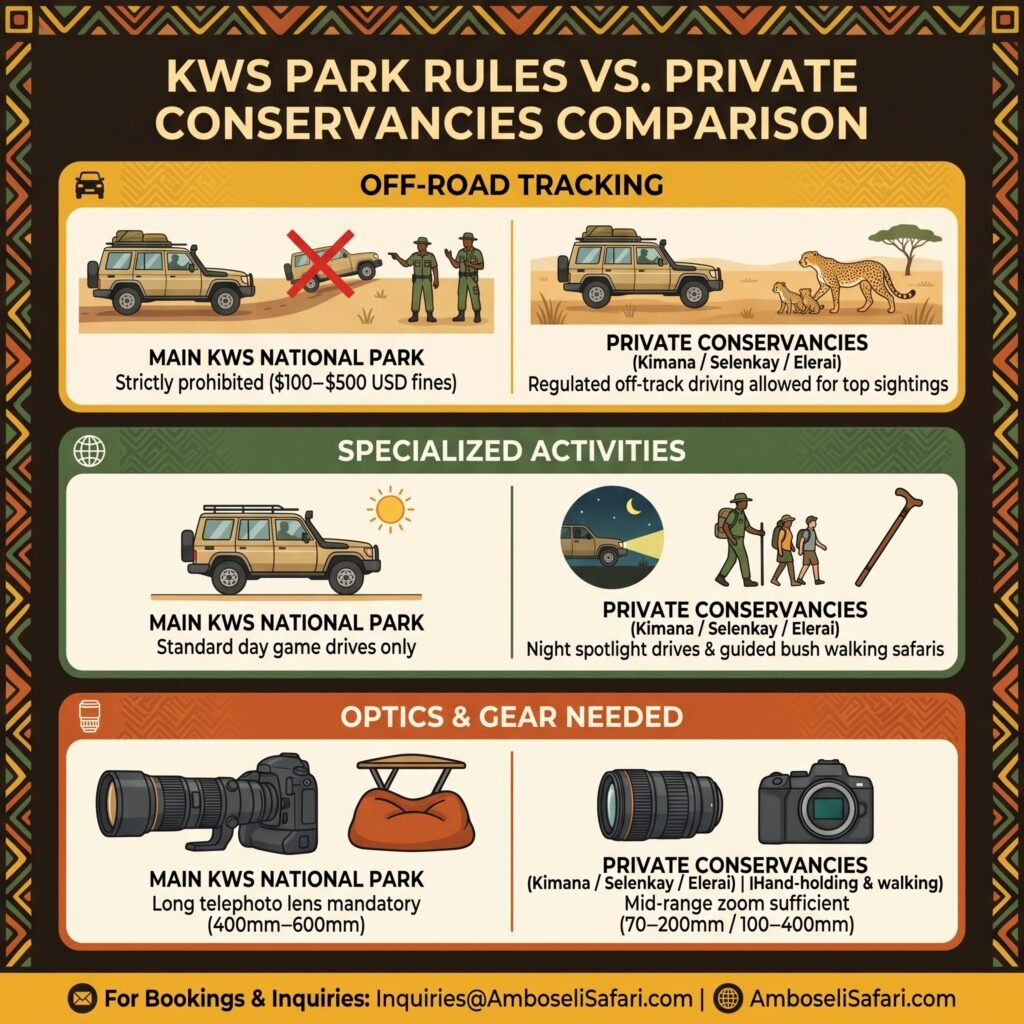
Off-roading is strictly illegal inside main KWS National Park boundaries. If a driver spots a cheetah resting 200 meters off the main track in central sectors, you cannot drive across open soil to get closer. KWS rangers actively enforce off-track driving bans with steep fines ($100 to $500 USD) to protect fragile salt crusts and prevent soil erosion.
If close-up, off-track tracking is your priority, private conservancies along the park border offer a completely different set of rules:
- Kimana Sanctuary & Elerai Conservancy: Community-owned buffer zones allow regulated off-roading for high-value predator sightings when keeping a safe distance from mothers with cubs.
- Selenkay Conservancy: Private land north of the park boundary permits off-track tracking, guided walking safaris, and night drives with spotlights when cheetahs are actively hunting nocturnal prey.
- Main KWS Park Core: Vehicles must remain strictly on marked dirt loops around Enkongo Narok swamp and Lake Amboseli. Long telephoto lenses are mandatory for off-track cats.
When picking where to stay in Amboseli, combining a stay in a private conservancy with day drives inside the national park gives you the best of both worlds.
KWS Park Rules vs. Private Conservancies Comparison
Deciding where to track Amboseli’s cheetahs requires understanding the strict operational differences between the central National Park and surrounding private conservancies. While KWS regulations strictly prohibit off-road driving inside park boundaries to protect fragile salt crusts, private sanctuaries permit controlled off-track maneuvering for major predator sightings. This operational comparison matrix details off-road permissions, specialized activities, and lens requirements across major sectors. Use these guidelines to choose the right base for your wildlife objectives.
| Tracking Parameter | Main KWS National Park | Private Conservancies (Kimana / Selenkay / Elerai) |
| Off-Road Tracking | Strictly prohibited ($100–$500 USD fines) | Regulated off-track driving allowed for top sightings |
| Specialized Activities | Standard day game drives only | Night spotlight drives & guided bush walking safaris |
| Optics & Gear Needed | Long telephoto lens mandatory (400mm–600mm) | Mid-range zoom sufficient (70–200mm / 100–400mm) |
Seasonal Tracking Calendar
Vegetation height and surface water drive cheetah movements across the ecosystem throughout the year.
| Month Range | Vegetation & Sightings Conditions | Cheetah Behavior & Visibility |
| January – February | Dry interlude; short grass across central plains. | High visibility on open salt flats; cats gather around permanent swamp edges. |
| March – May | Long rains; tall perennial grass in scrub zones. | Low visibility; mothers move litters deep into thick acacia bush to hide from lions. |
| June – October | Peak Dry Season: Grass grazed down by plains game. | Best Tracking Window: Open ground, dust clouds, and clear sightlines along dry pans. |
| November – December | Short rains; green shoots emerge across outer ranches. | Cats disperse into outer group ranches following gazelle birth herds. |
During peak dry months (July through October), grazing wildebeest and zebra herds crop grass short, giving cheetahs zero hiding cover. They rely heavily on termite mounds and volcanic boulders to scan open ground before launching sprints.
Longinye Swamp Twilight Hunts & Olodoare Pumice Warming
Classic wildlife documentaries show cheetahs hunting under intense midday sun. In Amboseli, heavy predator pressure around central water channels forces them to adapt.
Along the outer sedge fringes of Longinye Swamp, resident cheetahs adjust their hunting schedules to avoid hyena packs and lion prides. Instead of chasing prey during mid-morning hours when tourist vehicles are active, these cats hunt Grant’s gazelle fawns during late twilight and early nightfall.
As light fades over Mount Kilimanjaro, chilly evening winds sweep across the sedges. Stalking right as darkness falls allows cheetahs to catch prey quietly and feed before hyenas notice the commotion.
On the open Olodoare Plains in the southern sector, termite mounds are scarce. Cheetahs adapt by using dark volcanic pumice boulders thrown during ancient Mount Kilimanjaro eruptions. Dark volcanic rocks absorb thermal energy from the sun throughout the day and hold heat into cold dawn hours. Resting against warm stone helps the cats raise their body temperature before embarking on an early morning hunt.
Dry season conditions add a layer of visual camouflage as well. Fine red volcanic dust covers the outer plains beyond the salt flats. Cheetahs roll in this dry soil, coating their tawny fur in red dust. The combination of red-dusted coats, black spots, and dark pumice stone breaks up their outline against dry brush, letting them crawl within 20 meters of grazing gazelles before sprinting.
Organize local route logistics using our complete Amboseli safari planning guide.
Low Tree Canopy Escapes & Enkongu Narok Circuit
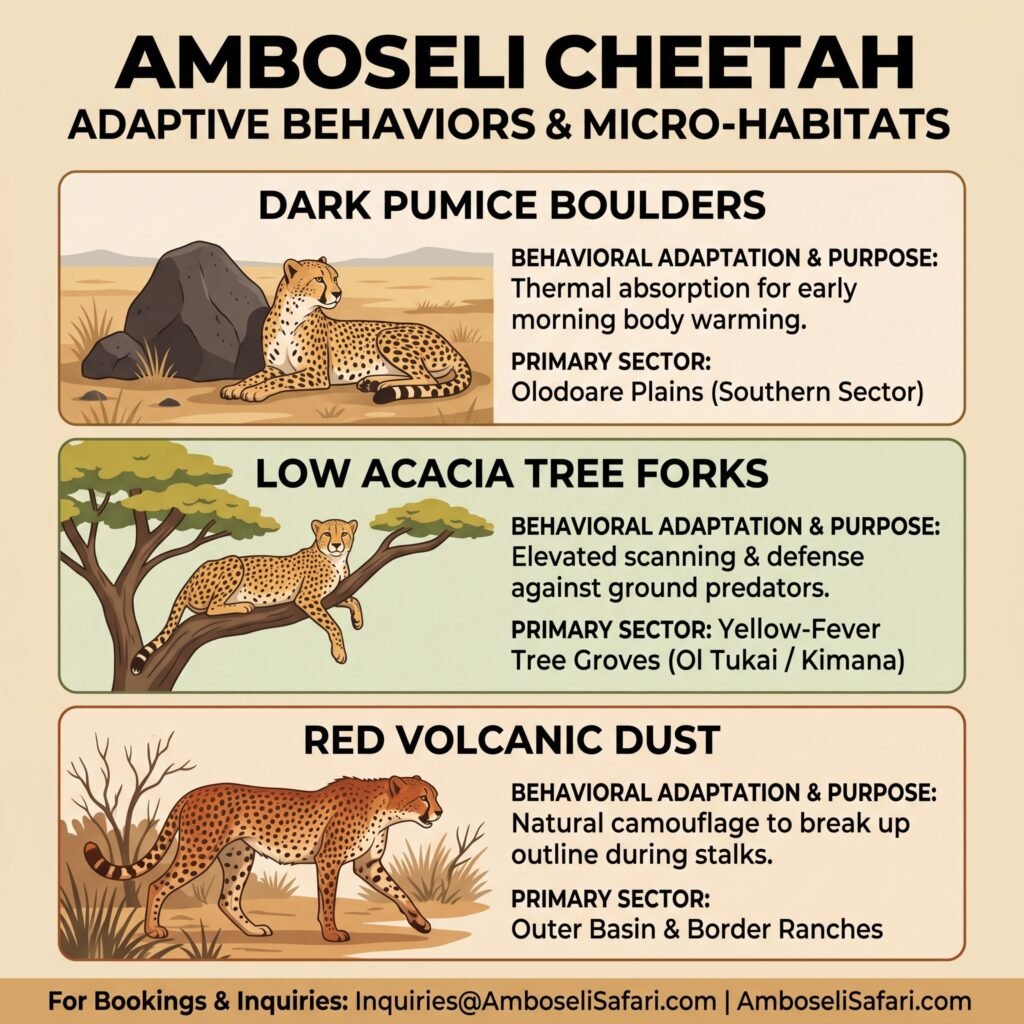
Cheetahs lack fully retractable claws, which makes them poor tree climbers compared to leopards. However, in the yellow-fever tree (Vachellia xanthophloeia) groves surrounding Ol Tukai and Kimana, local cheetahs display unusual climbing behavior.
They routinely scramble up low, sloping tree forks six to eight feet off the ground. These low branches serve two distinct purposes:
- Elevated Scanning: Gaining a clear line of sight over tall sedge grass to spot distant gazelle herds.
- Defensive Escape: Climbing out of reach when surprised by advancing hyena clans or territorial lionesses.
Anthony Mule, a senior safari guide with ten years of field experience, notes that watching a mother cheetah balance on an acacia branch while watching her cubs play below is one of the rarest sightings in the basin.
To avoid minibus crowding along busy gate tracks, ask your driver to explore the quieter Enkongu Narok Circuit during late afternoon hours. This loop winds through low acacia scrub away from main lodge transit roads. Female cheetahs frequently move their young cubs across these quiet brush channels when tourist traffic dies down.
If you plan to drive your own vehicle through these woodland tracks, review clearance and track advice on our Amboseli self-drive tips page.
Amboseli Cheetah Adaptive Behaviors & Micro-Habitats
Heavy competition from lion prides and hyena clans has forced Amboseli’s resident cheetahs to develop unique behavioral adaptations across varied terrain. Unlike their open-savanna counterparts, these big cats utilize volcanic stone, low tree forks, and mineral dust to hunt and survive. This adaptation matrix outlines key environmental features, corresponding behavioral benefits, and prime tracking zones within the basin. Review these habits to spot cats making use of subtle landscape features.
| Landscape Feature | Behavioral Adaptation & Purpose | Primary Ecosystem Sector |
| Dark Pumice Boulders | Thermal absorption for early morning body warming | Olodoare Plains (Southern Sector) |
| Low Acacia Tree Forks | Elevated scanning & defense against ground predators | Yellow-Fever Tree Groves (Ol Tukai / Kimana) |
| Red Volcanic Dust | Natural camouflage to break up outline during stalks | Outer Basin & Border Ranches |
Optics & Wildlife Photography Field Guide
Photographing cheetahs inside KWS park boundaries requires specialized gear and technique because off-roading is prohibited:
- Recommended Optics: Pack a 400mm to 600mm telephoto prime or a 100–500mm zoom lens. Extra focal length is crucial when a cat remains 100 to 150 meters off the established vehicle track.
- Beating Midday Heat Haze: Heat waves bouncing off Empusel salt crust create intense optical distortion after 10:30 AM. Shoot at high shutter speeds (1/1600s or faster) during early morning light (06:30 AM to 08:30 AM) when the atmosphere is still cool and sharp.
- Roof Stability: Rest your heavy lens on a filled canvas beanbag wedged onto the Land Cruiser pop-up roof frame. Turn off the vehicle engine completely before firing high-speed shutter bursts to eliminate idle motor vibration.
Read about wide-angle landscapes and elephant tracking routes in our famous elephants guide.
Citizen Science: Spot Pattern Identification
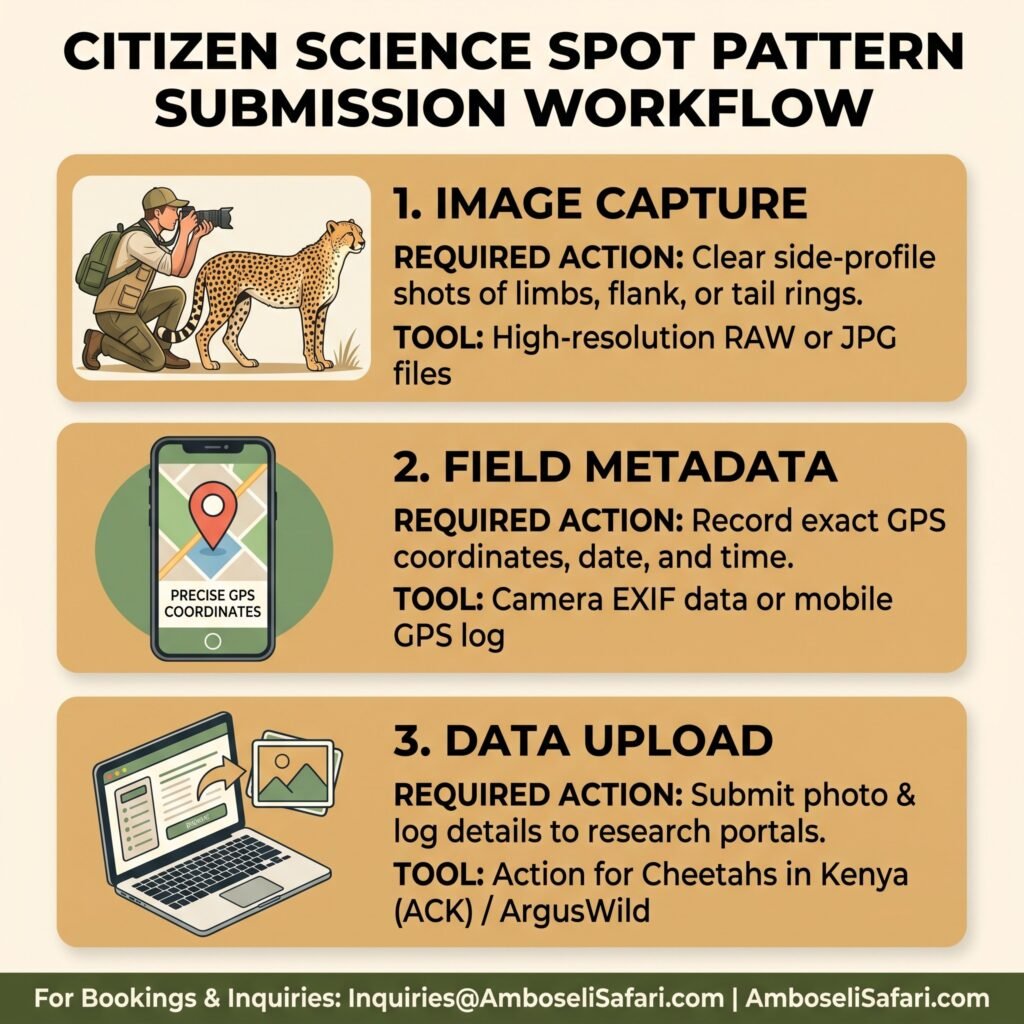
You can turn your safari photographs into valuable conservation data. Every cheetah carries a completely unique arrangement of black spots across its body, limbs, and tail—much like a human fingerprint.
Step 1: Capture clear profile photos of the cheetah’s limbs, body flank, or tail rings.
Step 2: Note the exact GPS coordinates, date, and time of your sighting.
Step 3: Submit digital files to field databases like Action for Cheetahs in Kenya (ACK) or KWS Big Cat Monitoring.
Research initiatives like Action for Cheetahs in Kenya run the Gr8 Cheetah Census, using pattern-matching software (such as ArgusWild) to cross-reference tourist photos against known individual profiles. Submitting your clear side-profile photos helps field researchers track territory shifts, cub survival rates, and cross-border movements between Kenya and Tanzania.
Citizen Science Spot Pattern Submission Workflow
Tourist photographs play a crucial role in non-invasive big cat monitoring across Kenya’s southern conservation corridors. Because every cheetah carries a unique spot pattern across its flank and tail, clear field photos enable researchers to track territory boundaries, cub survival, and cross-border migrations. This step-by-step submission workflow details target image profiles, required metadata, and partner research databases. Follow these guidelines to submit your safari photographs to active conservation databases.
| Workflow Step | Required Action & Target Data | Partner Database & Tool |
| 1. Image Capture | Clear side-profile shots of limbs, flank, or tail rings | High-resolution RAW or JPG files |
| 2. Field Metadata | Record exact GPS coordinates, date, and time | Camera EXIF data or mobile GPS log |
| 3. Data Upload | Submit photo & log details to research portals | Action for Cheetahs in Kenya (ACK) / ArgusWild |
Safari Realities & Traveler Disclaimers
Planning a trip focused on big cats requires honest field expectations:
- Cheetahs Are Easily Disrupted: Crowding a hunting cheetah with vehicles causes the cat to abandon its stalk. Responsible drivers maintain a 50-meter buffer to let the animal hunt naturally.
- High Cub Mortality: Hyenas and lions kill a large percentage of cheetah cubs in open park sectors. This is why sightings are less guaranteed than elephant encounters.
- Fine Silt Gear Hazards: Afternoon winds drive fine white salt dust off Empusel into safari vehicles. Keep camera bodies wrapped in cotton towels inside closed bags between sightings to protect rubber zoom seals.
Community ranger networks supported by the Big Life Foundation work alongside local Maasai herders to protect cheetah corridors connecting Amboseli to surrounding group ranches.
If you are ready to book a private Land Cruiser and driver-guide for your trip on Amboselisafari.com, submit your dates through our safari inquiry form or request a custom itinerary via our main safari booking form.
Frequently Asked Questions
Where is the best spot to see cheetahs in Amboseli National Park?
Look along the open Olodoare Plains in the south, the Enkongu Narok Circuit in the late afternoon, and outer border tracks near Kimana Sanctuary.
Is off-roading allowed to get closer to cheetahs in Amboseli?
No. Off-roading is strictly illegal inside KWS National Park grounds. To track cheetahs off-track legally, book game drives in surrounding private conservancies like Selenkay or Kimana.
Why do cheetahs in Amboseli climb yellow-fever trees?
While cheetahs cannot climb vertical trunks like leopards, they scramble onto low sloping forks of yellow-fever trees (Vachellia xanthophloeia) to escape lions and hyenas or scan tall grass for prey.
How can I submit my cheetah photos to Kenya research projects?
Take clear side-profile shots showing limb spots or tail rings, note the date and location, and upload them to conservation portals like Action for Cheetahs in Kenya (ACK).