
Amboseli Elephant Trust (ATE): Research History, Field Visits & Safari Packages
Overview
Learning about the Amboseli Elephant Trust (ATE) gives you a rare look into the world’s longest-running continuous study of wild land mammals. Operating its research arm—the Amboseli Elephant Research Project (AERP)—from a shaded base inside the park, ATE has tracked over 3,800 individual elephants across five decades. Many travelers assume the ecosystem is managed under Narok County Council, but Amboseli sits entirely in Kajiado County under Kenya Wildlife Service (KWS) protection. Full-board 3-day and 4-day safari packages in a private 4×4 Land Cruiser range from $1,080 per person for budget lodging up to $5,950 per person for fly-in luxury trips.
Fast Navigation Links
- Safari Packages & 2027 Rates
- Founding History & Scientific Milestones
- Ol Tukai Orok & Legacy Herds
- Family Naming & Migration Routes
- Corridor Conservation & Coexistence
- Field Ethics & Recommended Reading
2027 Elephant Research Safari Packages & Rates
Searching for long-studied elephant families across marsh tracks requires patient spotter work. A private 4×4 Safari Land Cruiser with a pop-up roof gives you an elevated vantage point to scan ear notches and tusk shapes over tall papyrus reeds without vehicle engine vibration shaking your binoculars.
All package prices below are total per-person costs calculated for two adults traveling together in a private 4×4 Land Cruiser. Rates include full-board accommodation, private transport, guide allowances, fuel, vehicle entry fees, chilled bottled water, and pre-paid non-resident KWS park permits ($90 USD per adult per 24 hours).
3-Day & 4-Day Amboseli Research & Wildlife Safari Packages
| Package Tier & Accommodations | Standard Season (USD / Person)* | Peak Season (USD / Person)* | Booking Action |
| 3-Day Budget Research Safari (Sentrim Amboseli / AA Lodge / Amboseli Eco Camp) | $1,080 | $1,820 | Reserve Budget Stay |
| 3-Day Mid-Range Research Safari (Kibo Safari Camp / Zebra Plains / Kilima Safari Camp) | $1,280 | $2,050 | Reserve Mid-Range Stay |
| 3-Day Luxury Research Safari (Ol Tukai Lodge / Amboseli Serena / Tawi Lodge) | $1,580 | $2,480 | Reserve Luxury Stay |
| 4-Day Fly-In Luxury Plus Safari (Safarilink Flight + Elewana Tortilis / Sanya Camp / Porini) | $3,950 | $5,950 | Reserve Fly-In Package |
*Rates are valid for 2026/2027 based on two adults sharing a room or tented suite with private 4×4 Land Cruiser transport. Standard season covers January through May and November. Peak season spans June through October and December. Packages cover full-board lodging, transport, guide allowances, fuel, and daily KWS permits ($90 USD/day). Fly-in options include roundtrip domestic flights from Wilson Airport (WIL) on Safarilink or Airkenya plus airstrip transfers.
Package Inclusions
- Private 4×4 Safari Land Cruiser with pop-up roof for viewing and photography
- Services of a TRA-licensed, English-speaking driver-guide
- Full-board accommodation (breakfast, lunch, and dinner)
- Pre-paid non-resident KWS park permits ($90 USD per 24 hours)
- Chilled bottled drinking water kept in the vehicle cooler
Package Exclusions
- International flights, visa fees, and processing through the official eTA portal
- Driver-guide tips, laundry, and alcoholic drinks
- Optional ATE educational lecture donation fees or Maasai village visits ($30 per person)
Optional Add-Ons
- Authentic Maasai cultural village tour: USD 30 per person
- Sunrise hot air balloon flight over central marshes: USD 450 per person
Review transport logistics, fuel costs, and permit fee details on our Amboseli safari cost breakdown.
Founding History & Scientific Milestones
Cynthia Moss and Harvey Croze established the Amboseli Elephant Research Project in 1972. They set out to record individual lives across the basin. What started as a small field mapping effort turned into five decades of uninterrupted data collection.
Daily field observations led directly to major wildlife discoveries:
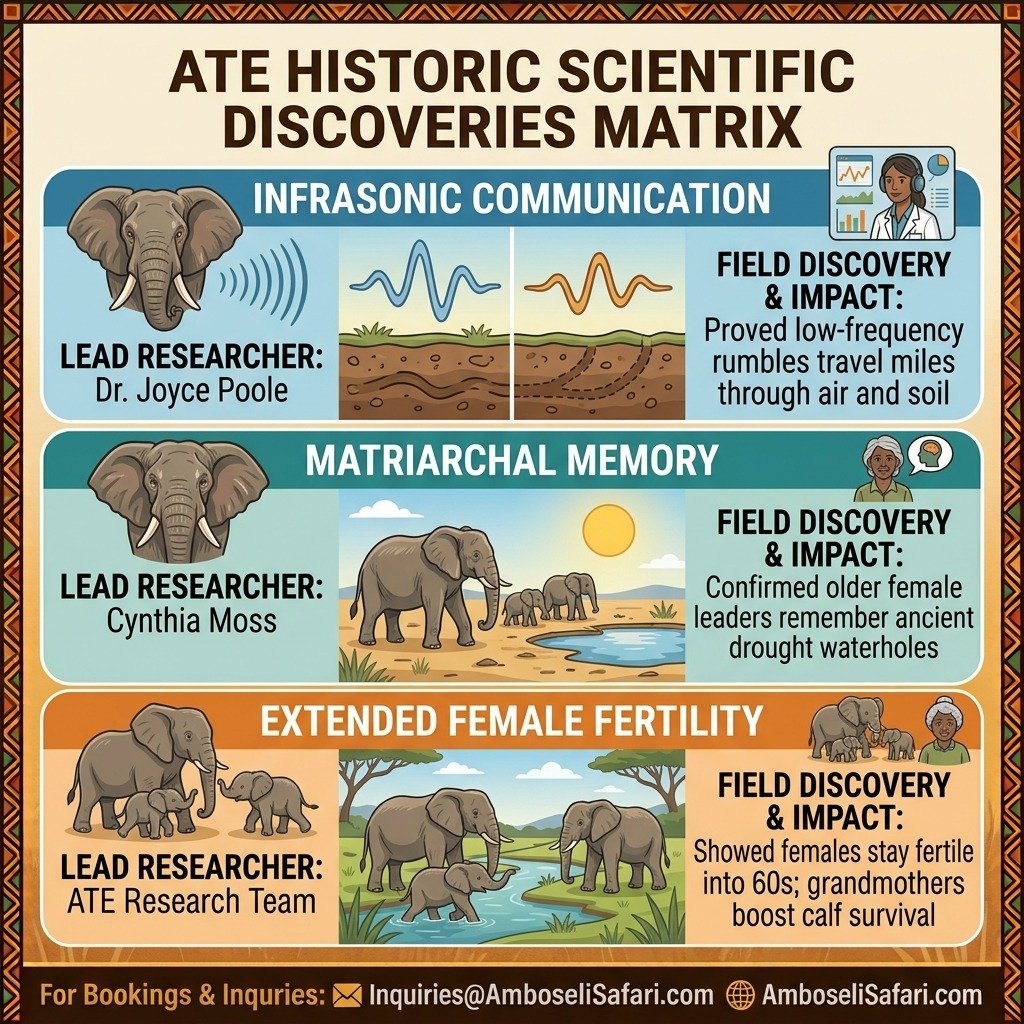
- Infrasonic Communication: Dr. Joyce Poole proved that elephants send low-frequency rumbles over vast distances through the air and soil, well below human hearing range.
- Matriarchal Memory: Long-term studies confirmed that older female leaders store environmental memories for decades, leading herds to hidden water sources during severe dry cycles.
- Extended Fertility: ATE records proved female elephants stay fertile into their 60s, showing that grandmothers play a direct role in calf survival rates.
ATE Historic Scientific Discoveries Matrix
Over five decades of uninterrupted data collection by the Amboseli Elephant Research Project (AERP) have reshaped global understanding of wild land mammal behavior. Key breakthroughs led by Cynthia Moss, Dr. Joyce Poole, and Harvey Croze revealed complex communication networks and social structures that drive elephant survival. This comparative matrix outlines ATE’s major scientific discoveries, the lead researchers involved, and their real-world conservation impact. Use these research benchmarks to understand why Amboseli remains a world-renowned field laboratory.
| Scientific Breakthrough | Lead Researcher | Field Discovery & Impact |
| Infrasonic Communication | Dr. Joyce Poole | Proved low-frequency rumbles travel miles through air and soil |
| Matriarchal Memory | Cynthia Moss | Confirmed older female leaders remember ancient drought waterholes |
| Extended Female Fertility | ATE Research Team | Showed females stay fertile into 60s; grandmothers boost calf survival |
Ol Tukai Orok Field Base & Legacy Herds
Researchers operate out of a quiet field base in the Ol Tukai Orok Phoenix palm grove, roughly 3.5 kilometers east of Observation Hill.
Unlike commercial safari trucks cruising nearby tracks, researchers still rely on open-sided vintage Land Rovers. Chief mechanic Sylvester Mukoto rebuilt Cynthia Moss’s legendary 1980s green Land Rover—registration plate KXC—straight from its stripped chassis frame. The engine has a soft, recognizable mechanical chug. Resident herds know that sound. Matriarchs barely look up when KXC idles near marsh channels.
Dust is everywhere here. Fine white silt off Lake Amboseli settles over camera barrels in minutes. Never use wet wipes on your lenses—moisture turns alkaline dust into a sticky white paste that ruins rubber zoom rings. Use a dry microfiber cloth instead.
The Echo Legacy and the ‘EB’ Family
Documented extensively in the Echo of the Elephants films, the matriarch Echo led the ‘EB’ family through severe droughts, wildebeest competition, and human expansion for 36 years until her natural death in 2009.
Researchers now track her daughter Enid and granddaughter Ely. Watching the ‘EB’ family feed near yellow-fever trees (Acacia xanthophloeia) connects you directly to five decades of field conservation history documented in our guide to famous elephants in Amboseli.
Two-Letter Family Codes & Seasonal Migration
Biologists assign every family a two-letter code created during early field mapping. The AA Family carries American names like Annabel and Agatha. The MB Family uses Celtic names like Maggie and Moira.
Researchers call the MB Family “dual-passport elephants” because their seasonal movement changes dramatically across the year:
- Dry Season Concentration (June–October & January–February): Herds crowd into permanent freshwater channels at Enkongo Narok swamp and Ol Okenya. Melting snows from Mount Kilimanjaro feed underground springs that keep sedges green when open plains dry up. The warm, earthy smell of crushed palm leaves mixes with dry dust along these marsh tracks.
- Wet Season Dispersal (November & March–May): Seasonal rains fill shallow pans across outer community group ranches like Kuku, Kimana, and Mbirikani. Families spread out across miles of open acacia scrub, with some herds crossing south into Tanzanian territory.
Compare nearby lodging options in our guide covering where to stay in Amboseli.
Corridor Conservation & Community Partnerships
Subdivision of group ranches threatens open migration paths across the region. Small agricultural plots block historic game trails.
ATE works alongside local Maasai landowners, community scouts, and group ranches to safeguard narrow movement bottlenecks like the Kimana Wildlife Corridor. This thin strip of open bush allows elephants, lions, and buffaloes to move safely between Amboseli, the Chyulu Hills, and Tsavo West.
Organizations like the Big Life Foundation partner with ATE to fund mobile ranger units along farm borders, reducing crop raiding when herds cross park limits.
Pre-Booked Research Lectures & Financial Impact
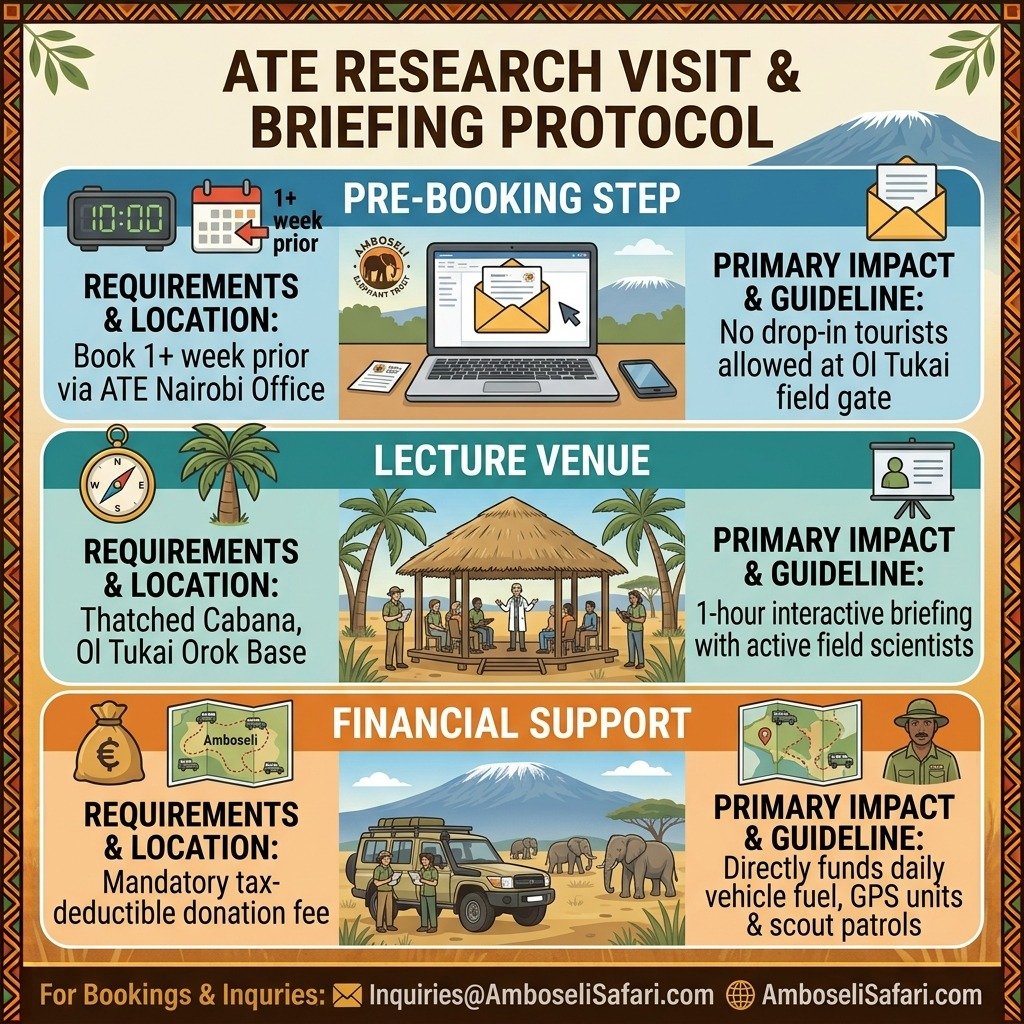
Drop-in tourists are turned away at the research gate. The base is an active field laboratory without a public gift shop or walk-in visitor center.
To attend an official briefing, request an appointment at least a week in advance through ATE’s Nairobi administrative office. Paying a research donation secures a private one-hour interactive presentation inside the thatched-roof cabana at Ol Tukai Orok.
How Lecture Fees and Visitor Donations Support ATE
| Funding Area | Operational Impact |
| Daily Tracking Fuel | Keeps field vehicles monitoring wild herds across the basin daily. |
| Field Gear Maintenance | Funds replacement camera lenses, GPS units, and weatherproofing gear. |
| Conflict Mitigation | Supports Maasai community scout patrols along vulnerable farm borders. |
| Local Scholarships | Funds secondary education programs for youth living near park boundaries. |
During these presentations, researchers show guests physical field log sheets. Digital databases hold thousands of records today, but scientists still write daily sightings by hand on paper forms. That physical paper archive has remained unbroken since Cynthia Moss filled out her first page in 1972.
ATE Research Visit & Briefing Protocol
Access to the Amboseli Elephant Research Project field base at Ol Tukai Orok is strictly regulated to protect ongoing scientific work from commercial tour disruptions. Drop-in visitors without confirmed appointments are turned away at the gate, but travelers can reserve private briefings through official channels. This step-by-step visit protocol outlines booking requirements, lecture location details, and how visitor donations directly fund local conservation efforts. Follow these booking guidelines to add an authentic scientific lecture to your safari itinerary.
| Access Stage | Requirements & Location | Primary Impact & Guideline |
| Pre-Booking Step | Book 1+ week prior via ATE Nairobi Office | No drop-in tourists allowed at Ol Tukai field gate |
| Lecture Venue | Thatched Cabana, Ol Tukai Orok Base | 1-hour interactive briefing with active field scientists |
| Financial Support | Mandatory tax-deductible donation fee | Directly funds daily vehicle fuel, GPS units & scout patrols |
Field Ethics, Musth Protocols & Recommended Reading
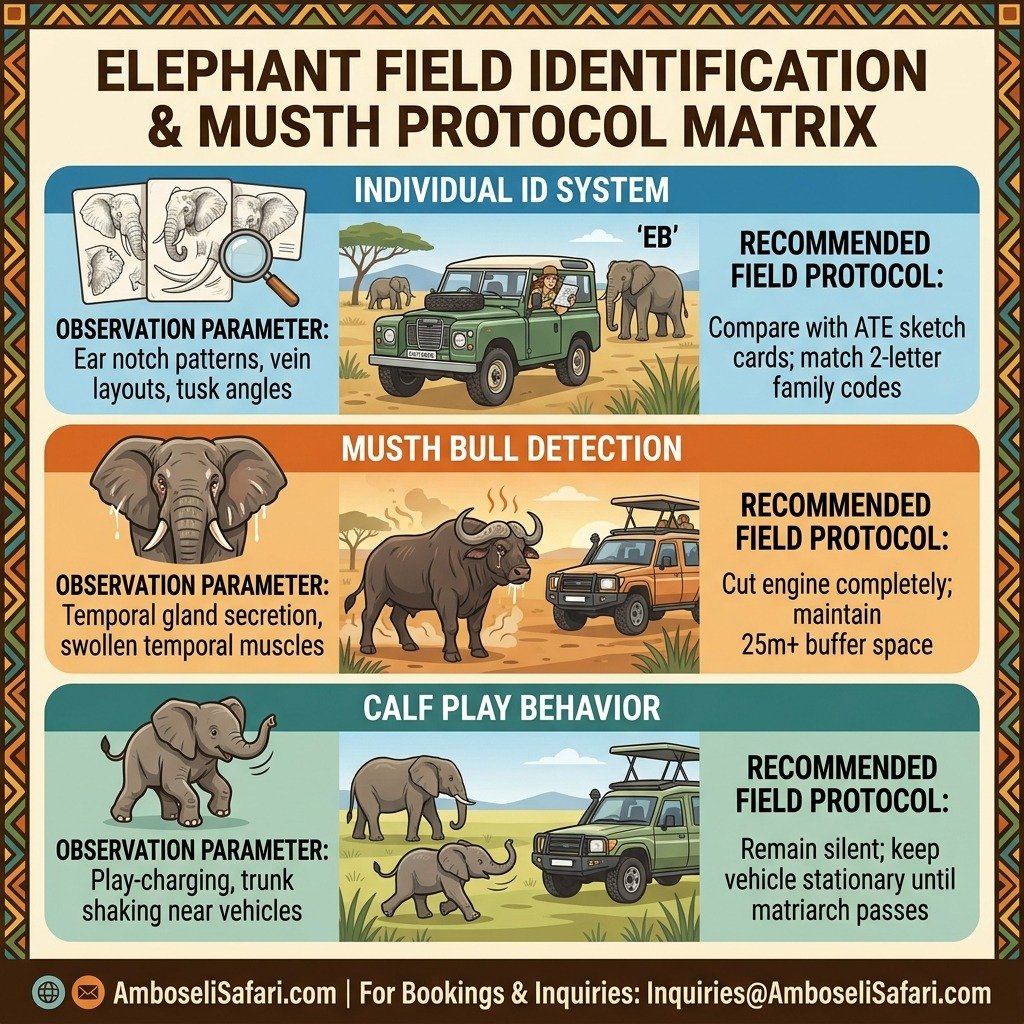
Biologists identify individual animals without radio collars by carrying laminated sketch cards mapping ear notches, vein patterns, and unique tusk angles.
Anthony Mule, who has guided safari vehicles through these marsh tracks for over a decade, often watches habituated calves like Irina (daughter of Ipii) play-charge stationary Land Cruisers. The young calves shake their tiny trunks and kick up dust while their mothers graze peacefully nearby. You can feel low-frequency rumbles pass through the soil beneath your vehicle floor before you even spot a herd breaking out of the fever trees.
To keep these habituated herds safe, follow this field code:
- Keep a minimum distance of 25 meters from feeding family groups.
- Never drive off designated KWS tracks to chase a herd.
- Turn off your vehicle engine completely when approaching musth bulls or young calves.
- Give way to crossing families. Never cut off a matriarch leading her herd to marsh water.
Elephant Field Identification & Musth Protocol Matrix
Field biologists track over 3,800 individual elephants across Kajiado County without using intrusive radio collars for every animal. Instead, researchers rely on visual markers mapped on laminated field cards while observing strict distance rules around high-testosterone musth males. This quick-reference guide details key physical identification markers, behavioral triggers, and essential safety protocols when encountering habituated herds or aggressive bulls. Review these field rules before setting out on game drives around Ol Tukai Orok.
| Observation Parameter | Identification Marker / Behavioral Trigger | Recommended Field Protocol |
| Individual ID System | Ear notch patterns, vein layouts, tusk angles | Compare with ATE sketch cards; match 2-letter family codes |
| Musth Bull Detection | Temporal gland secretion, swollen temporal muscles | Cut engine completely; maintain 25m+ buffer space |
| Calf Play Behavior | Play-charging, trunk shaking near vehicles | Remain silent; keep vehicle stationary until matriarch passes |
Joyce Poole’s Musth Discoveries
Dr. Joyce Poole’s behavioral research established safety protocols for observing mature males in musth, such as the famous bull Bad Bull.
Testosterone levels in musth bulls surge up to 60 times above normal levels. Musth males react aggressively to low mechanical engine noise, so drivers switch off engines completely and wait quietly whenever a musth bull approaches, letting the male walk past on his own terms.
Non-invasive research extends to health monitoring too. Field biologists collect fresh dung right after herds leave marsh channels. Laboratory testing of fecal glucocorticoid hormones allows scientists to measure stress levels during severe droughts without capturing or darting wild animals.
Self-drive travelers can review safety clearance guidelines on our Amboseli self-drive tips page.
Essential Reading List
- Elephant Memories: Thirteen Years in the Life of an Elephant Family by Cynthia Moss — The foundational book on the ‘EB’ family and early research history.
- Coming of Age with Elephants by Joyce Poole — An extraordinary memoir detailing male musth discoveries and vocalization research.
- Amboseli Elephants: A Long-Term Perspective on a Long-Lived Mammal (University of Chicago Press) — The primary academic reference summarizing 40 years of AERP data.
If you are ready to book a private Land Cruiser and driver-guide for your trip on Amboselisafari.com, send us a note through our safari inquiry form or reserve your dates via our main safari booking form.
Frequently Asked Questions
Can you volunteer or work at the Amboseli Elephant Trust field camp?
The research station inside Ol Tukai Orok is a closed scientific facility and does not offer walk-in volunteer placements. Research internships and professional positions are handled exclusively through academic partnerships and advertised on ATE’s official site.
How do I foster an elephant through the Amboseli Elephant Trust?
You can foster an Amboseli elephant family directly through the Amboseli Trust for Elephants website. Foster supporters receive regular field updates, family trees, and seasonal migration news regarding their chosen herd.
Is the Amboseli Elephant Research Project open to general tourists daily?
No. General tourists cannot drop in unannounced. Private educational briefings at the Ol Tukai Orok thatched cabana must be booked at least one week in advance through ATE’s Nairobi administrative office alongside a tax-deductible donation.
Why do researchers turn off vehicle engines near male elephants in musth?
Dr. Joyce Poole’s behavioral studies showed that musth bulls carry testosterone levels up to 60 times higher than normal and react aggressively to low mechanical engine vibrations. Turning off the engine eliminates noise triggers and keeps the animal calm.