
Safari Vehicles for Photography Amboseli: Custom Rigs, Optics & Rates
Overview
Photographing wildlife in Amboseli takes specialized 4×4 Land Cruisers equipped for low-angle shots, lens mounts, and dust control. Managed by Kenya Wildlife Service in Kajiado County, this basin hosts elephant herds studied by the Amboseli Elephant Research Project. Rates start from $1,180 on Amboselisafari.com.
Fast Navigation Links
- Custom Photo Vehicle Package Rates
- Technical Specs of Photo Rigs
- Seasonal Modifications for Photo Vehicles
- Support Mounts and Driver Positioning
- Dust Control and Emergency Kits
- Low Angle Floor Mount Mods
2027 Photo Safari Packages & Vehicle Rates
Standing on open salt flats framing elephants at 6:30 AM will show you real fast if your truck was actually prepped for cameras. We run our photo trips using modified 4×4 Land Cruisers fitted with cut-out window bays, dual roof hatches, and dedicated power strips.
Prices below cover total costs per person for two adults sharing a private vehicle setup:
3-Day & 4-Day Amboseli Photography Safari Packages
| Package Tier & Accommodations | Standard Season (USD / Person)* | Peak Season (USD / Person)* | Guide Note |
| 3-Day Budget Photo Safari (Amboseli Junction Camp / Kibo Safari Camp / Kimana Bush Camp) | $1,180 | $1,880 | Our budget favorite if you don’t mind basic tents; reserve at least 3 months ahead for dry season dates. |
| 3-Day Mid-Range Photo Safari (Kilima Safari Camp / Amboseli Sopa Lodge / Zebra Plains Camp) | $1,480 | $2,180 | Best location if you want quick 10-minute runs out to the main swamp tracks at dawn. |
| 3-Day Luxury Photo Safari (Ol Tukai Lodge / Amboseli Serena Safari Lodge / Satao Elerai Camp) | $1,980 | $2,780 | Pro tip: lock these in 6 months early if you’re aiming for peak July–October light. |
| 4-Day Fly-In Luxury Plus Safari (Flight + Elewana Tortilis Camp / Tawi Lodge / Angama Amboseli) | $3,950 | $5,950 | Flies you right to the airstrip, skipping the bumpy 4-hour highway haul from Nairobi. |
*Rates cover 2026/2027 for two adults sharing a room or tented suite with a private 4×4 Land Cruiser. Standard season runs January through May and November. Peak season spans June through October and December. Rates cover full-board lodging, transport, guide fees, fuel, daily $90 USD KWS entry permits, and custom vehicle gear. Fly-in options include roundtrip flights from Wilson Airport (WIL) on Safarilink or Airkenya plus airstrip transfers.
If you want to see how the numbers break down, we’ve put together a realistic look on our full cost breakdown guide.
Package Inclusions
- Modified 4×4 Safari Land Cruiser with pop-up roof hatches and custom beanbag mounts.
- Services of an experienced driver-guide who actually understands camera angles and herd positioning.
- Full-board accommodation covering breakfast, lunch, and dinner.
- Pre-paid $90 USD daily KWS park permits.
- Need power? An onboard 1000W Pure Sine Wave inverter with multi-plug strips stays running all day.
- Chilled drinking water stocked in the vehicle cooler.
Package Exclusions
- International flights, travel insurance, and entry processing via the official eTA portal.
- Tipping your driver or camp staff.
- Personal laundry and alcoholic drinks at the bar.
- Optional extras like a Maasai village visit ($30) or a sunrise balloon flight ($450).
Optional Add-Ons
- Night photography drive in a private conservancy: USD 50 per person
- Sunrise hot air balloon flight over central marshes: USD 450 per person
Technical Specs of Photo Rigs
We build our rigs on extended Toyota Land Cruiser 79 Series 4x4s powered by 4.5L V8 Turbo Diesel engines. That heavy torque matters when you’re crawling through soft alkaline sand or wading across wet swamp borders with heavy camera gear mounted on the side rails.
Batteries are usually the first thing to fail on standard game drives. Anthony once had a photographer lose three hours of prime morning light near Observation Hill because their cheap modified inverter fried—we’ve used 1000W Pure Sine Wave systems ever since. A two-person photo crew easily burns through six to eight camera batteries, drone packs, and a laptop during a single morning drive. Clean sine-wave power keeps fast chargers from overheating or blowing fuses.
We keep passenger limits down to 2 or 3 shooters per truck. You need space. Period. Capping passenger numbers means you can swing a 600mm prime from the left window bay to the right roof hatch without clashing gear with anyone else.
Camera Power & Mount Infrastructure
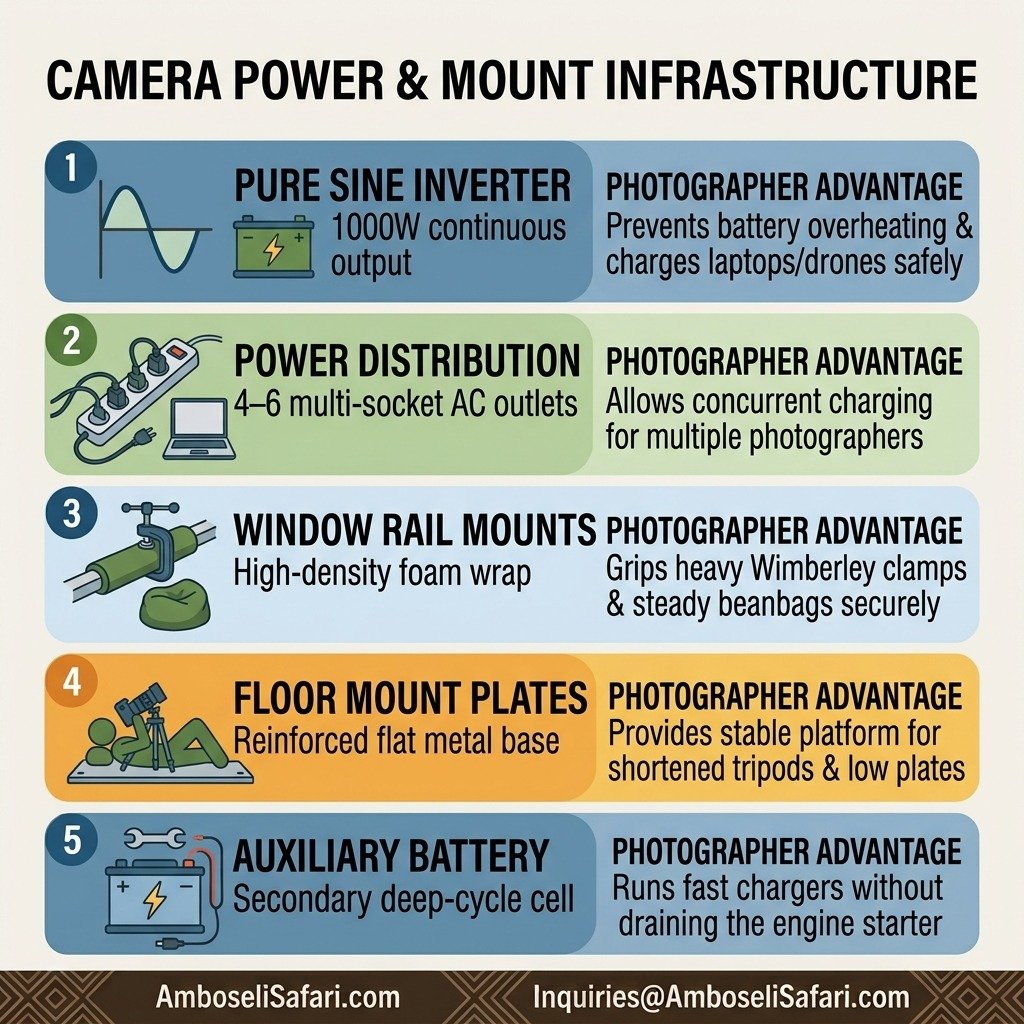
Maintaining full battery power and stable lens support is critical during long morning game drives in Amboseli. While standard vehicles rely on basic cigarette lighters, professional photography rigs feature dedicated electrical circuits and heavy-duty physical mounts. This reference details the exact technical infrastructure built into custom Land Cruisers to keep heavy telephoto gear operational and secure.
| Power & Mount System | Field Specification | Photographer Advantage |
| Pure Sine Inverter | 1000W continuous output | Prevents battery overheating & charges laptops/drones safely |
| Power Distribution | 4–6 multi-socket AC outlets | Allows concurrent charging for multiple photographers |
| Window Rail Mounts | High-density foam wrap | Grips heavy Wimberley clamps & steady beanbags securely |
| Floor Mount Plates | Reinforced flat metal base | Provides stable platform for shortened tripods & low plates |
| Auxiliary Battery | Secondary deep-cycle cell | Runs fast chargers without draining the engine starter |
Seasonal Modifications for Photo Vehicles
Amboseli’s dust and mud dictate how we modify the trucks throughout the year:
| Season / Conditions | Vehicle Modification Needed | Why It Matters |
| Dry Season (Aug–Oct) | Snorkel air intakes & sealed cabin air filters | Our pro-tip: pack extra lens cloths anyway, but this setup stops dust from blowing into camera bags. |
| Rainy Season (Apr–May, Nov) | Mud-terrain tires, Maxtrax boards, 12,000-lb winch | Essential unless you like picking dried mud off your winch line instead of shooting morning light. |
| Mid-Day Heat (11 AM–3 PM) | Roof hatch canvas awnings & solar-reflective wraps | A lifesaver when sitting in the 1 PM heat near Kimana waiting for elephants to cross. |
Season-Specific Photo Rig Setups
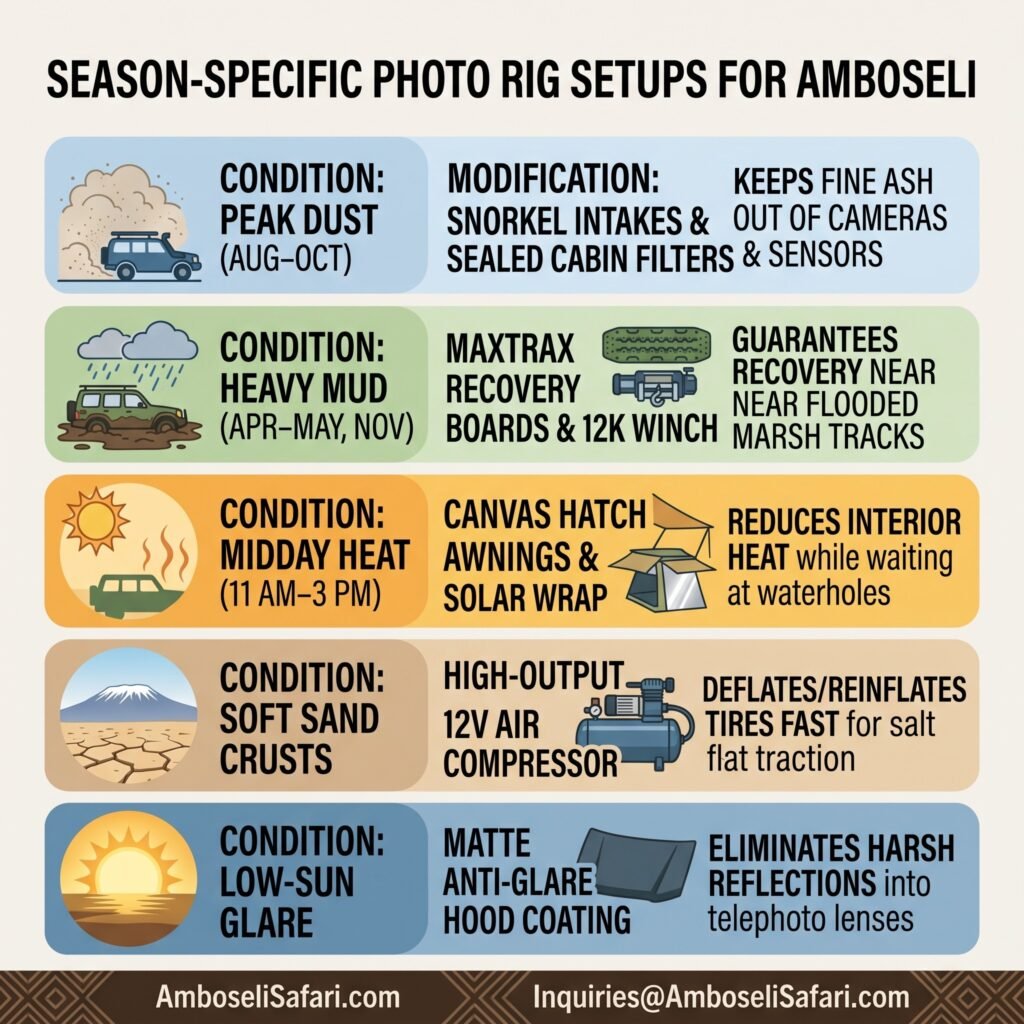
Amboseli’s extreme climate swings—from blinding volcanic dust storms to deep alkaline mud—require specific seasonal adjustments to safari vehicles. Utilizing the wrong setup can ruin delicate lens glass or leave you stranded during prime lighting hours. Use this field summary to understand how specialized modifications protect camera gear and ensure access to top shooting locations year-round.
| Season & Condition | Custom Vehicle Modification | Shooting Impact |
| Peak Dust (Aug–Oct) | Snorkel intakes & sealed cabin filters | Keeps abrasive fine ash out of camera bags & sensors |
| Heavy Mud (Apr–May, Nov) | Maxtrax recovery boards & 12k winch | Guarantees vehicle recovery near flooded marsh tracks |
| Midday Heat (11 AM–3 PM) | Canvas hatch awnings & solar wrap | Reduces interior heat build-up while waiting at waterholes |
| Soft Sand Crusts | High-output 12V air compressor | Deflates tires for traction on salt flats & reinflates fast |
| Low-Sun Glare | Matte anti-glare hood coating | Eliminates harsh hood reflections into telephoto lenses |
Support Mounts and Driver Positioning
Our window rails are wrapped in thick foam padding that grips Wimberley side-mount clamps tightly. They hold heavy lenses like a 400mm f/2.8 or 600mm f/4 completely solid. When we pull the middle seats out, flat floor plates give you a rigid surface for ground-level plate mounts or shortened tripods.
Having a driver who knows how to read light is just as important as the truck itself.
Our drivers pull up at a 45-degree angle to the early morning sun. That side-lighting catches the deep skin texture on an elephant’s trunk while keeping Mount Kilimanjaro sharp in the background. Down near the wet marshes of Enkongo Narok at dusk, we line up right into the setting sun for golden rim-lighting on wading storks. Instead of driving straight at a herd, our guides watch where the animals are walking and park 100 meters ahead. The elephants walk right toward your lens.
Dust Control and Emergency Kits
That fine white volcanic dust (Empusel ash) gets everywhere.
When we’re driving between Kimana Gate and Ol Tukai, our drivers keep a 200-meter gap behind any vehicle ahead. We lock the front roof hatch shut while moving and leave just the rear hatch cracked open. That creates positive air pressure inside the cabin, pushing dust outward and keeping gear safe inside your bags. It’s worth reading through our self-drive track and spacing rules if you plan on navigating these roads yourself.
Every vehicle carries a basic camera rescue kit:
- Compressed air cans and rubber blower bulbs for clearing grit off lens elements.
- Spare inverter fuses and multi-socket surge strips.
- Heavy-duty 12V air compressor to drop tire pressure on soft salt crusts and pump back up for asphalt.
Low Angle Floor Mount Mods
Shooting down from a high roof hatch compresses perspective. Big tuskers look surprisingly small against Mount Kilimanjaro when shot from nine feet up.
We pull out the middle row of seats completely and lay down thick foam floor pads. You can lie flat on your stomach and shoot through open lower side doors just 1.5 feet off the ground. That low perspective drops the horizon line down, making big tuskers look massive against the sky. If you’re looking to track specific herds for low-angle shots, we’ve mapped out their favorite crossing corridors in our guide to tracking big tuskers.
Bush Flight Beanbag Secrets and Nairobi Supermarkets
Strict 15 kg baggage limits on Safarilink and Airkenya flights into local airstrips mean you shouldn’t waste weight carrying pre-filled beanbags from home.
Pack empty canvas beanbag shells in your main duffel bag instead. When your driver picks you up in Nairobi, ask to stop at a supermarket like Carrefour or Naivas. Buy 3 to 5 kg of cheap dried kidney beans or rice to fill your bags in the truck. When the trip ends, leave the beans with the camp kitchen staff so your return flight luggage stays light. You’ll find more packing tips in our seasonal travel planning guide.
Field Disclaimers & Real-World Photography Risks
Great wildlife photography means dealing with tough local conditions:
- Heat shimmer gets brutal after 10:30 AM. Intense heat rising off the salt pans ruins telephoto focus beyond 100 meters, so get your critical shots between 06:15 AM and 08:30 AM while the air is still cool.
- Never shoot with the engine idling. Diesel motor vibrations travel right up through the roof frame, so our drivers kill the ignition the second the truck stops.
- Driving off marked tracks to get closer to an animal is strictly illegal inside national park grounds. Bring a 400mm or 600mm lens so you can reach animals resting away from the road.
If you haven’t picked a camp yet, our breakdown of top Amboseli lodges highlights which camps put you closest to the main photo tracks.
If you’re thinking about putting together a photo trip, drop us a line on our safari inquiry form or request a custom setup through our booking form.

Low-Angle Belly Shooting vs. High Hatch Shooting
Choosing the right shooting angle drastically changes the visual impact of wildlife photos taken in Amboseli. High-angle roof shots offer expansive views across the plains, while low-angle floor mounts create dramatic, larger-than-life portraits of big tuskers. Comparing these two perspectives helps photographers choose the best position for each sighting.
| Perspective Factor | Low-Angle Floor Mount | High Pop-Up Roof Hatch |
| Eye Level | 1.5 feet off the ground | 8 to 9 feet off the ground |
| Visual Impact | Makes elephants look monumental against sky | Compresses subject against broad landscape |
| Best Used For | Big tuskers, eye-contact portraits & horizon lines | Tracking herds in high grass & wide marsh scenes |
| Physical Setup | Lying flat on foam floor pads | Standing upright with padded window/rail support |
| Lens Range | Ideal for 70–200mm & 300mm primes | Best for 500mm & 600mm heavy telephotos |
Frequently Asked Questions
What base vehicle model do you use for photo safaris?
We run extended Toyota Land Cruiser 79 Series 4x4s with V8 Turbo Diesel engines. They’re customized with dual pop-up hatches, 1000W Pure Sine Wave inverters, padded floors for belly-shooting, and padded window rails for beanbags.
How many photographers share one vehicle?
We limit it to 2 or 3 photographers max per truck. That way, everyone gets full 360-degree shooting access across both sides without bumping long lenses.
Can I charge my camera batteries and laptop in the truck?
Yes, absolutely. Each rig has a 1000W Pure Sine Wave inverter wired to secondary auxiliary batteries. You can charge camera batteries, drone packs, and laptops safely while driving between sightings.
Why do drivers kill the engine during a shoot?
Because diesel engine vibrations travel straight through the chassis and roof rail, which blurs telephoto shots instantly. Shutting off the motor keeps your 500mm or 600mm lens rock-steady.