
Amboseli Conservancy Areas: Night Drives, Wildlife Corridors & Safari Packages
Overview
The Amboseli conservancy areas are private and community-owned wildlife sanctuaries wrapping around the borders of the national park. Spanning key territories like Selenkay, Kitirua, Elerai, and the massive Olgulului-Ololarashi Group Ranch, these conservancies protect vital migration corridors connecting Mount Kilimanjaro with the Chyulu Hills and Tsavo. Managed in partnership with local Maasai landowners, the conservancies allow activities prohibited inside the main park—including off-road tracking, guided night game drives, and walking safaris.
Fast Navigation Links
- Park vs. Conservancy Comparison
- Olgulului & Team Lioness Patrols
- Selenkay Night Drives & Airstrip
- Kitirua KWS Fee Bypass
- Elerai Corridor & Night Waterhole
- Safari Packages & Rates
- Frequently Asked Questions
Park vs. Conservancy Differences
Staying in the Amboseli conservancy areas changes how your safari runs once the sun goes down. Inside Amboseli National Park, Kenya Wildlife Service rangers enforce a strict 6:00 PM gate curfew. Outside on the private group ranches—Selenkay, Kitirua, Elerai, and Olgulului-Ololarashi—the night shift is just beginning.
| Feature | Amboseli National Park | Amboseli Private Conservancies |
| Night Drives | Prohibited (6:00 PM curfew) | Permitted with red-filtered spotlights |
| Walking Safaris | Restricted to designated spots | Guided foot patrols with Maasai rangers |
| Off-Road Driving | Strictly forbidden | Allowed for major cat sightings |
| Crowd Density | High vehicle concentration | Exclusive, low vehicle density |
Booking a stay on private concession land gets you away from busy public park tracks. You can sit with a spotlight watching a leopard hunt after dark, walk across open plains with Maasai trackers, or follow a cat sighting off-road without three dozen safari vans crowding the scene.
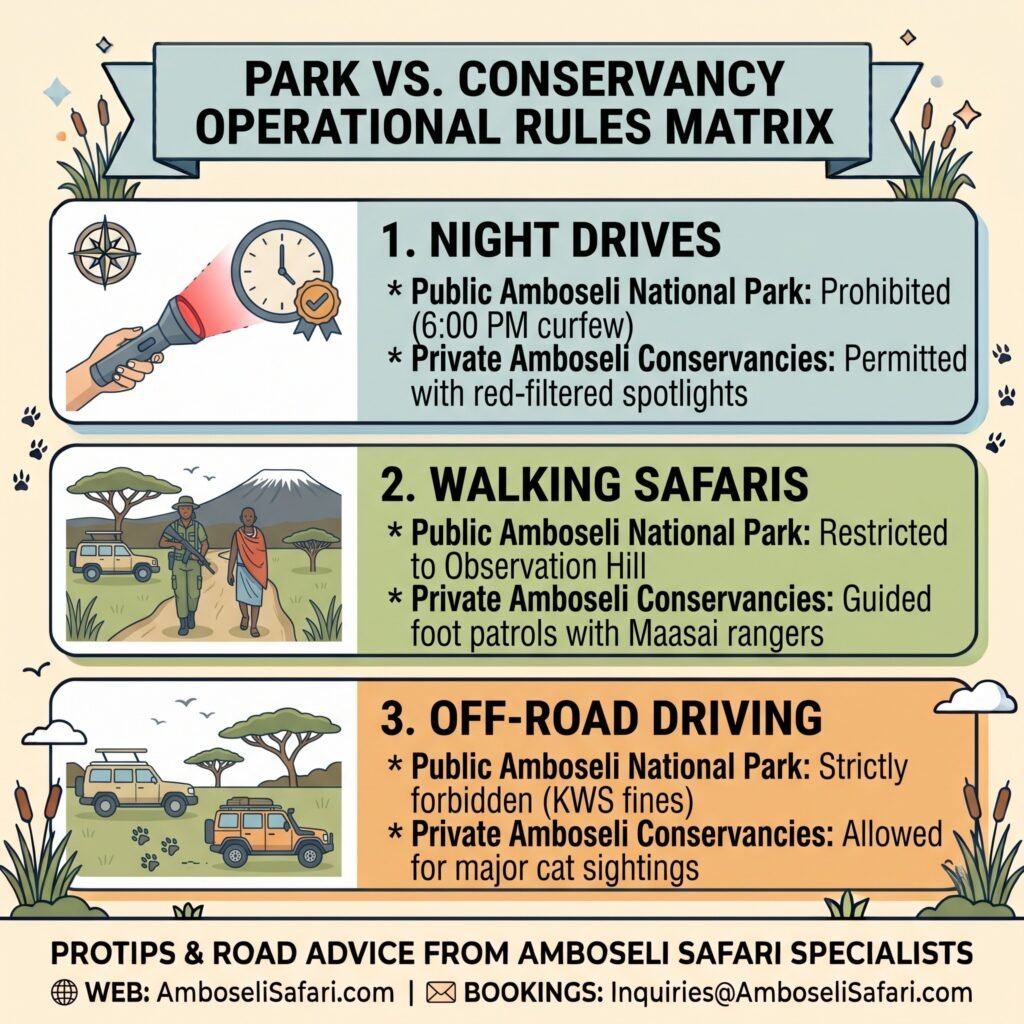
Park vs. Conservancy Operational Rules Matrix
Choosing between public park tracks and private concessions shapes the entire structure of an African safari. While state-run national parks enforce rigid curfews and stay on established dirt roads, neighboring group ranches offer flexible off-road tracking and night drives under star-lit skies. The matrix below contrasts the operational rules between public park territory and private conservancy lands.
| Operational Feature | Public Amboseli National Park | Private Amboseli Conservancies |
| Night Drives | Prohibited (6:00 PM curfew) | Permitted with red-filtered spotlights |
| Walking Safaris | Restricted to Observation Hill | Guided foot patrols with Maasai rangers |
| Off-Road Driving | Strictly forbidden (KWS fines) | Allowed for major cat sightings |
Olgulului-Ololarashi & Team Lioness Patrols
The Olgulului-Ololarashi Group Ranch wraps around the national park in a giant 475-square-mile horseshoe, forming the largest community buffer in the entire ecosystem. Because elephants and lions do not recognize park boundaries, herds spend half their time grazing across these private Maasai lands.
This vast territory is patrolled on foot by Team Lioness—one of East Africa’s first all-female indigenous Maasai ranger units, supported by the International Fund for Animal Welfare. These female rangers cover miles of wildlife corridors every day.
The unit is unarmed. Its rangers work directly with local pastoralists to settle human-wildlife conflicts, track lion movements near bomas, and protect migratory herds without conflict. Guests staying in Olgulului community camps can arrange informal briefings with the rangers to learn how they track herds on foot.
Ecosystem Conservation & Ranger Operations
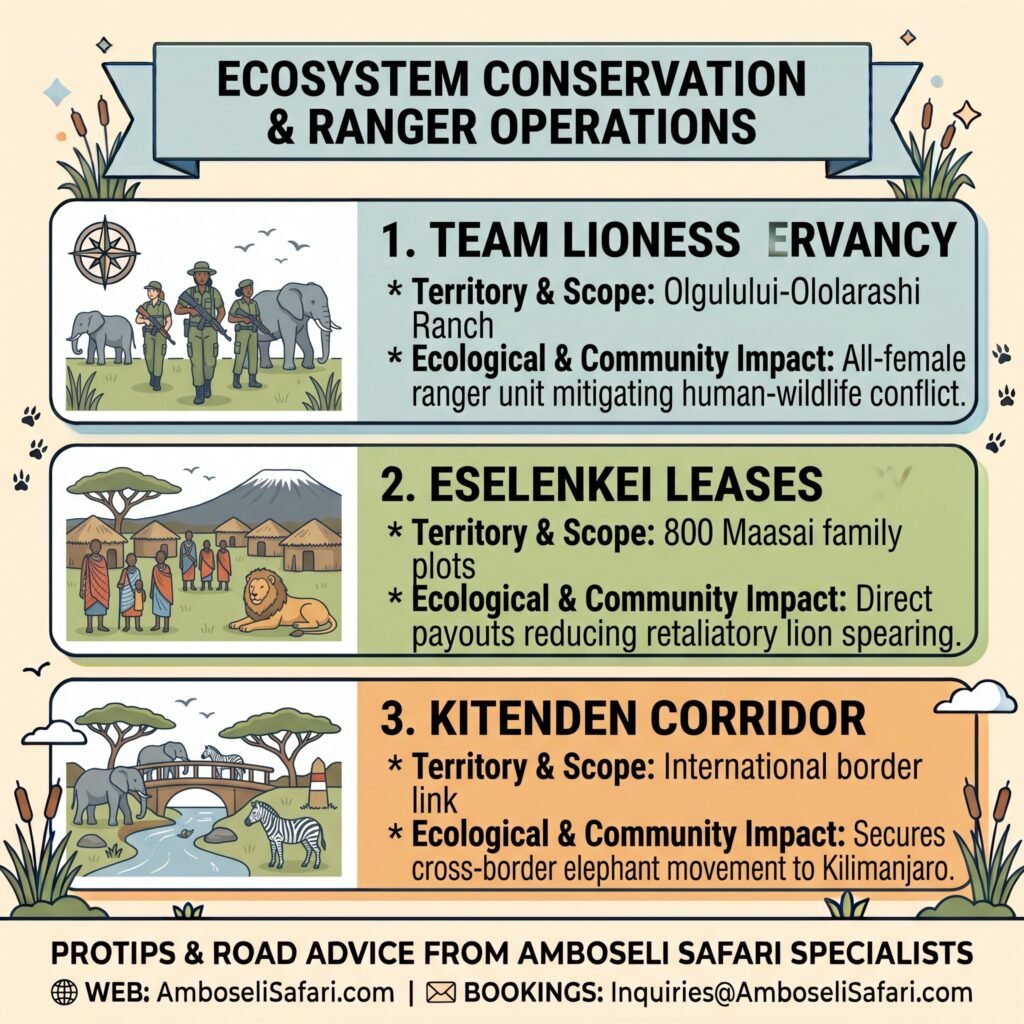
Protecting wide-ranging megafauna across the greater Amboseli ecosystem requires direct partnerships with indigenous Maasai landowners and dedicated foot patrols. Community lease models fund local schools and livestock compensation funds, turning former pastoralist boundaries into safe migration corridors. The conservation breakdown below outlines how community ranger units safeguard wild herds across private group ranches.
| Security / Patrol Unit | Territory & Scope | Ecological & Community Impact |
| Team Lioness | Olgulului-Ololarashi Ranch | All-female ranger unit mitigating human-wildlife conflict |
| Eselenkei Leases | 800 Maasai family plots | Direct payouts reducing retaliatory lion spearing |
| Kitenden Corridor | International border link | Secures cross-border elephant movement to Kilimanjaro |
Selenkay Conservancy: Red-Filtered Spotlights & Airstrip Logistics
Located north of the main park, Selenkay Conservancy sits on dry acacia scrub and sandy soils. This habitat is completely different from the deep, flooded mud channels of central Enkongo Narok swamp.
Night game drives inside Selenkay strictly require guide vehicles to use red-filtered spotlight lenses rather than harsh white beams. Red filters protect the eyesight of nocturnal animals and prevent hunting lions from using vehicle headlights to ambush prey. Because Selenkay’s sandy soil doesn’t flood, the terrain holds active breeding dens for nocturnal burrowers like bat-eared foxes and elusive aardwolves.
Fly-in travelers staying in Selenkay land directly at the private Selenkay Airstrip. Landing here skips the busiest airstrips inside the park and cuts out the 45-minute transit drive through public gates, letting you step off the plane and begin off-road game drives within ten minutes.
Here is how Selenkay works. Roughly 800 Maasai families of the Eselenkei Group Ranch lease their land directly to safari operators at a guaranteed annual rate per acre. Landowners receive reliable income regardless of seasonal tourist numbers. Revenue from these lease fees funds community school bursaries and livestock compensation funds, which reimburse herdsmen when lions attack cattle. This direct payout model has reduced retaliatory lion spearing across Selenkay by over 80%.
Kitirua Conservancy & The KWS Double-Pass Bypass
Spanning 30,000 acres along Lake Amboseli‘s southwestern margin, Kitirua Conservancy offers a major strategic advantage for travelers looking to manage their safari budget.
Guests staying inside Kitirua—such as at Elewana Tortilis Camp—can do night game drives, bush walks, and off-road tracking on private conservancy land without paying the KWS daily non-resident park fee ($90 per day) on days they stay strictly within Kitirua boundaries.
When you do decide to enter the main park, vehicles in Kitirua enter the southwest marshes directly through an unpaved conservancy boundary post, completely bypassing morning traffic queues at Meshanani Gate.
Elerai Conservancy, Kitenden Corridor & Night Waterholes
Elerai Conservancy covers 5,000 acres along the Kitenden Wildlife Corridor—the primary international transit route connecting Amboseli with Mount Kilimanjaro National Park across the border in Tanzania.
At the edge of the conservancy, the floodlit natural rock waterhole at Satao Elerai Camp sits directly beneath Kilimanjaro’s northern wall. Late at night—between 10:00 PM and 2:00 AM—elusive striped hyenas and leopards frequent this rock pool to drink in peace, away from the noisy hippo pods in the central swamps.
Elerai also offers interactive cattle drives. Instead of staged cultural dances, guests can walk alongside Maasai herdsmen as they move livestock through designated buffer zones. When Maasai cattle graze down the tall, woody stalks, fresh green grass sprouts in its place—drawing wild zebras and gazelles straight to the edge of the property.
Practical Trade-Offs & Field Strategy
Conservancies offer freedom and low vehicle numbers, but they come with real operational trade-offs you should plan for:
- Lower Animal Density: Central park swamps hold dense concentrations of wildlife around permanent water. Conservancies cover wider, dryer bush terrain, meaning you have to drive further to find game.
- Thicker Bush Cover: Heavy stands of yellow-fever trees make spotting big cats harder than on the open salt flats.
- Separate Conservancy Fees: Staying outside the park means paying daily conservancy fees, which are included in your lodge bill but must be factored into self-drive budgets.
During our morning briefing before heading out toward Selenkay, head guide Anthony Mule laid out a practical approach for travelers: “If you stay three nights, split them up. Put two nights in a private conservancy for the night drives and walking safaris, then spend one night near the central swamps so you don’t miss the massive elephant herds in the main marsh.” You get the night activities, and you still see the big herds.
Regional Conservancy Profiles & Features
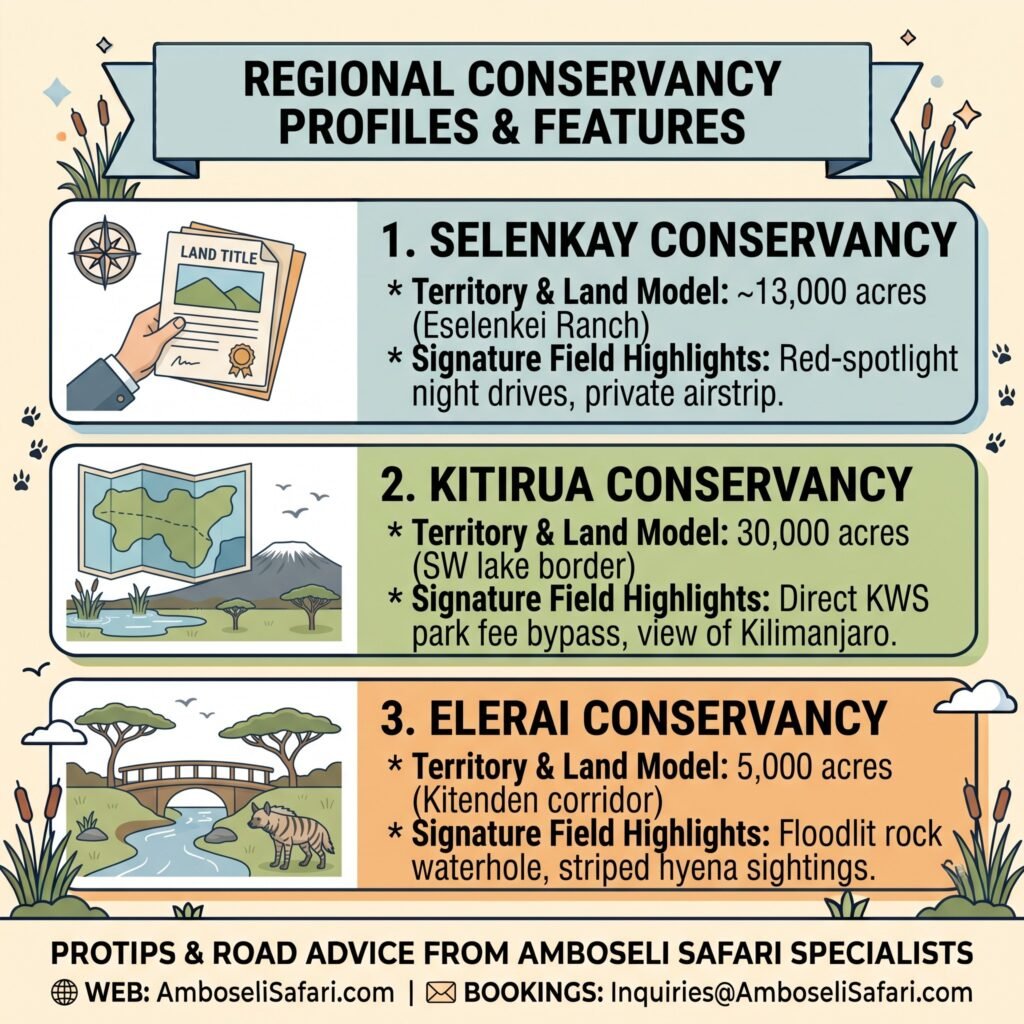
Surrounding the central swamps of Amboseli lies a mosaic of distinct community-owned conservancies, each offering unique landscapes and logistical benefits. From deep waterhole observation points in Elerai to exclusive flight transfers in Selenkay, selecting the right concession depends on your specific safari priorities. Review the conservancy profile guide below to compare acreage, location, and key field experiences.
| Conservancy Area | Territory & Land Model | Signature Field Highlights |
| Selenkay | ~13,000 acres (Eselenkei Ranch) | Red-spotlight night drives, private airstrip |
| Kitirua | 30,000 acres (SW lake border) | Direct KWS park fee bypass, view of Kilimanjaro |
| Elerai | 5,000 acres (Kitenden corridor) | Floodlit rock waterhole, striped hyena sightings |
Safari Packages & Seasonal Rates
Arranging a trip across the Amboseli conservancy areas requires coordinating private lodge bookings, conservancy fees, and KWS park permits. On Amboselisafari.com, our private tours combine your vehicle logistics, professional guide, full-board accommodation, and all conservation fees into one clear rate.
Our packages are calculated for two adults traveling together in a private 4×4 Safari Land Cruiser with a pop-up roof. Transport, fuel, and guide fees run USD 190 per person sharing per day during normal season and USD 400 per person sharing per day during peak dry season (July to October).
We recommend a 4-day multi-destination itinerary that combines private conservancies with Tsavo West National Park.
4-Day Amboseli Conservancies & Tsavo West Safari Packages
Prices are total per person based on two adults sharing accommodation and a private 4×4 Land Cruiser.
| Season & Tier | Included Lodges | Price Per Person (USD) |
| Normal – Budget | AA Lodge Amboseli & Rhino Valley Lodge | USD 1,370 |
| Normal – Mid-Range | Ol Tukai Lodge & Kilaguni Serena Lodge | USD 1,610 |
| Normal – Luxury | Tortilis Camp (Kitirua) & Severin Safari Camp | USD 2,150 |
| Normal – Luxury Plus | Angama Amboseli & Finch Hattons | USD 3,560 |
| Peak – Budget | AA Lodge Amboseli & Rhino Valley Lodge | USD 2,300 |
| Peak – Mid-Range | Ol Tukai Lodge & Kilaguni Serena Lodge | USD 2,600 |
| Peak – Luxury | Tortilis Camp (Kitirua) & Severin Safari Camp | USD 3,250 |
| Peak – Luxury Plus | Angama Amboseli & Finch Hattons | USD 5,050 |
Book a Custom Safari Package today to design a private itinerary tailored around your preferred travel dates.
Package Inclusions:
- Private 4×4 Safari Land Cruiser with pop-up roof for game drives.
- Services of a TRA-licensed, English-speaking driver-guide.
- All KWS park entry fees and conservancy conservation fees.
- Full board accommodation (breakfast, lunch, dinner) at listed properties.
- Unlimited bottled drinking water in the vehicle.
- Emergency medical evacuation insurance cover.
Package Exclusions:
- International flights and Kenyan electronic Travel Authorization (eTA) fees.
- Driver-guide tips, alcoholic drinks, and personal laundry.
- Optional activities such as hot air balloon flights.
Optional Add-Ons:
- Maasai Cultural Village Visit: USD 30 per person.
- Amboseli Hot Air Balloon Safari: USD 450 per person.
- One-Way Flight Upgrade (Wilson Airport to Selenkay Airstrip): USD 540 per person (Includes flight, landing fees, and bush transfers).
Frequently Asked Questions
Do I have to pay KWS park fees if I only stay in a conservancy?
No. If you spend your entire day inside a private conservancy like Kitirua or Selenkay and do not enter the main national park gates, you only pay the conservancy daily fee. You only pay KWS park fees ($90 USD/day) on days you physically cross into the national park.
Are night game drives safe in Amboseli conservancies?
Yes. Night game drives are conducted in custom open 4×4 safari vehicles accompanied by experienced driver-guides and spotters using red-filtered spotlights. Red filters prevent blinding animals and ensure safe, low-impact wildlife viewing.
Can children participate in conservancy walking safaris?
Most conservancy lodges permit guided bush walks for children aged 12 and older when accompanied by an armed ranger and local Maasai tracker. Younger children can usually take shorter nature walks within fenced lodge perimeters.