
Walking Safaris Amboseli: Conservancy Trails, Tracking Secrets & Rates
Overview
Stepping out on Walking Safaris Amboseli lets you explore private conservancy trails on foot beside Maasai warriors. While Kenya Wildlife Service bans walking inside the main park—except at Observation Hill—outer reserves offer guided bush tracking beneath Mount Kilimanjaro.
Fast Navigation Links
- 2027 Walking Safari Packages Rates
- Best Season for Walking Safaris
- Conservancy Walking Comparison Matrix
- Daily Timeline and Physical Demands
- Boots Gaiters and Volcanic Gravel
- Maasai Ethnobotany and Bush Medicine
2027 Walking Safari Packages & Cost Breakdown
When you take to the bush on foot, having a support vehicle nearby matters. A private 4×4 Land Cruiser drops you at outer conservancy trailheads at first light, staying within radio contact while carrying extra canteens, daypacks, and heavy camera gear.
Rates below cover two adults sharing a private 4×4 Land Cruiser:
3-Day & 4-Day Amboseli Walking Safari Packages
| Package Tier & Accommodations | Standard Season (USD / Person)* | Peak Season (USD / Person)* |
| 3-Day Budget Walking Safari (Penhy Tented Camp / Kili Spring Camp / Amboseli Gateway Camp) | $1,180 | $1,880 |
| 3-Day Mid-Range Walking Safari (Kilima Safari Camp / Sentrim Amboseli Wing / Maasai Land Tented Lodge) | $1,480 | $2,180 |
| 3-Day Luxury Walking Safari (Tawi Lodge Reserve / Satao Elerai Tented Suites / Penhy Luxury Wing) | $1,980 | $2,780 |
| 4-Day Fly-In Luxury Plus Safari (Flight + Ol Donyo Lodge / Campi ya Kanzi / Elewana Tortilis Bush Suites) | $3,950 | $5,950 |
*Rates cover 2026/2027 for two adults sharing a room or suite with private 4×4 Land Cruiser ground transport. Standard season runs January through May and November. Peak season covers June through October and December. Prices include full-board accommodation, private transport, guide fees, fuel, daily $90 USD Kenya Wildlife Service (KWS) park permits, and private conservancy walking permits. Fly-in options include roundtrip flights from Wilson Airport (WIL) on Safarilink or Airkenya plus airstrip transfers.
To reserve your dates or customize a multi-day walking route with our team, send us your details through our safari inquiry form.
Package Inclusions
- Private 4×4 Safari Land Cruiser for transfers to conservancy trailheads
- TRA-licensed driver-guide paired with a Maasai Moran tracker
- Armed conservancy or KWS ranger escort
- Full-board lodging (breakfast, lunch, and dinner)
- Pre-paid KWS entry permits and conservancy walking fees
- Chilled bottled drinking water kept in the vehicle cooler
Package Exclusions
- International flights, travel insurance, and digital entry processing via the eTA portal
- Tips for driver-guides, armed rangers, and local trackers
- Personal laundry or alcoholic drinks at lodges
- Optional cultural village visits ($30) or balloon flights ($450)
Optional Add-Ons
- Night game drive in Selenkay or Elerai: USD 50 per person
- Sunrise hot air balloon flight over central marshes: USD 450 per person
We lay out complete transport logistics, fuel allowances, and permit calculations on our Amboseli safari cost breakdown page.
Best Season for Walking Safaris
Seasonality dictates whether you are strolling over short stubble or struggling through deep mud.
From June to October and again from January to February, dry weather dries out the plains. Wildlife grazes the grass down to short stubble, giving you clear sightlines across the scrub. Predators cannot hide close to walking paths unnoticed, making open tracking significantly safer. Water sources dry up on the outer ranches, forcing animals to gather around permanent conservancy pans.
The rains in April, May, and November present real challenges on foot. Heavy downpours turn the fine volcanic ash into thick, grey clay that sticks to your boot soles like wet cement. Perennial grass shoots up six feet tall in a matter of days. That high cover hides lions, requiring armed rangers to double their safety buffers and change routes frequently.
Conservancy Walking Comparison Matrix
Terrain dictates the walk. Some reserves give you wide ridge views, while others wind through shaded fever-tree groves along dry riverbeds.
| Conservancy | Area Size | Dominant Terrain | Signature Walking Experience |
| Selenkay Conservancy | 15,000 Acres | Dense acacia scrub & dry sand rivers (laggas) | Tracking big game along sandy riverbeds far from vehicle tracks. |
| Elerai Conservancy | 5,000 Acres | Volcanic ridges & open grass plains | Elevated ridge walks facing Mount Kilimanjaro with sweeping valley views. |
| Kitirua Conservancy | 30,000 Acres | Open alkaline salt flats & marsh edges | Tracking elephant family groups wending toward southern marshes. |
| Kimana Sanctuary | 5,700 Acres | Yellow-fever tree forests & river corridors | Shaded tree walks tracking resident bull elephants and riverine birdlife. |
To see how conservancy camps compare with boundary lodges, check our recommendations on where to stay in Amboseli.
Daily Timeline & Physical Demands
Morning bush walks operate on a strict clock to beat the heat.
- 06:00 AM: Quick coffee and biscuits at camp while your guide runs through emergency signals.
- 06:30 AM: Step off onto the trail just as early sunlight turns the snow on Kilimanjaro pink.
- 08:30 AM: Walk into a mobile bush breakfast setup in a dry sand riverbed.
- 09:30 AM: Board the Land Cruiser for the drive back to camp.
Expect to cover three to five miles per outing. We keep the pace slow and educational. The ground is mostly flat, but stepping over loose volcanic gravel and hidden aardvark holes means these walks are not suitable for anyone with bad ankles or severe mobility limits.
Dual Escort Safety Rules on Conservancy Trails
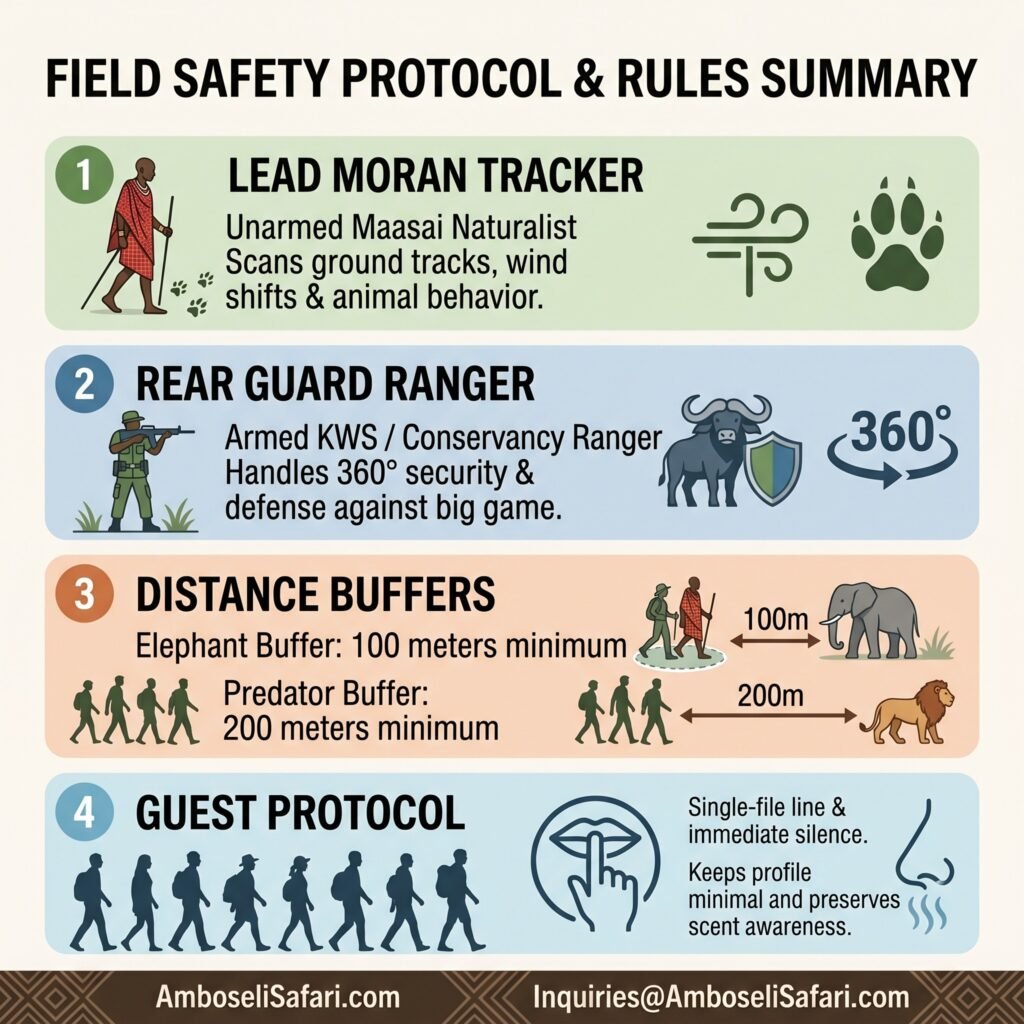
Walking into territory shared with large mammals requires strict safety protocols. While many travelers assume this region falls under Narok County Council, the Amboseli ecosystem sits in Kajiado County under KWS wildlife management oversight.
You never step onto a trail here with just one guide. Walking teams rely on a two-person escort system for maximum protection:
- An armed KWS or conservancy ranger carries a high-caliber rifle to handle safety against unpredictable animals like solitary bull buffaloes. The ranger walks at the back, scanning 360 degrees constantly.
- Ahead of the group walks an unarmed Maasai Moran (warrior naturalist). Raised on these outer ranches, a Moran notices things most people miss—a slightly bent blade of grass, a faint footprint edge, or a fresh pile of dung. A quick, quiet whistle from the Moran tells everyone to freeze instantly.
Field Safety Protocol & Rules Summary
Stepping out into open wilderness requires a clear understanding of field protocol and safety roles. While walking safaris provide an intimate look at the savanna, clear team mechanics ensure guest safety around big game. This quick reference breaks down the mandatory roles, safety protocols, and key distance buffers enforced on outer conservancy trails.
| Safety Element | Requirement / Rule | Primary Purpose |
| Lead Moran Tracker | Unarmed Maasai Naturalist | Scans ground tracks, wind shifts & animal behavior |
| Rear Guard Ranger | Armed KWS / Conservancy Ranger | Handles 360° security & defense against big game |
| Elephant Buffer | 100 meters minimum distance | Prevents matriarch stress & defensive charges |
| Predator Buffer | 200 meters minimum distance | Avoids startling hidden lions or big cats |
| Guest Protocol | Single-file line & immediate silence | Keeps profile minimal and preserves scent awareness |
Boots, Gaiters & Volcanic Scoria Terrain
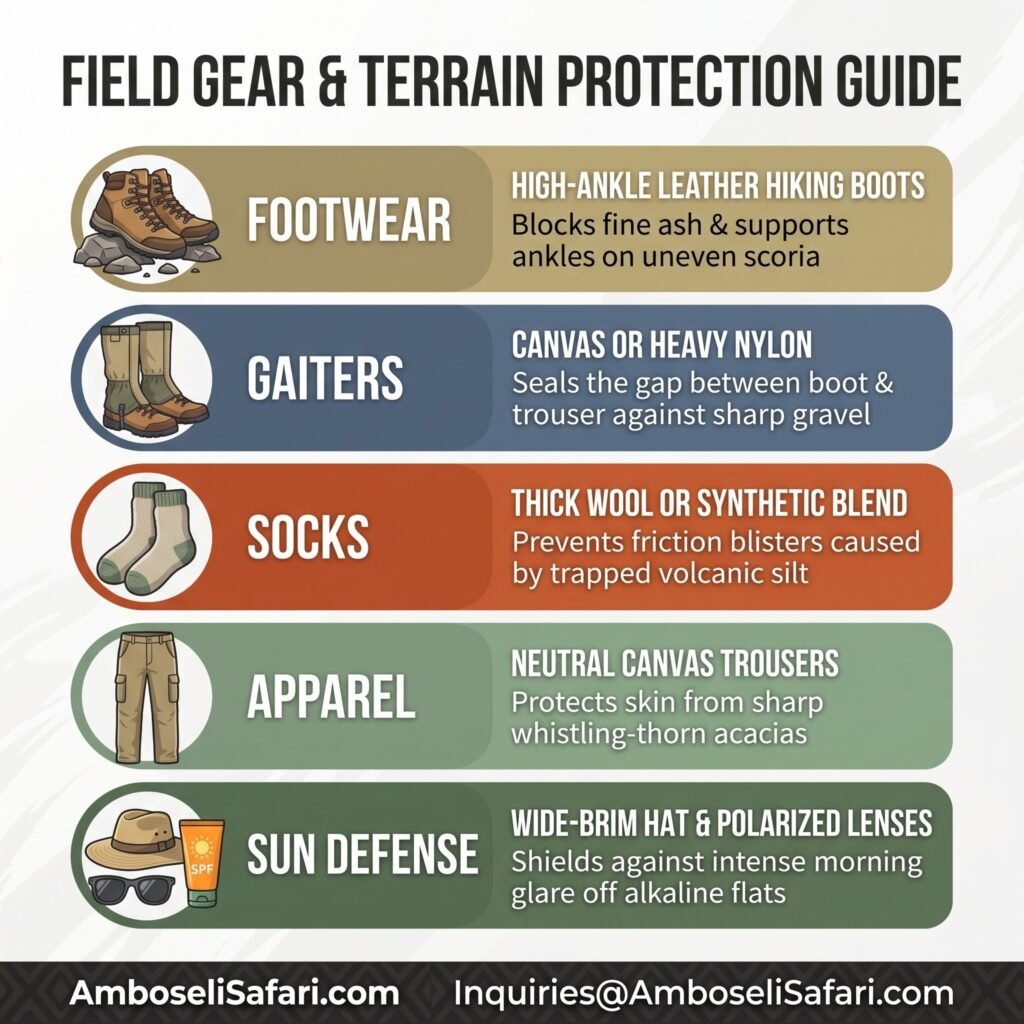
Standard mesh running shoes fail miserably out here. Fine volcanic ash cuts right through breathable shoe mesh within twenty minutes. Once inside, that abrasive silt mixes with sweat and turns your socks into sandpaper.
The ground across the outer basin alternates between razor-sharp volcanic scoria stones and chalky white dust (Empusel).
To protect your feet:
- Pack high-ankle leather hiking boots that keep dust out.
- Wear canvas or nylon gaiters to bridge the gap between your boots and trousers.
- Use thick wool socks to cushion against sharp scoria gravel.
You can check our complete packing checklist and seasonal weather recommendations in our Amboseli safari planning guide.
Field Gear & Terrain Protection Guide
Navigating Amboseli’s outer basin presents unique terrain challenges, from sharp scoria rocks to abrasive volcanic silt. Standard sports footwear quickly fails under these harsh field conditions. Use this mobile packing guide to select gear engineered to protect your feet and ensure a comfortable trek.
| Gear Item | Recommended Feature | Why It Matters |
| Footwear | High-ankle leather hiking boots | Blocks fine ash and supports ankles on uneven scoria |
| Gaiters | Canvas or heavy nylon | Seals the gap between boot and trouser against sharp gravel |
| Socks | Thick wool or synthetic blend | Prevents friction blisters caused by trapped volcanic silt |
| Apparel | Neutral canvas trousers | Protects skin from sharp whistling-thorn acacias |
| Sun Defense | Wide-brim hat & polarized lenses | Shields against intense morning glare off alkaline flats |
Maasai Ethnobotany and Bush Medicine
Game drives focus on the big stuff—elephants, lions, and giraffes. A bush walk brings your attention down to the smaller details of how the savanna survives.
As you follow dry drainage lines, Maasai naturalists share practical plant knowledge passed down through generations:
- Toothbrush Bush (Salvadora persica / Oremit): Guides snap off thin twigs and fray the ends with their teeth, showing how herders keep their teeth clean and gums healthy without toothpaste.
- Umbrella Acacia (Acacia nilotica / Ol-kiloriti): Naturalists strip the inner bark to boil a dark, bitter tonic that Maasai warriors drink for energy before long treks.
- Yellow-Fever Tree (Acacia xanthophloeia): Crushing the sticky green leaves releases aromatic oils used in the bush to soothe insect bites.
Ash Wind Testing & Wildlife Safety Buffers
Elephants have poor eyesight, but their sense of smell is sharp. Research from the Amboseli Elephant Research Project shows how matriarchs rely heavily on scent to evaluate threats.
When tracking elephants on foot in Kitirua or Selenkay, Maasai guides carry small leather pouches filled with fine volcanic ash. Squeezing the pouch releases a puff of dust that drifts on the light morning breeze, showing subtle shifts in wind direction.
If the wind shifts toward a herd within 150 meters, matriarchs flare their ears and trumpet. To keep things calm, guides maintain a zig-zag route that keeps the walking group downwind at all times.
Rangers enforce strict distance limits:
- Elephants & Solitary Buffaloes: Minimum 100-meter buffer.
- Lions & Predators: Minimum 200-meter buffer (guides alter direction immediately if fresh tracks indicate big cats are nearby).
To learn more about matriarch behaviors and family structures, explore our famous elephants guide.
Walking Safaris vs. 4×4 Game Drives
Combining walking safaris with vehicle game drives gives you the best of both worlds:
- 4×4 Game Drives: Ideal for covering wide distances, crossing deep mud near Enkongo Narok swamp, and getting close-up photos of lion prides or large elephant herds out on the open salt flats.
- Walking Safaris: Slow, quiet, and hands-on. You learn how to read tracks, smell crushed herbal plants, and experience the savanna at ground level without engine noise.
Observation Hill Stone Path: The Park’s Only Foot Trail
Walking on foot inside KWS National Park grounds is strictly illegal almost everywhere to protect visitors from wildlife encounters. The single official exception is the stone hiking trail ascending Observation Hill (Noomotio).
Driver-guides park Land Cruisers at the base parking area, letting you hike a 15-minute volcanic stone pathway leading to a thatched lookout shelter. From the summit, you enjoy sweeping 360-degree views across central marshes as elephant herds wade through green sedges below.
Self-drive travelers can review park rules and parking navigation details on our Amboseli self-drive tips page.
Sand Rivers and Bush Breakfast Ends
Bush walks run during the cool morning hours from 06:30 AM to 08:30 AM before the sun bakes the open plains.
Anthony Mule, who coordinates our field guide team, often reminds guests that the simplest moments are the ones that stick: sitting in a dry sand riverbed with a tin cup of hot coffee while a herd of giraffes steps quietly across the ridge above you.
Instead of returning to a lodge dining room, morning walks end with a hot meal in the bush:
- In Elerai Conservancy, walking routes climb an elevated ridge facing Mount Kilimanjaro, where camp staff cook fresh eggs over glowing wood coals.
- In Selenkay Conservancy, walks finish in dry sandy riverbeds (laggas) under ancient acacia trees, with dining tables set directly on soft river sand.
Common Traveler Concerns & Field Realities
Stepping out of a vehicle into open wilderness requires respect for the environment:
- Midday Heat: The sun gets intense quickly after 09:00 AM. Drink water early, wear a wide-brimmed sun hat, and apply sunscreen before leaving camp.
- Acacia Thorns: Whistling thorn trees feature long, needle-sharp spines. Wear tough canvas trousers rather than light exercise leggings.
- Ranger Commands: You must follow safety instructions instantly. If a ranger tells you to freeze, crouch, or fall back, you do it without asking questions.
Community ranger networks supported by the Big Life Foundation patrol these outer conservancy corridors, protecting wild herds while keeping walking routes secure.
Ready to book a private Land Cruiser and driver-guide for your trip on Amboselisafari.com? Send your details through our safari inquiry form or reserve dates via our main safari booking form.
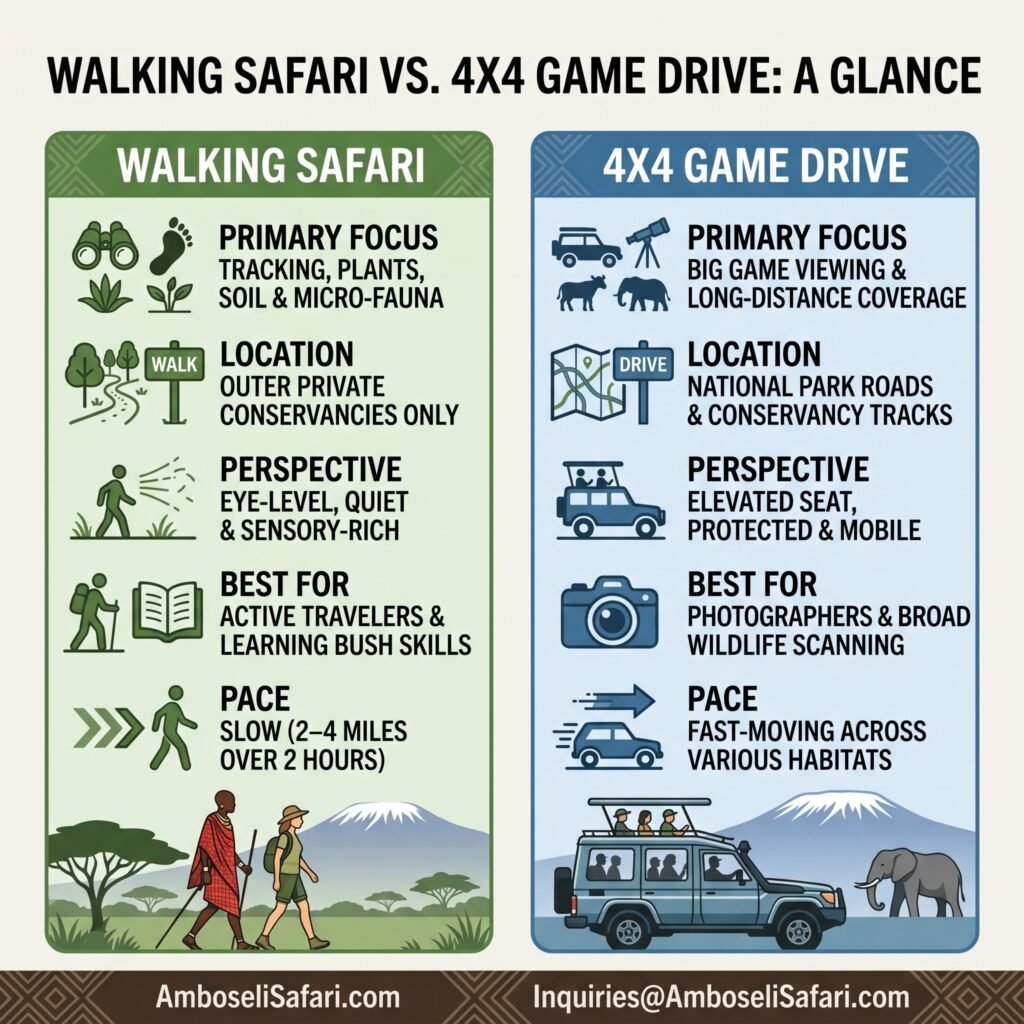
Walking Safari vs. 4×4 Game Drive at a Glance
Choosing between a traditional game drive and a guided walking safari depends on what you want to experience in Amboseli. While 4×4 vehicles offer broad territory coverage and quick photo opportunities, foot safaris deliver an immersive, slow-paced exploration of the ecosystem. Comparing these two formats helps travelers build a balanced, memorable itinerary.
| Feature | Bush Walking Safari | 4×4 Vehicle Game Drive |
| Primary Focus | Tracking, plants, soil & micro-fauna | Big game viewing & long-distance coverage |
| Location | Outer private conservancies only | National Park roads & conservancy tracks |
| Perspective | Eye-level, quiet & sensory-rich | Elevated seat, protected & mobile |
| Best For | Active travelers & learning bush skills | Photographers & broad wildlife scanning |
| Pace | Slow (2–4 miles over 2 hours) | Fast-moving across various habitats |
Frequently Asked Questions
Can you go on a walking safari inside Amboseli National Park?
No. Walking inside KWS National Park grounds is strictly prohibited everywhere except on the designated stone trail up Observation Hill (Noomotio). All open wilderness walking safaris take place on surrounding private conservancies.
Are walking safaris safe for families with children?
Yes, when operating under experienced guides. Most private conservancies enforce a minimum age of 12 years for open bush walks to ensure guests can follow ranger safety commands quietly during animal encounters.
What should I wear on a bush walk in Amboseli?
Wear sturdy, high-ankle leather boots, canvas trail gaiters, long trousers, a neutral-colored long-sleeved shirt (khaki or green), and a wide-brimmed sun hat. Avoid bright white or red clothing.
How long do morning walking safaris usually last?
Guided bush walks last between 1.5 and 2.5 hours, covering two to four miles at a relaxed, educational pace focused on tracking and flora.