
Dry Season Wildlife Viewing Amboseli: Swamps, Tracking & 2027 Rates
Overview
Experiencing Dry Season Wildlife Viewing Amboseli brings thousands of animals to central swamps under Mount Kilimanjaro. Kajiado County and Kenya Wildlife Service manage this dry basin where Amboseli Elephant Research Project herds gather when outer plains bake dry.
Fast Navigation Links
- 2027 Dry Season Package Rates
- Dry Season vs Green Season
- Species Spotting and Big Five
- Park Gate Access and Routes
- Monthly Climate and Temperature Data
- Dry Season Packing Gear Checklist
2027 Dry Season Safari Packages & Vehicle Rates
When surface water bakes off the outer plains between July and October, wildlife tracking concentrates around central spring channels. We run these safaris in open-topped 4×4 Land Cruisers fitted with high-clearance suspension to handle washboard dust tracks and muddy marsh crossings.
Rates below reflect total costs per person for two adults traveling together in a private 4×4 Land Cruiser:
3-Day & 4-Day Amboseli Dry Season Safari Packages
| Package Tier & Accommodations | Standard Season (USD / Person)* | Peak Season (USD / Person)* |
| 3-Day Budget Dry Season Safari<br>(Kibo Safari Camp / Kimana Bush Camp / Amboseli Junction Eco Lodge) | $1,180 | $1,880 |
| 3-Day Mid-Range Dry Season Safari<br>(Kilima Safari Camp / Amboseli Sopa Lodge / Zebra Plains Camp) | $1,480 | $2,180 |
| 3-Day Luxury Dry Season Safari<br>(Ol Tukai Lodge / Amboseli Serena Safari Lodge / Satao Elerai Camp) | $1,980 | $2,780 |
| 4-Day Fly-In Luxury Plus Safari<br>(Flight + Elewana Tortilis Camp / Tawi Lodge / Angama Amboseli) | $3,950 | $5,950 |
*Rates are valid for 2026/2027 for two adults sharing a room or tented suite with private 4×4 Land Cruiser ground transport. Standard season covers January through May and November. Peak season spans June through October and December. Rates cover full-board lodging, transport, guide allowances, fuel, daily $90 USD KWS park permits, and chilled vehicle water. Fly-in options include roundtrip domestic flights from Wilson Airport (WIL) on Safarilink or Airkenya plus airstrip transfers.
To hold specific travel dates or reserve a private vehicle with our team, send your trip details through our safari inquiry form.
Package Inclusions
- Private 4×4 Safari Land Cruiser with pop-up roof hatch and beanbag mounts
- Services of a TRA-licensed driver-guide skilled in tracking swamp corridors
- Full-board accommodation (breakfast, lunch, and dinner)
- Pre-paid daily $90 USD KWS park entry permits
- Chilled drinking water stocked in the vehicle cooler
Package Exclusions
- International flights, travel insurance, and entry processing via the official eTA portal
- Tipping your driver-guide or camp staff
- Alcoholic beverages, soft drinks, or personal laundry
- Optional Maasai village visits ($30) or hot air balloon flights ($450)
Optional Add-Ons
- Night game drive in a private conservancy: USD 50 per person
- Sunrise hot air balloon flight over central marshes: USD 450 per person
We lay out every vehicle day-rate, driver allowance, and permit calculation on our Amboseli safari cost breakdown page.
Dry Season vs. Green Season Comparison
Deciding when to plan your trip comes down to what you want out of the landscape. The dry season concentrates massive herds around open water, while the green season brings lush scenery and lower lodge rates.
| Feature & Factor | Dry Season (July – October) | Green Season (November – June) |
| Wildlife Visibility | Exceptional. Sparse grass forces animals into open marshes. | Moderate. Thick cover lets game scatter across outer plains. |
| Kilimanjaro Views | Clear morning skies; high afternoon dust haze. | Crisp, dust-free views after rain showers. |
| Dust & Road Conditions | Heavy white alkaline dust; firm salt pan tracks. | Deep mud along marsh tracks; zero dust. |
| Crowd Density | High vehicle numbers around central swamp roads. | Quiet tracks; few vehicles around waterholes. |
| Package Rates | Peak pricing across lodges and private Land Cruisers. | Standard and green season discounted rates. |
Underground Aquifers & The Morning Swamp Highways
Many first-time visitors confuse local administration with Narok County Council, but Amboseli sits in Kajiado County under strict KWS management.
By August, surface water across 90 percent of the park bakes into a cracked salt crust. Wildlife survival relies entirely on subterranean aquifers fed by Mount Kilimanjaro’s melting snowfields. Water flows underground through porous volcanic rock before bubbling up as permanent freshwater springs at Ol Okenya, Ol Tukai, Longinye, and Enkongo Narok swamp.
Field observations from our team at Amboselisafari.com show a predictable daily rhythm. Every morning around 09:00 AM, hundreds of elephants, buffaloes, zebras, and wildebeests march along beaten dirt tracks—known locally as elephant highways—moving from outer yellow-fever tree (Acacia xanthophloeia) scrublands directly into central marsh channels.
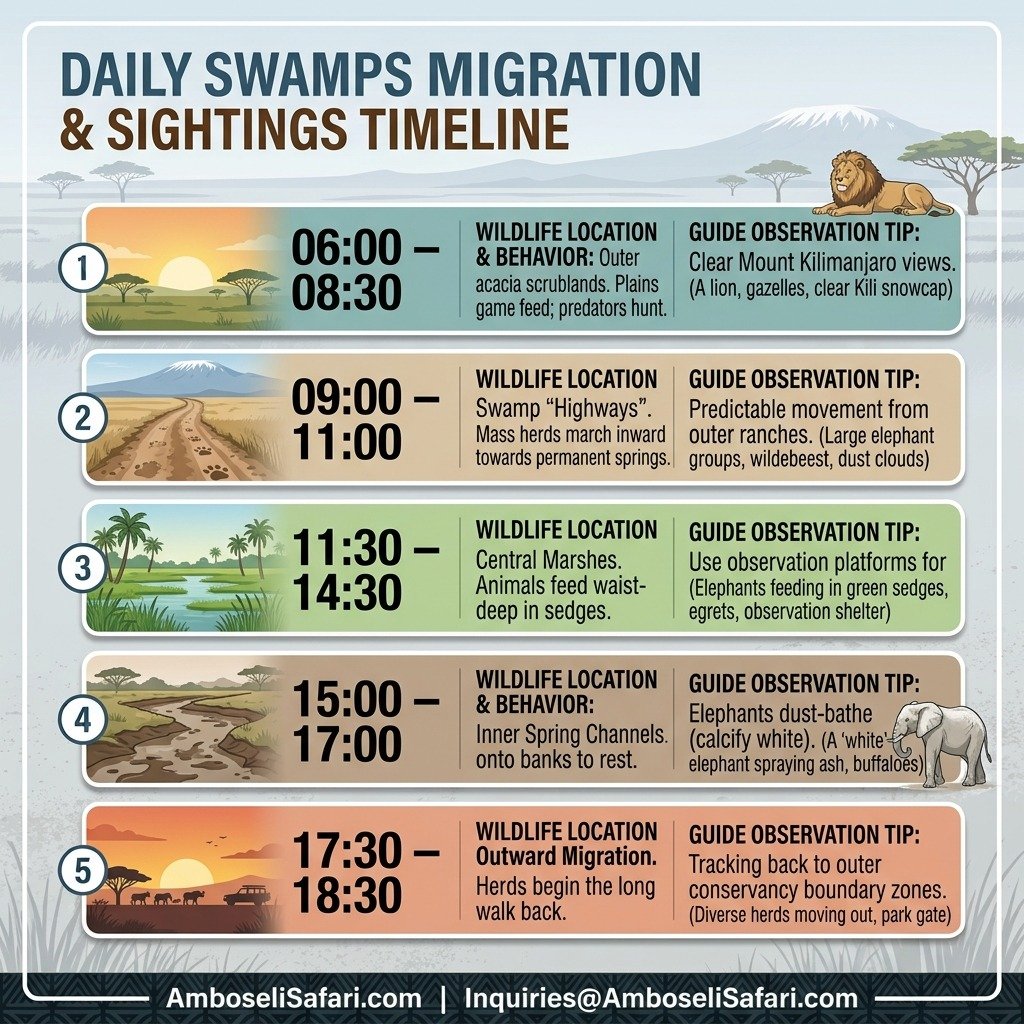
Daily Swamps Migration & Sightings Timeline
Dry season wildlife viewing in Amboseli follows a predictable daily rhythm driven by the search for water. While standard safaris drive randomly, success relies on syncing your movements with the migration corridors. This timeline breaks down the peak activity windows along the main “elephant highways” moving between outer scrublands and central marshes.
| Time Window | Wildlife Location & Behavior | Guide Observation Tip |
| 06:00 – 08:30 | Outer acacia scrublands | Plains game feed while predators hunt in cool air. Clear Kili views. |
| 09:00 – 11:00 | Swamp “Highways” | Mass herds march along beaten dirt tracks inward toward permanent springs. |
| 11:30 – 14:30 | Central Marshes | Animals feed waist-deep in sedges. Observation Hill offers top views. |
| 15:00 – 17:00 | Inner Spring Channels | Elephants climb onto banks to dust-bathe (calcify white) and rest. |
| 17:30 – 18:30 | Outward Migration | Herds begin the long walk back to outer conservancy boundary zones. |
“White Elephants” and Alkaline Dust Armor
If you’ve visited Tsavo, you know its famous “red elephants” that coat themselves in iron-rich soil. In Amboseli, dry season elephants take on a ghostly, calcified white appearance.
After feeding waist-deep in swamp sedges all morning, herds climb onto dry ground banks. They use their trunks to spray fine volcanic silt (Empusel ash) over their wet hides.
As the mineral-rich ash bakes under the afternoon sun, it hardens into a stark white shell. This layer serves two practical functions: it acts as a natural sunscreen against intense equatorial radiation and forms a physical shield against biting marsh flies.
To learn more about tracking these matriarchs along spring channels, explore our famous elephants guide.
Species-by-Species Spotting Matrix & Big 5 Expectations
While elephants dominate the landscape, the dry season concentrates predators and plains game along tight environmental zones:
| Species | Primary Habitat Zone | Best Tracking Window | Guide Pro-Tip |
| Cheetah | Open salt flats near Lake Amboseli bed. | 07:00 AM – 09:30 AM | Look for them scanning gazelles from raised termite mounds. |
| Leopard | Riverine acacia trees along Ol Okenya. | Pre-dawn & dusk drives | Scan thick horizontal branches of yellow-fever trees (Acacia xanthophloeia). |
| Giraffe | Boundary acacia scrub & Kimana corridor. | All day | They stay clear of deep mud, feeding along dry acacia margins. |
| Spotted Hyena | Den sites along dry salt pan edges. | 05:30 AM – 07:00 AM | Follow them as they head back to dens after night hunting near marshes. |
| Waterbirds | Longinye and Enkongo Narok open water. | Midday | Look for crowned cranes, saddle-billed storks, and white pelicans. |
The Big Five Reality Check
Travelers often ask if they can check off the full Big Five in Amboseli. You will easily see lions, leopards, elephants, and buffaloes. However, rhinos are absent from central park sectors. Black rhinos were relocated to secure sanctuaries like Tsavo and Lewa decades ago. If seeing a rhino is essential, pair your trip with a regional circuit.
Park Gate Access & Transit Logistics
Choosing the right gate cuts down on unnecessary washboard driving:
- Driving from Nairobi: The 215 km drive takes about 4 hours via the paved A109 highway to Emali, turning south onto the C102 tarmac road. You can also take the Namanga route along the Tanzanian border.
- Driving from Mombasa: Access the park via the C103 road through Tsavo West or enter directly via Kimana Gate.
- Iremito Gate (Northern Entry): Best entry point when driving down from Nairobi via Emali.
- Kimana Gate (Eastern Entry): Ideal for guests staying at eastern lodge clusters or coming from Tsavo.
- Meshanani Gate (Northwestern Entry): Quickest access to the dry bed of Lake Amboseli and western salt pans.
- Kitirua Gate (Southwestern Entry): Serves private conservancies along the Tanzanian border.
- Fly-In Logistics: Safarilink and Airkenya operate 45-minute daily flights from Nairobi’s Wilson Airport (WIL) directly to Amboseli Airstrip.
Monthly Climate & Temperature Metrics
The dry season brings warm, sunny days paired with surprisingly cold pre-dawn mornings:
| Month | Avg Daytime High (°C / °F) | Pre-Dawn Low (°C / °F) | Avg Relative Humidity |
| July | 24°C / 75°F | 13°C / 55°F | 71% |
| August | 25°C / 77°F | 13°C / 55°F | 70% |
| September | 27°C / 80°F | 14°C / 57°F | 65% |
| October | 28°C / 82°F | 15°C / 59°F | 65% |
Essential Dry Season Packing Checklist
Fine alkaline dust and cold pre-dawn winds require specific gear:
- Dust Protection: Pack two breathable cotton buffs or bandanas to cover your face when driving behind other vehicles on dry tracks.
- Eye Care: Bring saline eye drops. Fine volcanic ash (Empusel) suspended in the air dries out your eyes quickly.
- Camera Protection: Pack dust-proof camera rain covers or cotton towels to wrap around lens barrels during road transit.
- Optical Filters: Screw a circular polarizer onto your telephoto lens to manage harsh glare off white salt flats.
- Pre-Dawn Layering: Bring a fleece jacket, beanie, and windbreaker. Pre-dawn temperatures dip to 13°C before rising quickly after 09:00 AM.
You can review complete seasonal gear recommendations on our Amboseli safari planning guide.
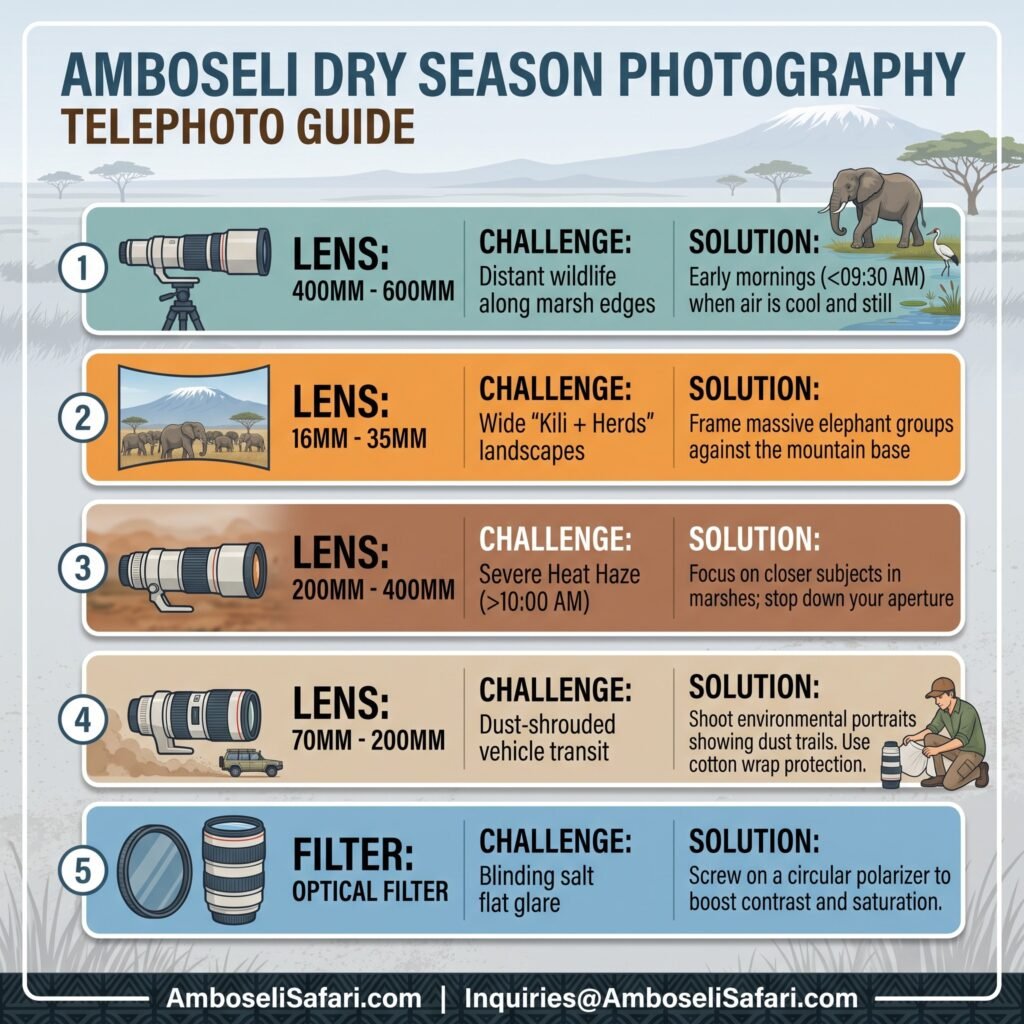
Dry Season Photography Telephoto Field Guide
Photographing Amboseli’s “white elephants” against the dry salt pans requires adapting your gear to challenging optical conditions. Intense equatorial glare off the alkaline crust and severe heat haze can ruin sharp images faster than a low battery. Use this technical field cheat sheet to select the right focal lengths and manage optical distortions across the basin.
| Optimal Lens | Field Condition / Challenge | Operational Solution |
| 400mm – 600mm | Distant wildlife along marsh edges | Early mornings (<09:30 AM) when air is cool and still. |
| 16mm – 35mm | Wide “Kili + Herds” landscapes | Frame massive elephant groups against the mountain base. |
| 200mm – 400mm | Severe Heat Haze (>10:00 AM) | Focus on closer subjects in marshes; stop down your aperture. |
| 70mm – 200mm | Dust-shrouded vehicle transit | Shoot environmental portraits showing dust trails. Use cotton wrap protection. |
| Optical Filter | Blinding salt flat glare | Screw on a circular polarizer to boost contrast and saturation. |
Photography Telephoto Guide & Route Mapping
Understanding optical limits on the salt flats keeps your images sharp:
Navigating Heat Haze
After 10:00 AM, intense ground heat rising off salt crusts creates severe thermal shimmering. Using a 600mm lens beyond 100 meters at noon results in soft, blurry images regardless of your shutter speed. Switch to a 300mm or 400mm lens and focus on animals feeding closer to marsh edges.
Route Tracking
Plan your morning drive starting at Iremito or Kimana corridors, moving inward to reach Ol Okenya and Longinye by 09:30 AM as elephant herds cross open tracks.
KWS Park Rules & Off-Road Regulations
Official Kenya Wildlife Service rules are strictly enforced across the park:
- Off-Road Driving Ban: Driving off marked tracks onto salt flats or swamp margins incurs immediate fines starting at $100 USD alongside vehicle impoundment.
- Marshland Boundaries: Drivers must maintain a safe distance from soft sedge edges to prevent vehicles from sinking into anaerobic black mud.
- Stay Inside Vehicles: Passengers must remain inside vehicles at all times, except at designated sites like Observation Hill (Noomotio).
- Speed Limits: The park speed limit is capped at 40 km/h to prevent dust buildup and protect wildlife crossing tracks.
Review self-drive spacing and track rules on our Amboseli self-drive tips page.
Beating Midday Crowds at Observation Hill (Noomotio)
The base parking lot at Observation Hill (Noomotio) gets congested with tour minibuses between 12:30 PM and 02:00 PM as groups stop for picnic lunches.
To avoid crowds and enjoy sweeping views of the green marshes below, change your timing:
- 06:30 AM Visit: Climb the stone pathway at sunrise when cool mountain air keeps the trail quiet and Kilimanjaro’s snowcap is clear of clouds.
- 05:00 PM Visit: Hike up late in the afternoon as shadow lines lengthen across the basin and tourist traffic drops off completely.
To compare accommodation options positioned close to central swamp tracks, check our guide on where to stay in Amboseli.
Electrostatic Interior Window Cleaning Protocol
Driving across dry salt flats creates electrostatic charges on your 4×4 that attract fine volcanic dust to the inside surface of the vehicle window glass.
Our senior guide, Anthony Mule, who brings ten years of field experience to these routes, advises wiping down interior window glass with a damp microfiber cloth before every morning drive.
If you leave that fine film on the glass, auto-focus camera sensors will lock onto the dusty window pane instead of the lion or elephant you are trying to shoot through a partially lowered window.
Ranger teams supported by the Big Life Foundation patrol these outer border corridors, keeping wildlife routes safe from poachers during dry season concentrations.
Ready to reserve your private Land Cruiser and driver-guide on Amboselisafari.com? Send your travel details through our safari inquiry form or book directly on our main safari booking form.
Washboard Tracks & Mud Traps Vehicle Gear
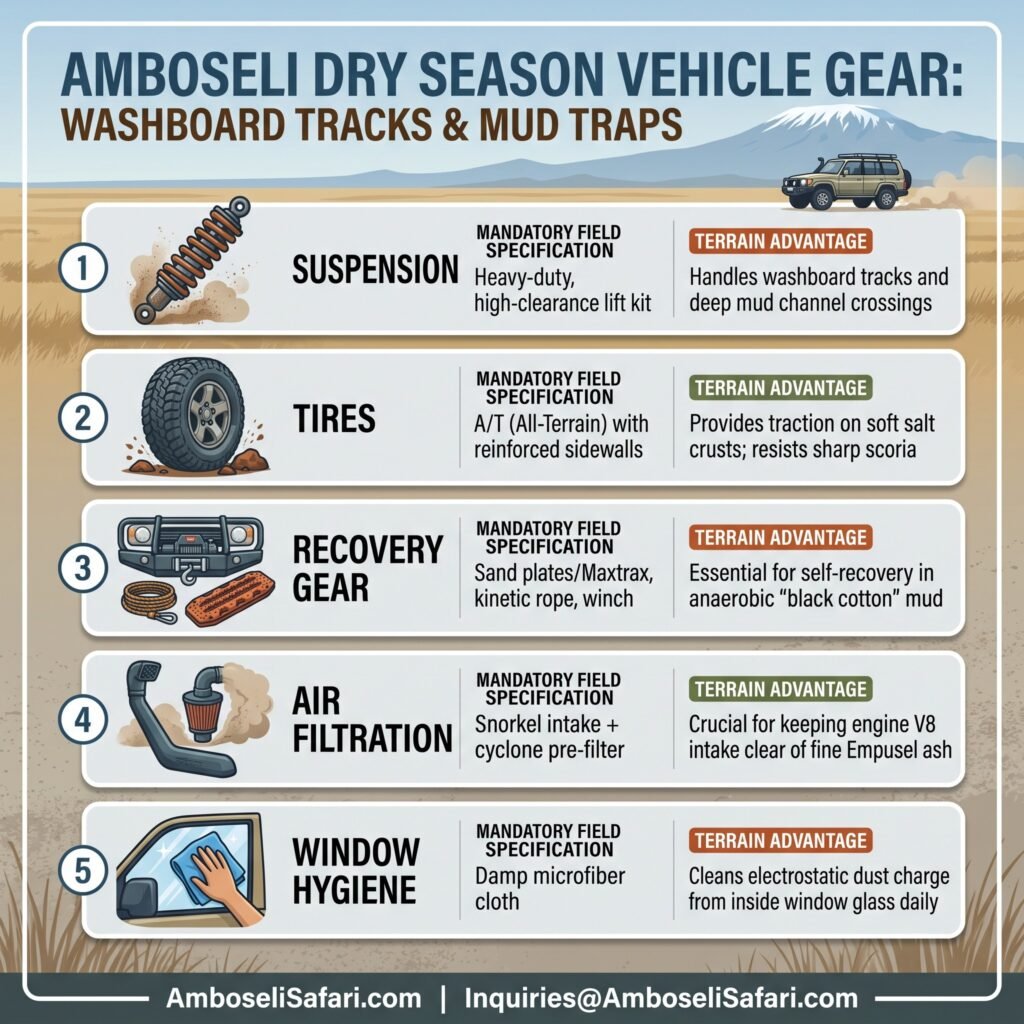
Dry season road conditions in Amboseli oscillate between loose, alkaline volcanic silt and black, anaerobic anaerobic marsh mud. While self-drive rentals might look capable, navigating these extremes takes heavy modifications and specific recovery gear. This summary outlines the crucial vehicle infrastructure required to handle high afternoon dust loads and safe marshland tracking.
| Vehicle Component | Mandatory Field Specification | Terrain Advantage |
| Suspension | Heavy-duty, high-clearance lift kit | Handles washboard tracks and deep mud channel crossings. |
| Tires | A/T (All-Terrain) with reinforced sidewalls | Provides traction on soft salt crusts; resists sharp scoria. |
| Recovery Gear | Sand plates/Maxtrax, kinetic rope, winch | Essential for self-recovery in anaerobic “black cotton” mud. |
| Air Filtration | Snorkel intake + cyclone pre-filter | Crucial for keeping engine V8 intake clear of fine Empusel ash. |
| Window Hygiene | Damp microfiber cloth | Cleans electrostatic dust charge from inside window glass daily. |
Frequently Asked Questions
Is 3 days enough time in Amboseli during the dry season?
Yes. A 3-day safari allows four game drives covering central marsh highways, Observation Hill, and private conservancy boundary routes without feeling rushed.
Which dry season month offers the clearest Kilimanjaro views?
July and August offer the clearest early morning mountain views with minimal cloud cover. By late September, airborne dust increases afternoon haze.
Are malaria risks higher or lower during the dry season?
Malaria risks are lower during the dry season because standing surface water across outer plains dries up completely, reducing mosquito breeding areas away from central swamps.
Why do elephants look white in Amboseli during the dry season?
Elephants spray white volcanic ash (Empusel) over their wet hides after bathing in swamps. As the mineral dust dries under the sun, it forms a protective white shell against heat and insects.