
Amboseli Safari with Kids: Vehicle Safety, Flights & Gear
Overview
Taking an Amboseli Safari with Kids offers incredible family wildlife viewing across Kajiado County—often confused with Narok County Council. The Kenya Wildlife Service manages this park where Amboseli Elephant Research Project herds roam around Enkongo Narok swamp beneath Mount Kilimanjaro.
Fast Navigation Links
- 4 Day Family Circuit Rates
- Fly Versus Drive Transit Logistics
- Booster Blocks and Vehicle Safety
- Kid Friendly Meals and Picky Eaters
- Age Limits and Activity Rules
- Family Gear Checklist and Medical
Taking your children into the bush takes careful prep. High pop-up vehicle hatches, freezing lodge pools, and long drives across open marshes present real challenges for small kids. When we take families out past Kimana Gate, simple adjustments to your vehicle and daily routine make the difference between a stressful trip and a great experience.
4-Day Multi-Destination Safari Package (2 Nights Amboseli + 1 Night Lake Nakuru)
Combining the elephant herds of Amboseli with the flamingo shores and rhino sanctuaries of Lake Nakuru makes an ideal, well-paced family circuit. We run this route using private 4×4 Safari Land Cruisers equipped with pop-up roof hatches, high-clearance suspension, and onboard fridges stocked with chilled bottled water.
Rates below show total costs per person for two adults traveling together with children:
4-Day Circuit Rates & Lodging Options
| Package Tier & Accommodations | Included Lodges & Hotels | Price per Person (Low – Peak)* |
| Budget Tier | Sentrim Amboseli Camp & Lake Nakuru Lodge | From USD $1,290 to USD $1,890 |
| Mid-Range Tier | Kilima Safari Camp & Sunbird Lodge Nakuru | From USD $1,620 to USD $2,380 |
| Luxury Tier | Ol Tukai Lodge & Sarova Lion Hill Game Lodge | From USD $2,240 to USD $3,150 |
| Luxury Plus Tier | Amboseli Serena Lodge & The Cliff Nakuru | From USD $3,920 to USD $5,580 |
Rates cover 2026/2027 travel for two adults sharing a room or tented family suite with a private 4×4 Land Cruiser and driver-guide. Standard/Low season covers January through May and November. Peak season spans June through October and December. Rates include full-board lodging, private transport, driver allowances, fuel, daily $90 USD KWS park permits (plus the mandatory 5% eCitizen gateway processing fee), Nakuru sanctuary fees, and chilled vehicle water. Luxury Plus includes domestic flights from Wilson Airport (WIL).
To reserve a private vehicle equipped for children, submit your travel details through our safari booking form.
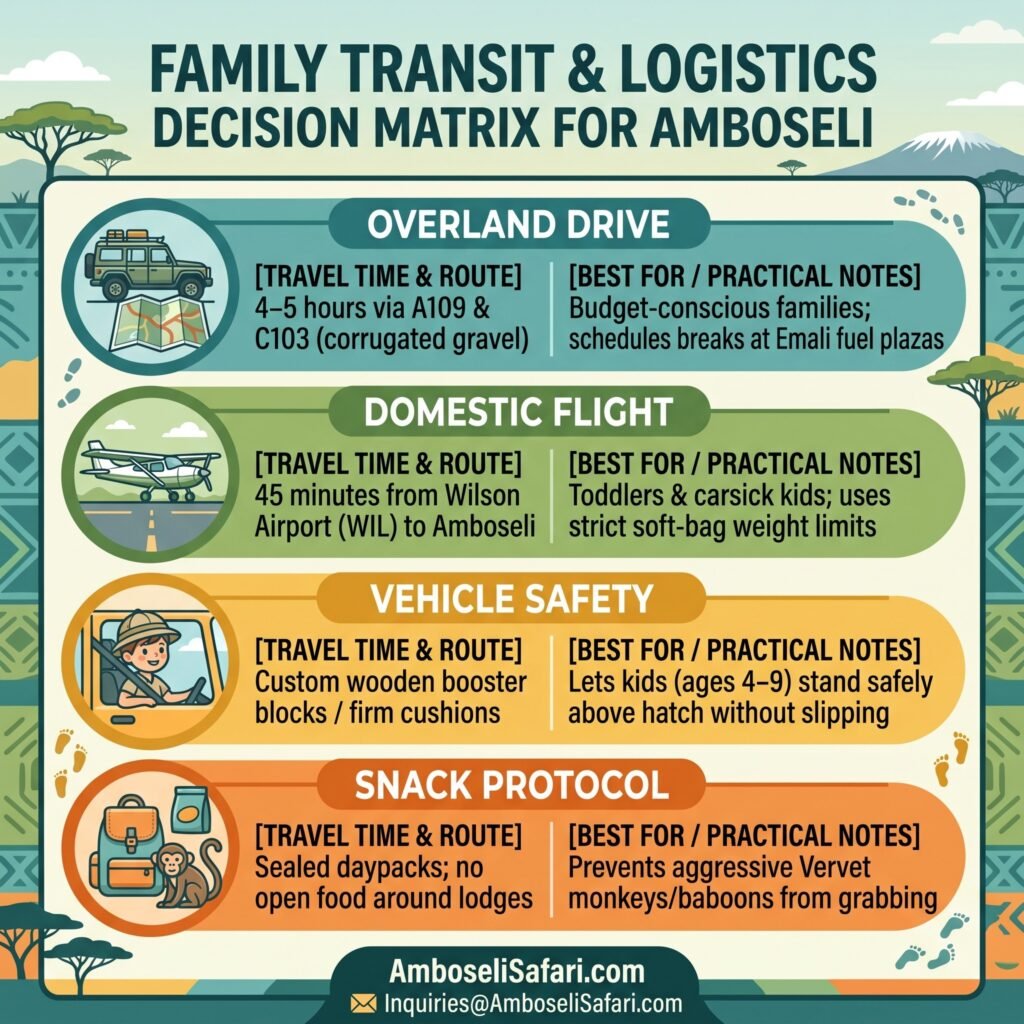
Family Transit & Logistics Decision Matrix
Planning transport logistics for an Amboseli safari with children requires balancing transit speed against budget and road conditions. Choosing between a 45-minute flight from Wilson Airport and a 4-to-5-hour overland drive depends heavily on your kids’ ages and carsickness tendencies. This decision matrix breaks down key transit logistics, safety setups, and comfort hacks to keep your family trip stress-free.
| Option / Factor | Travel Time & Route | Best For / Practical Notes |
| Overland Drive | 4–5 hours via A109 & C103 (corrugated gravel) | Budget-conscious families; schedules breaks at Emali fuel plazas |
| Domestic Flight | 45 minutes from Wilson Airport (WIL) to Amboseli | Toddlers & carsick kids; uses strict soft-bag weight limits |
| Vehicle Safety | Custom wooden booster blocks / firm cushions | Lets kids (ages 4–9) stand safely above hatch without slipping |
| Snack Protocol | Sealed daypacks; no open food around lodges | Prevents aggressive Vervet monkeys/baboons from grabbing snacks |
Package Inclusions
- Private 4×4 Safari Land Cruiser with pop-up roof hatch and custom beanbag mounts
- Dedicated, TRA-licensed driver-guide experienced with family groups
- Full-board accommodation covering breakfast, lunch, and dinner daily
- Pre-paid daily $90 USD KWS entry permits (plus 5% eCitizen fee) and Nakuru sanctuary passes
- Chilled drinking water stocked in the vehicle cooler
Package Exclusions
- International flights, travel insurance, and digital Kenya entry processing through the official eTA portal
- Tipping your driver-guide or lodge staff
- Alcoholic beverages, sodas, or personal laundry
- Optional Maasai village entry vouchers ($30) or hot air balloon flights ($450)
Optional Add-Ons
- Local village entry voucher & cultural walkthrough: USD 30 per person
- Night game drive in a private conservancy: USD 50 per person
- Sunrise hot air balloon flight over central marshes: USD 450 per person
Fly vs. Drive Transit Logistics for Families
Deciding how to get your family to the park comes down to budget and how well your kids handle long car rides:
- Driving from Nairobi (4 to 5 Hours): The route follows the paved A109 highway past Athi River before turning onto the C103 at Emali. Past Emali, the road becomes corrugated washboard gravel leading to Kimana Gate. We always schedule clean restroom breaks at major fuel plazas in Emali town (like Shell or Total). If your kids get carsick, bring motion sickness bands or chewables for that final bumpy dirt stretch.
- Flying from Wilson Airport (45 Minutes): Domestic flights on Safarilink or Airkenya leave from Nairobi’s Wilson Airport (WIL) and land directly at Amboseli Airstrip. Flying skips road fatigue entirely. It is by far the best option for toddlers who struggle in car seats.
Vehicle Cabin Safety Rules for Children
- Keep hands, arms, and heads inside the pop-up roof frame while the truck is moving.
- Stay seated on cushions during active predator sightings—never jump across bench seats.
- Keep voices down near elephant herds. High-pitched screams startle matriarchs fast.
Booster Blocks, Vehicle Safety & Binoculars
In standard 4×4 Safari Land Cruisers, roof handles and internal bench heights are built for adult bodies.
Children between 4 and 9 standing on leather seats during game drives risk losing their balance whenever the truck hits corrugated dirt. Standing on leather is slippery, making it hard for small hands to hold onto the roof frame.
We recommend requesting custom wooden footrest blocks or firm foam booster cushions when setting up your vehicle. Placing wooden blocks on the floor lets kids stand comfortably with their shoulders safely above the hatch line while keeping their feet planted.
Our senior guide, Anthony Mule, always carries child-sized 8×21 binoculars and a sketchbook in his truck. Giving children their own optics to scan the fever tree (Acacia xanthophloeia) thickets keeps them focused during slower drives. You can review seasonal route timing and vehicle prep in our Amboseli safari planning guide.
Kid-Friendly Meals, Milk & Picky Eaters
Lodge chefs know young travelers can be picky. Main buffets consistently serve plain pasta, fries, grilled chicken, rice, and fresh fruit spreads.
- Fresh vs. UHT Milk: Fresh pasteurized milk can be hard to find in remote camps, but long-life UHT milk boxes are everywhere. If your toddler needs specific milk, buy a carton grid in Nairobi before leaving.
- Formula & Bottle Sterilizing: Camp kitchens will boil water to sterilize baby bottles if you ask the manager.
- Vehicle Fridges: Our private 4×4 Land Cruisers carry electric onboard fridges to keep milk boxes, baby formula, and fruit cold on long drives.
Age Limits & Activity Rules
Standard game drives inside closed or pop-top trucks have no age limits, but specific activities enforce strict cutoffs:
- Bush Walks: Guided walking safaris near park boundaries require kids to be at least 12 years old due to safety rules around large wildlife.
- Conservancy Night Drives: Private conservancies surrounding the park set a minimum age of 6 for night game drives.
- Stroller Restrictions: Small bush planes cannot fit hard-shell strollers into their cargo holds. Bring a compact umbrella stroller or an ergonomic baby carrier for walking around camp paths.
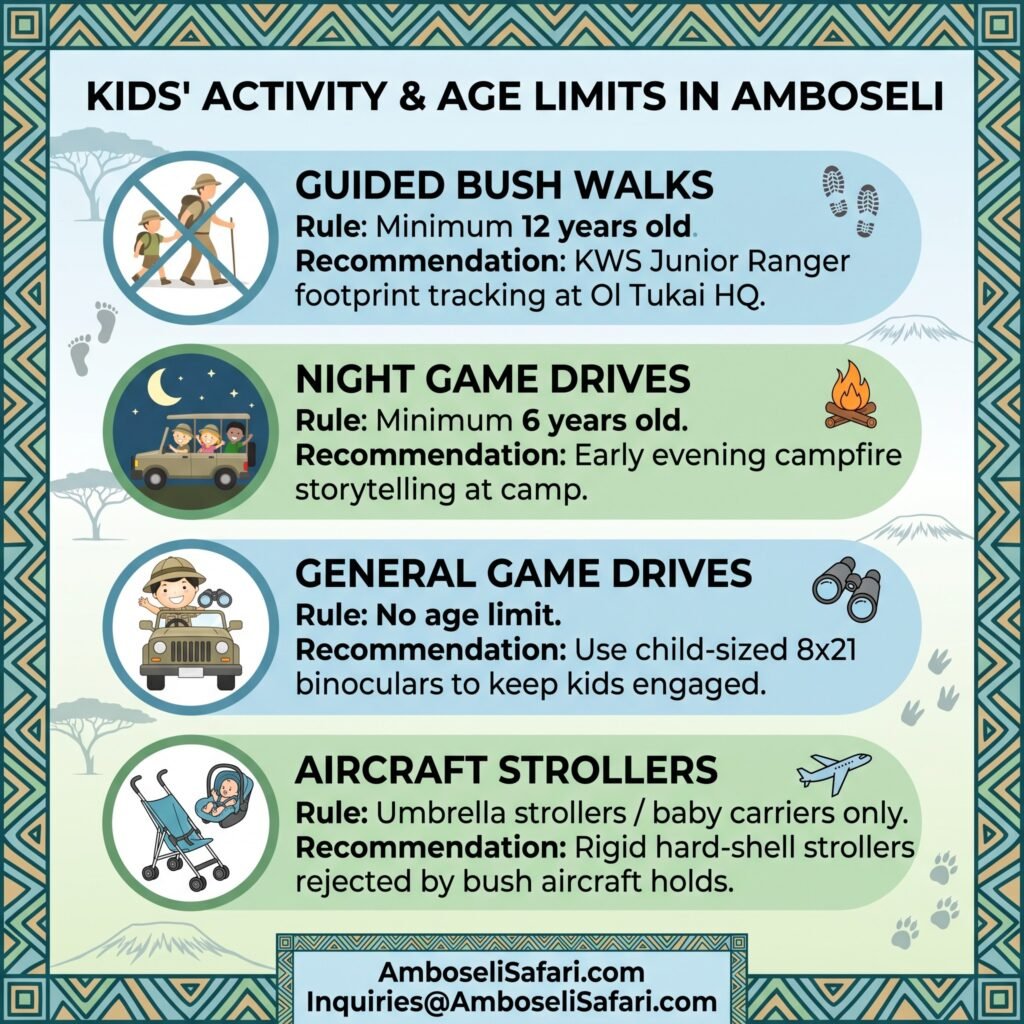
Kids’ Activity & Age Limits Quick Reference
Safari activities enforce strict age cutoffs and safety rules to protect families near large wildlife. While standard enclosed game drives welcome all ages, bush walks, night drives, and light aircraft transfers have firm restrictions. Review this quick-reference guide to understand age limits, gear requirements, and midday engagement options for your children.
| Safari Activity | Age Cutoff / Rule | Alternative / Recommendation |
| Guided Bush Walks | Minimum 12 years old | KWS Junior Ranger footprint tracking at Ol Tukai HQ |
| Night Game Drives | Minimum 6 years old | Early evening campfire storytelling at camp |
| General Game Drives | No age limit | Use child-sized 8×21 binoculars to keep kids engaged |
| Aircraft Strollers | Umbrella strollers / baby carriers only | Rigid hard-shell strollers rejected by bush aircraft holds |
Lodge Pools and Thermal Swimwear
Lodge pools inside and outside the park look inviting after a dusty 30°C afternoon drive. Parents are usually surprised by the water temperature.
The pools aren’t heated. They are filled with unheated mountain spring runoff from Mount Kilimanjaro. Even on hot afternoons, pool water stays around 18°C to 20°C (64°F to 68°F). Your kids will shiver in ten minutes. Pack UV thermal swim rashguards or thin neoprene swim vests so they can swim without catching a cold before the evening drive.
You can compare pool layouts and family settings in our guide on where to stay in Amboseli.
Bathroom Emergencies on Swamp Causeways
Game drives through central marsh sectors along the Enkongo Narok and Longinye causeways take you straight into lion and hippo territory.
Stepping out of the vehicle for a bathroom break is strictly forbidden by rangers. Public restrooms are miles away at Observation Hill (Noomotio) or Park HQ.
When driving through marsh tracks, keep leak-proof portable travel potties or gel urine pouches inside your daypack. Having a cabin option avoids panic when your truck gets stuck in traffic along narrow causeways. You can inspect marsh loops and toilet stops on our Amboseli National Park guide.
Primate Risks Around Lodge Grounds
At open-ground lodges, Vervet Monkeys (Chlorocebus pygerythrus) and Yellow Baboons watch guest verandahs for food all day.
Monkey warnings matter for small kids holding snacks:
- A child walking alone holding an open juice box, biscuit, or fruit risks an aggressive monkey lunging for the food.
- Keep all snacks sealed inside zipped daypacks until you sit down in enclosed dining halls.
- Remind kids never to feed or wave food at monkeys on room verandahs.
Check out elephant herd movements and shade stops in our famous elephants guide.
Managing Fine Dust and Nosebleeds
Fine, alkaline volcanic dust (Empusel) kicked up into open hatches reaches eye and nose level for seated children much faster than standing adults. Kids often get dry nosebleeds, coughing, and red eyes after open-roof drives across dry salt pans.
Apply a thin coating of petroleum jelly (Vaseline) inside your children’s nostrils before morning drives. In the evening at camp, flush their eyes and nasal passages with isotonic saline spray to clear out airborne silt.
If you plan to drive your own rig, review our practical Amboseli self-drive tips.
Kids’ Health, Dust & Wildlife Field Hacks
Placement: Inside the “Managing Fine Dust and Nosebleeds” section, right before the Emergency Medical & AMREF Evacuation Cover topic.
Intro Paragraph:
Fine volcanic silt, unheated pool water, and curious wildlife present unique challenges for young travelers in the African bush. Implementing simple, proactive routines—from nasal Vaseline barriers to thermal swim gear—prevents common issues like nosebleeds and cold chills. Use these practical health and safety tactics to keep your children comfortable throughout their safari experience.
| Hazard / Challenge | Field Solution for Kids | Why It Works |
| Volcanic Dust | Vaseline in nostrils + saline eye spray | Blocks silt from nasal lining; prevents dry nosebleeds & coughing |
| Cold Mountain Pools | UV thermal swim rashguards (neoprene) | Insulates against 18–20°C unheated mountain runoff pools |
| Bathroom Emergencies | Portable travel potty / gel urine pouches | Solves cabin emergencies along off-limit swamp causeways |
| Bumpy Tracks | Stand on floor blocks, not leather seats | Keeps feet planted and hands firmly on the pop-top frame |
| Flight Noise | Noise-canceling earmuffs | Dampens prop plane engine noise for infants and toddlers |
Emergency Medical & AMREF Evacuation Cover
Park dispensaries handle basic first aid, but they lack pediatric facilities for severe dehydration or acute high fevers.
Before leaving home, buy an AMREF Maisha Tourist Cover ($16 to $24 USD per person). In a medical emergency, AMREF dispatches an air ambulance directly to Amboseli Airstrip, flying your child straight to Nairobi Hospital’s pediatric ER unit. Local clinics in Kimana and Loitokitok offer basic stabilization for minor issues.
Family Seasonality Comparison
Choosing your travel month changes how your children experience the bush:
| Season & Months | Conditions for Children | Parent Recommendation |
| Dry Season (Jul–Oct, Jan–Feb) | High dust, easy wildlife spotting around swamps, warm days. | Best for kids 4+ (pack dust goggles and Vaseline). |
| Long Rains (Apr–May) | Heavy mud, higher mosquito activity, potential track delays. | Avoid with toddlers due to vehicle stick risk. |
| Short Rains (Nov–Dec) | Green views, clear skies, low dust, brief afternoon showers. | Ideal balance of lower rates and good weather. |
Maasai Village Visits: School Supplies vs. Candy
Visiting a local Maasai homestead (Enkang) near Kimana Gate is educational for kids, but handing out candy, plastic toys, or balloons causes tooth decay and plastic waste in livestock bomas.
Our guides coordinate with village elders (Oloiboni) so visiting kids can present exercise books, pens, or soccer balls directly to primary schools in Kimana Town instead. You can budget for village entry fees and guide allowances on our Amboseli safari cost breakdown page.
KWS Junior Ranger Footprints at Ol Tukai HQ
Keeping kids busy during the hot midday break between drives is easy if you know where to go.
The KWS Education Desk at Ol Tukai Park Headquarters hands out printed footprint tracking cards and junior ranger checklists. Kids can search for animal tracks along fenced lodge pathways and get their cards officially stamped by KWS rangers before afternoon drives start.
Family Safari Gear Checklist
Pack these essential items in your daypack before heading into the park:
- Dust-Proof Swimming Goggles: Keeps fine silt out of children’s eyes during windy salt pan drives.
- Pediatric Insect Repellent: DEET or Picaridin wipes made for young skin.
- Noise-Canceling Earmuffs: Cuts engine noise for toddlers on small domestic prop planes.
- Child-Sized 8×21 Binoculars: Lightweight optics keep kids actively scanning trees.
- Warm Morning Layers: Fleece jackets and beanies for cold 12°C pre-dawn drives.
- Petroleum Jelly & Saline Spray: Prevents dust nosebleeds and flushes silt out of eyes.
Frequently Asked Questions
What is the best age for a child on an Amboseli safari?
Children aged 5 and older generally get the most out of a safari. They can see over vehicle window sills, follow safety rules around animals, and handle 3-hour game drives without getting overly tired.
Are lodge swimming pools heated for children?
No. Lodge pools are filled with unheated mountain runoff from Mount Kilimanjaro and stay cold (18–20°C). Packing thermal swim rashguards keeps young kids warm.
How do we handle bathroom emergencies on long game drives?
Stepping out of vehicles is forbidden in swamp sectors. Keep leak-proof portable travel potties or gel urine pouches inside your daypack for cabin emergencies between designated toilet stops at Observation Hill or Park HQ.
Are malaria precautions required for children in Amboseli?
Yes. Permanent marshes mean mosquitoes are active year-round. Consult your pediatrician before travel for age-appropriate pediatric malaria prophylaxis, and use DEET insect repellent during morning and evening hours.