
Flying Safari vs Driving Safari Amboseli: Flight Tips, Road Rules & Costs
Overview
Deciding between a Flying Safari vs Driving Safari Amboseli shapes your travel budget and overall schedule. Managed by the Kenya Wildlife Service, options range from 45-minute bush flights to driving past Enkongo Narok swamp near Mount Kilimanjaro.
Fast Navigation Links
- Flying vs Driving Comparison Table
- 4 Day Safari Rates and Packages
- When Driving Beats Flying Costs
- Flight Restrooms and Road Pitstops
- Seasonal Weather Mud and Turbulence
- Private Airstrips versus Public HKAM
Deciding whether to take a quick domestic flight or drive down the highway comes down to a simple trade-off: time versus flexibility. Flying saves hours on the highway. You step off the plane refreshed and ready for game drives. Driving costs significantly less for families and groups, lets you stop whenever you see something interesting, and means you never have to weigh your camera bag on a scale.
When I coordinate trips at Amboselisafari.com, the biggest choice guests face is finding the right balance between convenience and budget. Here is how both options actually work on the ground.
Flying vs. Driving Comparison Table
| Safari Feature | Flying Safari (Cessna 208B) | Driving Safari (4×4 Land Cruiser) |
| Travel Time from Nairobi | 45 minutes from Wilson Airport (WIL) | 4 to 5 hours on the highway |
| Budget Estimate | $350 – $450 USD per seat round-trip | $190 – $400 USD vehicle/day (split by group) |
| Luggage Allowance | 15 kg (33 lbs) strictly in soft bags | Full trunk space for hard cases and gear |
| Onboard Restroom | None on 14-seater bush planes | Restroom stops at highway gas stations |
| Schedule Control | Fixed daily flight departures | 100% flexible departure times |
| Park Ticket Clock | Activates instantly upon landing | Starts only when passing park gates |
4-Day Multi-Destination Safari Package (2 Nights Amboseli + 1 Night Lake Naivasha)
You can combine a stay near Mount Kilimanjaro with the shaded shores of Lake Naivasha for a well-paced trip. We run ground trips in private 4×4 Safari Land Cruisers equipped with pop-up roof hatches, heavy-duty suspension, and vehicle fridges stocked with cold bottled water. For fly-in guests, domestic flight connections smoothly link Nairobi’s Wilson Airport directly with the park airstrip.
Rates below show total costs per person for two adults traveling together:
4-Day Package Rates & Lodging Options
| Package Level & Details | Included Lodges & Hotels | Price per Person (Low – Peak)* |
| Budget Option | Kibo Safari Camp & Naivasha Kongoni Lodge | From USD $1,290 to USD $1,890 |
| Mid-Range Option | Amboseli Eco Camp & Lake Naivasha Resort | From USD $1,630 to USD $2,390 |
| Luxury Option | Tawi Lodge & Great Rift Valley Lodge | From USD $2,250 to USD $3,290 |
| Luxury Plus Option (Fly-In) | Elewana Tortilis Camp & Kiboko Luxury Camp Naivasha | From USD $4,150 to USD $6,100 |
Rates cover 2026/2027 travel for two adults sharing a room or tented suite with a private 4×4 Land Cruiser and driver-guide. Standard/Low season covers January through May and November. Peak season spans June through October and December. Rates include full-board lodging, private ground transport, driver allowances, fuel, daily $90 USD KWS park permits (plus the mandatory 5% eCitizen gateway processing fee), Naivasha sanctuary passes, and chilled vehicle water. Luxury Plus includes domestic scheduled flights from Wilson Airport (WIL) on Safarilink or Airkenya.
To check open dates or organize a custom fly-in or driving itinerary, submit your details through our safari booking form.
What’s Included
- Private 4×4 Safari Land Cruiser with pop-up roof hatch and custom beanbag mounts
- Dedicated, TRA-licensed driver-guide for ground transfers and game drives
- Full-board accommodation covering breakfast, lunch, and dinner daily
- Pre-paid daily $90 USD KWS entry permits (plus 5% eCitizen fee) and Lake Naivasha sanctuary passes
- Scheduled domestic flights for Luxury Plus tier (Wilson Airport to Amboseli Airstrip)
- Chilled drinking water stocked in the vehicle cooler
What’s Excluded
- International flights, travel insurance, and digital Kenya entry processing through the official eTA portal
- Tipping your driver-guide or lodge staff
- Alcoholic beverages, soft drinks, or personal laundry
- Optional Maasai village entry vouchers ($30) or hot air balloon flights ($450)
Optional Add-Ons
- Local village entry voucher & cultural walkthrough: USD 30 per person
- Night game drive in a private conservancy: USD 50 per person
- Sunrise hot air balloon flight over central marshes: USD 450 per person
When Driving Beats Flying: Group Cost Math
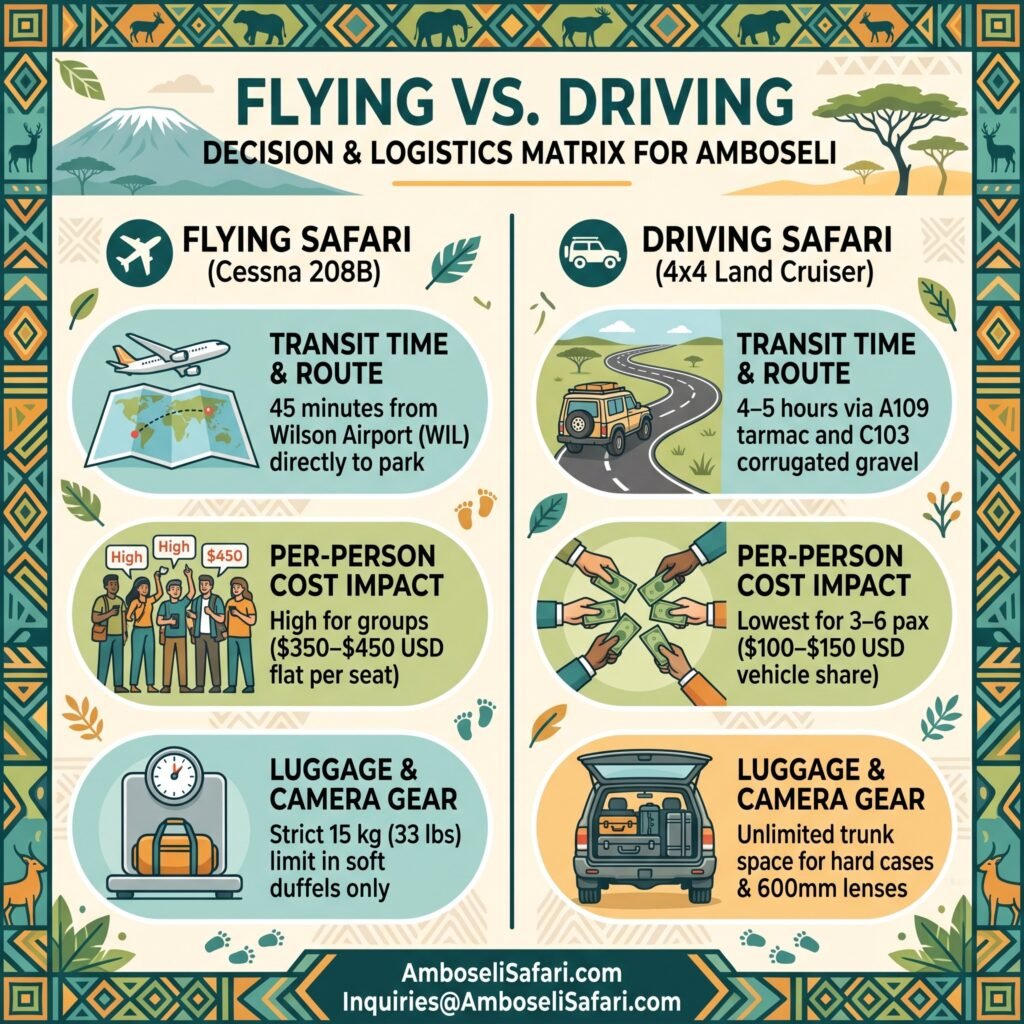
If you are traveling as a family or group, driving changes the financial equation completely.
For solo travelers and couples, flying and driving cost roughly the same. A round-trip flight seat runs between $350 and $450 USD per person. When only one or two people pay for a private Land Cruiser, absorbing the $190 to $400 daily vehicle rental, fuel, and driver fee alone costs about the same as buying two flight tickets.
The math changes as soon as you add a third or fourth person:
- Groups of 3 to 6 Travelers: Hiring one 4×4 Land Cruiser splits the vehicle and fuel fee across all passengers. Your per-person transport cost drops to roughly $100–$150 USD for the entire trip.
- Family Savings: A family of four saves well over $1,000 USD by driving instead of buying four round-trip airline tickets. You can review detailed vehicle rates and permit fees on our Amboseli safari cost breakdown before setting your budget.
Flying vs. Driving Decision & Logistics Matrix
Choosing whether to fly or drive to Amboseli impacts your budget, schedule, and luggage flexibility depending on your group size. While domestic flights bypass long highway journeys, overland driving becomes significantly more cost-effective as soon as three or more passengers share a single vehicle. Use this quick-reference matrix to compare travel times, per-person costs, and luggage constraints before making your reservation.
| Travel Factor | Flying Safari (Cessna 208B) | Driving Safari (4×4 Land Cruiser) |
| Transit Time & Route | 45 minutes from Wilson Airport (WIL) directly to park | 4–5 hours via A109 tarmac and C103 corrugated gravel |
| Per-Person Cost Impact | High for groups ($350–$450 USD flat per seat) | Lowest for 3–6 pax ($100–$150 USD vehicle share) |
| Luggage & Camera Gear | Strict 15 kg (33 lbs) limit in soft duffels only | Unlimited trunk space for hard cases & 600mm lenses |
Airplane Seating for Mount Kibo Views
Flight views of Mount Kilimanjaro start before your wheels touch the dirt runway. Scheduled flights leaving Nairobi’s Wilson Airport (WIL) on Safarilink or Airkenya use 14-seater Cessna 208B Grand Caravan aircraft.
- Nairobi to Amboseli: Pick a seat on the right side of the cabin when boarding at Wilson Airport. As the plane descends into the basin, right-side windows give you unblocked aerial views of Mount Kibo’s snowcap.
- Amboseli to Nairobi: Choose a seat on the left side of the plane to catch the mountain backdrop as you climb out.
- Seat Selection: Boarding is first-come, first-served on small bush planes. Get to the gate early.
You can organize flight times and road connections through our Amboseli safari planning guide.
Onboard Restrooms and Highway Pitstops
Plane flights on this route are short, but you won’t find a bathroom onboard.
- Cessna Caravans Have No Toilets: The small 14-seater planes used for this 45-minute flight do not have restrooms. Use the facilities at Wilson Airport’s passenger lounge before boarding.
- Highway Gas Stations Are Clean: The drive from Nairobi follows the A109 highway through Athi River, Machakos Junction, and Sultan Hamud before reaching Emali town. Modern fuel stations in Athi River and the Shell or Total stations in Emali have clean, fully tiled restrooms and coffee shops. Expect a bumpy ride past Emali.
Runway Sweeps and Seasonal Weather
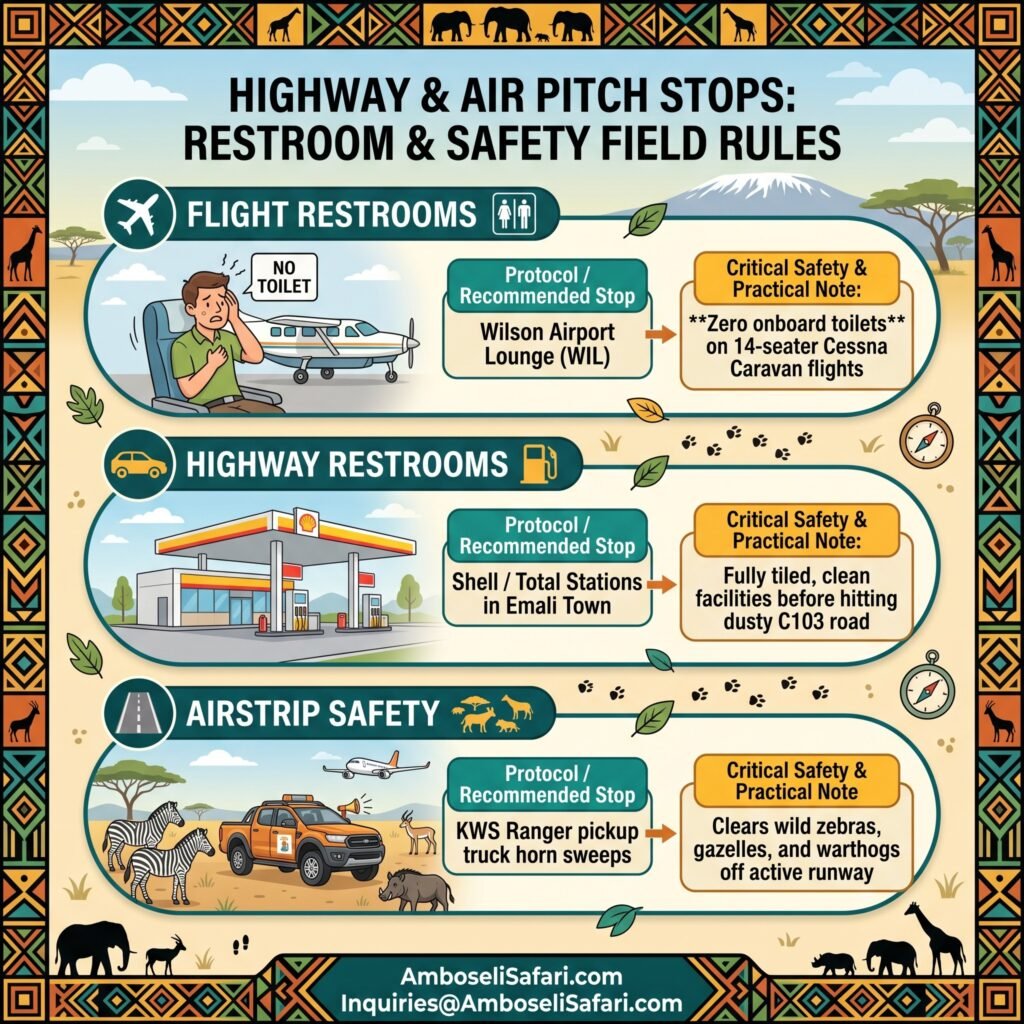
Amboseli Airstrip (HKAM) sits right inside central park grounds near Ol Tukai Lodge. The dirt runway is completely unfenced. Zebras, gazelles, and warthogs wander across the gravel whenever they want.
Before your plane lands, KWS ranger pickup trucks drive down the runway blaring their horns to clear wildlife off the strip. Hearing truck horns echoing below while your pilot circles over Enkongo Narok swamp is part of the experience.
Weather changes travel conditions quickly depending on the month:
- Rainy Season (April–May & November): Heavy rain turns the gravel C103 road from Emali into thick, slippery mud. Standing water on the airstrip can also briefly delay plane landings until the runway drains.
- Hot Dry Season (January–February & July–October): Midday heat creates heavy dust plumes behind agricultural trucks on the road. Flying avoids highway dust entirely. However, afternoon flights departing between 11:30 AM and 02:30 PM pass over the dark basalt fields of the Chyulu Hills, where rising heat causes thermal bumps. Book the 07:30 AM morning flight for smooth air.
You can inspect airstrip points, swamp loops, and gate locations directly on our Amboseli National Park guide.
Highway & Air Pitch Stops: Restroom & Safety Field Rules
Whether touching down on an unfenced dirt runway or navigating highway pitstops, anticipating field conditions ensures a seamless transition into the bush. Small 14-seater aircraft operate without onboard restrooms, requiring strategic comfort breaks at airport lounges or modern fuel plazas in Emali. On the ground, unique safety protocols—such as KWS ranger runway sweeps—keep wildlife clear of arriving flights.
| Field Scenario | Protocol / Recommended Stop | Critical Safety & Practical Note |
| Flight Restrooms | Wilson Airport Lounge (WIL) | Zero onboard toilets on 14-seater Cessna Caravan flights |
| Highway Restrooms | Shell / Total Stations in Emali Town | Fully tiled, clean facilities before hitting dusty C103 road |
| Airstrip Safety | KWS Ranger pickup truck horn sweeps | Clears wild zebras, gazelles, and warthogs off active runway |
Private Airstrips vs. Public HKAM Permits
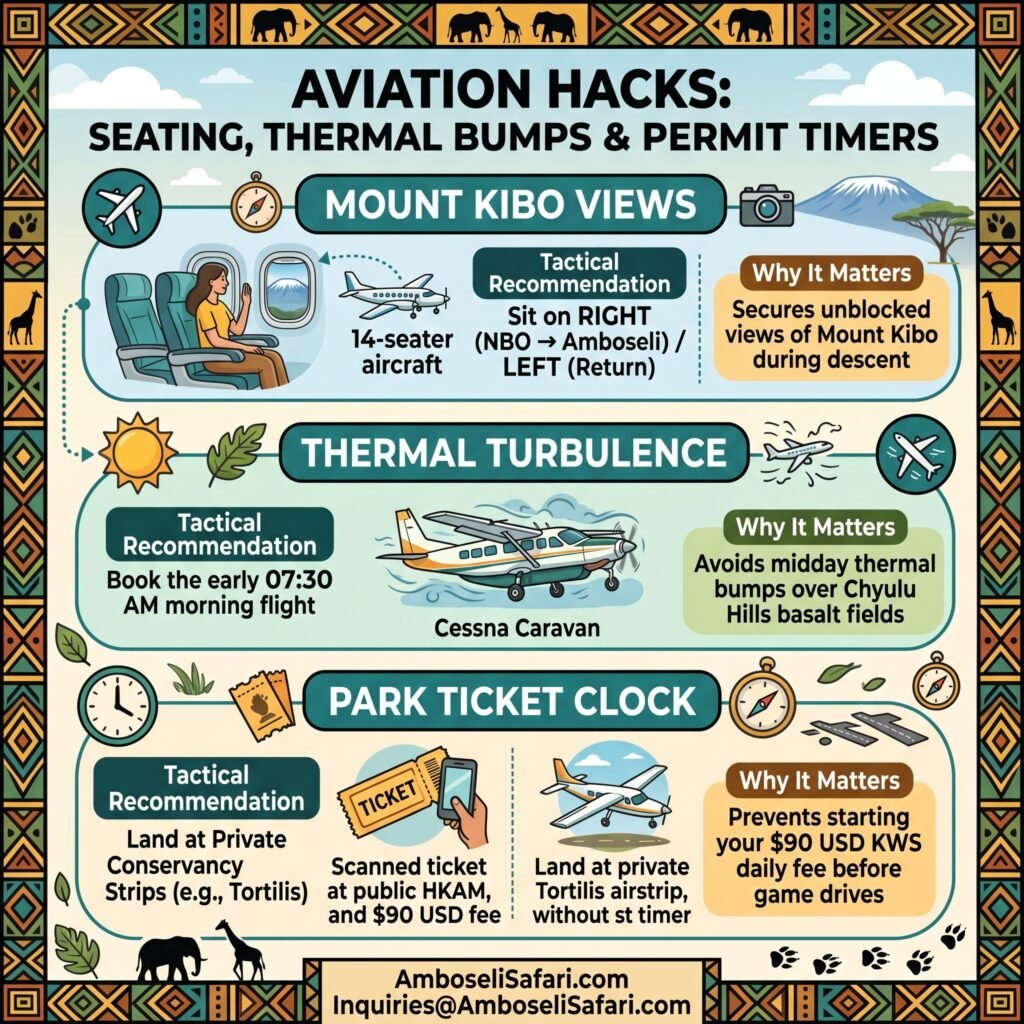
Your arrival point dictates when your park permit clock starts running. Non-resident adult park fees cost $90 USD per 24-hour period (plus the 5% eCitizen processing fee).
Landing at public Amboseli Airstrip (HKAM) activates your 24-hour park ticket instantly because the runway sits inside KWS territory. Rangers scan your digital pass at the airstrip gate before you step into your camp’s transfer vehicle.
If you book a camp in an adjacent private conservancy, landing at private strips—such as Selenkay Airstrip or Tortilis Airstrip—keeps you outside national park boundaries upon arrival. You can check in, eat lunch, and relax without starting your $90 USD daily park pass until you actually pass through national park gates for a game drive.
Aviation Hacks: Seating, Thermal Bumps & Permit Timers
Navigating domestic flight logistics into Amboseli requires tactical planning around plane seating, daily weather patterns, and arrival gates. Flying early in the morning guarantees smoother air over the Chyulu Hills, while strategic seating grants unblocked aerial views of Mount Kilimanjaro’s snowcap. Furthermore, choosing between public and private airstrips dictates whether your daily park permit clock starts immediately upon landing or when you first enter the park.
| Flight / Park Hack | Tactical Recommendation | Why It Matters |
| Mount Kibo Views | Sit on Right (NBO $\rightarrow$ Amboseli) / Left (Return) | Secures unblocked views of Mount Kibo during descent |
| Thermal Turbulence | Book the early 07:30 AM morning flight | Avoids midday thermal bumps over Chyulu Hills basalt fields |
| Park Ticket Clock | Land at Private Conservancy Strips (e.g., Tortilis) | Prevents starting your $90 USD KWS daily fee before game drives |
Luggage Limits, Soft Duffels, and Pelican Cases
Camera gear and luggage rules mark the single biggest difference between flying and driving.
Airlines enforce a strict 15 kg (33 lbs) total weight limit per person. That limit includes your checked bag, daypack, and camera gear combined. Baggage handlers squeeze luggage into narrow belly pods beneath the aircraft fuselage. Hard-shell suitcases and rigid rolling duffels with metal handles or wheels get turned away at Wilson Airport check-in counters—even if they weigh under 15 kg.
Our lead guide, Anthony Mule, constantly warns photographers about this restriction. “If you bring rigid Pelican hard cases or 600mm prime lenses, flying gets complicated fast,” Anthony notes. “Pelican cases won’t fit into a Cessna Caravan belly pod. You either have to buy an extra seat on the plane, pay to send cases down by road, or just drive the whole way in a Land Cruiser.”
Driving gives you massive trunk space. You can pack heavy camera bodies, tripods, and hard cases without putting every bag on a scale. You can compare camp storage options and vehicle setups in our guide on where to stay in Amboseli.
You can also see how elephant herds move near salt pan tracks and road crossings on our famous elephants guide.
If you decide to drive yourself, check our practical Amboseli self-drive tips before setting off.
Ready to organize your Land Cruiser or book flight transfers? Submit your details through our safari booking form to hold your dates.
Frequently Asked Questions
Can I fly into Amboseli and drive back to Nairobi?
Yes. Flying down saves time on day one, while driving back lets you add stops at Lake Naivasha or Lake Nakuru on your return journey.
How far is Amboseli Airstrip from central lodges?
It takes about 10 minutes to drive to Ol Tukai Lodge and roughly 25 minutes to reach Amboseli Serena Safari Lodge.
What happens if my camera gear exceeds the 15 kg flight limit at Wilson Airport?
You can buy an extra seat allowance on the aircraft to double your weight limit to 30 kg. You can also leave excess city luggage stored at Wilson Airport’s luggage desk.
Is driving to Amboseli safe for international visitors?
Yes. The A109 highway to Emali is smooth paved tarmac, and the C103 dirt road to Kimana Gate is regularly maintained. Hiring a professional driver-guide removes all navigation stress.