
The Role of Local Maasai Safari Guides in Amboseli
Overview
Understanding the role of local Maasai safari guides deepens your wildlife experience across Kajiado County. Licensed by the Kenya Wildlife Service, indigenous guides combine tracking skills around Enkongo Narok swamp with community conservation under Mount Kilimanjaro.
Fast Navigation Links
- Front Bumper Tracker Seats
- Reading Animal Body Language
- Foot Tracking Mechanics
- Community Conservation Work
- Guide Ethics and Tipping Standards
- Cultural Photography Etiquette
Hiring a guide who grew up walking these plains gives you a much sharper eye for tracking game. Non-local drivers often focus strictly on main dirt roads and radio chatter. A local Maasai guide notices subtle signals—a sudden shift in bird calls, fresh tracks in fine ash, or lenticular clouds gathering over Mount Kibo.
At Amboselisafari.com, our team works closely with local guides who combine deep cultural heritage with professional wildlife training. They know this land intimately.
Front-Bumper Tracker Seats in Private Conservancies
Tracking rules inside national park gates differ from those in surrounding private conservancies like Selenkay or Kimana.
Inside Amboseli National Park boundaries, all vehicles must stay on designated dirt roads, and no passenger can sit outside the cabin. In private conservancies, local Maasai spotters sit on an exterior frame-mounted bumper seat (Ol-Abalang’i) attached to the front of the 4×4 Land Cruiser.
Sitting on the tracker seat lets the spotter inspect fresh animal spoor, lion paw prints, and broken grass stems in the volcanic silt before vehicle tires roll over them. A driver from Nairobi staying inside a closed cab easily misses these micro-details. Spotters on the front bumper read the ground directly.
Reading Animal Body Language & Savannah Safety
Indigenous guides prevent dangerous wildlife encounters by reading subtle behavioral cues long before an animal reacts. When you approach large wildlife in open vehicles, your guide constantly evaluates mood and posture to keep everyone safe.
Reading Elephant Stress and Musth Signals
Amboseli is famous for its giant bull elephants, but approaching a 5-ton bull requires experienced judgment. Local guides instantly distinguish between relaxed play, mock charges, and true aggression:
- Relaxed Grazing: Ears fan slowly to cool the body. The trunk swings gently while plucking swamp grass.
- Mock Charges: The elephant spreads its ears wide, kicks up dust with its front feet, and trumpets loudly while rushing forward a few yards. Local guides remain calm and keep the vehicle steady without revving the engine.
- True Aggression & Musth: A bull in musth secretes dark, oily temporal gland fluid down the sides of his head and continuously dribbles urine. His head stays high, ears pinned back, walking with a silent, determined stride straight toward the vehicle. Local guides recognize these signals early and back the vehicle away before the bull closes the distance.
Interpreting Predator Body Language
During close approaches to lion prides in open conservancies, guides watch tail movement and ear positions. A lion lying on its side in a soft, relaxed pose is comfortable with the vehicle.
If a lion sits upright, twitches the dark tuft of its tail rapidly, and flattens its ears, the guide knows the animal feels crowded. They immediately ease the truck back to give the predator room.
Wildlife Tracking & Behavioral Safety Protocols
Local Maasai safari guides rely on generations of indigenous knowledge to read micro-signals across the savannah long before animals react. Whether observing a 5-ton bull elephant near Enkongo Narok swamp or tracking lions on a bush walk, their split-second interpretation of animal posture keeps safety high. Use this quick-reference matrix to understand how local guides decode animal behavior, wind patterns, and fresh spoor.
| Scenario / Signal | Guide Interpretation & Field Action | Practical Safety Impact |
| Elephant Musth / Stress | Spots temporal fluid & urine dribble; backs vehicle away | Prevents aggressive encounters with 5-ton bull elephants |
| Predator Body Language | Watches tail twitches & flat ears; eases vehicle back | Avoids crowding lions and triggering defensive reactions |
| Dust & Wind Testing | Tosses volcanic dust to monitor wind shifts downwind | Prevents human scent from spooking wildlife on foot walks |
| Bird Alarm Calls | Decodes sharp chatter from Starlings & Coucals | Pinpoints hidden predators (cheetahs/servals) in thick brush |
Foot Tracking Mechanics on Bush Walking Safaris
Stepping off the 4×4 for a guided walking safari (Ol-Olam) in a private conservancy changes how you interact with the savannah. Without vehicle engine noise, every step relies on raw sensory awareness.
Local spotters use precise mechanics during walking tours, which you can coordinate during your Amboseli safari planning:
- Testing Wind Direction: Guides carry small pouches of fine, powdery volcanic dust. They toss a pinch of dust into the air every few minutes to monitor wind shifts, ensuring the group stays downwind of elephants and buffaloes so human scent does not trigger a panic.
- Judging Trail Age from Scat: When crossing animal tracks, guides examine scat moisture and temperature. Warm, moist elephant dung with visible steam indicates a herd passed through within the last ten minutes. Dry, faded dung means the track is hours old.
- Spotting Broken Twig Sap: Along fever tree (Acacia xanthophloeia) thickets, guides inspect broken branches. Fresh, wet sap oozing from a snapped twig reveals a browsing giraffe or feeding elephant is actively moving just ahead in the brush.
Oral Elephant Lineages and Ear-Notch Memory
Non-local drivers usually rely on printed ID sheets to recognize famous animals. Local Maasai guides who grew up near the marshes identify individual bulls and matriarchs purely by sight.
They memorize the ear notches, tusk asymmetries, and family histories of elephants tracked by the Amboseli Elephant Research Project or featured in our guide on famous elephants.
A local guide will point to a matriarch crossing a causeway and tell you her age, her past calves, and her family group without checking a book. They know individual personalities—which old bulls are calm around vehicles and which young males need extra space.
Bird Alarms and Mountain Weather Caps
Spotting predators in thick brush takes more than visual scanning. Local guides navigate using sound and cloud patterns that weather apps cannot predict.
Listening for Bird Alarm Calls
Local guides track predators by listening for specific bird alarm calls (Ol-Kinyen). When a cheetah or serval moves through tall grass near fever tree thickets, Superb Starlings and White-browed Coucals make frantic, sharp chattering sounds. Local guides spot hidden cats long before other trucks notice anything moving.
Reading Mountain Cloud Caps
Weather shifts fast across the salt flats, which is crucial if you are following our Amboseli self-drive tips. Local guides predict dust storms (Sipili) by watching lenticular cloud formations over Mount Kilimanjaro’s peak (Ol-Moyiop). When a thick white cloud flattens over Kibo peak, guides know a dust storm is coming and steer the vehicle off open lakebed tracks before visibility drops to zero.
Human-Wildlife Coexistence & Conservation Roles
A local guide serves a dual purpose: they are a professional tourism guide during the day and an active community conservation scout year-round.
Local guides collaborate directly with conservation organizations like the Big Life Foundation and local research teams. Because guides live in neighboring group ranches like Kimana or Olgulului, they play a vital role in de-escalating human-wildlife conflicts:
- Protecting Livestock Corridors: Guides advise local herders on safe grazing routes, keeping cattle clear of active lion hunting grounds and elephant migratory corridors.
- Preventing Retaliatory Hunts: When lions attack livestock outside park boundaries, local guides alert Big Life ranger units to respond quickly. This allows compensation claims to be processed for herders, preventing retaliatory lion hunts.
- Reporting Wildlife Injuries: While on game drives, guides monitor snared or injured animals and report coordinates directly to KWS veterinary units for rapid treatment.
Community Conservation & Cultural Etiquette Rules
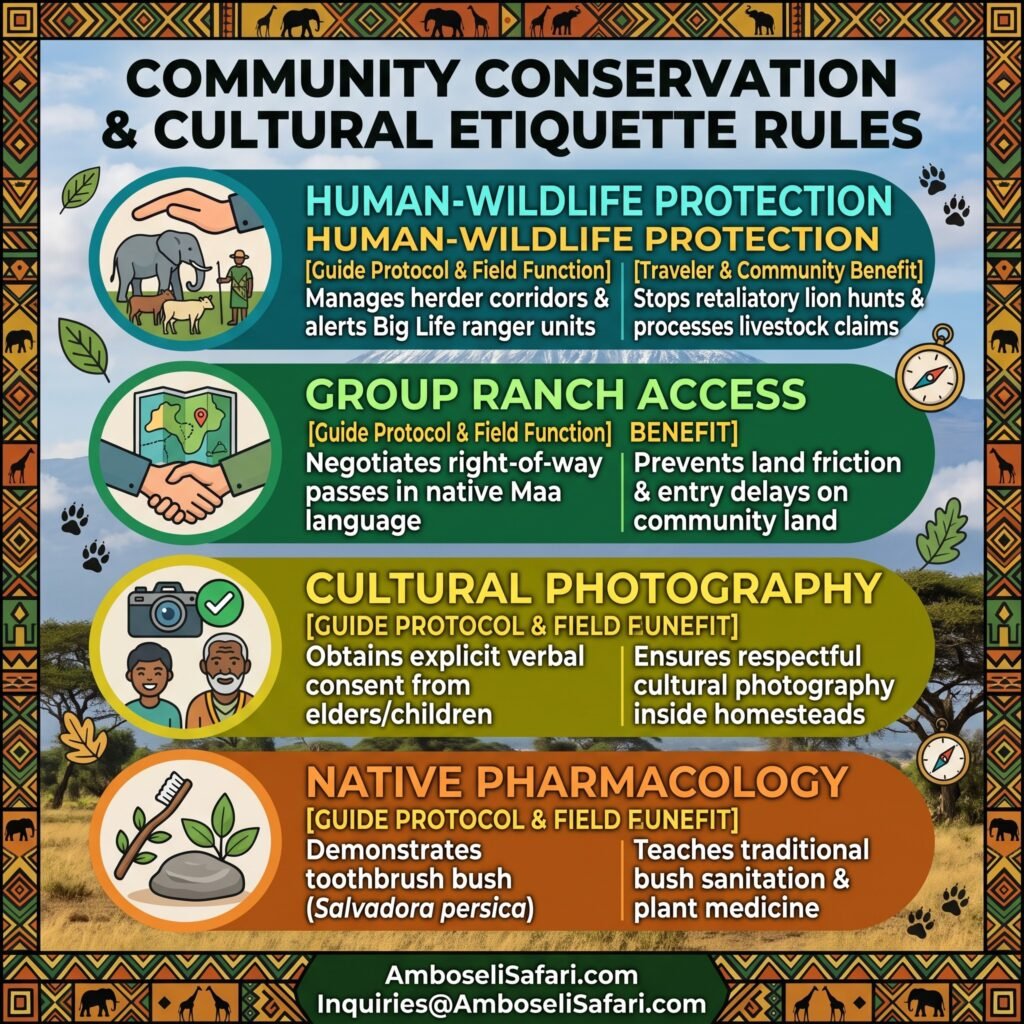
Beyond guiding game drives, local Maasai safari guides serve as active community conservation scouts and cultural mediators across Kajiado County group ranches. They manage livestock corridors, de-escalate human-wildlife conflicts, and ensure village entry fees directly support local schools and boreholes. Review these core field protocols to understand how indigenous guides protect local ecosystems while facilitating respectful cultural visits.
| Conservation / Cultural Role | Guide Protocol & Field Function | Traveler & Community Benefit |
| Human-Wildlife Protection | Manages herder corridors & alerts Big Life ranger units | Stops retaliatory lion hunts & processes livestock claims |
| Group Ranch Access | Negotiates right-of-way passes in native Maa language | Prevents land friction & entry delays on community land |
| Cultural Photography | Obtains explicit verbal consent from elders/children | Ensures respectful cultural photography inside homesteads |
| Native Pharmacology | Demonstrates toothbrush bush (Salvadora persica) | Teaches traditional bush sanitation & plant medicine |
Dual Accreditation and Community Passages
A major challenge on safari is navigating land boundaries smoothly outside main park gates.
Driver-guides from Nairobi who do not know local customs can run into friction when driving across community group ranches. Local Maasai guides hold double credentials: an official license from the Tourism Regulatory Authority (TRA) and formal approval from local Group Ranch Committees.
When game drives cross community land where herders graze cattle, local guides speak the Maa language and negotiate right-of-way passes directly with elders. This dual status avoids delays, and the cost of these local allowances is already factored into your total Amboseli safari cost breakdown.
Cultural Photography & Village Interaction Protocols
Visiting a traditional Maasai homestead (Enkang or Manyatta) offers genuine insight into local culture, but visits must be handled with respect. Your local guide acts as a cultural mediator to ensure interactions remain respectful.
Follow these practical guidelines during village visits:
- Photo Consent: Always ask your guide before taking close-up photos of individuals, particularly elders and children. Your guide will explain when photography is welcomed.
- Respecting Private Spaces: Traditional huts (Enkaji or plural Inkajijik) are private family homes. Wait for an invitation from the homeowner before stepping inside or photographing interior spaces.
- Direct Community Impact: Local guides ensure your entry fees go directly into collective community funds managed by elders and women’s cooperatives, supporting clean water boreholes and school fees.
Native Bush Pharmacology and Toothbrush Twigs
During guided foot walks, local guides share practical plant knowledge that has been used in the bush for generations. You can compare properties that offer these guided walks in our review of where to stay in Amboseli.
Walks usually include a demonstration of native bush pharmacology:
- Guides harvest small branches from the toothbrush bush (Salvadora persica) or wild acacia (Ol-Oriti).
- Chewing the fibrous wood end releases natural antibacterial juices that clean teeth and refresh the mouth.
- Guides point out medicinal plants used locally to treat stomach bugs, minor cuts, and insect bites.
Maasai Guide Ethics & Tipping Standards
Tipping your guide fairly supports local families and directly incentivizes habitat preservation across community group ranch lands. When local communities see tangible economic benefits from wildlife tourism, community lands remain open for migrating herds rather than being converted into farms.
Use these industry-standard daily tipping guidelines:
- Private Driver-Guide: $15 to $25 USD per day total from your vehicle group.
- Front-Bumper Spotter (Conservancy Drives): $10 to $15 USD per day total from the group.
- Walking Safari Guide: $10 to $15 USD per walking activity from the group.
Hand your tip directly to your guide in cash on the final day of your trip.
Guide Licensing, Activity Rules & Tipping Matrix
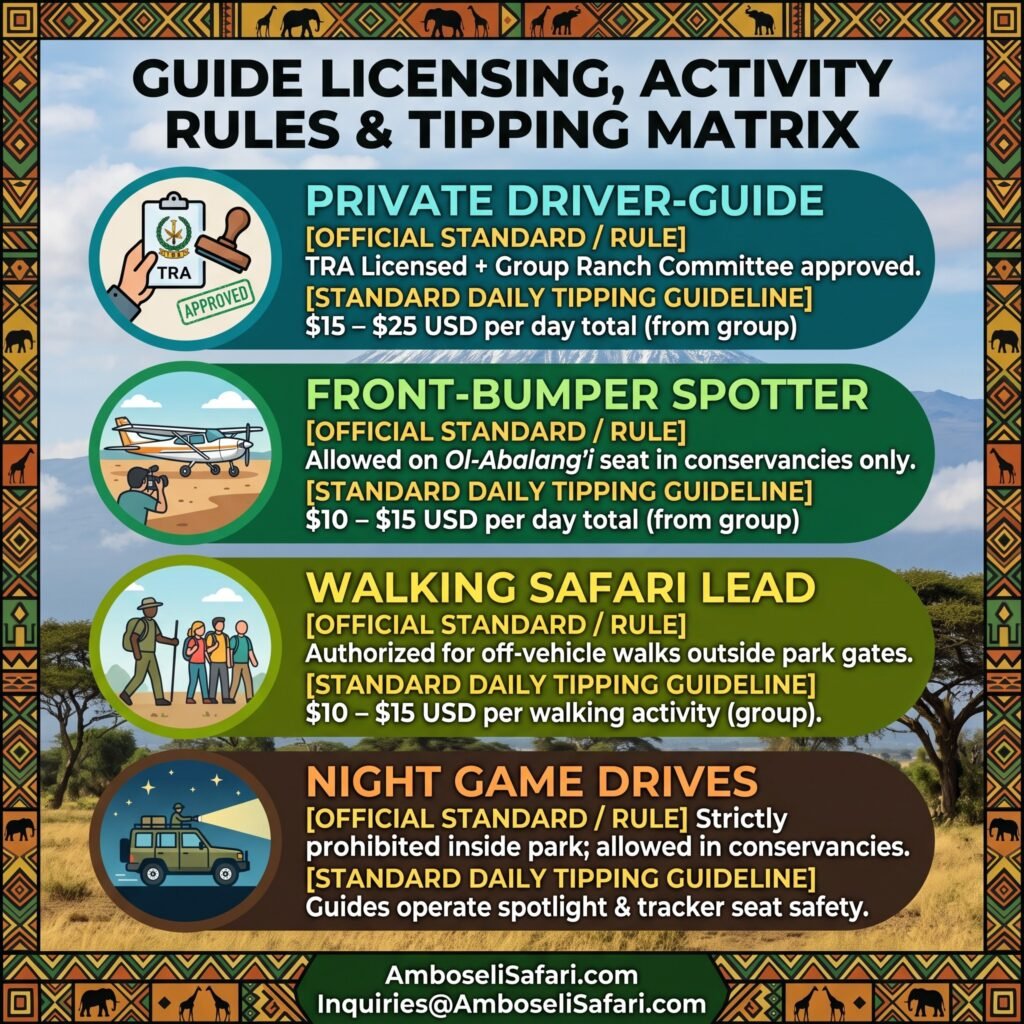
Navigating safari logistics requires clear knowledge of guide accreditation, activity permissions across park boundaries, and fair daily tipping standards. Local guides hold dual credentials from Kenya’s Tourism Regulatory Authority (TRA) and local Group Ranch Committees to operate seamlessly on both public and conservancy land. Use this reference table to plan daily gratuities and verify guide qualifications before your safari.
| Operating Feature | Official Standard / Rule | Standard Daily Tipping Guideline |
| Private Driver-Guide | TRA Licensed + Group Ranch Committee approved | $15 – $25 USD per day total (from group) |
| Front-Bumper Spotter | Allowed on Ol-Abalang’i seat in conservancies only | $10 – $15 USD per day total (from group) |
| Walking Safari Lead | Authorized for off-vehicle walks outside park gates | $10 – $15 USD per walking activity (group) |
| Night Game Drives | Strictly prohibited inside park; allowed in conservancies | Guides operate spotlight & tracker seat safety |
Field Notes & Real Guiding Insights
Having a guide who understands the land keeps your safari running smoothly.
Anthony Mule, a licensed safari guide with over ten years of experience in Amboseli, points out that patience is key when tracking game near the marshes: “Drivers who rush from one radio call to another waste fuel and miss sightings. When we sit quietly near Enkongo Narok swamp at 06:30 AM, you smell the crushed papyrus and cold mountain air while waiting for elephants to step out of the mist.”
Ready to book your private Land Cruiser and local driver-guide with Amboselisafari.com? Send your travel details through our safari booking form to reserve your dates.
Frequently Asked Questions
Why should I hire a local Maasai safari guide instead of a driver from Nairobi?
Local Maasai guides grew up in the ecosystem. They read subtle bird alarm calls, recognize individual elephant families without ID books, understand animal body language, and navigate community lands smoothly through local relationships.
Do local Maasai safari guides speak fluent English?
Yes. Professional Maasai guides complete formal training at wildlife colleges, hold official TRA licenses, and speak fluent English, Swahili, and Maa.
Can local Maasai guides take us on night game drives?
Night drives are prohibited inside the main national park, but local Maasai guides can lead night drives in private conservancies surrounding the park where they use front tracker seats and searchlights.
How do I confirm my guide is properly licensed?
Licensed guides carry a valid digital card or physical badge issued by Kenya’s Tourism Regulatory Authority (TRA) and hold registration with local group ranch committees.