
Is Amboseli National Park Safe? Wildlife Rules, Roads & Night Safety
Overview
Amboseli is extraordinarily safe when it comes to personal crime against tourists. The Kenya Wildlife Service tightly patrols the park in Kajiado County, where safety concerns focus on animal encounters, saline water, and road conditions under Mount Kilimanjaro.
Amboseli Safety Overview & Risk Matrix
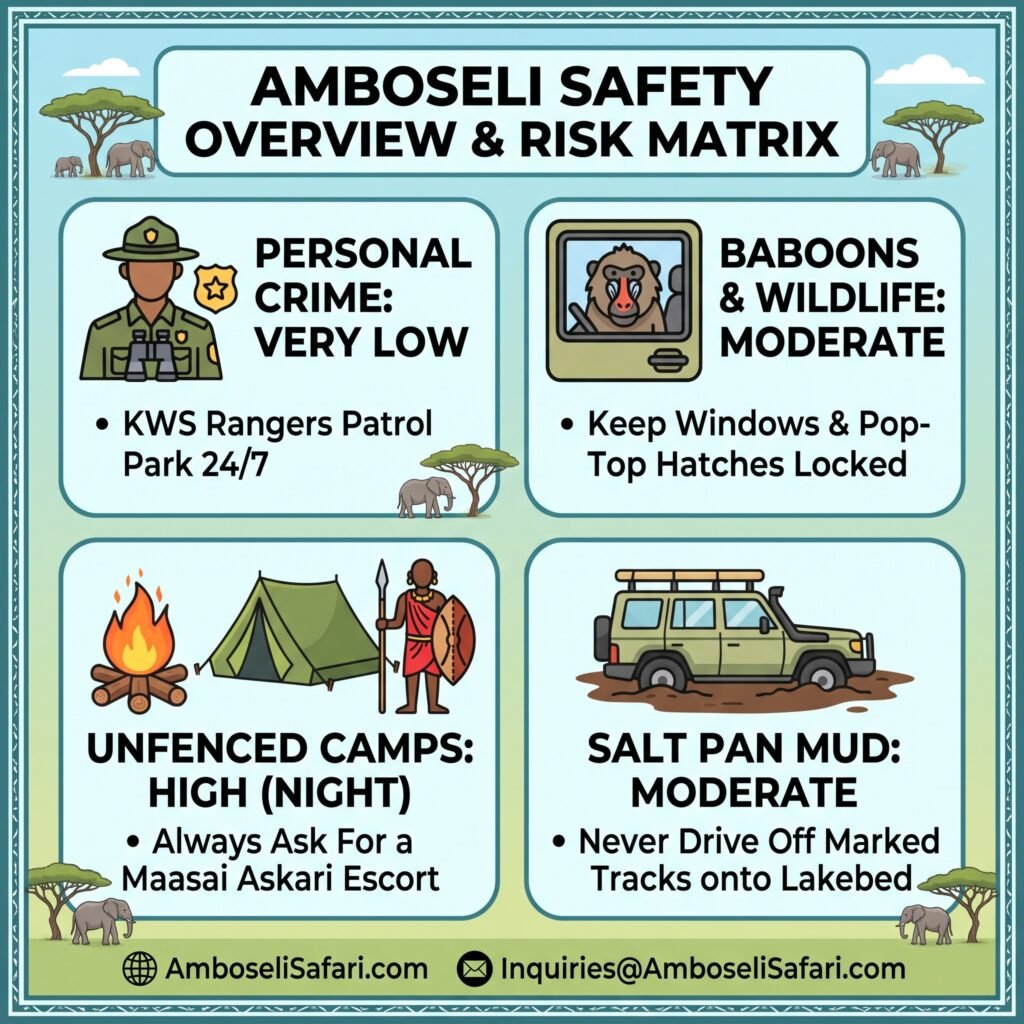
While Amboseli National Park boasts exceptional personal security maintained by KWS rangers, navigating the bush requires specialized awareness. Safety hazards here stem primarily from unpredictable wildlife encounters, saline water, hidden mud traps, and nighttime highway conditions rather than violent crime. The following quick-reference visual breaks down critical bush rules, essential health precautions, and local emergency contacts to keep your safari seamless. Use these parameters to plan a secure journey under Mount Kilimanjaro.
| Risk Factor | Hazard Level | Key Prevention Action |
| Personal Crime | Very Low | Patrols by KWS rangers cover gates and tracks 24/7. |
| Baboons / Wildlife | Moderate | Keep windows and pop-top hatches locked around picnic sites. |
| Unfenced Camps | High (Night) | Always request a Maasai Askari escort after 7:00 PM. |
| C103 Highway | High (Night) | Arrive before 6:00 PM; avoid transit driving after dark. |
| Salt Pan Mud | Moderate | Never drive off marked tracks onto dry lakebed crusts. |
Fast Navigation Links
- 4 Day Circuit Package Rates
- Wildlife Rules and Baboon Hazards
- Unfenced Camps and Night Escorts
- Health Malaria and Water Safety
- Gate Touts and Emergency Directory
- Official KWS Rules and Fines
When travelers ask our team at Amboselisafari.com about safety, they are usually thinking about pickpockets or violent crime. In reality, theft or aggression toward visitors is extremely rare inside the park boundaries. Armed KWS rangers patrol gate counters, main tracks, and airstrips around the clock.
The real safety risks come down to basic bush sense: knowing how to handle habituated animals, keeping off soft salt pan crusts, avoiding unpurified borehole water, and skipping the approach highways after dark.
4-Day Multi-Destination Safari Package (2 Nights Amboseli + 1 Night Lake Nakuru)
If you are booking an organized driver-guide circuit rather than self-driving, combining Amboseli with the flamingo shores and rhino sanctuaries of Lake Nakuru offers a secure, well-routed safari circuit. We run this trip in private 4×4 Safari Land Cruisers equipped with pop-up roof hatches, high-clearance suspension, and onboard power outlets.
Rates below show total costs per person for two adults traveling together in a private vehicle:
4-Day Circuit Rates & Lodging Options
| Package Tier & Accommodations | Included Hotels & Accommodations | Price Range Per Person (Low – Peak)* |
| Budget Tier | Amboseli Junction Eco Lodge & CityMax Hotel Nakuru | From USD $1,280 to USD $1,880 |
| Mid-Range Tier | Zebra Plains Amboseli Camp & Lake Nakuru Sopa Lodge | From USD $1,610 to USD $2,350 |
| Luxury Tier | Ol Tukai Lodge & Mbweha Camp Lake Nakuru | From USD $2,250 to USD $3,280 |
| Luxury Plus Tier | Satao Elerai Camp & The Cliff Nakuru | From USD $3,880 to USD $5,650 |
*Rates cover 2026/2027 travel for two adults sharing a room or tented suite with a private vehicle. Standard/Low season covers January through May and November. Peak season spans June through October and December. Rates include full-board lodging, private transport, driver allowances, fuel, daily $90 USD KWS park permits (plus the mandatory 5% eCitizen gateway fee), Nakuru sanctuary fees, and chilled vehicle water. Luxury Plus includes domestic flights from Wilson Airport (WIL) on Safarilink or Airkenya.
If you prefer to tailor your dates or review private vehicle options, submit your details through our safari booking form.
What’s Included
- Private 4×4 Safari Land Cruiser with pop-up roof hatch and custom beanbag mounts
- Dedicated, TRA-certified driver-guide for the full itinerary
- Full-board accommodation covering breakfast, lunch, and dinner daily
- Pre-paid daily $90 USD KWS park permits (plus 5% eCitizen fee) and Nakuru sanctuary passes
- Chilled drinking water stocked in the vehicle cooler
What’s Excluded
- International flights, travel insurance, and digital Kenya entry processing through the official eTA portal
- Tipping your driver-guide or lodge staff
- Alcoholic beverages, sodas, or personal laundry
- Optional Maasai village entry vouchers ($30) or hot air balloon flights ($450)
Optional Add-Ons
- Local village entry voucher & cultural walkthrough: USD 30 per person
- Night game drive in a private conservancy: USD 50 per person
- Sunrise hot air balloon flight over central marshes: USD 450 per person
We lay out every vehicle day-rate, fuel calculation, and permit fee on our Amboseli safari cost breakdown page.
Baboon Habituation at Observation Hill & Lodges
While big cats stay clear of vehicles, habituated baboons are a daily headache around the Observation Hill (Noomotio) picnic clearing and near the Ol Tukai Lodge fence line.
Baboons know that safari trucks carry food. They can unlatch loose pop-up roof hatches and slide open unlocked side windows to grab lunchboxes or bags in seconds.
Never leave packed lunches or fruit visible on seats when your vehicle is parked near fever trees, and keep sliding side windows locked while stopped at picnic sites. If a baboon jumps into your car, do not corner it. A trapped animal will bite to defend itself—simply step back, leave the vehicle doors open, and let it exit on its own.
Unfenced Camps, Nighttime Grazing & Askari Escorts
To keep open wildlife corridors clear for herds tracked by the Amboseli Elephant Research Project, several eco-camps along Kimana Conservancy and inside park grounds skip perimeter electric fencing.
Wild animals wander through camp pathways after dark. Once night falls around 7:00 PM, hippos leave the Enkongo Narok swamp to graze between guest tents, and hyenas occasionally pass through camp boundaries.
Walking unescorted between your tent and the dining mess after dark is unsafe. Always flash your spotlight outside or blow your room whistle if you need to leave your tent at night, then wait inside until a Maasai guard (Askari) arrives at your door. Your Askari will walk you safely across camp using a heavy torch and spear.
When picking a place to stay, compare fenced and open layouts across our guide on where to stay in Amboseli.
Sinking Lakebed Crusts & Dust Devils (Sipili)
Driving off marked tracks across the salt pan of Lake Amboseli creates serious vehicle trouble.
During seasonal weather changes, the top salt layer bakes dry, but it covers soft, waterlogged silt underneath. Heavy Land Cruisers breaking through this top crust sink to their axles fast. Pulling a vehicle out of deep volcanic mud takes heavy tractor equipment and hours of waiting.
The open lakebed also builds sudden wind columns known locally as Sipili (dust devils). These spinning dust clouds pick up fine silt and sweep across dirt tracks without warning. Drop your pop-top roof hatch immediately if you see a dust column heading toward your truck to keep fine ash out of your eyes and camera gear.
If you plan to drive the park yourself, check our practical Amboseli self-drive tips.
Musth Bull Elephants & Buffer Etiquette
Amboseli is famous for old bull elephants, but mature bulls in musth need extra space.
Bulls in musth are aggressive and easily agitated. You can spot them by the dark fluid leaking from the glands behind their eyes and wet stains down their legs. Anthony prefers parking 40 yards back on the Kimana causeway whenever he spots wet leg stains on a solitary bull, keeping his reverse gear engaged so he can back away smoothly if the bull turns toward the bonnet.
Always keep a minimum buffer distance of 30 meters from solitary bulls, leave your engine idling when stopping near an active bull, and give family herds complete right-of-way when they cross narrow swamp causeways.
Learn more about tracking these large bulls in our famous elephants guide.
Highway Driving Risks on the C103 Emali-Namanga Road
Crime inside park gates is almost non-existent, but road safety on approach highways takes careful planning.
The main safety concern is the paved C103 road connecting Emali to Kimana Gate. Fast overland freight trucks share this single-lane tarmac, streetlights do not exist, and unlit livestock herds cross the road around dusk.
Plan your transit drive to reach your lodge or park gate before 6:00 PM, and avoid driving this highway at night.
Review driving times and transit routes in our Amboseli safari planning guide.
Flash Floods at Seasonal River Crossings
During the rainy months (April to May and November), water levels shift fast along boundary tracks.
Dry riverbeds (laggas) like the Kimana Stream and tracks near Iremito Gate can flood in less than 30 minutes. Heavy rain up on Mount Kilimanjaro or the Chyulu Hills runs straight down into the basin, even when skies directly over your vehicle look completely clear.
Never drive into fast brown water. Muddy currents hide deep underwater ruts that can wash a light truck right off the concrete drift. Wait on the bank and watch local drivers test the water depth first.
Health, Vaccines & Water Safety
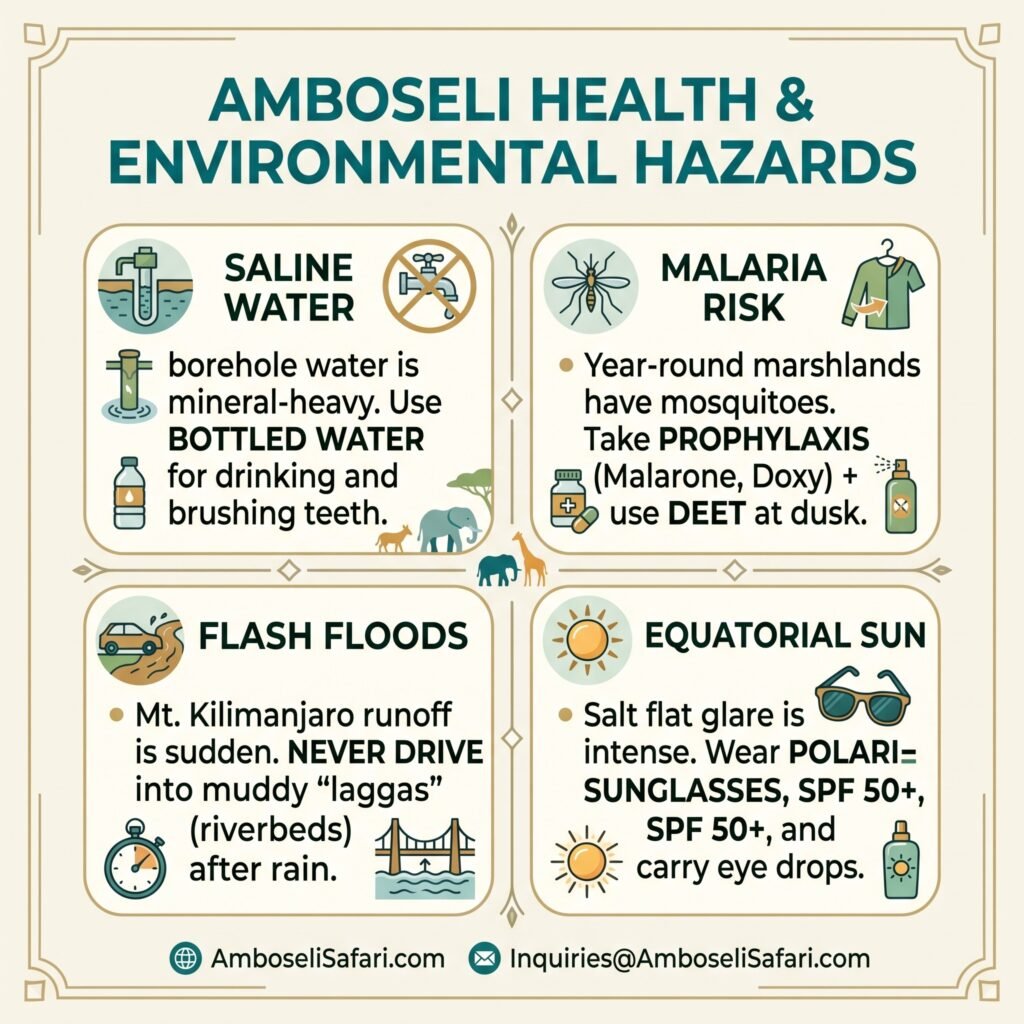
Staying healthy in the park means watching mosquitoes, drinking water, and equatorial sun exposure:
- Malaria Risks: Permanent swamps mean active mosquito populations year-round. Take prescription malaria pills like Malarone or Doxycycline, apply DEET repellent, and wear long sleeves near marsh tracks at dusk.
- Water & Food Safety: Tap water and borehole water carry high mineral salinity from mountain runoff. Drinking unboiled tap water causes stomach bug troubles. Stick strictly to sealed bottled water or filtered camp water, even when brushing your teeth, and skip ice made from tap water.
- AMREF Flying Doctors Cover: Park dispensaries only handle basic first aid. For serious health issues, air evacuation to Nairobi is necessary. Buy an AMREF Maisha Tourist Cover ($10 to $35 USD for 30 days) before leaving Nairobi so emergency medical flights are covered.
- Dust & Equatorial Sun: Midday sun reflecting off white salt flats causes harsh glare. Pack polarized sunglasses, SPF 50+ sunscreen, and saline eye drops to clear dust from your eyes after open vehicle drives.
Health, Water & Environmental Hazards
Staying healthy while exploring Amboseli requires proactive preparation against distinct bush elements. High mineral levels in local groundwater and year-round mosquito populations near permanent swamps pose everyday risks for unprepared travelers. Extreme weather, including blinding salt glare and sudden flash floods from Kilimanjaro runoff, also demands smart field decisions. This quick environmental guide outlines essential health precautions for your time in the park.
| Hazard Type | Cause / Source | Essential Safeguard |
| Saline Water | Mineral-heavy borehole water | Use bottled water for drinking and brushing teeth. |
| Malaria | Year-round marshlands | Take Malarone or Doxycycline; apply DEET at dusk. |
| Flash Floods | Kilimanjaro runoff | Avoid driving into muddy riverbeds (laggas) after rain. |
| Equatorial Sun | White salt flat glare | Wear polarized sunglasses, SPF 50+, and carry eye drops. |
| Dust Devils | Sudden wind columns (Sipili) | Lower pop-top roof hatches immediately when spotted. |
Gate Navigation, Hawkers & Cultural Scams
Navigating park gates smoothly comes down to a few basic rules:
- Handling Gate Hawkers: Souvenir sellers gather around Kimana, Meshanani, and Iremito gates. They can be pushy when showing woodcarvings or beadwork through open truck windows. Keep windows rolled up while your driver processes entry paperwork, and give a firm, polite “No thank you” if you aren’t buying.
- Cultural Village Visits: Agree on entry fees ($20 to $30 USD per adult) and photo rules with the village elder (Oloiboni) at the outer gate before walking inside any nearby Maasai homestead (Enkang).
Cellular Dead Zones & Emergency Protocols
Mobile network reliability varies across different park sectors:
- Cellular Coverage: Safaricom works reasonably well near central lodges (Ol Tukai, Serena) and Kimana Gate. Signal drops out completely across open salt pans and western sectors near Meshanani and Kitirua gates. Airtel coverage is spotty everywhere in the park.
- Vehicle Breakdown Steps: If your vehicle breaks down near wildlife, stay inside the cabin with your roof hatch pulled down. Never walk out on foot to check tires or engines. Call your safari operator or use your vehicle’s VHF radio on KWS Channel 1 for ranger support.
Emergency Contact Directory
- KWS Amboseli HQ Desk: +254 720 650 426
- KWS Toll-Free Customer Line: 0800 597 000
- AMREF Flying Doctors Emergency Control: +254 20 699 2299
- Namanga Border Police Post / Hospital: +254 790 771 679
Solo & Female Traveler Considerations
Amboseli is a safe destination for solo travelers booking established lodges or guided safaris:
- Solo female travelers experience high personal safety and professional service from lodge staff and driver-guides.
- If you self-drive as a solo traveler, do not drive the C103 Emali-Namanga highway after dark. Keep vehicle doors locked when passing through junction towns like Emali or Namanga, and download offline maps before leaving Nairobi.
Official KWS Rules & Penalty Guidelines
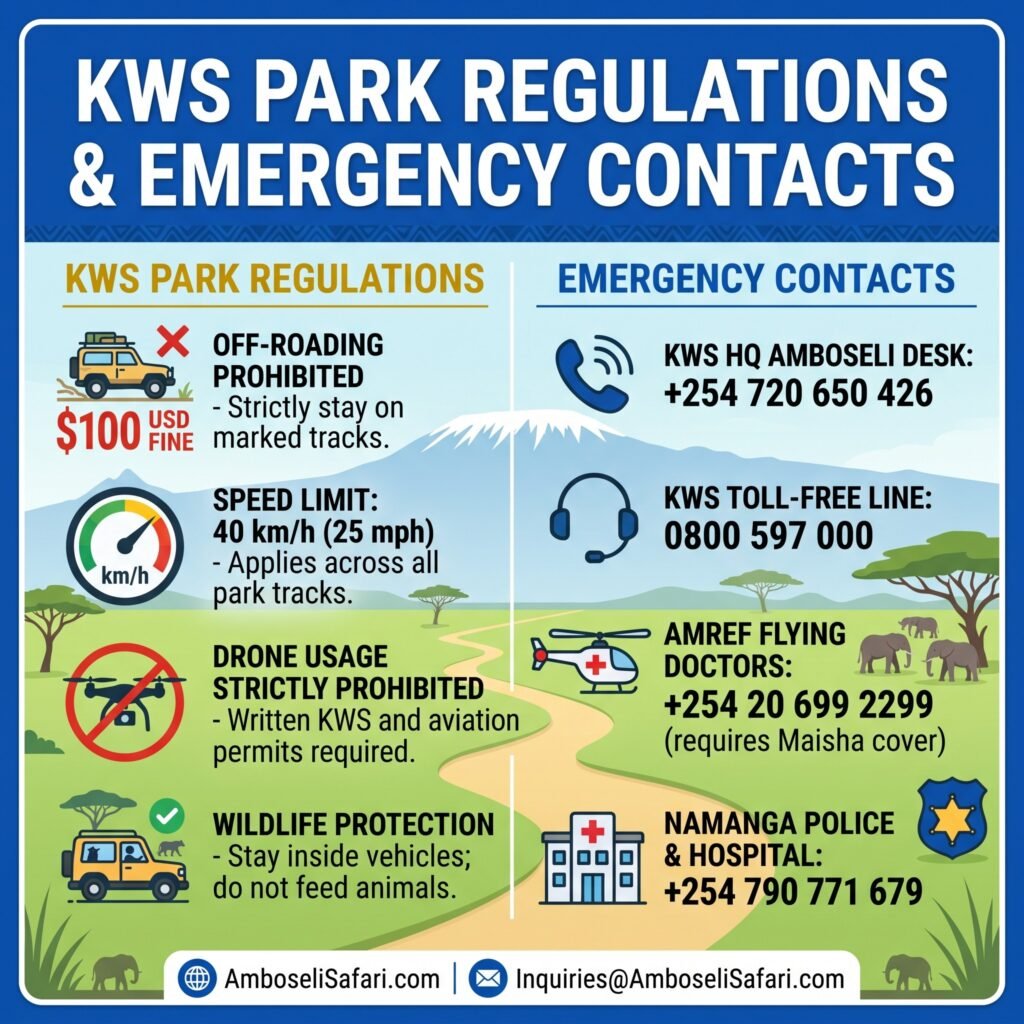
Rangers actively enforce park rules to protect wildlife and visitors:
- Off-Road Driving: Driving off marked dirt tracks damages fragile terrain, and rangers will write you a ticket on the spot carrying a $100 USD (KES 10,000+) fine.
- Speeding: The park speed limit is 40 km/h (25 mph). Speeding attracts immediate ranger fines.
- Strict No-Drone Rule: Flying recreational drones inside national parks is illegal without written permits from KWS and aviation authorities. Unapproved drones are confiscated on the spot.
- Staying Inside Vehicles: Stepping out of your vehicle is prohibited except at designated spots like Observation Hill (Noomotio) or fenced lodge grounds.
- Wildlife Protection: Never feed animals, throw items, or crowd herds closer than 25 meters.
KWS Park Regulations & Emergency Contacts
Strict adherence to Kenya Wildlife Service (KWS) rules protects both visitors and the fragile park ecosystem. Rangers actively enforce driving limits and wildlife protection laws with strict on-the-spot penalties. Having immediate access to emergency dispatchers and medical evacuation teams ensures swift support during unexpected incidents. Keep this directory and regulatory guide handy throughout your safari transit.
| Category | Regulation / Contact | Detail / Penalty |
| Off-Roading | KWS Rule | Prohibited; $100 USD fine issued on the spot. |
| Speed Limit | KWS Rule | 40 km/h (25 mph) maximum across park tracks. |
| Drone Usage | KWS Rule | Strictly prohibited without KWS/aviation permits. |
| KWS HQ Desk | Phone Contact | +254 720 650 426 (Toll-Free: 0800 597 000) |
| Medical Evac | AMREF Flying Doctors | +254 20 699 2299 (Requires Maisha cover) |
Field Advice & Practical Insights
Navigating wildlife corridors comes down to reading animal behavior and giving herds space.
Anthony notes that getting out near Enkongo Narok swamp by 6:15 AM gets you quiet viewing before main gate traffic kicks up dust across the marsh tracks. Watching elephant herds cross open water channels in the cool morning air is worth the early wakeup call.
Frequently Asked Questions
Is crime a problem inside the park?
No. Violent crime against tourists inside the park is extremely rare. Armed KWS rangers patrol the park tracks, gates, and airstrips around the clock.
Can I use lodge tap water to brush my teeth?
No. Tap and borehole water carry high mineral salt levels. Always drink bottled or filtered water, and use bottled water for brushing teeth.
Do I need malaria pills for Amboseli?
Yes. The permanent marshes create active mosquito habitats. Doctors recommend taking prescription malaria pills like Malarone or Doxycycline alongside insect repellent.
Can I fly a drone in Amboseli?
No. Flying drones without written permits from KWS and aviation authorities is strictly illegal, and rangers will confiscate unapproved gear at the gate.
What happens in a medical emergency out in the bush?
KWS runs a small dispensary for basic first aid. Serious medical emergencies require AMREF air ambulance evacuation directly to Nairobi hospitals.