
Amboseli Safari Photography Tips: Gear Protection, Framing & Rates
Overview
Photographing wildlife in Amboseli takes a smart setup, solid camera protection, and an understanding of how light shifts across the salt flats. Managed by Kenya Wildlife Service in Kajiado County, this basin hosts herds tracked by the Amboseli Elephant Research Project.
Fast Navigation Links
- 2027 Photo Safari Package Rates
- When Mount Kilimanjaro Is Visible
- Vehicle Stabilization and Engine Rules
- Protecting Camera Gear From Dust
- Carrying Two Camera Bodies Everyday
- Editing Shots from Harsh Light
2027 Photo Safari Packages & Vehicle Rates
Framing big tuskers on open salt flats takes a driver who understands camera angles and a vehicle prepped for heavy gear. We run these photo trips in custom 4×4 Safari Land Cruisers equipped with wide roof hatches, foam-padded window rails, and onboard battery charging outlets.
Rates below show the total cost per person for two adults traveling together in a private vehicle setup:
3-Day & 4-Day Amboseli Photography Safari Packages
| Package Tier & Accommodations | Standard Season (USD / Person)* | Peak Season (USD / Person)* | Booking Action |
| 3-Day Budget Photo Safari (Kibo Safari Camp / Kimana Bush Camp / Amboseli Junction Eco Lodge) | $1,180 | $1,880 | Book Now |
| 3-Day Mid-Range Photo Safari (Kilima Safari Camp / Amboseli Sopa Lodge / Zebra Plains Camp) | $1,480 | $2,180 | Book Now |
| 3-Day Luxury Photo Safari (Ol Tukai Lodge / Amboseli Serena Safari Lodge / Satao Elerai Camp) | $1,980 | $2,780 | Book Now |
| 4-Day Fly-In Luxury Plus Safari (Flight + Elewana Tortilis Camp / Tawi Lodge / Angama Amboseli) | $3,950 | $5,950 | Book Now |
*Rates are valid for 2026/2027 for two adults sharing a room or tented suite with private 4×4 Land Cruiser transport. Standard season runs January through May and November. Peak season spans June through October and December. Rates cover full-board lodging, transport, guide allowances, fuel, daily $90 USD KWS entry permits, and custom vehicle gear. Fly-in options include roundtrip domestic flights from Wilson Airport (WIL) on Safarilink or Airkenya plus airstrip transfers.
If you want to hold travel dates or talk through specialized Land Cruiser setups, send your details through our safari inquiry form.
Package Inclusions
- Private 4×4 Safari Land Cruiser with pop-up roof hatches and beanbag mounts
- Licensed driver-guide skilled in camera positioning and lighting angles
- Full-board accommodation covering breakfast, lunch, and dinner
- Pre-paid daily $90 USD KWS park entry permits
- Onboard power inverter for battery charging
- Chilled drinking water stocked in the vehicle cooler
Package Exclusions
- International flights, travel insurance, and digital entry processing via the official eTA portal
- Tipping your driver-guide or lodge staff
- Alcoholic beverages, soft drinks, or personal laundry
- Optional extras like a Maasai village visit ($30) or a hot air balloon flight ($450)
Optional Add-Ons
- Night photography drive in a private conservancy: USD 50 per person
- Sunrise hot air balloon flight over central marshes: USD 450 per person
If you’re mapping out fuel math and KWS fees, we list those exact numbers on our full cost breakdown guide.
When Mount Kilimanjaro Is Visible
Getting a clear shot of Mount Kilimanjaro behind an elephant herd takes patience and good timing. Clouds usually cover the peak for most of the day, so you have to plan your game drives around local weather patterns.
- 06:00 AM – 08:30 AM: This is your best window. Cold night air stabilizes moisture over the plains, keeping the peak clear of clouds right after sunrise.
- 09:00 AM – 04:30 PM: Midday heat warms up the swamps and salt flats. Water evaporates quickly, building dense cloud banks that hide the summit until late afternoon.
- 04:45 PM – 06:30 PM: As the air cools before sunset, clouds often break apart for 15 or 20 minutes, giving you a second chance at golden hour shots.
Season matters too. During the dry season (July to October), airborne dust creates a soft haze around the base of the mountain. If you travel right after the rains in November or April, the air is clean, giving you crisp views of the snowcap.
Vehicle Stabilization and Engine Rules
Leave the tripod at your hotel. There is no room for tripod legs inside an open Land Cruiser, and someone will shake your frame every time they shift seats.
Use canvas beanbags instead. Bring heavy-duty bags double-stitched and filled with dried beans or rice. Resting your telephoto lens on a beanbag wedged over the roof hatch or window frame gives you a steady, comfortable mount.
Tell your driver to shut off the motor the second you stop. Diesel engine idle vibration travels straight up through the frame, turning long lens shots blurry. A good guide kills the ignition automatically before you even raise your camera.
Protecting Camera Gear From Dust
Fine volcanic dust (Empusel ash) gets into everything. Standard nylon camera bags are actually part of the problem on washboard dirt roads between Kimana Gate and Ol Tukai.
Nylon builds up static electricity as the truck bounces along dirt tracks. That static charge pulls fine silt right through zipper teeth and mesh pockets, coating your camera gear inside.
An easy field trick is wrapping your camera bodies and lenses in a slightly damp cotton Maasai Shúkà (traditional woven blanket) on your seat. Natural cotton fibers cancel static charges and catch airborne dust before it reaches your focus rings.
Put strips of gaffer tape over zoom barrel seams and auto-focus toggle switches. It creates a simple barrier that keeps grit out of mechanical gear parts without leaving sticky marks when you peel it off.
If you are driving yourself, read through our Amboseli self-drive tips before hitting the park tracks.
Carrying Two Camera Bodies Everyday
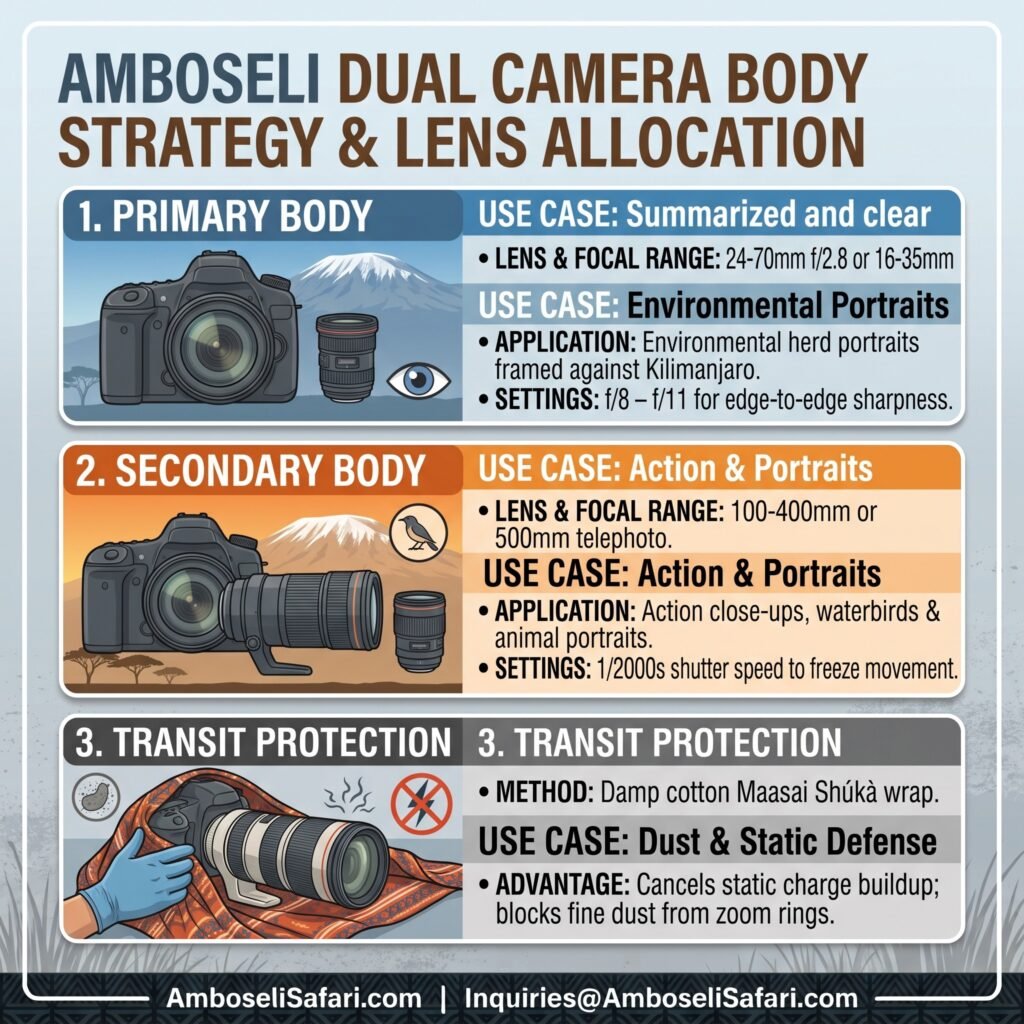
Never swap lenses inside an open safari truck. Dust is always floating in the air, and a single speck on your camera sensor means spending hours cleaning dark spots off every sky photo later.
Carry two camera bodies instead:
- First Body: Keep a wide 24-70mm lens mounted for environmental herd shots framed against Mount Kilimanjaro and yellow-fever tree (Acacia xanthophloeia) groves.
- Second Body: Keep a 100-400mm or 600mm telephoto lens mounted for tight wildlife portraits and waterbirds.
Having two bodies ready lets you switch from a wide landscape shot to a close-up portrait instantly without exposing your sensor to open air.
Check seasonal weather packing advice and flight weight limits in our Amboseli safari planning guide.
Dual Camera Body Strategy & Lens Allocation
Swapping lenses inside an open safari Land Cruiser exposes sensitive camera sensors to airborne volcanic silt (Empusel ash). Carrying two dedicated camera bodies eliminates lens-swapping dust risks while ensuring you never miss a sudden focal shift. This matrix outlines the optimal lens configurations, primary use cases, and ideal settings for each camera body setup.
| Camera Setup | Lens & Focal Range | Primary Shooting Application & Settings |
| Primary Body | 24-70mm f/2.8 or 16-35mm wide | Environmental herd portraits framed against Kilimanjaro; f/8 – f/11 for edge-to-edge sharpness. |
| Secondary Body | 100-400mm or 500mm telephoto | Action close-ups, waterbirds & animal portraits; 1/2000s shutter speed to freeze movement. |
| Transit Protection | Damp cotton Maasai Shúkà wrap | Cancels static charge buildup and blocks fine dust from entering mechanical zoom rings. |
Spot Metering Silhouettes & Polarizer Warnings
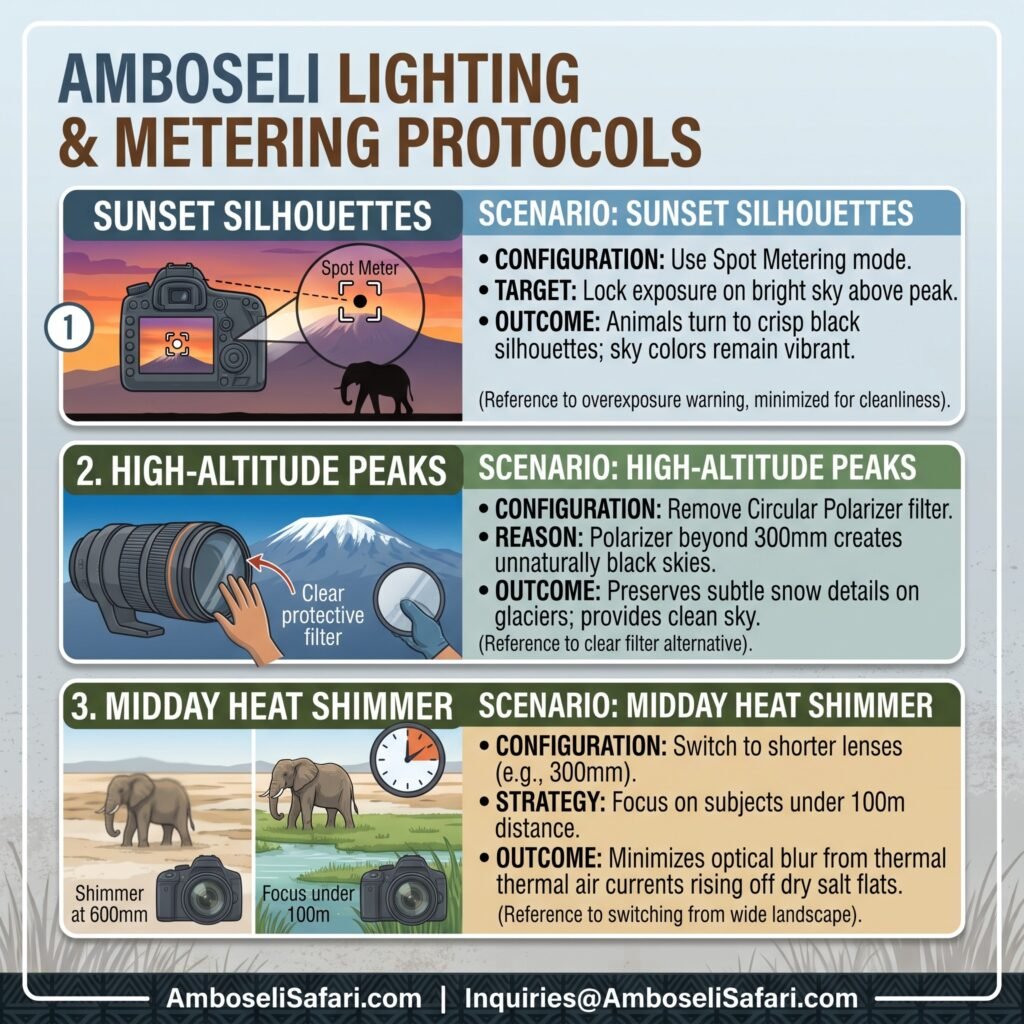
Default camera meters get easily confused when shooting elephants against a bright sky.
Spot Metering for Silhouettes
Standard matrix or evaluative metering fails during late-afternoon silhouette shoots. Because dark elephant hides fill much of the frame, your camera tries to brighten the shadow, overexposing the sky and washing out orange sunset colors.
Switch your camera to Spot Metering. Point your focus spot at the bright sky glow just above the mountain peak to lock in exposure, then recompose your shot over the elephant. This keeps the sky colorful while turning the elephant into a sharp black silhouette.
Metering, Polarizer & Lighting Protocols
Navigating the extreme contrast between dark elephant hides, reflective salt crusts, and high-altitude equatorial skies requires specialized exposure techniques. Standard camera meters often fail, resulting in washed-out skies or underexposed subjects. Use this technical field cheat sheet to master metering modes, filter selections, and lighting windows across the basin.
| Lighting Scenario | Camera & Filter Configuration | Technical Advantage / Field Purpose |
| Sunset Silhouettes | Spot Metering on bright sky glow | Prevents camera from overexposing sky while turning animals into crisp black silhouettes. |
| High-Altitude Peaks | Remove Circular Polarizers (>300mm) | Prevents the sky from turning unnatural black and preserves subtle snow/glacier detail on Kibo. |
| Midday Heat Shimmer | 300mm or shorter; focus under 100m | Minimizes optical distortion caused by thermal air currents rising off dry salt flats (>10:30 AM). |
High-Altitude Polarizer Warning
Take your circular polarizer filter off telephoto lenses when shooting the mountain.
Amboseli sits at 1,150 meters elevation where the air is thin and clear. Beyond 300mm focal length, a polarizer turns the sky unnaturally dark black and washes out subtle white ice detail on Kibo peak’s glaciers. Plain glass or a clear protective filter works much better here.
If you want to track matriarchs across open corridors for mountain shots, explore our famous elephants guide.
Best Spots for Photography Inside the Park
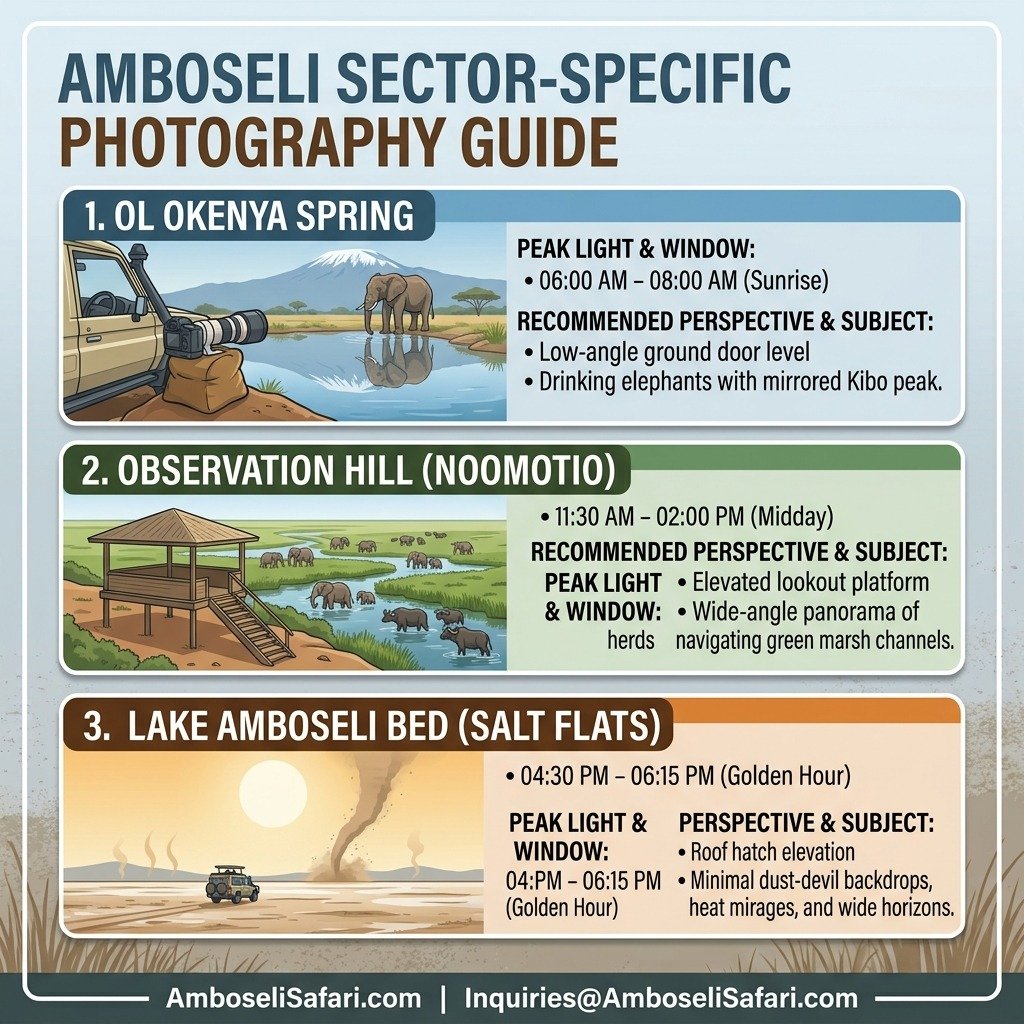
Different sectors inside the park offer distinct photo opportunities:
- Ol Okenya Spring: Snowmelt water trickles through short green sedges here early in the morning. Drop your lower door and shoot from ground level to capture drinking elephants with Kibo peak mirrored in the water.
- Observation Hill (Noomotio): Hike up the stone path for wide panoramic shots looking down over green marsh channels as herds walk through sedges below.
- Lake Amboseli Salt Flats: The dry lakebed gives you clean, simple backgrounds, heat shimmer mirages, and towering dust devils.
- Enkongo Narok Swamp: Deep water channels bring elephant herds wading waist-deep through papyrus beds in Enkongo Narok swamp.
If you haven’t picked a camp yet, our guide on where to stay in Amboseli breaks down which lodges sit closest to these main photo loops.
Sector-Specific Photography Mapping Guide
Achieving world-class photography in Amboseli depends on matching your camera angles and lighting windows to specific geographic sectors. Each habitat zone presents distinct visual elements, from mirror-like spring reflections to sweeping marsh panoramas. This field mapping guide breaks down optimal shooting times, recommended perspectives, and target subjects across the park.
| Park Sector | Peak Light & Shooting Window | Recommended Perspective & Subject |
| Ol Okenya Spring | 06:00 AM – 08:00 AM (Sunrise) | Low-angle ground door level; drinking elephants with Kibo peak mirrored in calm water. |
| Observation Hill | 11:30 AM – 02:00 PM (Midday) | Elevated lookout platform; wide-angle panoramic shots of herds navigating green marsh channels. |
| Lake Amboseli Bed | 04:30 PM – 06:15 PM (Golden Hour) | Roof hatch elevation; minimal dust-devil backdrops, heat mirages, and dramatic wide horizons. |
Editing Raw Files from Harsh Light
Equatorial sunlight gets harsh fast. Editing raw files from Amboseli takes a careful touch to balance high contrast:
- Taming Heat Waves: Boost Dehaze and Clarity just enough to cut through thermal shimmer, but back off the moment you see dark halos form around tree branches or elephant backs.
- Balancing Elephants and Snow: Lift your shadows to show skin texture on dark elephant hides, then pull back highlights to keep delicate snow details visible on Kibo peak.
- Fixing Tree Glare: Yellow-fever tree bark reflects a strong yellow-green glare under midday sun. Turn down yellow saturation slightly in your editing software to restore natural wood tones.
Drone Restrictions & Commercial Permits
Recreational drones are strictly banned in all Kenyan national parks. Launching a drone without permits will get your gear confiscated by KWS rangers and lead to heavy fines.
If you are filming a commercial project, you must clear permits months ahead of time:
- Get security clearance and flight permits from the Kenya Civil Aviation Authority.
- Obtain a commercial filming license from the Department of Film Services.
- Pay official KWS commercial filming fees, which start at $300 USD per day plus daily ranger escort costs.
Responsible Field Rules
Good field behavior keeps you safe and protects the park:
- Stay on Marked Tracks: Off-roading onto salt flats or marsh sedges damages fragile soil and brings heavy KWS fines.
- Give Calves Space: Stay at least 25 meters back from matriarchs with young calves to keep the herd calm.
- Never Make Noise to Get Attention: Whistling or clapping to make an animal turn its head stresses wildlife. Patient waiting gives you much better, more natural behavior.
Real Field Realities
Shooting in Amboseli comes with practical headaches that catch travelers off guard.
Pre-dawn mornings are surprisingly cold. Cold air drains lithium camera batteries fast, so keep spare batteries tucked inside your jacket pocket where body heat keeps them warm until you start shooting.
By 10:30 AM, thermal heat shimmer rising off the salt flats ruins long telephoto focus beyond 100 meters. Long lenses make subjects look soft in heat haze, so focus on close subjects or wider landscape compositions during midday hours.
Ready to reserve a private Land Cruiser and driver-guide on Amboselisafari.com? Send your details through our safari inquiry form or request a custom quote via our main safari booking form.
Frequently Asked Questions
What is the best focal length for an Amboseli photography safari?
A two-lens combination works best: a 24-70mm lens for wide landscape shots with Mount Kilimanjaro and a 100-400mm or 500mm telephoto lens for wildlife portraits.
Can I fly a drone for photography in Amboseli?
No. Recreational drones are strictly prohibited by KWS. Commercial drone filming requires advance permits from the KCAA, Department of Film Services, and paid KWS commercial fees.
How do I keep my telephoto lens steady inside a safari vehicle?
Rest your lens on a double-stitched canvas beanbag filled with rice or beans placed over the roof hatch frame, and make sure your driver turns off the engine while you shoot.
Should I use a circular polarizer filter on Mount Kilimanjaro?
No. High elevation and clean air mean a circular polarizer turns the sky dark black beyond 300mm focal length and destroys subtle snow detail on Kibo peak.