
Amboseli Safari Travel Insurance Guide: Evacuations, Fine Print & Costs
Overview
Getting a solid Amboseli Safari Travel Insurance Guide protects your non-refundable lodge deposits, emergency evacuations, and camera gear across Kajiado County—often confused with Narok County Council. Managed by the Kenya Wildlife Service, good policies cover unexpected delays near Enkongo Narok swamp beneath Mount Kilimanjaro.
Fast Navigation Links
- Safari Insurance Costs and eTA
- Trip Cancellation and CFAR Rules
- Evacuations and Hospital Deposit Rules
- Activity Riders and Camera Dust
- 5 Day Safari Package Rates
Buying travel insurance for an African safari isn’t like buying coverage for a weekend trip to London. Luxury safari camps and private 4×4 Land Cruisers require non-refundable deposits months before you ever board your flight. Standard credit card policies sound great in theory, but they fall apart fast when an air ambulance needs a cash guarantee before taking off from Nairobi, or when volcanic dust ruins your camera sensor.
When I set up trip logistics at Amboselisafari.com, missing policy fine print is the single biggest money trap I see guests fall into. Here is how to check your policy so you don’t get stuck paying out of pocket in the bush.
Safari Insurance Cost Benchmarking & Kenya eTA Rules
A solid safari travel policy usually costs between 5% and 10% of your total non-refundable trip costs. If you are spending $4,000 per person on a 5-day safari, set aside $200 to $350 for travel insurance. That covers medical evacuations, trip cancellation, and lost gear.
When applying for your digital Kenya entry pass on the official eTA portal, you have to show proof of valid travel health insurance. Kenya’s Ministry of Health requires at least $50,000 in emergency medical coverage for foreign visitors.
Keep a printed copy of your policy certificate in your daypack along with a screenshot on your phone. Border officers at Nairobi Airport occasionally ask to see it before letting you through.
Trip Cancellation, Interruption & CFAR Coverage
Safari camps and private drivers expect non-refundable deposits 60 to 90 days before you arrive. If a family emergency forces you to cancel six weeks out, the lodge won’t refund your money.
- Standard Cancellation: This covers you if you have to cancel for a specific documented reason, like a sudden illness, injury, or severe family emergency before departure.
- Cancel For Any Reason (CFAR): You have to buy CFAR within 14 to 21 days of making your very first trip deposit. It lets you cancel for any personal reason—like work conflicts—and recovers 50% to 75% of your non-refundable payments.
- Tour Operator Insolvency: Always check if your policy covers operator bankruptcy. That way, if a domestic flight provider or tour company goes out of business, you get your money back.
Primary Policy vs. Specialty Safari Riders
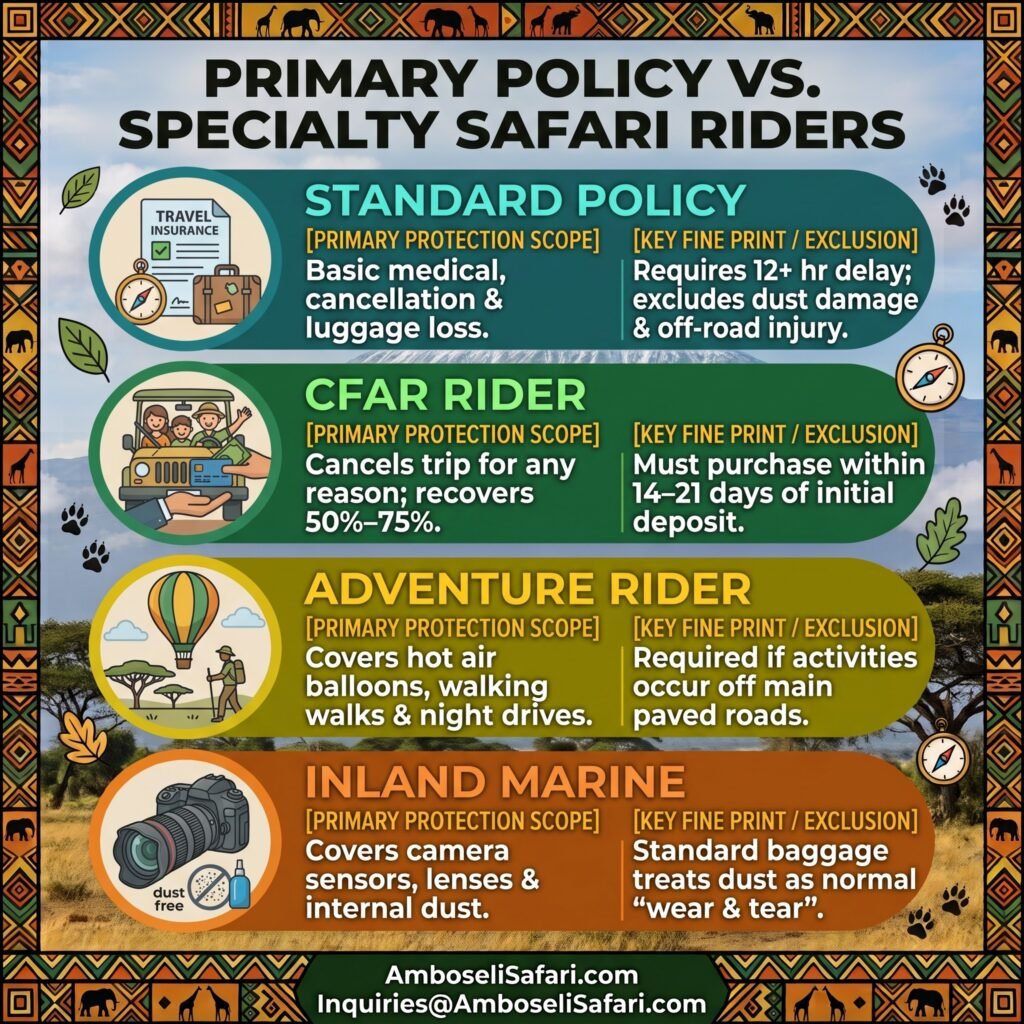
Standard credit card policies and basic travel insurance fall short when dealing with non-refundable luxury lodge deposits, emergency bush evacuations, or specialized gear. A tailored safari policy must balance general travel protections with field-specific riders for adventure activities and dust contamination. Review this comparative framework to identify which core protections and specialized add-ons your safari itinerary requires before making trip deposits.
| Policy Type / Rider | Primary Protection Scope | Key Fine Print / Exclusion |
| Standard Policy | Basic medical, cancellation & luggage loss | Requires 12+ hr delay; excludes dust damage & off-road injury |
| CFAR Rider | Cancels trip for any reason; recovers 50%–75% | Must purchase within 14–21 days of initial deposit |
| Adventure Rider | Covers hot air balloons, walking walks & night drives | Required if activities occur off main paved roads |
| Inland Marine | Covers camera sensors, lenses & internal dust | Standard baggage treats dust as normal “wear & tear” |
Medical Evacuation, Hospital Deposits & Emergency Care
If you get sick or hurt out in the park, getting to a hospital involves a few unique steps:
Private ER Deposit Rules
Private hospitals in Nairobi—like Aga Khan University Hospital or Nairobi Hospital—won’t admit you for non-emergency care until someone pays a cash or credit card deposit of $2,000 to $5,000. They will not wait around for foreign insurance companies to answer emails overnight. Unless your insurer has a 24/7 Guarantee of Payment desk that wires cash instantly, you’ll be charging that deposit to your own credit card.
Evacuation Providers
To avoid delays at Amboseli Airstrip, pair your primary policy with a dedicated evacuation membership:
- AMREF Flying Doctors (Maisha Plan): Costs between $16 and $50 per person. They fly turboprop air ambulances straight to the local runway, with flight medics on board to take you straight to Nairobi hospital helipads.
- Global Rescue / Medjet: These memberships transport you from a hospital in Kenya back to your home country once you are stable.
- World Nomads / Allianz / Travel Guard: Standard primary insurance policies providing medical care coverage and high evacuation limits.
Emergency Evacuation & Nairobi Hospital Protocols
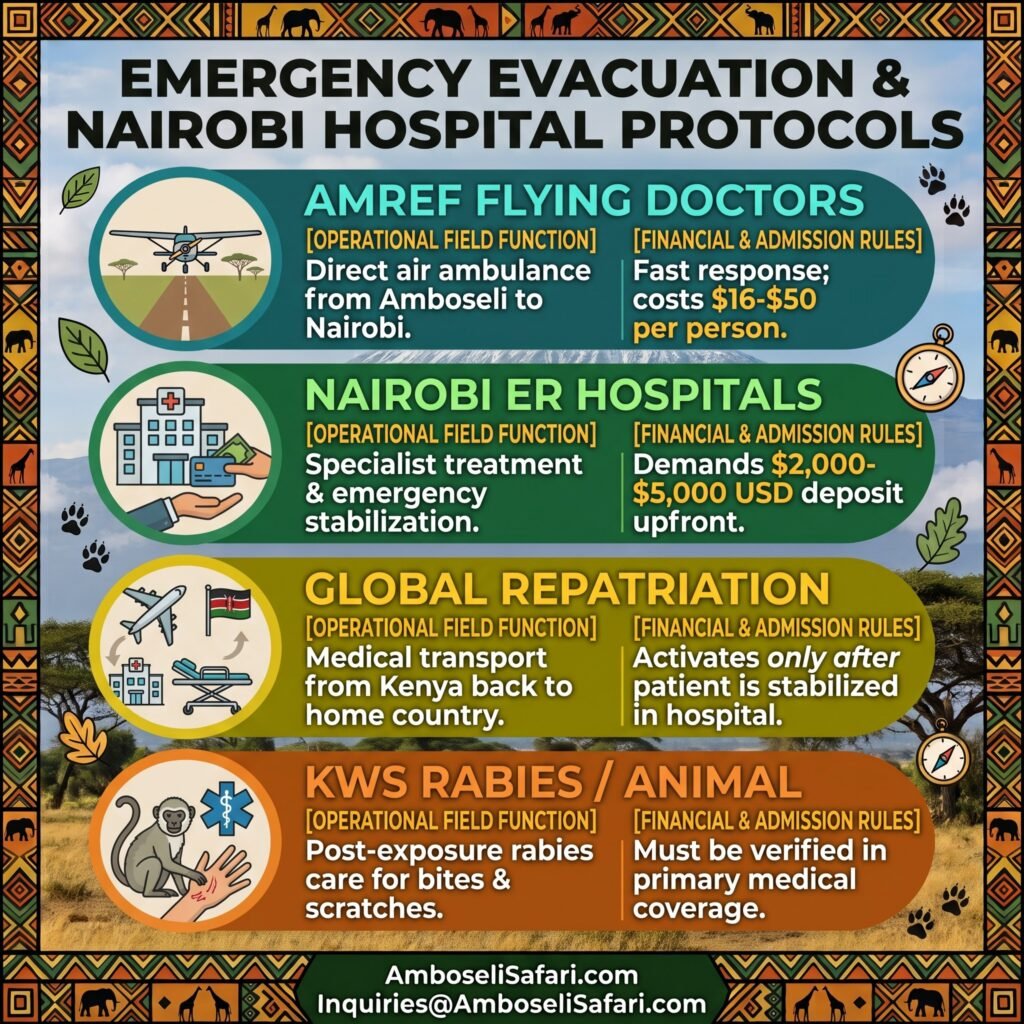
Navigating a medical emergency in Kajiado County requires an understanding of how local bush evacuations and hospital admissions function. Private hospitals in Nairobi demand immediate cash or credit deposits before admitting foreign patients, while air ambulances require direct payment guarantees before launching from bush airstrips. Use this action-oriented reference guide to streamline emergency evacuation memberships and upfront hospital deposit protocols.
| Service / Provider | Operational Field Function | Financial & Admission Rules |
| AMREF Flying Doctors | Direct air ambulance from Amboseli to Nairobi | Fast response; costs $16–$50 per person |
| Nairobi ER Hospitals | Specialist treatment & emergency stabilization | Demands $2,000–$5,000 USD deposit upfront |
| Global Repatriation | Medical transport from Kenya back to home country | Activates only after patient is stabilized in hospital |
| KWS Rabies / Animal | Post-exposure rabies care for bites & scratches | Must be verified in primary medical coverage |
Animal Encounters
Make sure your medical coverage includes bites and scratches from wildlife. If a stray dog nips you in Kimana town or a vervet monkey scratches your arm on a lodge porch, you need post-exposure rabies shots quickly.
Activity Riders for Balloons, Walking Safaris & Night Drives
Basic travel insurance often labels safari activities as “hazardous sports” and excludes them from coverage.
If you plan to add a $450 hot air balloon ride over the marshes, a guided walking safari along park borders, or an open-vehicle night drive in a private conservancy, add an Adventure Sports Rider. Without it, your insurer can deny claims if an injury happens off the main gravel roads.
Camera Gear and Volcanic Dust Protection
Dry season game drives get very dusty. The fine volcanic ash blows through open vehicle roofs, coats your gear, and smells like warm mineral dust. It gets inside lens barrels, coats camera sensors, and jams autofocus motors.
Standard baggage riders will reject your repair claims. Insurers consider dust contamination “normal wear and tear” or environmental exposure.
If you carry expensive lenses, add an “inland marine” gear rider to your home insurance policy before leaving. Specify that it must cover dust, sand, and silt contamination. Personally, I store my camera bodies inside a heavy-duty dry bag (like a Sea to Summit 20L roll-top) on the floor of the Land Cruiser whenever we cross dry lakebeds. It keeps the fine grit out of the buttons.
Corrugated Roads, Back Strain & Self-Drive Towing
Driving the C103 dirt road from Emali to Kimana Gate takes about three hours, and the washboards will rattle your teeth out. The constant vibration puts heavy compression forces on your spine.
If a sudden pothole jolt aggravates an old back injury, insurance companies might claim it was a pre-existing condition and deny the claim. Buy your insurance policy within 21 days of making your first trip deposit to lock in a Pre-Existing Condition Waiver.
If you rent a 4×4 and drive yourself, standard rental insurance (CDW) excludes undercarriage damage, cracked oil pans, flat tires, and towing fees on unpaved park tracks. Sinking a truck into volcanic ash near Kitirua Gate can cost over $1,000 in tow truck fees from Kimana. Make sure your rental insurance explicitly includes off-road towing and recovery.
Bush Airstrip Delays & Lost Soft Bags
Amboseli’s short dirt runway creates a few unique insurance headaches:
Lost Luggage on Bush Planes
Airlines like Safarilink enforce a strict 15 kg (33 lbs) limit in soft duffel bags so luggage can squeeze into light aircraft belly pods. If an international airline loses your suitcase in Nairobi, you have to fly to camp with only what you brought on your back. Pick a policy with a baggage delay clause that pays $200 to $300 a day for replacement clothes at camp gift shops.
Safari Disturbance Triggers & Mandatory Field Paperwork
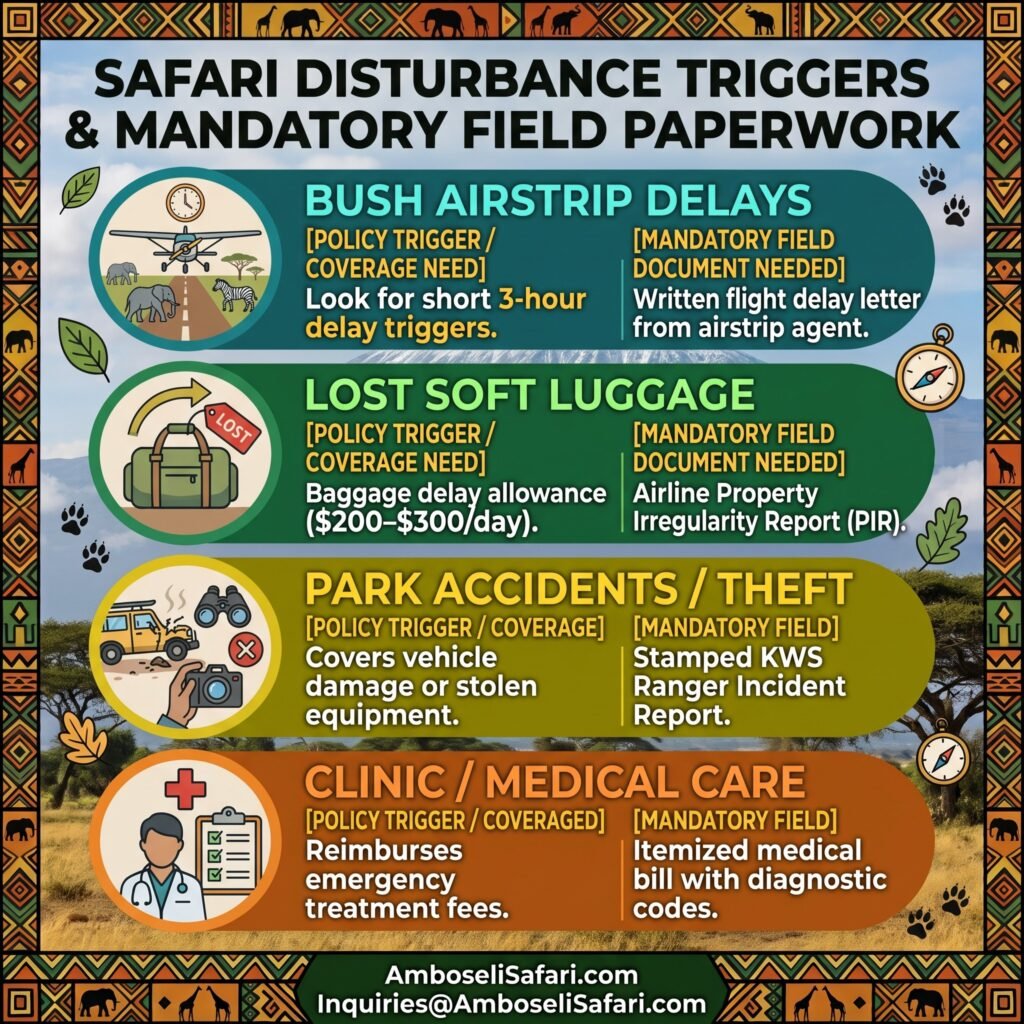
Unpaved airstrips, strict duffel weight limits, and rough corrugated dirt roads introduce unique travel disturbance risks that standard policies rarely cover. Securing claim approvals for missed flights or lost gear depends on gathering official stamped documentation on-site before leaving Kenya. Review this checklist to ensure your policy contains short delay triggers and that you collect all required ranger, clinic, and airline reports.
| Disturbance Scenario | Policy Trigger / Coverage Need | Mandatory Field Document Needed |
| Bush Airstrip Delays | Look for short 3-hour delay triggers | Written flight delay letter from airstrip agent |
| Lost Soft Luggage | Baggage delay allowance ($200–$300/day) | Airline Property Irregularity Report (PIR) |
| Park Accidents / Theft | Covers vehicle damage or stolen equipment | Stamped KWS Ranger Incident Report |
| Clinic / Medical Care | Reimburses emergency treatment fees | Itemized medical bill with diagnostic codes |
Short Delay Triggers
Flight departures from the airstrip get delayed when KWS ranger trucks have to drive down the runway to chase zebras or elephants off the dirt. Afternoon dust storms can also hold up takeoffs. Standard 12-hour flight delay policies won’t help you if a 3-hour runway delay causes you to miss your international flight home. Look for a policy with a short 3-hour delay trigger.
Paperwork to Collect for Insurance Claims
Insurers will reject your claim if you don’t bring back the right paperwork from Kenya:
- Get a stamped KWS ranger incident report at Ol Tukai HQ or Kimana Gate if an accident or theft happens in the park.
- Ask the clinic doctor for an itemized bill with diagnostic codes—your insurer back home will reject the claim without them.
- Save written receipts from local tow truck drivers if your vehicle gets stuck.
- Get a written flight delay letter from the airline agent at the airstrip counter if weather or wildlife delays your flight.
5-Day Multi-Destination Safari Package (2 Nights Amboseli + 2 Nights Masai Mara)
If you want to look at full safari pricing alongside your insurance budget, combining Amboseli with the Masai Mara gives you a complete circuit. We run this route using private 4×4 Safari Land Cruisers with pop-up roof hatches, heavy-duty suspension, and vehicle fridges stocked with cold bottled water.
Rates below show total costs per person for two adults traveling together:
5-Day Circuit Rates & Lodging Options
| Package Tier & Route Details | Included Lodges & Hotels | Price per Person (Low – Peak)* |
| Budget Tier | AA Lodge Amboseli & AA Lodge Mara | From USD $1,850 to USD $2,950 |
| Mid-Range Tier | Kibo Safari Camp & Basecamp Masai Mara | From USD $2,450 to USD $3,850 |
| Luxury Tier | Amboseli Serena Lodge & Mara Intrepids | From USD $3,650 to USD $5,450 |
| Luxury Plus Tier | Elewana Tortilis Camp & Governors’ IL Moran Camp | From USD $5,950 to USD $8,850 (Worth it if clear Kilimanjaro views and top guiding are your priorities) |
Rates cover 2026/2027 travel for two adults sharing a room or tented suite with a private 4×4 Land Cruiser and driver-guide. Standard/Low season covers January through May and November. Peak season spans June through October and December. Rates include full-board lodging, private ground transport, driver allowances, fuel, daily $90 USD KWS park permits (plus the mandatory 5% eCitizen gateway processing fee), Mara reserve fees, and chilled vehicle water. Luxury Plus includes domestic scheduled flights on Safarilink or Airkenya.
To check open dates or reserve your private vehicle, submit your inquiry through our safari booking form.
What’s Included
- Private 4×4 Safari Land Cruiser with pop-up roof hatch and custom beanbag mounts
- Services of a dedicated, TRA-licensed driver-guide for the full 5-day itinerary
- Full-board accommodation covering breakfast, lunch, and dinner daily
- Pre-paid daily $90 USD KWS entry permits (plus 5% eCitizen fee) and Mara reserve fees
- Chilled drinking water stocked in the vehicle cooler
What’s Excluded
- International flights, travel insurance, and digital Kenya entry processing through the official eTA portal
- Tipping your driver-guide or lodge staff
- Alcoholic beverages, soft drinks, or personal laundry
- Optional Maasai village entry vouchers ($30) or hot air balloon flights ($450)
Optional Add-Ons
- Local village entry voucher & cultural walkthrough: USD 30 per person
- Night game drive in a private conservancy: USD 50 per person
- Sunrise hot air balloon flight over central marshes: USD 450 per person
Field Notes & Real Advice
Having physical paper copies of your insurance documents saved in your daypack prevents major issues when technology fails in remote areas.
Anthony Mule, a senior guide with over ten years of experience navigating these park tracks, points out: “Once you head west past Kitirua Gate, cell service dies. If you don’t have a paper copy of your AMREF card in your daypack, you’re stuck waiting while someone tries to find a signal to verify your membership.”
Watching matriarch elephant herds monitored by the Amboseli Elephant Research Project move across shallow channels near Mount Kibo is a highlight of any Kenyan journey. Setting up proper travel insurance coverage beforehand ensures you enjoy every moment on the tracks with total peace of mind.
You can also double-check vehicle logistics and park entrance rules on our Amboseli safari planning guide or review itemized transit costs on our Amboseli safari cost breakdown before you travel.
Ready to book your Land Cruiser and local driver-guide with Amboselisafari.com? Send your details through our safari booking form to reserve your dates.
Frequently Asked Questions
Is AMREF Flying Doctors coverage mandatory for an Amboseli safari?
While not legally mandatory, AMREF Maisha Tourist coverage is strongly recommended. It guarantees rapid air ambulance evacuation directly from the local airstrip to private hospital helipads in Nairobi, bypassing ground transport delays.
Does standard travel insurance cover missed flights due to bush airstrip delays?
Standard policies often require a 12-hour delay before paying claims. Look for a policy with a short 3-hour delay trigger that covers weather holds or wildlife obstructions on unpaved runways.
Are camera lenses protected against volcanic dust damage?
Standard travel baggage riders exclude dust or environmental damage as normal wear and tear. You must add an inland marine gear rider or specialized camera policy to cover internal silt contamination.
What insurance is required for guided walking safaris or night game drives?
Ensure your policy includes an Adventure Activity rider that explicitly covers guided walking safaris on foot and off-paved-road 4×4 driving inside private conservancies.