
Great Migration vs Amboseli Wildlife: Ecosystem Comparison, Logistics & Rates
Quick Comparison: Head to the Masai Mara for huge big cat prides, raw predator action, and the Great Migration river crossings. Pick Amboseli if you want close-up views of giant elephant herds framed against Mount Kilimanjaro without spending six hours on a bumpy road from Nairobi.
Overview
Comparing Great Migration vs Amboseli Wildlife comes down to understanding two totally different wildlife survival strategies in East Africa. While the Masai Mara’s Great Migration depends on rain-fed rivers across land managed in part under Narok County Council, Amboseli’s compact 392 sq km basin sits entirely inside Kajiado County under Kenya Wildlife Service (KWS) jurisdiction. Fed by Mount Kilimanjaro’s underground volcanic springs, central marshes like Enkongo Narok swamp keep resident herds fed and watered year-round. Long-term studies by the Amboseli Elephant Research Project show that local wildebeests and zebras do not need to trek hundreds of miles across borders to survive the dry season. Full-board 3-day and 4-day safari packages in a private 4×4 Land Cruiser range from $1,080 per person for budget lodging up to $5,950 per person for fly-in luxury trips on Amboselisafari.com.
Fast Navigation Links
- Safari Packages & Cost Breakdown
- Travel Logistics and Drive Realities
- Wildlife Density: Cats vs Elephants
- Water Sources & Seasonal Movements
- Photographing Dust Lines vs River Crossings
- Combining Both Destinations: 7-Day Route
- Frequently Asked Questions
2027 Safari Packages & Cost Breakdown
Exploring Amboseli’s basin in a private 4×4 Safari Land Cruiser with a pop-up roof gives you front-row seats to resident herds. You can stand up comfortably to shoot zebra lines crossing open flats without engine vibrations shaking your lens.
All package rates below represent total per-person costs based on two adults traveling together in a private 4×4 Land Cruiser.
3-Day & 4-Day Amboseli Wildlife Safari Packages
| Package Tier & Accommodations | Standard Season (USD / Person)* | Peak Season (USD / Person)* | Practical Planning Advice |
| 3-Day Budget Wildlife Safari (Sentrim Amboseli / AA Lodge / Amboseli Eco Camp) | $1,080 | $1,820 | Ideal for budget travelers |
| 3-Day Mid-Range Wildlife Safari (Kibo Safari Camp / Zebra Plains / Kilima Safari Camp) | $1,280 | $2,050 | Requires booking 6 months ahead |
| 3-Day Luxury Wildlife Safari (Ol Tukai Lodge / Amboseli Serena / Tawi Lodge) | $1,580 | $2,480 | Best for central swamp access |
| 4-Day Fly-In Luxury Plus Safari (Safarilink Flight + Elewana Tortilis / Sanya Camp / Porini) | $3,950 | $5,950 | Best for short trips & photography |
*Rates cover 2026/2027 for two adults sharing a room with private 4×4 Land Cruiser transport. Standard season runs January through May and November. Peak season spans June through October and December. Packages cover full-board lodging, transport, guide allowances, fuel, and daily $90 USD KWS entry permits. Fly-in options include roundtrip flights from Wilson Airport (WIL) on Safarilink or Airkenya plus airstrip transfers.
Package Inclusions
- Private 4×4 Safari Land Cruiser with pop-up roof for game viewing
- Services of a TRA-licensed, English-speaking driver-guide
- Full-board accommodation at your selected lodge or tented camp
- Pre-paid non-resident KWS park permits ($90 USD per 24 hours)
- Chilled bottled drinking water kept in the vehicle cooler
Package Exclusions
- International flights, visa fees, and entry processing through the official eTA portal
- Driver-guide tips, laundry services, and alcoholic beverages
- Optional Maasai cultural village visits ($30 per person) or balloon safaris ($450 per person)
Optional Add-Ons
- Local Maasai village cultural walk: USD 30 per person
- Sunrise hot air balloon flight over central marshes: USD 450 per person
We break down every park fee, fuel allowance, and seasonal rate calculation on our Amboseli safari cost breakdown page.
Travel Logistics and Drive Realities
How you get to the park determines how much time you spend watching wildlife versus sitting on bumpy roads.
Our senior guide, Anthony Mule, always advises guests driving down from Nairobi to leave by 06:00 AM. This avoids heavy commercial truck traffic along the busy A109 Mombasa Highway corridor before you turn off at Emali onto the C103 tarmac road.
| Route / Connection | Drive Time (4×4 Road) | Flight Time (Wilson Airport – WIL) | Road Condition & Practical Reality |
| Nairobi to Amboseli | 3.5 to 4 Hours | 40 to 45 Minutes | Smooth tarmac down Mombasa Highway (A109) with a quick turn at Emali. Easy drive. |
| Nairobi to Masai Mara | 5.5 to 6.5 Hours | 45 to 60 Minutes | Paved to Narok town, followed by hours of bone-rattling corrugated gravel. |
| Amboseli to Masai Mara | 8.5 to 9.5 Hours | 45 to 60 Minutes (Direct Bush Flight) | Brutal all-day drive back through Nairobi traffic. Take the bush plane instead. |
Flight connections between Amboseli airstrips and the Mara take under an hour, saving you a grueling full-day drive across the Great Rift Valley floor.
Wildlife Density: Big Cats in the Mara vs. Elephant Herds in Amboseli
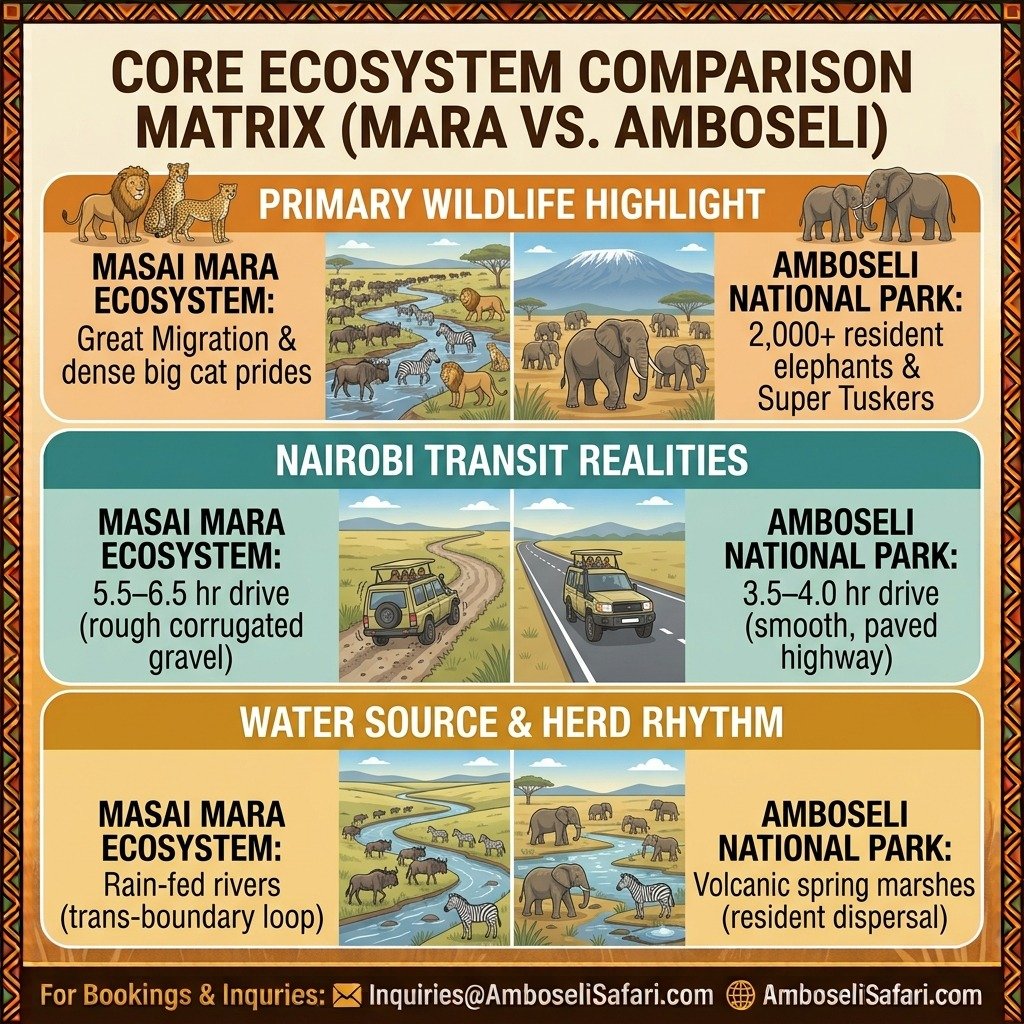
Deciding on the Masai Mara vs Amboseli for first timers comes down to what you want on your camera card:
- Masai Mara (The Big Cat Capital): Famous for dense lion prides, elusive leopards, and open-country cheetah coalitions. Wide rolling grasslands make tracking hunts easy, especially when over a million wildebeests fill the plains.
- Amboseli (The Tusker Sanctuary): Home to over 2,000 free-roaming elephants, including East Africa’s last remaining Super Tuskers. Herds walk right past your vehicle in open marshlands with Mount Kilimanjaro behind them.
If you are setting up the best Kenya safari for family with kids, Amboseli’s short four-hour smooth drive from Nairobi cuts out travel fatigue. Kids get restless on the rough six-hour haul into the Mara.
Core Ecosystem Comparison Matrix (Mara vs. Amboseli)
Choosing between the Masai Mara and Amboseli National Park requires weighing two distinct safari environments, wildlife density profiles, and travel realities. While the Mara offers vast open grasslands populated by dense big cat prides and seasonal migration herds, Amboseli provides intimate views of resident elephant herds framed against Mount Kilimanjaro. This comparative matrix contrasts key ecosystem parameters, primary wildlife draws, and transit times from Nairobi. Use these core benchmarks to match your safari preferences with the right park experience.
| Safari Parameter | Masai Mara Ecosystem | Amboseli National Park |
| Primary Wildlife Highlight | Great Migration & dense big cat prides | 2,000+ resident elephants & Super Tuskers |
| Nairobi Transit Realities | 5.5–6.5 hr drive (rough corrugated gravel) | 3.5–4.0 hr drive (smooth, paved highway) |
| Water Source & Herd Rhythm | Rain-fed rivers (trans-boundary loop) | Volcanic spring marshes (resident dispersal) |
Water Sources: Underground Volcanic Springs vs. Rain-Fed Rivers
The Masai Mara’s Great Migration revolves around seasonal rainfall. Over 1.5 million wildebeests and zebras follow green grass over vast distances, forcing chaotic river crossings over the Mara and Talek Rivers. When dry spells hit, those river levels drop or dry up completely, forcing the herds to keep moving.
Amboseli relies on a completely different underground water supply:
- Glacial runoff from Mount Kilimanjaro filters through porous volcanic rock on the mountain’s upper slopes.
- That underground water bubbles up inside Amboseli, feeding permanent wetlands like Enkongo Narok and Ol Okenya.
- Even during severe regional droughts, these swamps provide fresh water and green sedges under yellow-fever tree groves (Acacia xanthophloeia). Herds never need to migrate hundreds of miles just to find water.
Herd Movement: Local Seasonal Dispersal vs. Trans-Boundary Migration
The Great Migration is a 1,800-mile loop between Tanzania’s Serengeti and Kenya’s Masai Mara. Seeing it requires long drives across vast terrain.
Amboseli’s wildlife moves on a localized seasonal rhythm instead:
- When rains fall from November to May, resident wildebeests, zebras, and gazelles spread out into community group ranches like Olgulului and Kimana.
- When outer grasslands dry up between June and October, herds collapse back into the central 392 sq km park basin to drink from permanent springs.
This concentrated movement packs heavy animal numbers into a tight area. You see a lot of game without driving for hours.
You can organize route connections through our Amboseli safari planning guide.
Calving Seasons: Amboseli’s November Rains vs. Ndutu Birthing
Travelers looking for newborn animals during the Great Migration head to the southern Serengeti around Ndutu between January and March. By the time those migrating herds reach Kenya’s Masai Mara in July, calves are already fully grown.
Amboseli has its own local calving season right inside Kenya. Resident wildebeest herds give birth during the short rains in November and December. Calving happens along the low acacia scrub near Kitirua Gate in the southwest and Iremito Gate in the north. You can watch vulnerable, wobbly-legged calves taking their first steps without the vehicle crowds of the Serengeti.
Compare lodge locations near seasonal calving grounds in our guide on where to stay in Amboseli.
Month-by-Month Sightings Matrix
Plan your dates by comparing peak migration months in the Mara against clear mountain weather windows in Amboseli.
| Month | Great Migration Activity (Masai Mara) | Kilimanjaro Visibility & Wildlife (Amboseli) |
| January – February | Herds down in southern Serengeti. Mara is quiet. | Clear skies, grand mountain views, herds clustered in central swamps. |
| March – May | Herds moving through western Serengeti. Heavy rain. | Low lodge rates, lush landscapes, local game spread out in outer scrub. |
| June | Herds moving toward northern Serengeti. Early Mara arrivals. | Crisp morning air, herds moving back toward permanent water. |
| July – August | Peak Migration: Famous river crossings along Mara River. | Cold mornings, dry weather, massive elephant herds in central marshes. |
| September – October | Peak Migration: Large herd concentrations in northern Mara. | Dry salt pans, long dust trails, super clear early morning light. |
| November – December | Herds heading south back into Tanzania. Short rains start. | Calving Season: Newborn wildebeests, migratory birds, lush green plains. |
Land Management: KWS Rules vs. Private Conservancies
How you experience game drives depends heavily on land rules:
- Amboseli National Park (KWS Rules): Governed by strict Kenya Wildlife Service regulations. Vehicles must stay on marked tracks to protect fragile salt crusts. Off-roading, night drives, and walking safaris are banned inside park boundaries (though night drives are allowed in outer private conservancies like Selenkay or Elerai).
- Masai Mara Conservancies: While the core Masai Mara National Reserve enforces fixed-track rules, surrounding private conservancies (like Mara North or Olare Orok) allow off-roading for big cat sightings, guided bush walks, and night drives with spotlights.
Photographing the Dust Lines vs. Mara River Crossings
Great Migration photography is fast and chaotic—splashing water, plunging wildebeests, and dust along steep riverbanks.
Amboseli photography focuses on clean, orderly lines set against dramatic backdrops. Anthony notes that Kibo peak usually gets blanketed in thick cloud cover by 10:00 AM as thermal heat builds off the dry salt flats. Early morning drives are critical for mountain shots.
Every morning around 08:30 AM, thousands of zebras and wildebeests leave dry night roosts to walk toward central marshes. They walk single-file across the bone-dry alkaline salt pan (Empusel), kicking up fine white chalk dust.
Fine alkaline dust gets into everything. Pack a sealable camera bag and keep your lenses wrapped in cotton towels between sightings—that fine white silt works its way right into zoom rings if left exposed in an open vehicle.
If you’re targeting wide-angle shots of big tuskers, pack a 24-70mm lens and review gear tips in our famous elephants guide.
Predator Tactics: Papyrus Swamps vs. Riverbanks
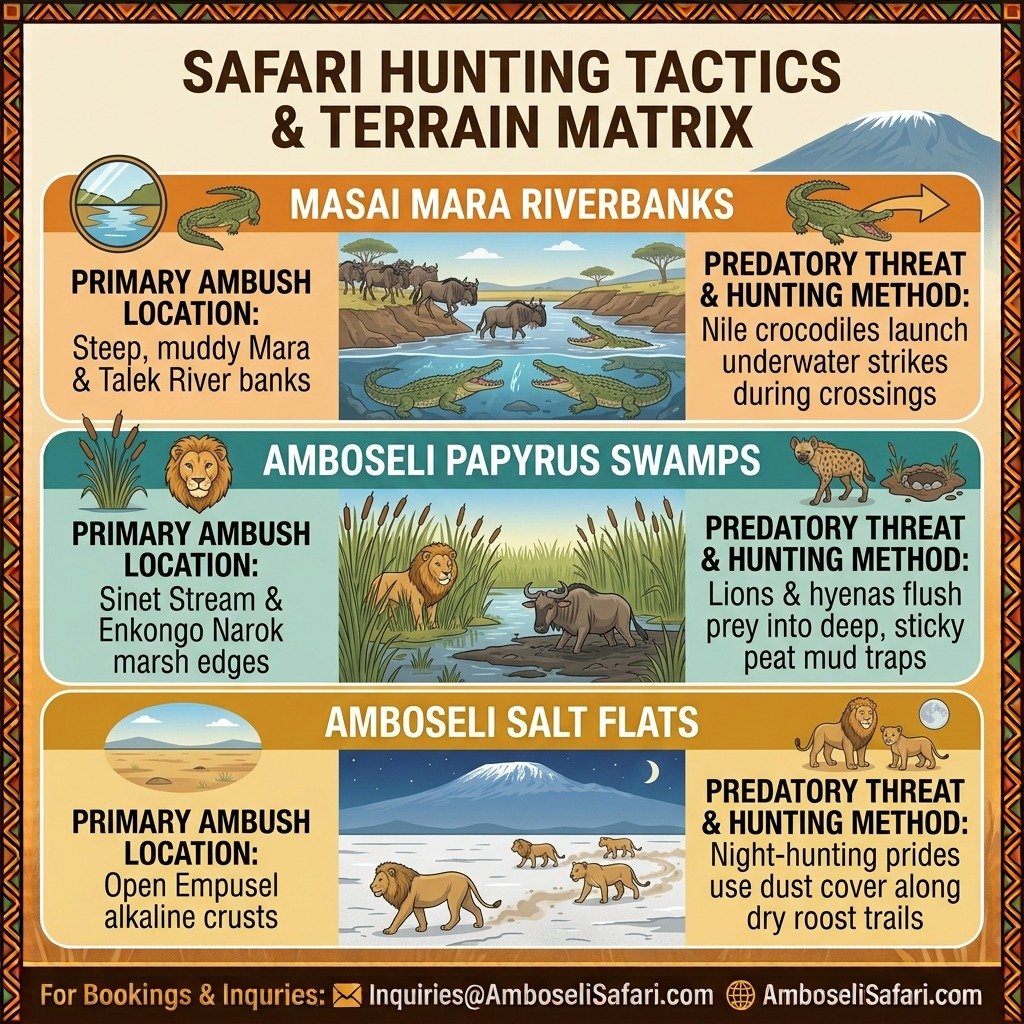
Massive Nile crocodiles waiting at riverbanks are the main threat for herds crossing during the Great Migration.
Amboseli has no large rivers and zero Nile crocodiles. Predators here use the marshy terrain differently:
- Lions and spotted hyenas hide in tall papyrus reeds framing Sinet Stream.
- They flush wildebeests and zebras toward shallow marsh edges lined with sticky black peat mud.
- Heavy hoofed animals sink deep into the wet peat, getting bogged down so big cats can make quick kills without long chases.
If you’re planning a self-drive trip, keep an eye on track conditions along marsh edges—check our Amboseli self-drive tips page to avoid getting stuck in those exact same mud traps.
Safari Hunting Tactics & Terrain Matrix
Predator-prey interactions differ dramatically between the steep, riverine channels of the Masai Mara and the spring-fed peat bogs of Amboseli. In the Mara, massive Nile crocodiles exploit chaotic river crossings, whereas Amboseli’s lions and hyenas use sticky marsh edges to trap heavy-hoofed ungulates. This tactical comparative matrix breaks down primary ambush zones, main predatory threats, and unique terrain traps across both ecosystems. Review these behavioral dynamics to know what to look for during morning predator drives.
| Ecosystem Zone | Primary Ambush Location | Predatory Threat & Hunting Method |
| Masai Mara Riverbanks | Steep, muddy Mara & Talek River banks | Nile crocodiles launch underwater strikes during crossings |
| Amboseli Papyrus Swamps | Sinet Stream & Enkongo Narok marsh edges | Lions & hyenas flush prey into deep, sticky peat mud traps |
| Amboseli Salt Flats | Open Empusel alkaline crusts | Night-hunting prides use dust cover along dry roost trails |
Combining Both Destinations: A 7-Day Route
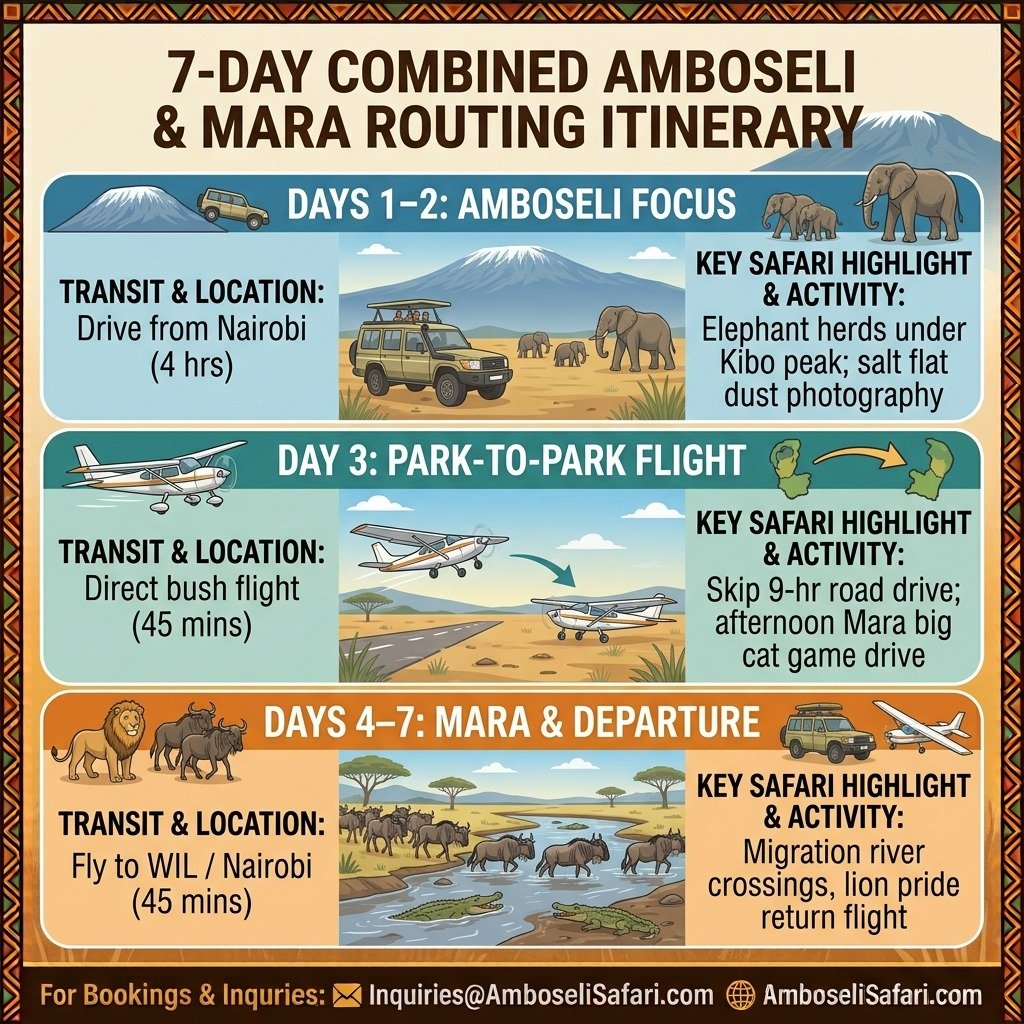
You don’t have to choose between big cats and giant tuskers. Combining both parks into a single 7-day trip gives you the ultimate Kenya experience.
- Day 1: Nairobi to Amboseli: Easy 4-hour drive on paved roads. Afternoon game drive along Sinet Stream as elephants walk back from the swamps.
- Day 2: Full Day Amboseli: Early morning photography on the salt pan under Mount Kilimanjaro. Midday walk up Observation Hill and an afternoon tracking tuskers.
- Day 3: Amboseli to Masai Mara Flight: Board a 45-minute bush plane flight from Amboseli airstrip straight to the Masai Mara. Afternoon game drive across the Mara plains.
- Day 4–6: Masai Mara Exploration: Three full days tracking lion prides, leopards, and cheetahs, with drives along the Mara River for migration crossings (July–October).
- Day 7: Masai Mara to Nairobi: Morning game drive, followed by a quick flight back to Wilson Airport in Nairobi.
7-Day Combined Amboseli & Mara Routing Itinerary
Combining Amboseli and the Masai Mara into a single 7-day safari offers the ultimate Kenya wildlife circuit without sacrificing comfort or travel efficiency. Utilizing a direct 45-minute bush flight between airstrips eliminates an exhausting 9-hour road transit back through Nairobi’s traffic corridor. This daily routing itinerary outlines key transit steps, overnight stays, and primary game viewing goals for an integrated multi-park itinerary. Follow this schedule to maximize your time in front of wildlife across both ecosystems.
| Itinerary Phase | Transit & Location | Key Safari Highlight & Activity |
| Days 1–2: Amboseli Focus | Drive from Nairobi (4 hrs) | Elephant herds under Kibo peak; salt flat dust photography |
| Day 3: Park-to-Park Flight | Direct bush flight (45 mins) | Skip 9-hr road drive; afternoon Mara big cat game drive |
| Days 4–7: Mara & Departure | Fly to WIL / Nairobi (45 mins) | Migration river crossings, lion pride tracking, return flight |
Practical Expectations & Safari Disclaimers
Keep these field realities in mind before booking:
- No 1.5 Million Herd Mass in Amboseli: Amboseli holds thousands of animals, but you will not see a continuous sea of 1.5 million wildebeests like the Mara migration.
- No River Crossings in Amboseli: If you want to see wildebeests leaping down steep riverbanks into crocodile-infested waters, you need the Masai Mara between July and October.
- Strict Off-Road Banning: KWS rangers strictly prohibit off-road driving in Amboseli. Drivers caught off-track face heavy fines.
Travelers who want relaxed game viewing with Mount Kilimanjaro backdrops often prefer Amboseli over the crowded vehicle tracks around Mara migration hubs. Community ranger networks supported by the Big Life Foundation work alongside local herders to keep movement corridors open for wildlife moving across park borders.
Ready to book a private Land Cruiser and driver-guide for your trip? Submit your dates through our safari inquiry form or reserve directly on Amboselisafari.com via our main safari booking form.
Frequently Asked Questions
Does Amboseli National Park have the Great Migration?
No. The Great Migration happens between the Serengeti in Tanzania and the Masai Mara in Kenya. Amboseli has its own resident herds of wildebeests, zebras, and gazelles that stay in the ecosystem year-round.
When is the best time to see wildebeest calving in Amboseli?
Resident wildebeests in Amboseli give birth during the short rains in November and December. Calving happens along the scrub fringes near Kitirua and Iremito gates.
Which is better for a short 3-day safari: Amboseli or Masai Mara?
Amboseli is usually better for a 3-day trip because of its compact size and shorter 4-hour drive from Nairobi. The Masai Mara takes over 6 hours to reach by road and requires more driving to cover its wide open plains.
How long is the flight between Amboseli and Masai Mara?
The flight between Amboseli airstrip and the Masai Mara takes about 45 to 60 minutes on direct bush charters or connecting flights through Nairobi’s Wilson Airport (WIL).