
Bird Watching in Amboseli: Hotspots, Target Species & Safari Packages
Overview
Tracking over 400 bird species across Amboseli takes more than good glass—it requires understanding how water levels and ground heat shift daily feeding patterns. While many travelers assume the park falls under Narok County Council, it sits entirely in Kajiado County under Kenya Wildlife Service (KWS) jurisdiction. From tracking flamingos between Junctions 25 and 26 to glassing raptor thermals above Observation Hill, timing drives around atmospheric haze saves hours of empty driving. Full-board 3-day and 4-day birding safari packages in a private 4×4 Land Cruiser run from $1,080 per person for budget stays up to $5,950 per person for fly-in luxury setups.
Fast Navigation Links
- Packages & Rates
- Seasonal Migration Calendar
- Target Species Checklist
- Key Route Map & Junctions
- Field Secrets & Grasslands
- Optics & Foot Rules
- Frequently Asked Questions
Birding Safari Packages & Rates
Searching for canopy weavers or ground larks gets tedious fast in a closed vehicle. Working out of an open-top 4×4 Land Cruiser gives 360-degree clearance. You can rest a heavy telephoto on a beanbag without vehicle engine vibrations ruining the frame. Keep optics bagged—alkaline dust ruins focus rings by 9 AM.
Skip the hot air balloon safari if dedicated birding is the main goal. Floating over the canopy at 500 feet makes it impossible to key in on small passerines, and $450 per person is far better spent extending your stay in a private conservancy for night drives.
3-Day & 4-Day Amboseli Birding Safari Packages
| Package Tier & Accommodations | Standard Season (USD / Person)* | Peak Season (USD / Person)* | Option |
| 3-Day Budget Birding Safari (Sentrim Amboseli / AA Lodge) | $1,080 | $1,880 | Entry-level option |
| 3-Day Mid-Range Birding Safari (Kibo Safari Camp / Zebra Plains) | $1,290 | $2,080 | Mid-tier option |
| 3-Day Luxury Birding Safari (Ol Tukai Lodge / Amboseli Serena) | $1,590 | $2,480 | Central swamp location |
| 4-Day Fly-In Luxury Plus Safari (Safarilink Flight + Elewana Tortilis / Angama) | $3,950 | $5,950 | Fly-in option |
*Rates valid through 2026/2027. Covers two adults sharing a room/tent and a private 4×4 Land Cruiser. Standard season runs January through May and November. Peak season covers June through October and December. Packages include full-board lodging, private transport, guide fees, fuel, and daily KWS permits ($90 USD/day). Fly-in trips include roundtrip domestic flights from Wilson Airport (WIL) on Safarilink or Airkenya plus airstrip transfers.
Package Inclusions
- Private 4×4 Land Cruiser with a pop-up roof for gear stability
- TRA-licensed driver-guide trained in bird calls and micro-habitats
- Full-board lodging (breakfast, lunch, and dinner)
- Pre-paid non-resident KWS park permits ($90 USD per 24 hours)
- Cold bottled water kept in the vehicle cooler
Package Exclusions
- International airfare, visa fees, and entry processing through the official eTA portal
- Tips, laundry, and alcoholic beverages
- Optional Maasai village visits ($30 per person) or balloon safaris ($450 per person)
Optional Add-Ons
- Local Maasai village cultural walk: USD 30 per person
- Sunrise hot air balloon flight over central marshes: USD 450 per person
Vehicle costs, park fees, and driver allowances are broken down in our Amboseli safari cost breakdown.
When to Go: Seasonal Migration Calendar
Arrival months dictate species density. European waders dominate the wetlands in December, while breeding plumages peak during the April rains.
| Window / Months | Season Status | What to Look For | Real-World Field Conditions |
| Nov – Mar | Peak Migration | Palearctic winterers joining resident waterbirds | Flooded marsh edges, high water levels, warm rain showers |
| Apr – May | Long Rains & Breeding | Weavers, bishops, and widowbirds in breeding plumage | Lush green cover; slick mud tracks requiring low-range 4×4 |
| Jun – Oct | Dry Season | Waterbird concentrations along permanent swamp channels | High dust levels; animals crowd the only open water sources |
Target Species Checklist
Field records published on eBird Kenya document over 500 species across this basin. Real-world sighting odds shift significantly depending on daily sun position and water levels:
| Species & Common Name | Family | Micro-Habitat | Real-World Odds |
| Pangani Longclaw | Motacillidae | Dry alkaline short-grass | Easy before 08:30 AM; impossible by noon in heat shimmer |
| Spike-heeled Lark | Alaudidae | Open salt-crust plains | High along KWS Junction 14 at first light |
| Taveta Golden Weaver | Ploceidae | Yellow-fever acacia canopy | Look for breeding males displaying near Ol Tukai water channels |
| Rufous-bellied Heron | Ardeidae | Kitirua papyrus margins | Hit-or-miss; only shows up when spring channels flood |
| Long-toed Lapwing | Charadriidae | Floating Pistia weed mats | Reliable along quiet Kitirua spring channels |
| Steel-blue Whydah | Viduidae | Bushes near Ol Tukai | Moderate; look for long-tailed breeding males in low scrub |
| Von der Decken’s Hornbill | Bucerotidae | Open acacia woodland | Easy; noisy calls from high dead branches |
| Lesser Flamingo | Phoenicopteridae | Causeway Junctions 25/26 | Flocks drift daily depending on lake algae levels |
| Greater Flamingo | Phoenicopteridae | Lake Amboseli shallows | Common after heavy rains fill the main pan |
| Martial Eagle | Accipitridae | Observation Hill thermals | Thermals picking up around noon bring soaring adults |
| Bateleur | Accipitridae | Soaring over dry plains | Very common; distinct short-tailed flight profile |
| Pallid Harrier | Accipitridae | Enkongo Narok marsh edge | Palearctic winterer; hunts low over reed tops |
| Montagu’s Harrier | Accipitridae | Open swamp borders | Palearctic winterer; common over tall grass from Nov–Mar |
| Pennant-winged Nightjar | Caprimulgidae | Selenkay sand tracks | 50/50 on night drives in private conservancies |
| Slender-tailed Nightjar | Caprimulgidae | Outer conservancy scrub | Easy with red spotlights along sandy tracks |
| African Pygmy Falcon | Falconidae | Dry thorn scrub | Low; look for tiny shapes on dead acacia twigs |
| Kori Bustard | Otididae | Dry basin grass plains | Easy; constantly walking open grass flats |
Key Route Map & Junction Markers
Driving aimlessly across the dry basin burns fuel without results. Focus on these specific park locations:
- KWS Junction 14 (Normati Sands): Located along the dry salt-basin border. Best at first light for ground-dwelling larks before ground heat rises.
- Junctions 25 to 26 (Sinet Causeway Extension): The main water crossing between central marshes and Lake Amboseli. Flamingos concentrate here when lake water shifts.
- Kitirua Marsh (Southwest sector): Quiet spring-fed wetlands protected by thick floating vegetation. Excellent for shy waders away from safari traffic.
- Ol Tukai Woodland (Central sector): Dense shade under yellow-fever trees (Acacia xanthophloeia). Ideal for woodland feeding flocks during hot afternoon hours.
- Observation Hill (Noomotio): The central high point. Perfect for scanning raptors riding mid-day thermal updrafts.
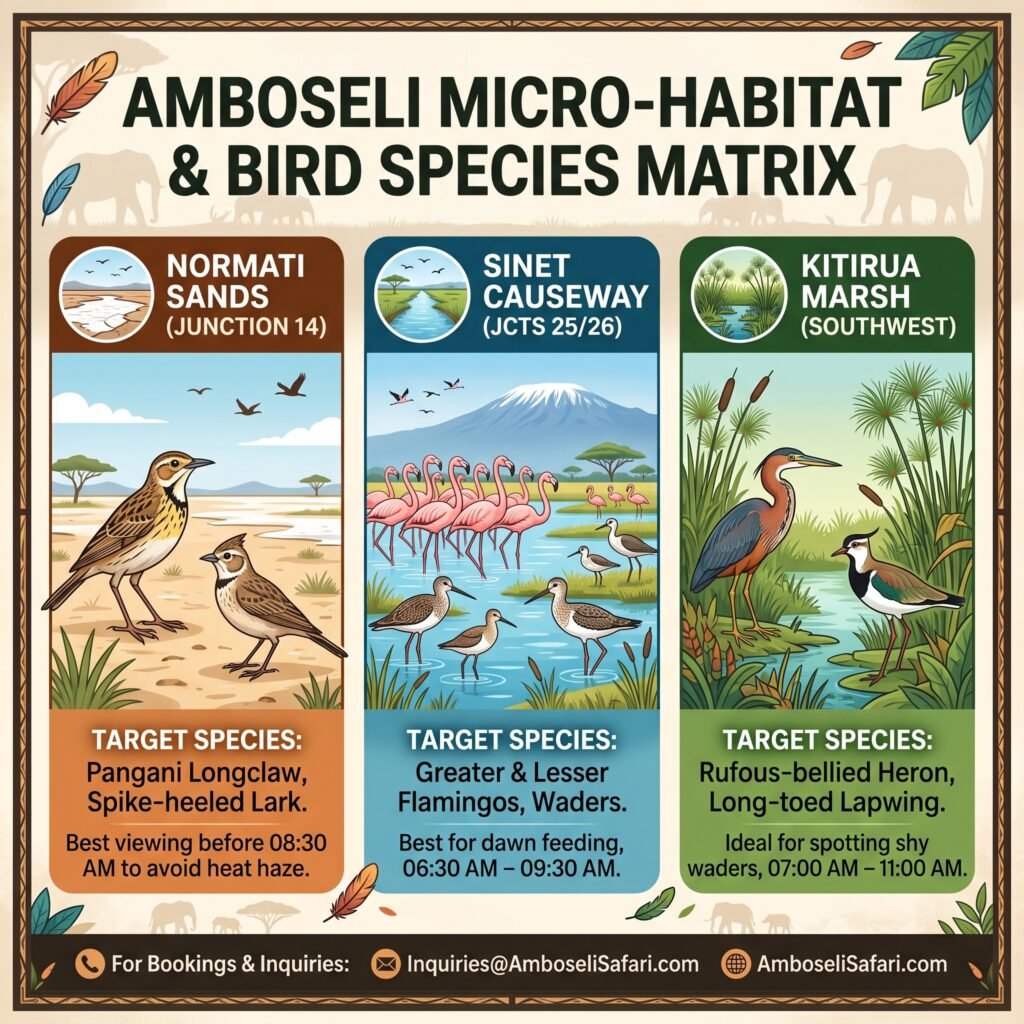
Amboseli Micro-Habitat & Bird Species Matrix
Navigating Amboseli’s diverse ecosystems requires matching your drive times with specific micro-habitats and daily bird activity windows. From dry salt-crust plains to dense papyrus swamps, bird density shifts dramatically as ground heat rises. This micro-habitat matrix details the primary park locations, key target species, and optimal daily viewing hours for birders. Coordinate these coordinates and timeframes with your driver-guide to maximize your species tally.
| Micro-Habitat & Location | Key Target Species | Optimal Viewing Window |
| Normati Sands (Junction 14) | Pangani Longclaw, Spike-heeled Lark | 06:00 AM – 08:30 AM (Before heat haze) |
| Sinet Causeway (Jcts 25/26) | Greater & Lesser Flamingos, Waders | 06:30 AM – 09:30 AM (Dawn feeding) |
| Kitirua Marsh (Southwest) | Rufous-bellied Heron, Long-toed Lapwing | 07:00 AM – 11:00 AM (Quiet channels) |
Grassland Endemics at Normati Sands
Out on the salt flats around Normati Sands, the ground appears empty at noon. Switching off the engine near KWS Junction 14 at 06:30 AM reveals the dry ticks and calls of specialized ground species documented by BirdLife International.
Pangani Longclaws (Macronyx aurantiigula) and Spike-heeled Larks (Chersomanes albofasciata) forage between low grass tufts while the air remains cool. Once hot air hits the alkaline crust around 10:00 AM, heat waves make tiny larks look like blurred specks.
Causeway Flamingos & Waterbird Drifts
Flamingos in the ecosystem are not restricted to Rift Valley lakes. Large mixed flocks of Greater and Lesser Flamingos crowd the flooded causeway between KWS Junctions 25 and 26 along the Enkongo Narok extension.
Flocks drift back and forth based on water chemistry. They feed on microscopic algae in Lake Amboseli’s alkaline shallows, then retreat to fresh papyrus channels when lake levels rise.
Check water depth reports at Kimana Gate before setting out. If recent rains filled the main pan, driving straight to Junction 25 at dawn captures flamingos feeding against Mount Kilimanjaro before they retreat into deep reeds.
Canopy Species in the Ol Tukai Woodlands
Ol Tukai gets loud with tourist groups around lunch, but by 04:00 PM the grounds quiet down and the shaded yellow-fever tree canopy becomes active.
Insect-eating birds form fast-moving feeding flocks through the upper branches. A short walk along lodge footpaths inside this woodland yields several key sightings:
- Near-endemic Taveta Golden Weavers (Ploceus castaneiceps) weaving nests over water channels
- Von der Decken’s Hornbills calling from dead limbs
- Steel-blue Whydahs (Vidua hypocherina) showing off long tail streamers in low bushes
Property layouts and boundary location differences are compared in our guide to where to stay in Amboseli.
Kitirua Marsh Secrets & Observation Hill Thermals
Kitirua Marsh (Southwest sector): Thick mats of floating water lettuce (Pistia stratiotes) shield timid swamp birds from busy main tracks.
This quiet corner holds elusive waders like the Rufous-bellied Heron (Ardeola rufiventris) and the Long-toed Lapwing (Vanellus crassirostris). Vehicles parked along quiet Kitirua spring channels provide views of herons picking through floating plants right alongside submerged hippos.
Observation Hill (Noomotio) serves as the primary raptor lookout. Thermals picking up around noon bring soaring adults right to eye level.
Between 11:00 AM and 01:00 PM, heat rising off the salt flats creates powerful updrafts. Standing on the shaded summit deck with 8×42 binoculars puts you at eye level with soaring raptors:
- Martial Eagles banking hard over the ridge
- Bateleurs showing their distinct red facial skin and short tails
- Migratory Palearctic species like Pallid and Montagu’s Harriers hunting low over Enkongo Narok swamp
Detailed marsh maps and gate entry tracks are published in our main Amboseli National Park guide.
Optics Setup & Foot-Birding Rules
Stepping out of your vehicle inside KWS national park grounds is strictly controlled for safety:
- Where You Can Walk: Pedestrians are limited to fenced lodge grounds like Ol Tukai or Serena, and the paved lookout path up Observation Hill.
- Vehicle Constraints: Walking open plains or marsh edges inside the national park is illegal due to wild buffaloes, hippos, and lions.
- Conservancy Walking Safaris: Dedicated foot-birding requires booking stays in outer private conservancies like Selenkay or Kilitome, where local Maasai naturalists escort guests through open acacia scrub.
Fine alkaline dust on the Normati loop locks up exposed focus rings within an hour—keep lenses bagged until the engine shuts down.
An 8×42 binocular is far more effective here than 10x or 12x glass. A wider field of view makes tracking fast canopy flocks easier, and lower magnification handles image jitter from heat shimmer much better.
For photography, a flexible 100–400mm zoom lens outperforms a heavy 600mm prime lens when heat waves build after 09:30 AM. Zooming back slightly cuts through optical distortion while keeping focus sharp. Draping a heavy canvas beanbag over the pop-up roof rim provides stable support without transferring engine vibration.
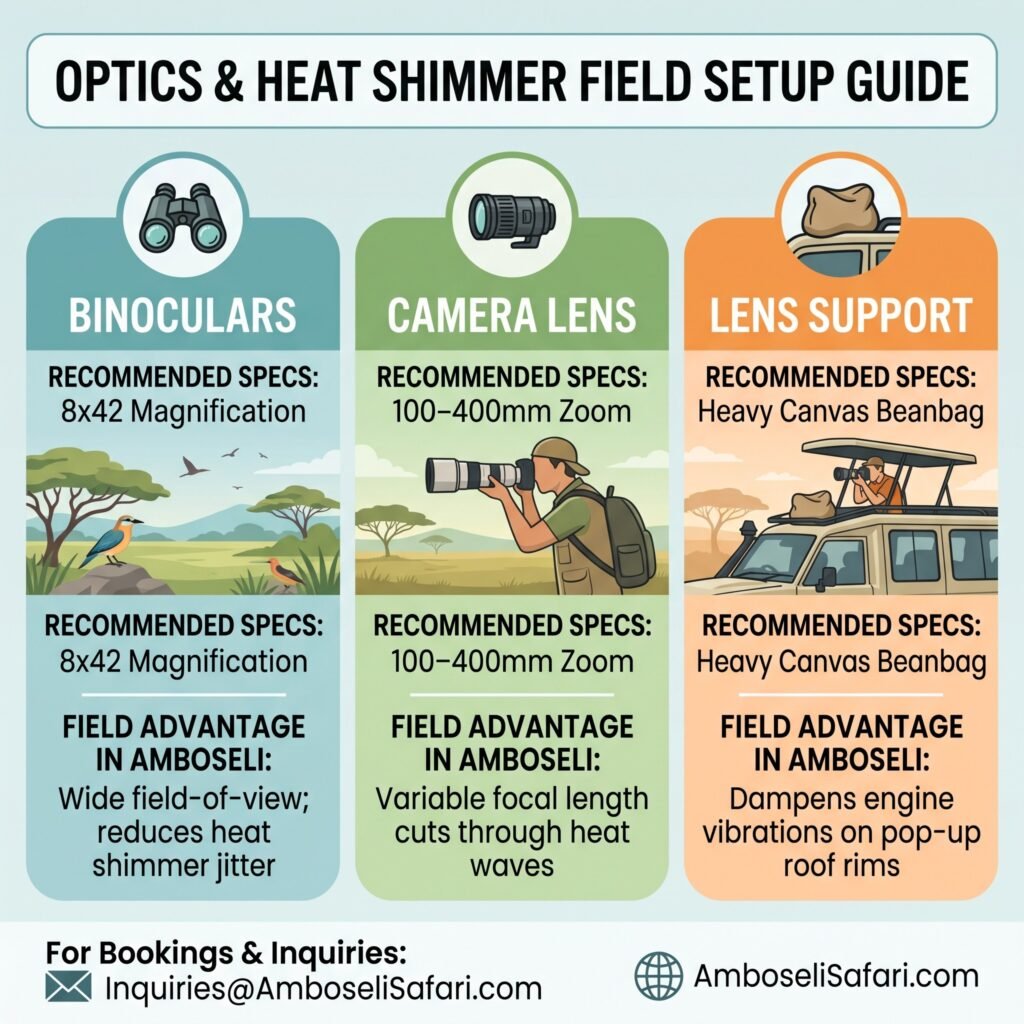
Optics & Heat Shimmer Field Setup Guide
Intense ground heat rising off Amboseli’s dry alkaline flats creates severe optical distortion by mid-morning, making long telephoto lenses and spotting scopes difficult to use. Choosing the right optics setup and dampening vehicle vibration is essential for sharp species identification. This optical field guide outlines the ideal binocular, camera, and vehicle support configurations for savanna birding. Adjust your gear according to these parameters to maintain crisp focus throughout the day.
| Equipment Type | Recommended Specs | Field Advantage in Amboseli |
| Binoculars | 8×42 Magnification | Wide field-of-view; reduces heat shimmer jitter |
| Camera Lens | 100–400mm Zoom | Variable focal length cuts through heat waves |
| Lens Support | Heavy Canvas Beanbag | Dampens engine vibrations on pop-up roof rims |
Nightjar Tracking in Private Conservancies
KWS rules strictly ban night drives inside national park borders. Staying in private conservancies like Selenkay or Kilitome opens up night birding possibilities.
After 08:00 PM, local trackers use red-filtered spotlights along sandy bush tracks. The red lens catches eyeshine without blinding birds or scaring Grey Crowned Cranes sleeping in nearby branches.
Night drives frequently yield:
- Pennant-winged Nightjars (Caprimulgus vexillarius) fluttering across sandy tracks in breeding season
- Slender-tailed Nightjars resting on open dirt
- Verreaux’s Eagle-Owls watching for prey from high branches
Seasonal migration timing and weather windows are covered in our Amboseli safari planning guide.
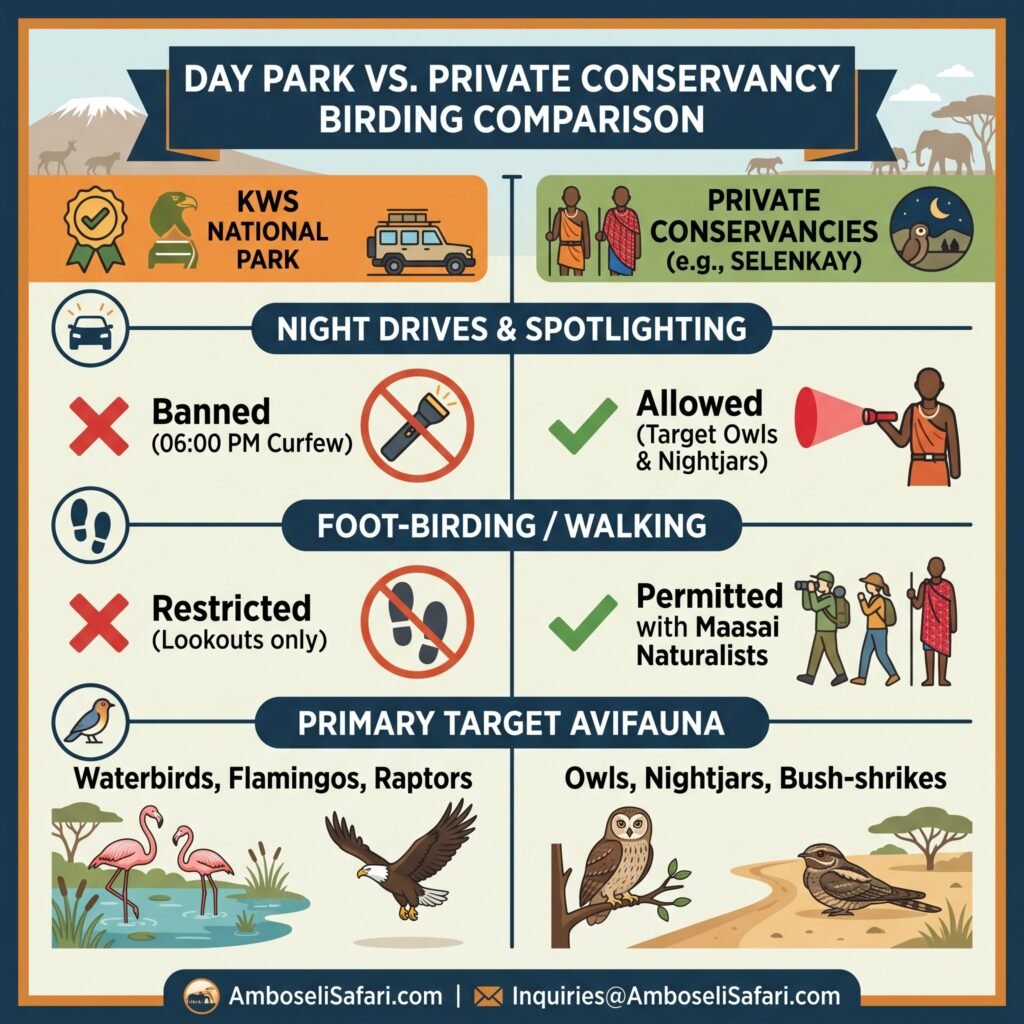
Day Park vs. Private Conservancy Birding Comparison
Understanding the operational differences between Kenya Wildlife Service (KWS) national park grounds and adjacent private conservancies is key to planning a complete birding itinerary. While the national park protects vast wetland swamps and waterbird concentrations, strict park curfews prevent night birding and foot safaris. This visual comparison highlights the distinct rules, access permissions, and target species available in each safari zone. Use this breakdown to balance your daytime game drives with specialized nocturnal birding stays.
| Feature / Activity | KWS National Park | Private Conservancies (e.g., Selenkay) |
| Night Drives & Spotlighting | Banned (06:00 PM Curfew) | Allowed (Target Owls & Nightjars) |
| Foot-Birding / Walking | Restricted (Lookouts only) | Permitted with Maasai Naturalists |
| Primary Target Avifauna | Waterbirds, Flamingos, Raptors | Owls, Nightjars, Bush-shrikes |
Field Realities & eBird Verification
Thermal heat haze limits optical range by 10:30 AM, rendering high-power spotting scopes almost useless across dry lakebeds. Completing critical species checks between 06:30 AM and 09:00 AM ensures clear views before heat shimmer sets in.
Checking recent postings on eBird Amboseli Hotspots before morning drives helps confirm active locations for rare waders or vagrant species.
While scanning marsh edges near Ol Tukai, birders often observe elephant herds studied by the Amboseli Elephant Research Project wading through the same reed beds as Grey Herons.
Self-drive travelers can review road clearance notes on our Amboseli self-drive tips page.
Need help building a species-specific itinerary or securing vehicle dates? Send a note through our safari inquiry form or request a custom package via our main safari booking form.
Frequently Asked Questions
What is the best season for bird watching in Amboseli?
November through April. Rains turn the dry basin green, and over 100 species of European and Asian migratory birds arrive to join resident waterbirds.
How many bird species can you expect to see on a 3-day safari?
Between 150 and 220 species over three days when working with an experienced guide covering swamps, woodlands, and salt flats.
Do I need a specialized birding guide in Amboseli?
Yes. General driver-guides focus primarily on large mammals, whereas spotting small ground endemics like the Pangani Longclaw or identifying female weavers requires a guide trained in bird calls and micro-habitats.
Are night drives allowed for spotting owls and nightjars?
Night drives are strictly banned inside KWS national park grounds. However, night drives are permitted on private conservancies along the border, such as Selenkay or Kilitome.