
Big Five in Amboseli National Park: Field Realities, Tracking Hotspots & Rates
Overview
Tracking down the Big Five in Amboseli National Park means knowing how the land actually works before you unlatch your camera lens. Most people assume Narok County Council runs this place, but it’s entirely inside Kajiado County under Kenya Wildlife Service (KWS) care. Massive elephant herds monitored by the Amboseli Elephant Research Project share these open marshes with resident lions and buffaloes—though finding rhinos or leopards takes a completely different plan. Full-board 3-day and 4-day safari packages in a private 4×4 Land Cruiser run from $1,080 per person for budget camps up to $5,950 per person for fly-in luxury lodges.
Fast Navigation Links
- Safari Packages & Rates
- Best Time for Big Five
- The Missing Rhino Reality
- Completing the Big Five
- Daily Tracking Itinerary
- Super Tuskers Spotlight
- Elephant Habituation & AERP
- Buffalo Swamp Behaviour
- Lion Culverts & Leopards
- Park Logistics & Gates
- Photography & Gear Tips
- Community Corridors
- Frequently Asked Questions
Safari Packages & Rates
Driving across dusty salt pans for hours gets exhausting in a small car. A private 4×4 Land Cruiser with a pop-up roof lets you stand up, rest heavy lenses on beanbags, and spot wildlife over tall grass without engine rattle shaking your viewfinder.
Our packages include full-board lodging, a private Land Cruiser with an experienced driver-guide, fuel, park vehicle permits, chilled bottled water, and pre-paid non-resident KWS entry passes ($90 USD per adult every 24 hours).
3-Day & 4-Day Amboseli Big Game Safari Packages
| Package Tier & Accommodations | Standard Season (USD / Person)* | Peak Season (USD / Person)* | Option |
| 3-Day Budget Safari (Sentrim Amboseli / AA Lodge) | $1,080 | $1,820 | Check Budget Availability |
| 3-Day Mid-Range Safari (Kibo Safari Camp / Zebra Plains) | $1,280 | $2,050 | View Mid-Range Itinerary |
| 3-Day Luxury Safari (Ol Tukai Lodge / Amboseli Serena) | $1,580 | $2,480 | Select Luxury Lodge Option |
| 4-Day Fly-In Luxury Plus Safari (Safarilink Flight + Elewana Tortilis / Tawi Lodge) | $3,950 | $5,950 | Book Fly-In Package |
*Rates are based on two adults sharing a room and a private 4×4 Land Cruiser. Standard season runs January through May and November. Peak season spans June through October and December. Price includes full-board lodging, private transport, guide allowances, fuel, and daily $90 USD KWS entry passes. Fly-in options include roundtrip domestic flights from Wilson Airport (WIL) on Safarilink or Airkenya plus airstrip transfers.
Package Inclusions
- Private 4×4 Land Cruiser with pop-up roof for game drives
- Services of a TRA-licensed, English-speaking driver-guide
- Full-board lodging (breakfast, lunch, and dinner)
- Pre-paid non-resident KWS park permits ($90 USD per 24 hours)
- Chilled bottled drinking water kept in the vehicle cooler
Package Exclusions
- International flights, visa fees, and entry processing through the official eTA portal
- Driver-guide tips, laundry, and alcoholic drinks
- Optional Maasai cultural village visits ($30 per person) or hot air balloon safaris ($450 per person)
Optional Add-Ons
- Local Maasai village cultural walk: USD 30 per person
- Sunrise hot air balloon flight over central marshes: USD 450 per person
We break down every park fee in our detailed rate guide.
Best Time to Visit for Big Five Tracking
Wildlife movement here comes down to one thing: water.
During the dry months (July to October and January to February), small water holes out on the plains dry up completely. Animals pile into permanent swamps like Enkongo Narok and Ol Okenya. Bush thins out, turning the dry lakebed into a prime spot for spotting big cats. Early mornings between 06:00 AM and 08:30 AM bring clear skies before clouds build over Mount Kibo.
Rainy months (November and March to May) wash the dry basin clean and spark calving season among zebras and gazelles. Water collects across open community ranches, so elephant herds and lion prides spread out over huge distances. Tracking takes more patience and driving, but you won’t deal with bumper-to-bumper vehicle traffic.
Here is the strategic analysis and 3 mobile-optimized visual infographic tables designed to maximize information gain, earn Position Zero snippets, and help your article rank #1 for its primary keyword: Big Five in Amboseli National Park.
SEO & Content Strategy Analysis
To claim the top search position and Featured Snippets for Big Five in Amboseli National Park, the content requires immediate structural clarity that solves real traveler expectations:
- Information Gain: While standard guides vaguely list the Big Five, providing structured, reality-checked metrics (sighting probability, specialized micro-habitats, and specific nearby rhino extensions) offers unmatched utility that competing travel sites omit.
- Search Intent Alignment: Users searching this query need honest field realities regarding species presence (specifically the missing rhino and elusive leopard) alongside actionable tracking times and locations.
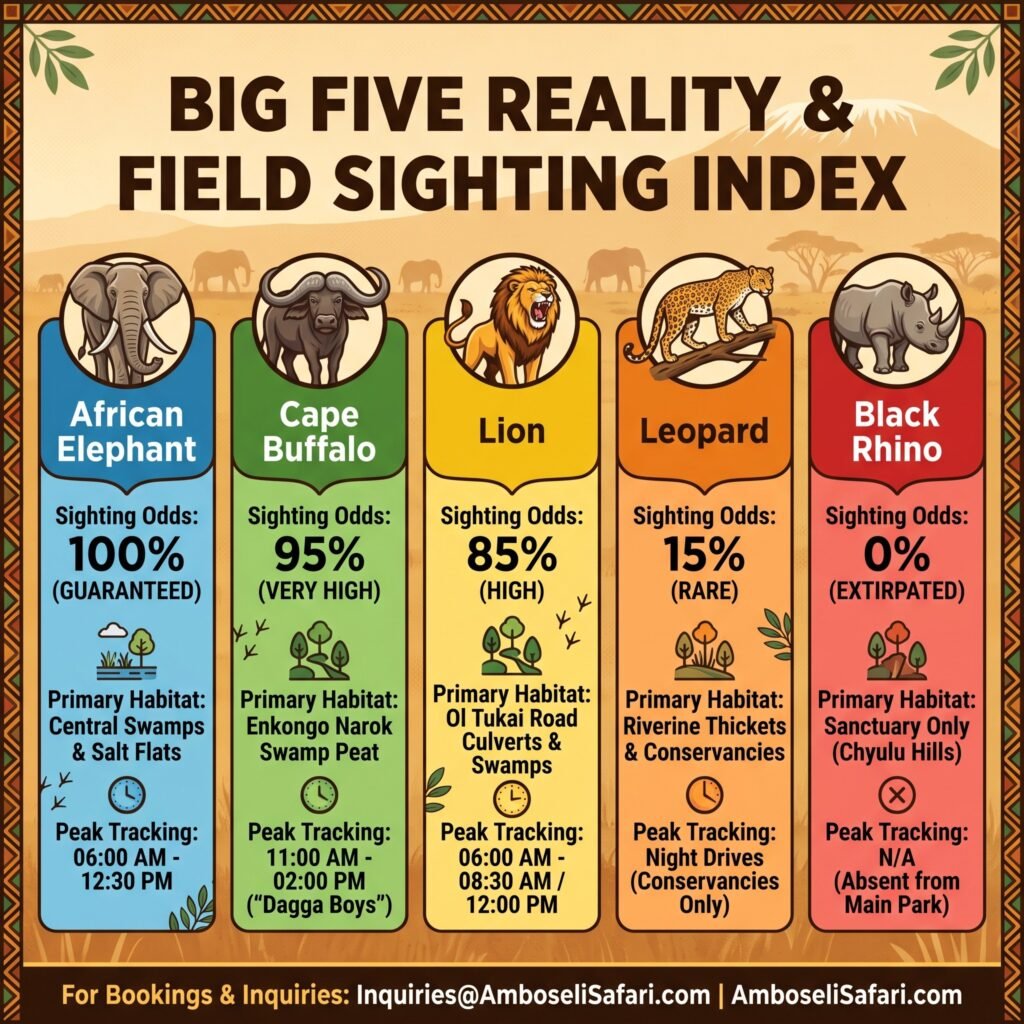
Big Five Reality & Field Sighting Index
Setting realistic expectations is essential when tracking big game across Amboseli’s distinct habitats. While giant elephant herds and lion prides are daily highlights, finding dense bush predators or displaced species requires specialized tactics. This visual field index outlines the real-world sighting probability, primary habitat zones, and peak viewing hours for each animal in the traditional Big Five line-up. Use these status indicators to plan your daily drive focus across the central marshes and surrounding conservancies.
| Big Five Species | Amboseli Field Status & Odds | Primary Micro-Habitat | Peak Tracking Window |
| African Elephant | 100% (Guaranteed) | Central Swamps & Open Salt Flats | 06:00 AM – 12:30 PM |
| Cape Buffalo | 95% (Very High) | Enkongo Narok Swamp Peat | 11:00 AM – 02:00 PM (“Dagga Boys”) |
| Lion | 85% (High) | Ol Tukai Road Culverts & Swamps | 06:00 AM – 08:30 AM / 12:00 PM |
| Leopard | 15% (Rare) | Riverine Thickets & Conservancies | Night Drives (Conservancies Only) |
| Black Rhino | 0% (Extirpated) | Sanctuary Only (Chyulu Hills) | N/A (Absent from Main Park) |
The Missing Rhino Reality & Rhino Corner
Let’s set expectations straight—you won’t see wild rhinos inside the main park boundaries today.
Heavy poaching throughout the 1970s and 1980s wiped out the basin’s resident black rhinos. If you drive along the western loop track, you’ll see a wooden post marking Rhino Corner. That’s where rangers logged the last central park rhino decades ago.
The ecosystem’s only surviving Eastern Black Rhinos live outside the main park, heavily guarded by KWS rangers in the nearby Chyulu Hills sanctuary. You can read more about regional sanctuary routes in our trip planning notes.
How to Complete the “Big Five” (Nearby Rhino Add-Ons)
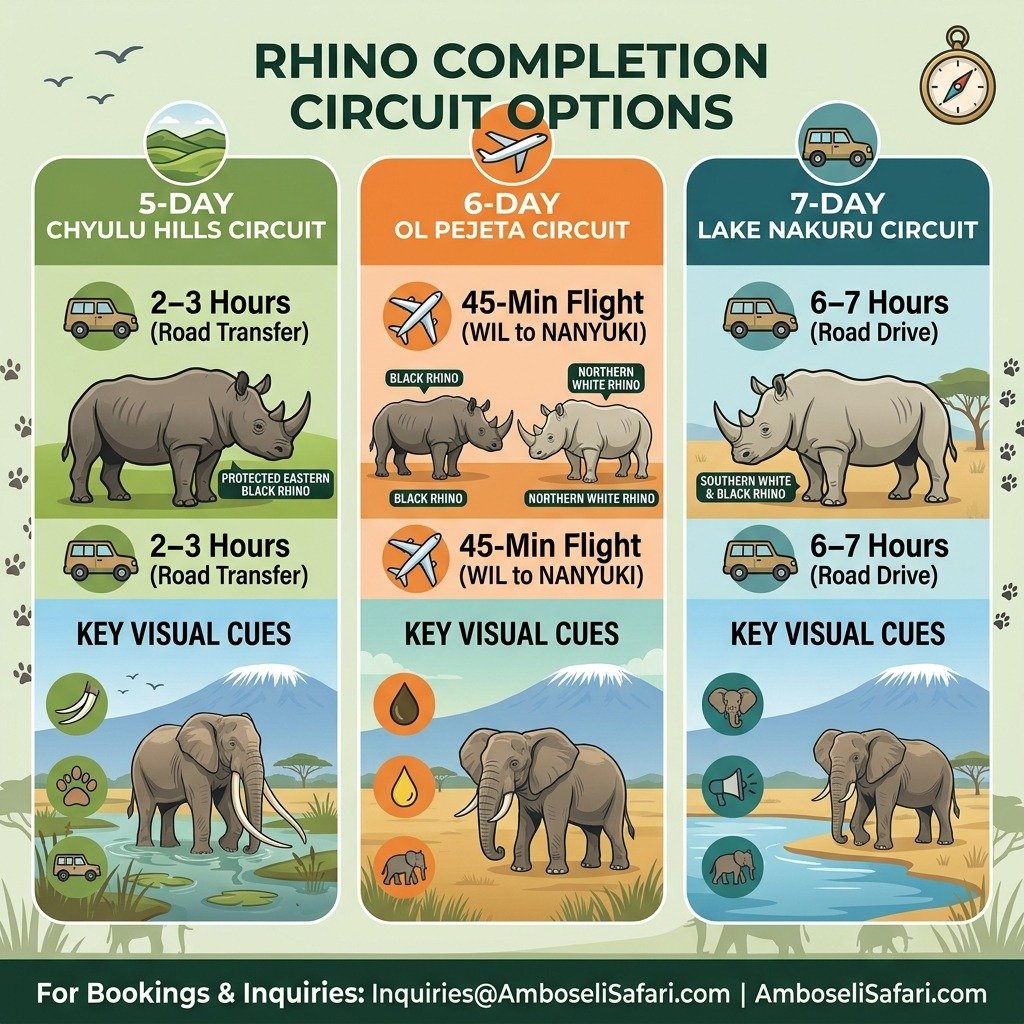
Want to check off all five animals on one East African trip? You’ll need to combine the basin with a dedicated rhino sanctuary.
- 5-Day Amboseli & Chyulu Hills Circuit: Spend three days watching swamp elephants, then head into the Chyulu Hills to visit protected black rhino zones managed alongside the Sheldrick Wildlife Trust.
- 6-Day Amboseli & Ol Pejeta Route: Fly north to Laikipia after your game drives. Ol Pejeta holds East Africa’s largest black rhino population plus the world’s last two northern white rhinos.
- 7-Day Southern Kenya & Rift Valley Loop: Pair Amboseli’s elephant marshes with Lake Nakuru National Park—a fenced sanctuary where spotting both white and black rhinos along the shoreline is almost guaranteed.
Rhino Completion Circuit Options
Because black rhinos were extirpated from the main park during historical poaching waves, completing a full Big Five checklist requires pairing Amboseli with a specialized rhino sanctuary. Kenya’s protected conservancies and fenced national parks offer safe havens for both Eastern Black and White rhinos within striking distance of the southern circuit. This comparison matrix details key regional route extensions, drive/fly transit times, and expected rhino species. Select the ideal circuit route to add a guaranteed rhino sighting to your safari itinerary.
| Circuit Route | Transit Time from Amboseli | Target Rhino Species |
| 5-Day Chyulu Hills | 2–3 Hours (Road Transfer) | Protected Eastern Black Rhino |
| 6-Day Ol Pejeta | 45-Min Flight (WIL to NANYUKI) | Black & Northern White Rhino |
| 7-Day Lake Nakuru | 6–7 Hours (Road Drive) | Southern White & Black Rhino |
Daily Tracking Itinerary & Game Drive Routes
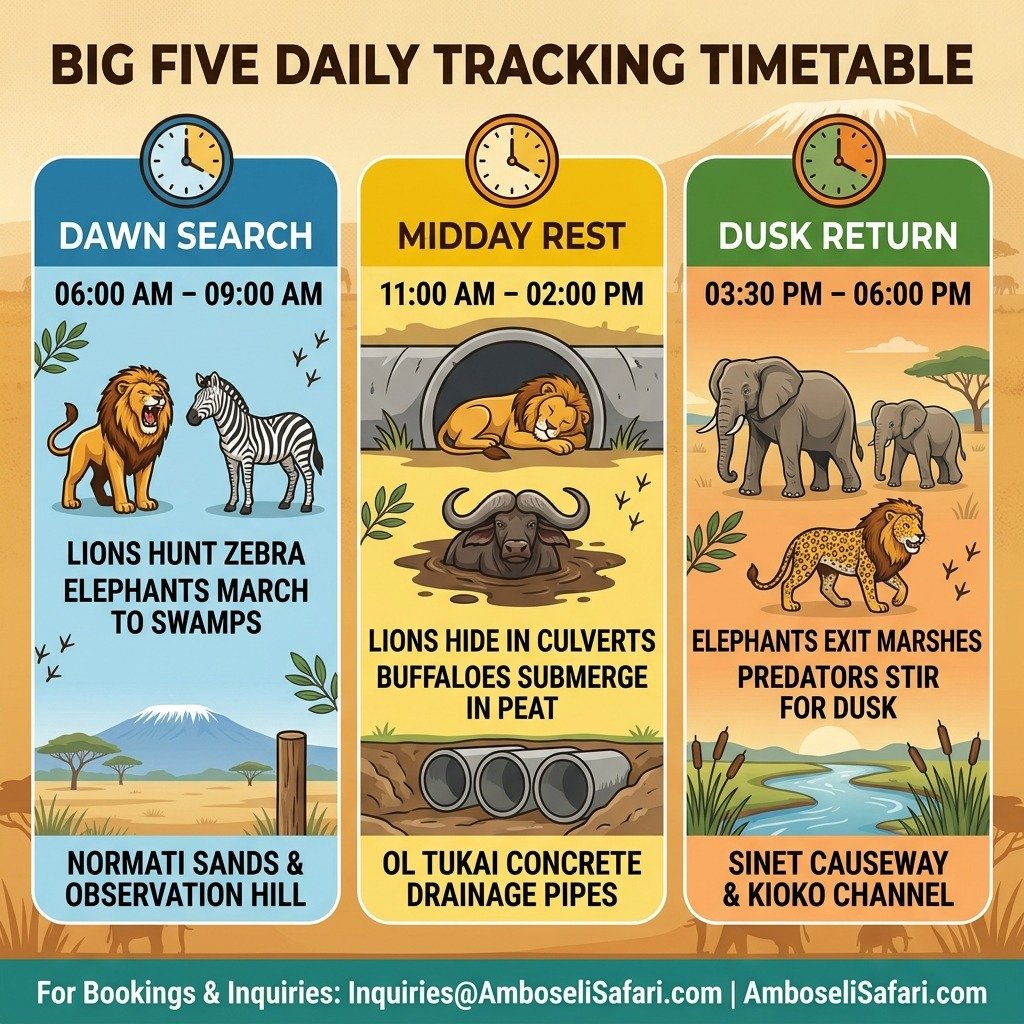
To get the most out of your game drives, line up your route with animal habits throughout the day:
- 06:00 AM – 09:00 AM: Hit the tracks as soon as park gates open. Drive toward Observation Hill and the open salt flats near Normati Sands. Lions hunt zebras returning from night grazing while the morning light stays sharp.
- 11:00 AM – 02:00 PM: Heat forces big cats into hiding. Check concrete road culverts around Ol Tukai for sleeping lions, or scan the deep water channels at Enkongo Narok where old buffalo bulls spend hours cooling off.
- 03:30 PM – 06:00 PM: Park your 4×4 along Sinet Causeway or Kioko Channel. Elephant families march out of the papyrus single-file to head back to dry bush roosts before the 06:00 PM KWS gate curfew.
Big Five Daily Tracking Timetable
Wildlife activity across the Amboseli basin shifts dramatically as ground temperatures rise off the open alkaline flats. Lions use morning hours to hunt along open salt-crust borders before heat forces predators into shaded road culverts. This daily tracking schedule maps animal behaviors and prime viewing locations to specific hours of the day. Coordinate your morning and late afternoon game drives around these natural activity cycles.
| Time Window | Predator & Herbivore Behavior | Prime Tracking Hotspot |
| 06:00 AM – 09:00 AM | Lions hunt zebras; elephants march to swamps | Normati Sands & Observation Hill |
| 11:00 AM – 02:00 PM | Lions hide in culverts; buffaloes submerge in peat | Ol Tukai Concrete Drainage Pipes |
| 03:30 PM – 06:00 PM | Elephants exit marshes; predators stir for dusk | Sinet Causeway & Kioko Channel |
Amboseli’s “Super Tuskers” Spotlight
This ecosystem is home to some of the last “Super Tuskers” left on earth—bulls carrying ivory so long it sweeps the dry soil, weighing over 100 pounds per tusk.
Decades of field protection by researchers at the Amboseli Elephant Research Project allowed legendary bulls like Tim and Craig to grow into old age. You can read about famous historical bulls in our elephant research guide.
Our senior guide, Anthony Mule, always keeps a 5-meter buffer when approaching these giant bulls. Their tusk spread is huge—even a calm bull walking past a parked vehicle needs plenty of turning room.
Elephant Habituation & Vehicle Tolerance
Over 1,500 elephants wander between the dry scrub and central marshes every day.
In places like Tsavo, elephants often keep their distance from engine noise. Here, five decades of research monitoring has conditioned matriarchs to treat safari vehicles like harmless rocks.
When a herd crosses your track, your driver cuts the ignition. You sit in quiet silence while matriarchs and tiny calves walk right past your Land Cruiser bumper without giving a single threat display.
Swamp “Dagga Boys” & The Mud Trap
Cape Buffaloes gather around Enkongo Narok swamp in big herds, but finding old solitary bulls takes a sharp eye.
These old bulls—called “Dagga Boys”—spend hot hours wallowing in thick black swamp peat. They submerge everything except their nostrils to stay cool and get relief from biting flies.
Guests scanning the marsh through binoculars often mistake these mud-coated heads for floating rocks or hippos. They don’t realize it’s a buffalo until the bull stands up at dusk to shake off the mud.
Lion Culverts & Kulamawe Pride Hotspots
Lions are everywhere in the central sector, but finding them at noon takes some know-how.
The Kulamawe Pride holds territory around Ol Tukai and Observation Hill. Because fever trees (Acacia xanthophloeia) give thin shade on open grass, these lions use concrete KWS drainage culverts under dirt roads as cool daytime dens.
Anthony always tells guests: “Check the road pipes around noon when the sun gets brutal.” Slowing down at culvert crossings and looking inside often reveals lionesses and cubs sleeping peacefully right under your vehicle tires.
If you’re driving yourself, check track maps in our self-drive survival guide.
Leopard Micro-Habitats & Conservancy Night Drives
Leopards are hands-down the hardest Big Five animal to find here. The flat, open salt basin doesn’t offer the rocky hills or thick trees leopards love.
Day game drives across open park tracks rarely spot them. We focus searches on three pockets of dense brush:
- Riverine thickets along the dry Ol Kejuado riverbed
- Dense acacia stands in the far southwestern Kitirua sector
- Fever-tree forest edges along Kimana Sanctuary
If a leopard is high on your wishlist, stay in an outer private conservancy. Day drives inside KWS grounds end at 06:00 PM, but conservancies allow spotlight night drives when leopards are out hunting.
You can compare nearby properties in our Amboseli lodging breakdown.
Park Logistics, Gates & Drive-vs-Fly Comparison
Getting down from Nairobi is simple whether you take the highway or fly:
- Driving from Nairobi (3.5 to 4.5 Hours): Head south on the paved Mombasa Road (A109) for 125 km to Emali, then turn right onto the C103 tarmac road straight to the park gates.
- Meshanani Gate: Northwest side. Primary gate for arrivals from Nairobi or the Namanga border.
- Kimana Gate: Eastern side. Quickest access to central swamps and lodges like Kibo or Sentrim.
- Iremito Gate: Northern boundary, handy for arrivals from Emali or northern camps.
- Flying from Nairobi (45 Minutes): Daily flights leave Wilson Airport (WIL) on Safarilink or Airkenya, landing at Amboseli Airstrip (AMB). It skips road corrugations and lands you right near lodge pickup points.
Wildlife Photography & Gear Tips
Bright white salt dust and intense sun take a toll on camera gear:
- Lens Choice: A flexible 100–400mm or 200–600mm zoom lens is ideal. Long telephoto reach lets you frame distant lions without driving off marked tracks.
- Harsh Midday Light: Midday sun reflecting off white salt crusts tricks light meters. Use spot-metering on animal hides so you don’t blow out background sky detail.
- Dust Control: Fine alkaline dust off the dry lakebed locks up focus rings within an hour. Keep camera bodies wrapped in padded bags while driving, and use a rubber air blower instead of wiping dry dust across optical glass.
Community Corridors & Big Life Outposts
Wild animals don’t care about map boundaries. Lions, elephants, and buffaloes constantly move out of KWS land onto surrounding community group ranches looking for grass and water.
Protecting game across human-settled borders relies on joint patrols between KWS wardens and community rangers from the Big Life Foundation. Mobile ranger teams operating out of outposts like Rombo and Kuku patrol farm borders 24/7 to prevent human-wildlife conflict when predators stray near local crops at night.
Field Realities, Disclaimers & Expectations
Planning a safari around a rigid Big Five checklist can backfire if expectations aren’t set right:
- No Rhinos in the Main Park: You won’t see a rhino on a standard park game drive. Enjoy the world-class elephant and lion views instead.
- Leopards Take Patience: Spotting a leopard requires early starts, luck, and ideally a night drive on conservancy land.
- Strict Gate Curfews: KWS rangers enforce a strict 06:00 PM park curfew. Getting caught out on swamp tracks past curfew means immediate fines.
Want to build a custom game drive route or lock in open vehicle dates with our team? Send us a message through our safari inquiry form or book directly using our custom quote form.
Frequently Asked Questions
Can you see all Big Five animals in Amboseli National Park?
No. Elephants, lions, buffaloes, and occasional leopards live here, but wild rhinos are absent from the main park. Rhinos were extirpated by historic poaching and now exist only under heavy ranger protection in the nearby Chyulu Hills sector.
Where is the best place to find lions in Amboseli?
Look along central swamp edges near Ol Tukai and Observation Hill. During hot midday hours, lions shelter from the sun inside concrete drainage culverts underneath dirt park roads.
Are leopards common in Amboseli?
Leopards are rare due to open terrain. Your best chance of seeing one is during night game drives along riverine thickets in private outer conservancies like Kimana or Selenkay.
Why do buffaloes in Amboseli look dark and muddy?
Solitary old bulls (“Dagga Boys”) submerge themselves up to their nostrils in black swamp mud inside Enkongo Narok to cool off and soothe insect bites. Covered in wet peat, they blend right into surrounding marsh water.