
Night Game Drives in Amboseli: Conservancy Spots, Spotting Secrets & Rates
Overview
If you’ve only explored Amboseli under the midday sun, you’re missing half the ecosystem. While many first-time visitors assume the park sits under Narok County Council, the basin is in Kajiado County under Kenya Wildlife Service (KWS) jurisdiction. Strict KWS rules ban driving after dark inside national park gates, so night safaris happen exclusively in surrounding private community conservancies. Bordering fever-tree groves (Acacia xanthophloeia) and outer marsh channels connected to Enkongo Narok swamp, these private reserves let our spotters track active predators while elephant herds monitored by the Amboseli Elephant Research Project settle down under Mount Kilimanjaro. Full-board 3-day and 4-day night safari packages in a private 4×4 Land Cruiser range from $1,180 per person for budget eco-camps up to $5,950 per person for fly-in luxury lodges on Amboselisafari.com.
Fast Navigation Links
- Night Safari Packages & Rates
- Why You Can’t Drive Park at Night
- Picking the Right Conservancy
- What Your Evening Looks Like
- Why We Use Red Lights
- Shooting in the Dark
- Best Months for Night Tracking
- Taking Kids Out After Dark
- Frequently Asked Questions
2027 Night Safari Packages & Cost Breakdown
Scanning open savanna scrub after dark takes an open vehicle, an experienced driver, and a spotter who knows how to pick out eyes in the grass. We run these drives in open-sided 4×4 Safari Land Cruisers fitted with high-powered red searchlights so we don’t blind or startle skittish animals.
Rates below cover two adults sharing a private 4×4 Land Cruiser:
3-Day & 4-Day Amboseli Night Safari Packages
| Package Tier & Accommodations | Standard Season (USD / Person)* | Peak Season (USD / Person)* | Practical Field Notes |
| 3-Day Budget Night Safari (Selenkay Adventure Camp / Kimana Bush Lodge / Amboseli Eco Tents) | $1,180 | $1,880 | Basic tented setups; tracks get dusty in August. |
| 3-Day Mid-Range Night Safari (Porini Amboseli Camp / Elerai Safari Camp / Kibo Conservancy Wing) | $1,480 | $2,180 | Excellent spotter teams; hot-water bottles provided on night loops. |
| 3-Day Luxury Night Safari (Tawi Lodge / Satao Elerai Luxury Tents / Tortilis Conservancy Camp) | $1,980 | $2,780 | Prime ridge views; direct access to private conservancy gates. |
| 4-Day Fly-In Luxury Plus Safari (Flight + Porini Amboseli / Tawi Lodge / Campi ya Kanzi) | $3,950 | $5,950 | Includes bush flights from Wilson Airport; zero long road transit. |
*Rates are valid for 2026/2027 based on two adults sharing a room or luxury tent with private 4×4 Land Cruiser transport. Standard season runs January through May and November. Peak season spans June through October and December. Packages cover full-board lodging, transport, guide fees, fuel, daily $90 USD KWS entry permits, and conservancy night fees. Fly-in options include roundtrip flights from Wilson Airport (WIL) on Safarilink or Airkenya plus airstrip transfers.
If you want to customize your dates or request a specific vehicle setup, send us your details through our safari inquiry form.
Package Inclusions
- Open-sided 4×4 Safari Land Cruiser with pop-up roof and side-mount searchlight
- Licensed driver-guide paired with a dedicated Maasai night spotter
- Full-board accommodation (breakfast, lunch, and dinner)
- Pre-paid KWS daily permits and private conservancy night access fees
- Chilled drinking water stocked in the vehicle cooler
Package Exclusions
- International airfare, entry visas, and digital processing via the official eTA portal
- Tips for your guide and spotter, personal laundry, or drinks at the bar
- Extra activities like Maasai village walks ($30 per person) or sunrise balloon flights ($450 per person)
Optional Add-Ons
- Night foot-safari with Maasai warriors: USD 40 per person
- Hot air balloon ride over central marshes: USD 450 per person
We list all vehicle day-rates, fuel calculations, and entry permits on our Amboseli safari cost breakdown page.
Why You Can’t Do Night Drives in the Main Park
Park gates lock up tight at 18:00 PM. Official KWS rules strictly ban night game drives inside the core national park to give wildlife a break from safari traffic and prevent illegal poaching. Drive inside park borders after dark and rangers will fine you, impound your vehicle, or revoke your driver’s park license.
To head out after sunset legally, you have to stay in or access private community conservancies buffering the park. These private reserves operate under their own management boards, allowing trained Maasai spotters to track nocturnal animals off-road using red-filtered lights.
Picking the Right Conservancy for Your Night Drive
Each private conservancy offers a different mix of terrain, vehicle rules, and animal sightings:
- Selenkay Conservancy: 15,000 acres of community-owned land north of the main park. Vehicle numbers are capped strictly to guests staying at Porini Amboseli Camp, so you’ll rarely see another set of headlights. Its dry riverbeds and acacia scrub are fantastic for finding aardwolves and aardvarks.
- Elerai Conservancy: Spans 5,000 acres along an elevated ridge southeast of the park boundary. Night drives climb rocky tracks to lookout points with wide views of Kilimanjaro under the stars. The woodland thickets here shelter serval cats, porcupines, and hunting lion prides moving toward the Chyulu Hills.
- Kitirua Conservancy: Sits on the southwestern border near the Tanzanian line. Mixes open salt flat edges with dense fever-tree thickets, making it a reliable spot to watch elephant herds bedding down and hyenas leaving subterranean dens.
Picking an eco-camp inside these private reserves means you can roll straight from dinner onto the night tracks without driving back through main park gates.
Conservancy Comparison Matrix
| Conservancy Name | Size & Vehicle Limits | Dominant Terrain | Key Nocturnal Species | Practical Field Notes |
| Selenkay Conservancy | 15,000 Acres (1 vehicle per sighting) | Open acacia scrub & dry sand rivers | Aardwolf, Aardvark, Serval Cat, Genet | Dry and clear from July to Oct; great spotter team. |
| Elerai Conservancy | 5,000 Acres (Low vehicle numbers) | Elevated ridge & thick acacia woods | Caracal, Striped Hyena, Leopard, Porcupine | Cold mountain winds on the ridge; wear heavy layers. |
| Kitirua Conservancy | 8,000 Acres (Strict private access) | Salt flat margins & fever trees | Roosting Elephants, Hyena Clans, Owls | Tracks turn to thick, sticky clay after April rains. |
To see how conservancy camps compare with boundary lodges, check our recommendations on where to stay in Amboseli.
What Your Evening Actually Looks Like
Night safaris move at an easy, deliberate pace:
- Quick 18:00 PM sundowner stop on an elevated ridge while Mount Kilimanjaro turns purple in the dying light.
- Early dinner at 19:00 PM. The guide runs through basic vehicle safety and spotlight rules before everyone gears up.
- Out on the tracks by 20:00 PM. Grab a heavy fleece blanket, slide a hot-water bottle over your lap, and let your eyes adjust.
- Two hours of active scanning. Spotters sweep red light across low grass while the driver cuts the engine every twenty minutes to listen for alarm calls.
- Back at camp by 22:15 PM for warm drinks around the campfire before heading to your tent.
Why We Use Red Lights (and How to Spot Eye-Shine)
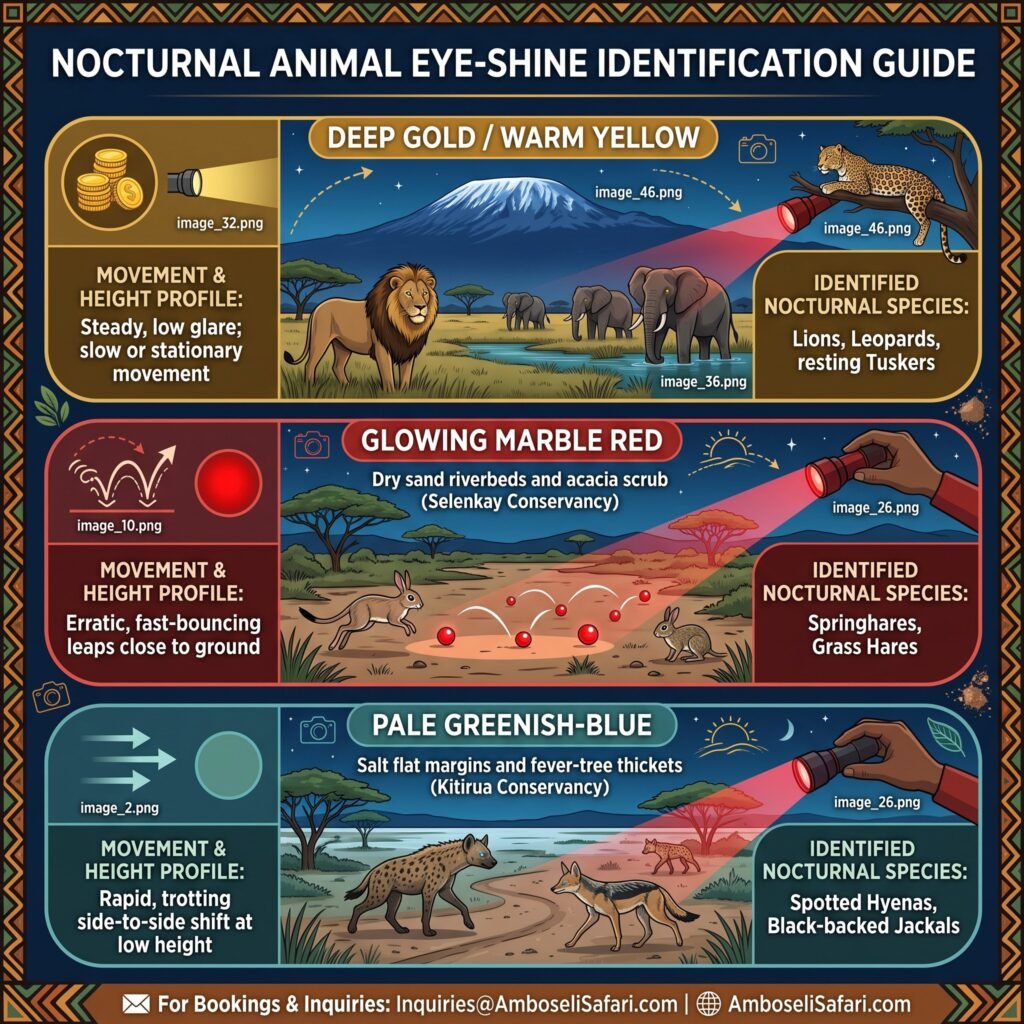
Pointing a powerful white searchlight into the darkness does more harm than good. Direct white light blinds big cats, ruins their peripheral vision for hours, and disrupts active hunts. Spotters fit searchlights with red optical glass instead. Red light lets us observe natural hunting behavior up close without stressing the animals or giving away their positions to prey.
Scanning the dark brush isn’t about looking for whole animal bodies. You’re searching for “eye-shine”—light bouncing off the reflective layer inside a nocturnal animal’s eye:
- Big cats reflect a steady, deep gold glow that doesn’t flicker when they stare back at the truck.
- Springhares look like glowing red marbles bouncing through tall grass.
- Hyenas and jackals show a pale, greenish-blue reflection that shifts rapidly as they trot along dirt tracks.
- Small genets and civets show tight, twin dots of silver-orange high up in acacia branches.
Keeping the vehicle downwind stops human scent from blowing across the scrub while you watch.
Nocturnal Animal Eye-Shine Identification Guide
Identifying nocturnal wildlife across open conservancy scrub relies primarily on picking out specific eye-shine reflections before an animal’s body becomes visible. Red-filtered searchlights reflect off the tapetum lucidum in a night creature’s eyes, producing distinct color tones, movement patterns, and heights above the ground. This field identification matrix maps reflective colors and movement characteristics to primary nocturnal species. Use these visual signatures to identify wildlife quickly during night tracks.
| Eye-Shine Reflection Color | Movement & Height Profile | Identified Nocturnal Species |
| Deep Gold / Warm Yellow | Steady, low glare; slow or stationary movement | Lions, Leopards, resting Tuskers |
| Glowing Marble Red | Erratic, fast-bouncing leaps close to ground | Springhares, Grass Hares |
| Pale Greenish-Blue | Rapid, trotting side-to-side shift at low height | Spotted Hyenas, Black-backed Jackals |
Hunting for Aardvarks, Aardwolves, and Servals
Daytime drives center on elephants, giraffes, and lions sleeping under trees. Once darkness hits, the savanna turns over to specialized insectivores and small cats.
Over a decade of guiding the Selenkay boundary, our spotters have logged some of the best sightings of Africa’s strangest nocturnal creatures:
- Aardwolves: Small, striped relatives of the hyena that eat harvester termites almost exclusively. A single aardwolf can lap up 200,000 termites in one night with its long, sticky tongue.
- Aardvarks: Solitary diggers with thick, muscular bodies and rabbit-like ears that tear open rock-hard termite mounds with powerful claws.
- Serval Cats: Long-legged felids that move through tall grass, using giant ears to locate grass mice before leaping six feet straight up into the air to pounce.
Anthony Mule, who has guided these conservancy tracks for over ten years, recommends driving slowly with the engine idling low: “You usually hear an aardvark’s heavy claws tearing into a hard dirt mound long before the searchlight beam catches its outline.”
Shooting in the Dark: Camera Settings & Etiquette
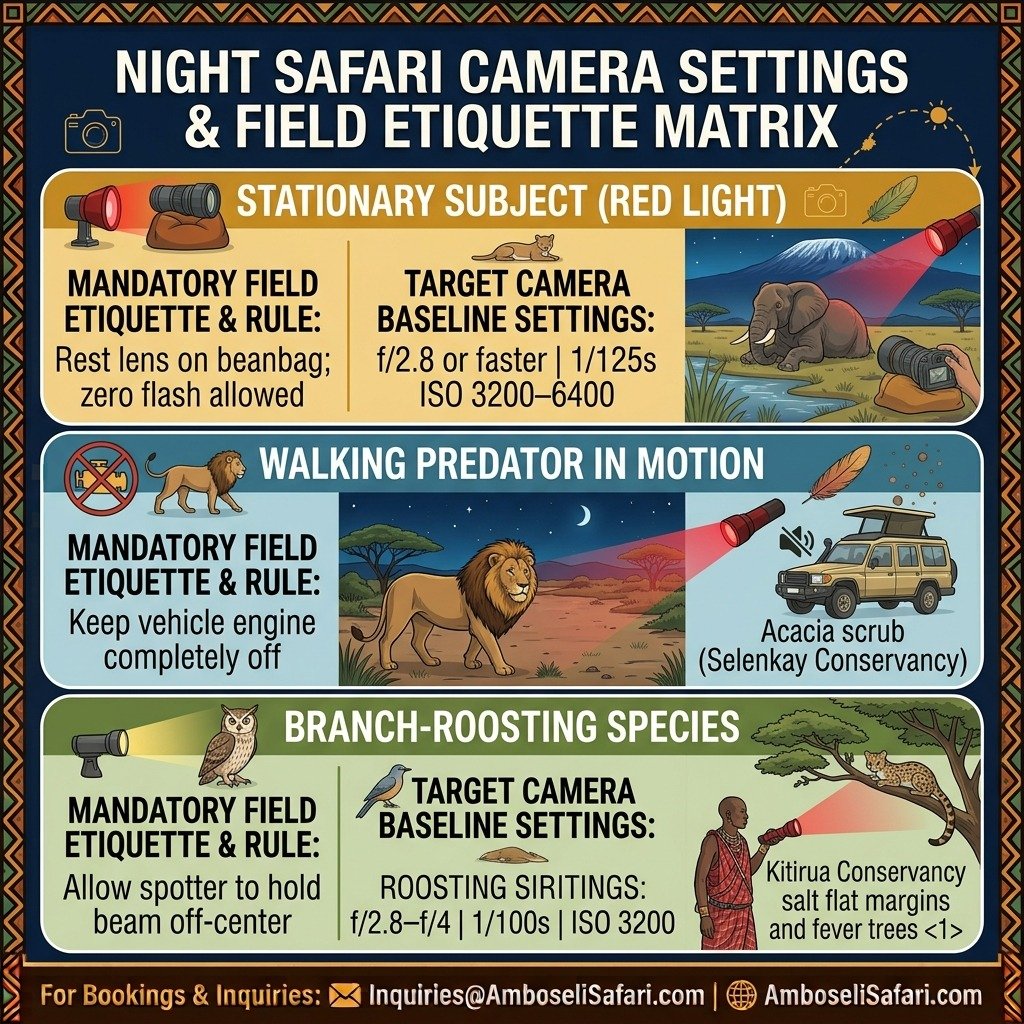
Photographing wildlife under a red spotlight takes a bit of adjustment compared to daylight shooting:
- Open your aperture completely. Lenses running f/2.8 or faster make a massive difference under faint red light.
- Push ISO up to 3200 or 6400. Full-frame digital camera bodies handle this noise easily in post-processing.
- Keep shutter speeds around 1/125s for resting animals, moving to 1/250s if a cat starts walking.
- Flashes are strictly banned. Electronic strobes blind animals and carry immediate vehicle bans across all conservancies.
- Stabilize heavy glass. Turn on lens VR and rest the barrel on a heavy beanbag on the side-rail.
- Give the spotter space. Spotters deliberately hold the red light beam slightly off-center so the subject isn’t blinded.
Night Safari Camera Settings & Field Etiquette Matrix
Photographing nocturnal species under faint red searchlights requires balancing high ISO sensitivity with low shutter speeds to capture sharp images without noise distortion. Since electronic flash strobes are strictly prohibited across all private conservancies to prevent animal blinding, photographers must maximize ambient red light gather. This technical camera matrix outlines baseline exposures, metering choices, and mandatory etiquette rules for dark conditions. Apply these configurations to shoot effectively during evening drives.
| Lighting & Subject Motion | Target Camera Baseline Settings | Mandatory Field Etiquette & Rule |
| Stationary Subject (Red Light) | f/2.8 or faster | 1/125s | ISO 3200–6400 | Rest lens on beanbag; zero flash allowed |
| Walking Predator in Motion | f/2.8 | 1/250s | ISO 6400+ | Keep vehicle engine completely off |
| Branch-Roosting Species | f/2.8–f/4 | 1/100s | ISO 3200 | Allow spotter to hold beam off-center |
Best Months for Night Tracking (and What Weather to Expect)
Vegetation height and night weather change what you can see across different seasons:
Dry Season Months (July – October & January – March)
Visibility is at its absolute best. Grazing herds crop the grass down short, making low-slung animals like aardvarks, porcupines, and serval cats easy to spot against bare ground. Keep in mind that cold air rolling off Kilimanjaro’s glaciers drops night temperatures quickly, so bring heavy layers.
Wet Season Months (April – May & November – December)
Rains trigger rapid grass growth, making it easy for small insectivores to hide inside tall perennial cover. Night temperatures are milder, but sudden evening downpours can turn black-cotton soil into slick mud and cut night loops short.
To align your travel dates with clear weather windows, check our Amboseli safari planning guide.
Staying Warm When the Mountain Wind Hits
Packing light clothes for a tropical safari makes sense during the day, but nights along the conservancy boundaries are a different story. Daytime temperatures on the plains are warm, but night temperatures on elevated ridges like Elerai drop down to 12°C–14°C once the sun goes down.
Cold katabatic winds roll off Mount Kilimanjaro’s upper snowfields, sweeping across open plains as soon as dusk hits. Sitting in an open-sided 4×4 moving through the dark brings a noticeable chill.
Eco-camps supply heavy fleece blankets and canvas-wrapped hot-water bottles to keep on your lap, but you should still pack:
- A solid windproof jacket or heavy fleece sweater.
- A warm beanie and light gloves.
- Long trousers and sturdy closed shoes.
Taking Kids Out After Dark: Safety and Age Rules
Taking children out into the bush after dark takes extra planning and attention to camp rules:
- Most conservancy camps set a minimum age of 6 years for shared night drives. If you’re traveling with kids under 6, you’ll need to book a private vehicle so young ones don’t disrupt other guests if they get tired or noisy.
- Kids must stay seated inside the vehicle footprint at all times. Standing up or leaning over open side-rails can trigger curiosity or aggression from nearby predators.
- Silence is essential. Sound carries far in the dark, so kids need to remain quiet during engine-off stops.
- Encountering an elephant herd in the dark takes real care. Guides keep a distance of at least 50 meters, dim lights, and cut the engine so the herd can walk past without feeling crowded.
Where Your Conservancy Night Fees Actually Go
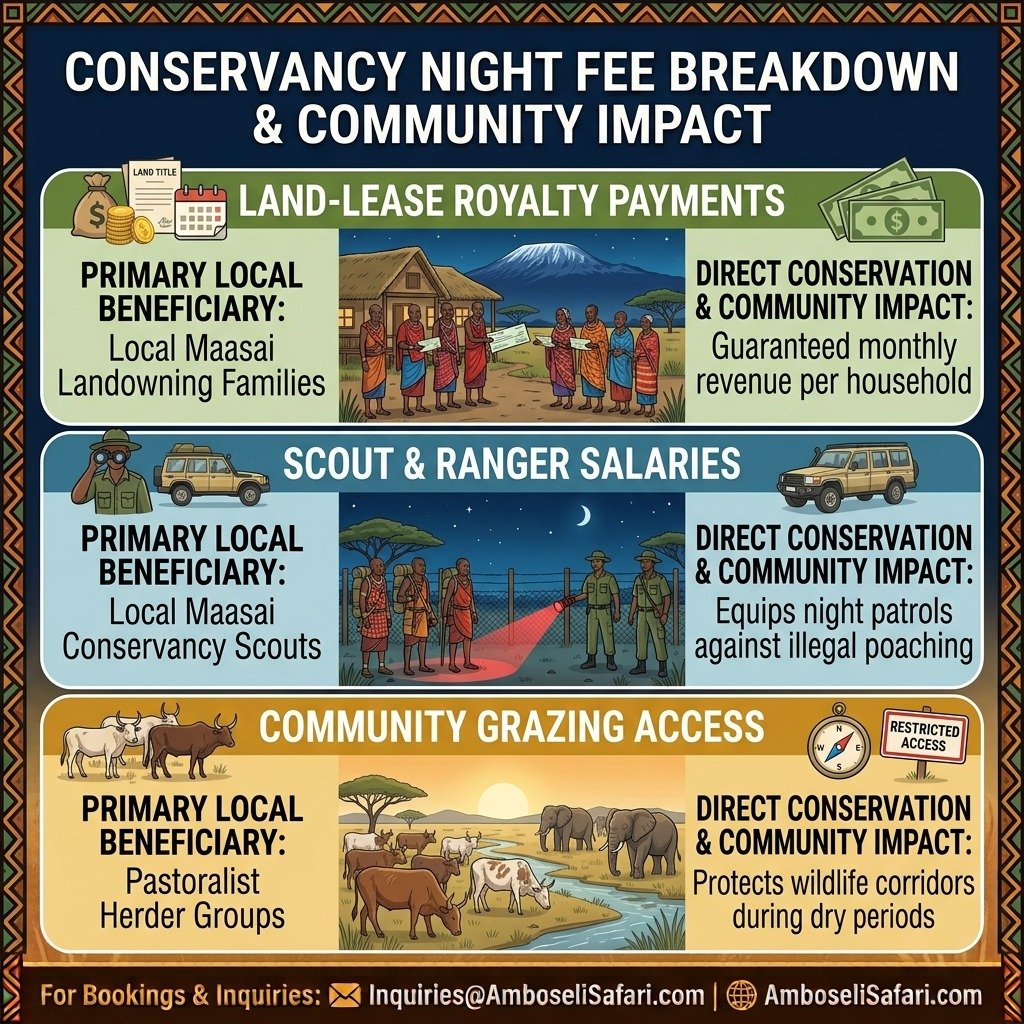
Night game drives provide direct financial support to local Maasai landowning families.
Night permit fees ($30 to $50 USD per vehicle slot) charged in private conservancies don’t go to government treasuries. Instead, these funds go directly to local Maasai families who lease their private land for wildlife conservation.
This community income covers:
- Monthly land-lease royalty payments paid directly to Maasai households.
- Salaries for local Maasai conservancy scouts who patrol boundary fences after dark.
- Practical incentives for herders to keep livestock clear of predator corridors at night.
Ranger networks supported by the Big Life Foundation work alongside local community scouts to keep these outer wildlife corridors safe from poachers.
If you plan to rent a vehicle for daytime drives, check our Amboseli self-drive tips page for navigation rules. To learn more about tracking daytime herds, explore our famous elephants guide.
Ready to book a private Land Cruiser with an expert driver-guide and spotter on Amboselisafari.com? Send your details through our safari inquiry form or reserve your dates via our main safari booking form.
Conservancy Night Fee Breakdown & Community Impact
Night game drives operate exclusively within private community conservancies where entry fees directly support Maasai landowning families and local ecosystem protection. Unlike national park permits paid directly to central government treasuries, night conservancy fees create direct financial incentives for community-led conservation. This economic distribution matrix details fee allocations, local beneficiaries, and community conservation impacts across bordering reserves. Review these contributions to see how your night safari supports regional conservation.
| Night Permit Allocation | Primary Local Beneficiary | Direct Conservation & Community Impact |
| Land-Lease Royalty Payments | Local Maasai Landowning Families | Guaranteed monthly revenue per household |
| Scout & Ranger Salaries | Local Maasai Conservancy Scouts | Equips night patrols against illegal poaching |
| Community Grazing Access | Pastoralist Herder Groups | Protects wildlife corridors during dry periods |
Frequently Asked Questions
Can you do a night game drive inside Amboseli National Park?
No. Night game drives are strictly banned inside the main KWS national park. Park gates close at 18:00 PM. Night drives happen exclusively on surrounding private conservancies like Selenkay, Elerai, and Kitirua.
What animals can you see on a night game drive in Amboseli?
You can spot nocturnal species rarely seen during the day, including aardwolves, aardvarks, serval cats, white-tailed mongooses, springhares, genets, bushbabies, hunting lions, and leopards.
Is camera flash allowed during a night safari?
No. Electronic camera flashes are strictly banned on all night game drives. White flash bursts blind animals and provoke defensive reactions. Photographers must rely on red-filtered spotlights provided by the spotter.
What is the minimum age for kids on a night game drive?
The minimum age is typically 6 years old on shared vehicles. Families with younger children can book a private 4×4 Land Cruiser to accommodate early bedtimes and custom schedules.