
Flamingo Season in Amboseli: Water Conditions, Field Spots & Safari Packages
Overview
Seeing Flamingo Season in Amboseli brings thousands of pink waterbirds to temporary soda lakes under Mount Kilimanjaro. Kajiado County and the Kenya Wildlife Service manage this basin alongside the Amboseli Elephant Research Project team.
Fast Navigation Links
- Flamingo Safari Packages and Rates
- Amboseli vs Rift Valley Lakes
- Month by Month Water Levels
- Temporary Soda Lakes and Algae
- Camera Gear and Settings Guide
- Driving Routes and Gate Logistics
2027 Flamingo Safari Packages & Vehicle Rates
Tracking flamingo flocks across temporary salt pans takes a driver who knows how water levels move week to week. We run these trips in private 4×4 Safari Land Cruisers fitted with wide pop-up roof hatches so you can frame birds against the mountain without engine shake blurring your shots.
Rates below show total costs per person for two adults sharing a private vehicle:
3-Day & 4-Day Amboseli Flamingo Safari Packages
| Package Tier & Accommodations | Standard Season (USD / Person)* | Peak Season (USD / Person)* |
| 3-Day Budget Flamingo Safari<br>(Nyati Safari Camp / WE4Kenya Guesthouse / Olemayian Cottages) | $1,180 | $1,880 |
| 3-Day Mid-Range Flamingo Safari<br>(Kibo Private Wing / Amboseli Heights Lodge / Little Amanya Bush Camp) | $1,480 | $2,180 |
| 3-Day Luxury Flamingo Safari<br>(Porini Amboseli Camp / Kitirua Plains Lodge / Campi ya Kanzi) | $1,980 | $2,780 |
| 4-Day Fly-In Luxury Plus Safari<br>(Flight + Finch Hattons Luxury Tents / Sanya Camp / Ol Donyo Lodge) | $3,950 | $5,950 |
*Rates cover 2026/2027 for two adults sharing a room or tented suite with a private 4×4 Land Cruiser. Standard season runs January through May and November. Peak season spans June through October and December. Rates cover full-board lodging, transport, guide fees, fuel, daily $90 USD KWS entry permits, and custom vehicle gear. Fly-in options include roundtrip flights from Wilson Airport (WIL) on Safarilink or Airkenya plus airstrip transfers.
If you want to hold travel dates or check vehicle availability for your trip, drop us a line on our safari inquiry form.
Package Inclusions
- Private 4×4 Safari Land Cruiser with pop-up roof hatch and custom beanbag mounts
- Licensed driver-guide trained in waterbird behavior and photography positioning
- Full-board accommodation covering breakfast, lunch, and dinner
- Pre-paid $90 USD daily KWS park permits
- Chilled drinking water stocked in the vehicle cooler
Package Exclusions
- International flights, travel insurance, and digital entry processing via the official eTA portal
- Tipping your driver-guide or camp staff
- Alcoholic beverages, soft drinks, or personal laundry
- Optional extras like a Maasai village visit ($30) or a sunrise balloon flight ($450)
Optional Add-Ons
- Night photography drive in a private conservancy: USD 50 per person
- Sunrise hot air balloon flight over central marshes: USD 450 per person
We lay out every vehicle day-rate, fuel allowance, and permit calculation on our full cost breakdown guide.
Amboseli vs. Rift Valley Lakes Comparison
Most tourists head straight to Nakuru or Bogoria for waterbirds. But seeing flamingos in Amboseli hits differently because you get giant elephant bulls walking past pink waterlines with Kilimanjaro towering in the background.
| Feature & Focus | Amboseli National Park | Lake Bogoria | Lake Nakuru |
| Primary Sight | Pink flocks framed directly against Kilimanjaro. | Massive permanent flocks around bubbling geysers. | Flamingos paired with black and white rhinos. |
| Wildlife Mix | Elephant herds, lions, cheetahs, giraffes. | Zebras and gazelles (rarely any big cats). | Rhinos, buffaloes, and Rothschild’s giraffes. |
| Flock Timing | Temporary. Depends strictly on shallow rains. | High year-round numbers. | Unpredictable due to changing water levels. |
| Crowd Levels | Barely any vehicles out on western salt pans. | Busy around main hot springs. | Heavy tourist traffic near main gates. |
Month-by-Month Water Level & Sightings Chart
Flamingos don’t care about your vacation calendar. They follow water depth.
| Month Range | Water Depth & Rains | What You Actually See |
| January – March | Short rains runoff (10–25 cm). | Secondary window. Flocks feed as salt pans dry down. |
| April – May | Heavy long rains (>50 cm). | Bad timing. Deep water drowns algae; birds fly off. |
| June – August | Water drops to 10–30 cm. | Peak season. Spirulina blooms trigger huge pink flocks. |
| September – October | Bone dry (0 cm). | Zero birds. The lake bakes into hard salt; flocks fly to Natron. |
| November – December | Short rains return. | Arrival time. Nomadic flocks drop in as shallow pools form. |
Temporary Soda Lakes and Volcanic Water Chemistry
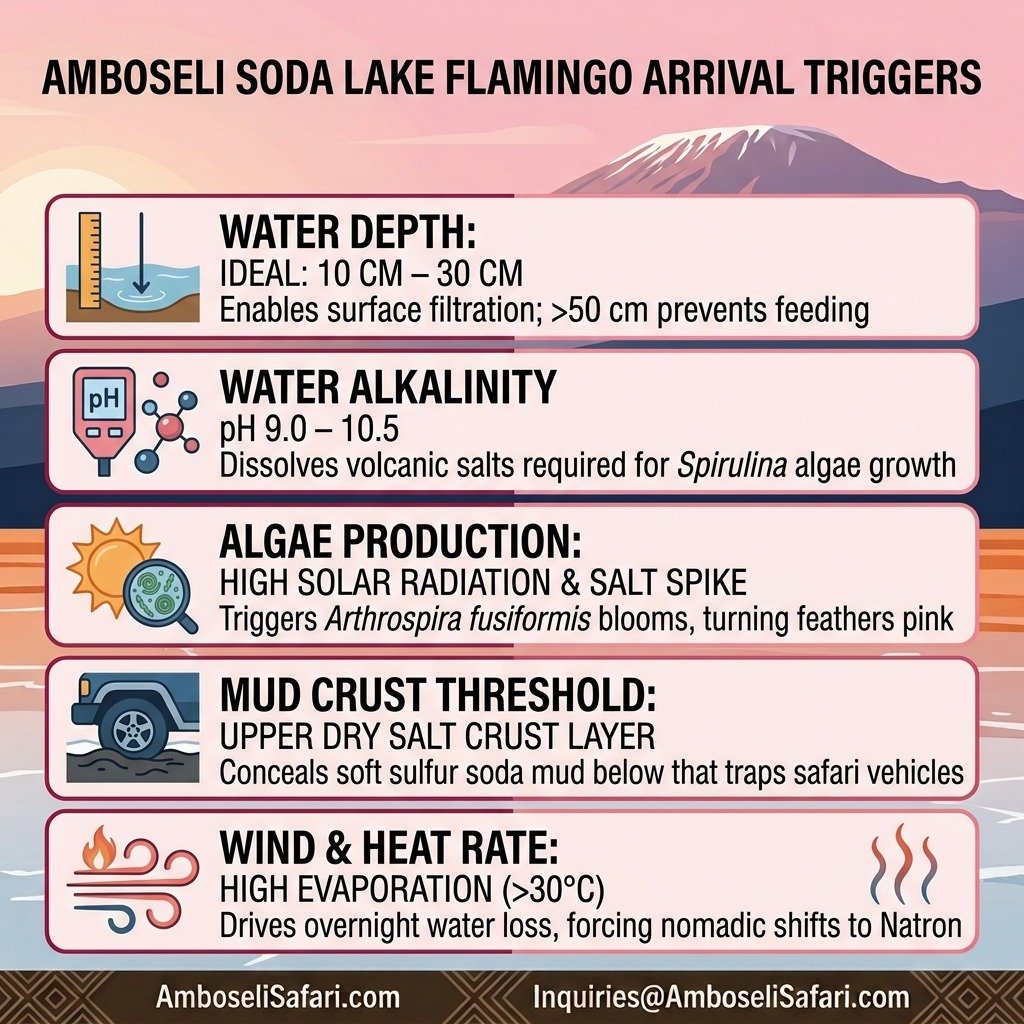
Flamingos aren’t permanent residents in Amboseli, and they don’t nest here. Their main breeding ground sits across the Tanzanian border at Lake Natron. They land in Amboseli only when seasonal rains transform the dry, cracked bed of Lake Amboseli (Empusel) and the western Meshanani pans into shallow brine pools.
KWS rangers at Meshanani Gate keep track of three water triggers:
- Water alkalinity spikes to pH 9.0–10.5 as rainwater dissolves volcanic mineral salts.
- Depth must stay between 10 cm and 30 cm. (Anything deeper than 50 cm makes it impossible for them to feed, and they vanish overnight.)
- Strong sun plus high salt levels creates explosive blooms of Arthrospira fusiformis (spirulina algae), turning their feathers bright pink.
When water levels hit that sweet spot, tens of thousands of birds arrive overnight, turning bare white salt pans into broad pink ribbons.
Water Salinity & Ecological Triggers
Flamingo movements across Amboseli’s outer basin are governed by strict environmental triggers rather than fixed seasonal schedules. While rainfall initiates pool formation, microscopic algae production relies on specific salinity levels and water depths. This quick reference breaks down the precise chemical and water parameters required to trigger massive pink flock arrivals.
| Environmental Trigger | Field Threshold / Parameter | Biological Impact on Flamingos |
| Water Depth | Ideal: 10 cm – 30 cm | Enables surface filtration; >50 cm prevents feeding completely |
| Water Alkalinity | pH 9.0 – 10.5 | Dissolves volcanic salts required for Spirulina algae growth |
| Algae Production | High solar radiation & salt spike | Triggers Arthrospira fusiformis blooms that turn feathers pink |
| Mud Crust Threshold | Upper dry salt crust layer | Conceals soft sulfur soda mud below that traps safari vehicles |
| Wind & Heat Rate | High evaporation (>30°C) | Drives overnight water loss, forcing nomadic shifts to Natron |
Feeding Depths: Lesser vs. Greater Flamingos
What looks like a solid pink carpet from a distance is actually two different species working separate water zones.
- Lesser Flamingos (Pheniconaias minor): These deep-crimson birds pack tightly into 5 cm shallows. They bend their heads backward to strain microscopic spirulina algae right off the surface.
- Greater Flamingos (Phoenicopterus roseus): Taller and paler. They wade out into 30 cm to 40 cm channels, constantly stomping their webbed feet into bottom mud to churn up brine shrimp and fly larvae.
Track broader wildlife patterns across the basin through our Amboseli safari planning guide.
Lesser vs. Greater Flamingo Feeding Niche Separation
Although Lesser and Greater Flamingos often share the same temporary soda pools, they operate in completely distinct ecological niches. Differences in bill structure, body height, and feeding techniques prevent competition between the two species. Use this breakdown to identify and differentiate species behavior during morning photo shoots.
| Niche Feature | Lesser Flamingo (P. minor) | Greater Flamingo (P. roseus) |
| Physical Stature | Smaller (approx. 80–90 cm tall); deep crimson bill | Taller (approx. 110–150 cm tall); pale pink, black-tipped bill |
| Water Feeding Zone | Ultra-shallow margins (5 cm – 15 cm) | Deeper channel edges (30 cm – 40 cm) |
| Primary Food Source | Microscopic Spirulina blue-green algae | Brine shrimp, insect larvae & small mollusks |
| Feeding Technique | Inverted head filter-feeding at water surface | Stomping bottom mud to churn up organisms |
Beware the Deceptive “Soda Mud” Vehicle Traps
Honestly, don’t ever drive onto the white salt crust. It looks like a solid highway, but it’s a trap.
Underneath that paper-thin white top layer lies “soda mud”—black, sulfurous goop with zero structural strength. Break through the crust, and your 4×4 drops to its axles instantly.
Anthony Mule has yanked three stuck self-drive vehicles out of Meshanani mud in a single season. The high salt and sulfur eat right through brake lines and wheel hubs if you don’t pressure-wash the chassis immediately. If you plan on driving yourself, review our Amboseli self-drive tips before leaving tarmac.
Photography Field Gear, Settings & Golden Hour Framing
Framing pink lines against Kilimanjaro takes specific setup choices:
- Bring a 400mm to 600mm lens. Strict off-road rules keep you on marked tracks, often 100+ meters back.
- Bump shutter speed to 1/2000s or faster to freeze wing action when a flock takes off.
- Use a circular polarizer to kill blinding salt crust glare.
- Rest your lens on a canvas beanbag over the roof hatch frame, and tell your driver to cut the engine.
- Shoot early between 06:15 AM and 08:15 AM while the air is still cool.
By 08:30 AM, heat shimmering off the white salt flats ruins telephoto focus. Check out our famous elephants guide for extra framing ideas.
Driving Routes and Gate Logistics
Driving down from Nairobi takes about 4 hours (215 km) via Emali or Namanga.
If you want direct access to the western salt pans without driving through the central park, enter through Meshanani Gate. Flying in? Safarilink and Airkenya run 45-minute bush flights from Wilson Airport (WIL) straight to Amboseli Airstrip, where your private Land Cruiser meets you at the runway.
Lake Natron Breeding Loop & Ecological Corridor
Amboseli’s birds are part of a regional cross-border loop. When Amboseli bakes dry, the flocks fly south overnight to Lake Natron in Tanzania to nest on isolated mud flats. When rains return to Amboseli, they fly back. Supporting conservation work through the Big Life Foundation helps keep this migration corridor open.
KWS Rules & Ethical Viewing Guidelines
KWS rangers enforce strict field rules around the pans:
- Drones are completely banned inside national park grounds. (They panic feeding flocks.)
- Off-road driving fines start at $100 USD on top of vehicle impoundment.
- Keep at least 50 meters back from feeding waterbirds and 100 meters from marsh elephants.
Practical Field Notes: Goose-Honks & Sulfur Smell
Be ready for the stink. Decaying algae and volcanic mud smell heavily like sulfur and rotten eggs when the morning wind shifts off the mountain.
It isn’t a quiet scene either. A flock of 20,000 flamingos sounds like a giant farm full of geese honking at the top of their lungs. You’ll hear them long before you spot the pink line.
Nomadic Shifts to Outer Ranches
Flamingos move fast. If hot winds dry out the salt pans overnight, the flocks shift to private conservancy water holes:
- Kimana Sanctuary river pools under yellow-fever trees (Acacia xanthophloeia).
- Selenkay Conservancy clay depressions.
- Fresh spring overflows near Enkongo Narok swamp.
Pro-tip: ask gate rangers at Iremito or Kimana where the birds are before buying KWS permits. If the flocks are on community land, save your park permits for another day. To see which lodges sit near both borders, check our guide on where to stay in Amboseli.
Planning custom travel dates? Request a tailored quote using our safari booking form.
Photography Lighting, Camera Rigs & Field Rules
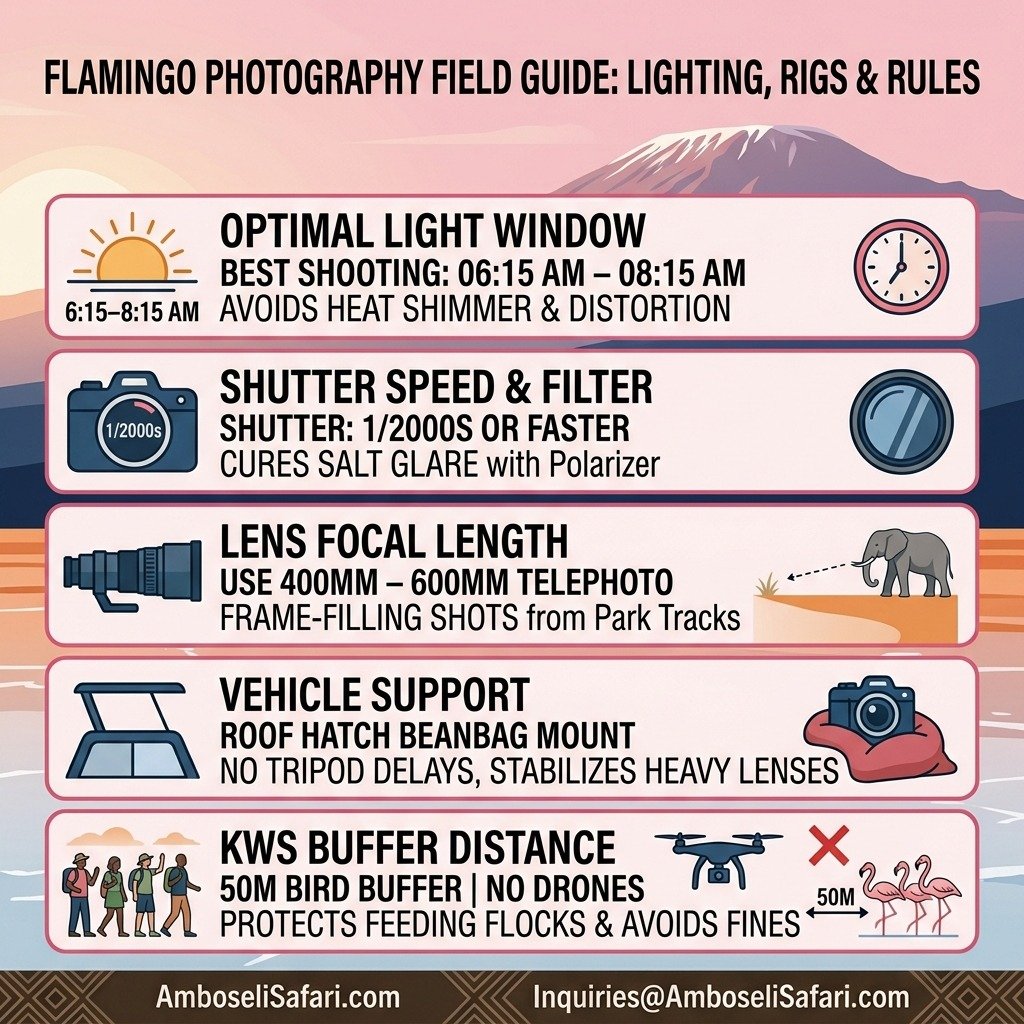
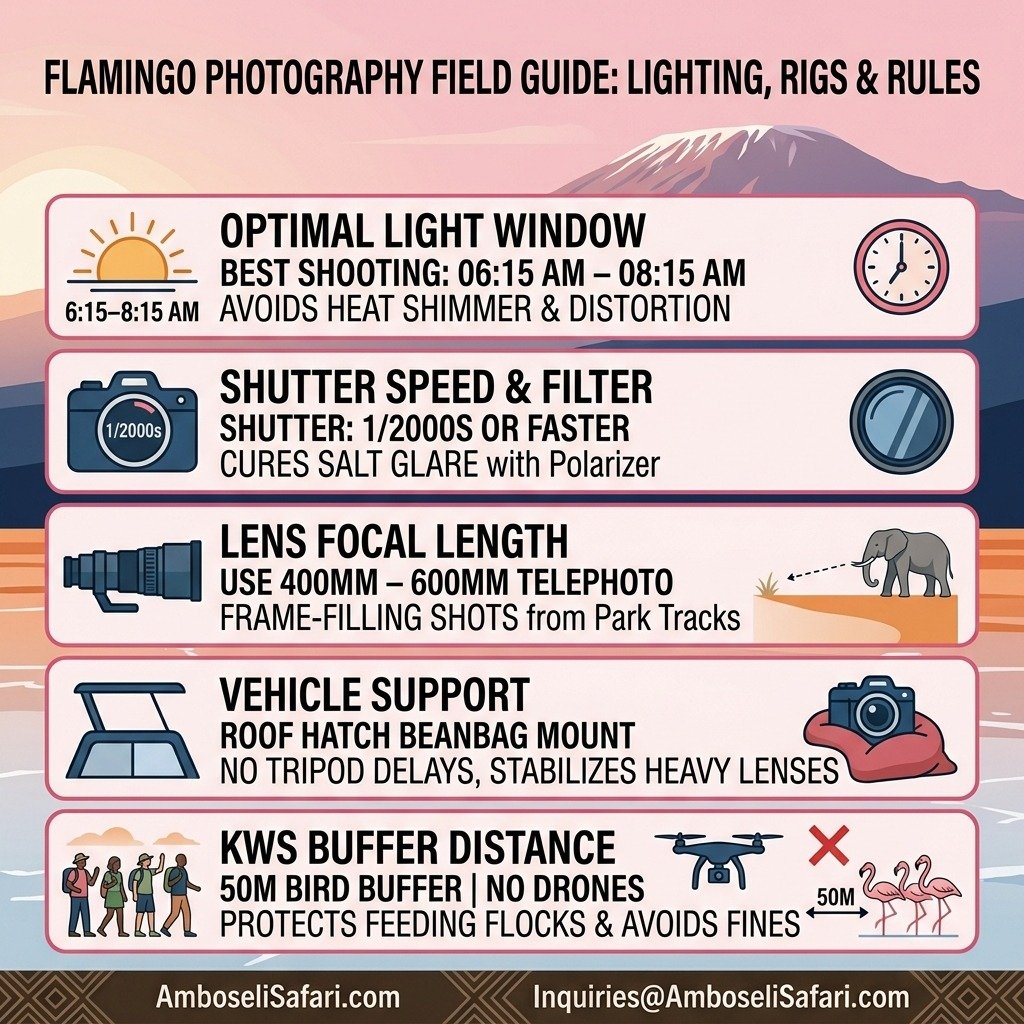
Capturing dramatic flamingo flock imagery requires balancing early morning light against severe salt flat glare. Strict national park regulations also mandate minimum distance buffers to avoid panicking feeding birds. This visual cheat sheet summarizes optimal camera settings, support gear, and official KWS viewing rules.
| Field Category | Recommendation / Setting | Technical / Operational Advantage |
| Optimal Light Window | 06:15 AM – 08:15 AM | Avoids heat shimmer distortion off white salt crusts |
| Shutter Speed & Filter | 1/2000s + Circular Polarizer | Freezes flight action & cuts blinding salt surface reflection |
| Lens Focal Length | 400mm – 600mm telephoto | Enables frame-filling shots from designated park tracks |
| Vehicle Support | Roof hatch beanbag mount | Eliminates tripod setup delays & stabilizes heavy lenses |
| KWS Buffer Distance | 50m bird buffer / Drones banned | Protects feeding flocks from panic flight & avoids fines |
Frequently Asked Questions
When is the best month to see flamingos in Amboseli?
They arrive after heavy rains form shallow soda pools, usually January through March and June through August. It depends on water levels, not calendar dates.
Why do flamingos leave during peak dry season?
When heat bakes the salt pans dry in September and October, there’s no algae left. The flocks fly south to Lake Natron.
Which gate is closest to the flamingo pans?
Meshanani Gate on the northwestern park boundary sits right next to the western soda flats.
Can I fly a drone to film flamingos?
No. Drones are strictly illegal in Amboseli National Park and will get confiscated by rangers.