
The Complete Insider Guide to
Amboseli National Park
Summary
Planning an Amboseli safari requires balancing seasonal KWS park fees ($90 USD/day), lodge locations, and transit choices. A typical 3-day Amboseli safari costs between $1,190 and $3,680 per person sharing in a private 4x4 Land Cruiser. This guide covers wildlife tracking hotspots, border logistics, lodge comparisons, and current entry rules beneath Mount Kilimanjaro.
Amboseli Safari Packages (2027 Rates)
Planning an Amboseli safari requires balancing seasonal KWS park fees ($90 USD/day), lodge locations, and transit choices. A typical 3-day Amboseli safari costs between $1,190 and $3,680 per person sharing in a private 4x4 Land Cruiser. This guide covers wildlife tracking hotspots, border logistics, lodge comparisons, and current entry rules beneath Mount Kilimanjaro.
| Safari Package | Ideal Traveler | Duration & Route | Normal Season Cost USD / Person* | Peak Season Cost USD / Person* |
|---|---|---|---|---|
Amboseli Day Trip | Short-stay & business travelers | 1 Day
Nairobi – Amboseli – Nairobi | $320 – $450
per person | $550 – $680
per person |
3-Day Classic Amboseli Safari | First-timers & core wildlife focus | 3 Days / 2 Nights
Amboseli | $1,190 – $2,180
per person | $1,880 – $3,250
per person |
4-Day Amboseli & Lake Naivasha Circuit | Couples & birdwatching enthusiasts | 4 Days / 3 Nights
2N Amboseli, 1N Naivasha | $1,360 – $2,350
per person | $2,320 – $3,580
per person |
6-Day Amboseli, Naivasha & Masai Mara | Full East Africa cross-country safari | 6 Days / 5 Nights
2N Amboseli, 1N Naivasha, 2N Mara | $2,650 – $4,850
per person | $4,250 – $7,200
per person |
Package Inclusions:
- Full transport in a customized 4×4 Safari Land Cruiser.
- Services of a professional, licensed safari guide.
- Two nights full board accommodation in the Amboseli lodges listed above.
- One night full board accommodation in the Tsavo West lodges listed above.
- Daily park entry fees for Amboseli and Tsavo West.
- Daily game viewing drives and bottled drinking water in the vehicle.
Package Exclusions:
- International flights and Kenyan entry visas.
- Alcoholic drinks and lodge tips.
- Optional activities (like hot air balloon safaris or Maasai village visits).
Optional Add-ons:
- Maasai Village Cultural Visit: USD 30 per person.
- Amboseli Hot Air Balloon Flight: USD 450 per person.
- One-way flight from Wilson Airport to Amboseli Airstrip: USD 540 per person (This includes the base airfare, a safety cushion to prevent underquoting, and our local operator operational margin).
Lodges and Safari Costs
To make your trip logistically smooth, we do not suggest staying more than three nights inside the park. The park is small, and three nights give you plenty of time. A great option is a 3-night combined tour that includes Tsavo West — see our full Amboseli and Tsavo West safari itinerary for the day-by-day plan.
3-Day Amboseli & Tsavo West Safari Packages
Based on 2 people traveling together in a 4x4 Safari Land Cruiser during the normal season.
| Travel Style | Lodge / Camp Name | Est. Price Per Person Sharing (USD) | Book Your Space |
|---|---|---|---|
Budget |
Sentrim Amboseli Lodge
& Rhino Valley Lodge | USD 1,190 | Book Now |
Mid-Range |
Amboseli Serena Safari Lodge
& Kilaguni Serena | USD 1,490 | Book Now |
Luxury |
Tortilis Camp Amboseli
& Severin Safari Camp | USD 2,180 | Book Now |
Luxury Plus | Angama Amboseli & Finch Hattons | USD 3,680 | Book Now |
Package Inclusions:
- Full transport in a customized 4×4 Safari Land Cruiser.
- Services of a professional, licensed safari guide.
- Two nights full board accommodation in the Amboseli lodges listed above.
- One night full board accommodation in the Tsavo West lodges listed above.
- Daily park entry fees for Amboseli and Tsavo West.
- Daily game viewing drives and bottled drinking water in the vehicle.
Package Exclusions:
- International flights and Kenyan entry visas.
- Alcoholic drinks and lodge tips.
- Optional activities (like hot air balloon safaris or Maasai village visits).
Optional Add-ons:
- Maasai Village Cultural Visit: USD 30 per person.
- Amboseli Hot Air Balloon Flight: USD 450 per person.
- One-way flight from Wilson Airport to Amboseli Airstrip: USD 540 per person (This includes the base airfare, a safety cushion to prevent underquoting, and our local operator operational margin).
The Amboseli Reality
If you have ever seen a postcard of a giant, long-tusked elephant standing against a massive blue mountain, you are looking at Amboseli National Park. This flat basin covers about 392 square kilometers — small by Kenyan standards, and we break down exactly where Amboseli sits and how big it really is — right on the border of Kenya and Tanzania. The local Maasai people call this area Empusel, which translates to the salty, dusty place. The name is older than the park itself, and Amboseli’s history runs from Maasai grazing land through a reserve era to full national park status in 1974.
When you drive through the gates, the scent of wild sage crushed by your safari vehicle’s tires immediately fills the air. The bright glare of the dry lakebed can be blinding. But as you get closer to the center, the dusty ground suddenly turns into green swamps dominated by yellow-barked Acacia xanthophloeia (fever trees). These permanent swamps and marshes are the engine of the whole park — every animal you came to see depends on them.
During his 10+ years guiding in the bush, licensed safari guide Moses notes that the park has no fences. The animals move freely. This means you will see local Maasai herd boys guiding their cattle right next to buffalo herds near the boundary zones. It is a fragile, beautiful way of life that depends heavily on community-backed anti-poaching networks.
If you are just beginning to plan your journey, we suggest starting with our detailed Amboseli National Park map to visualize the major driving routes.
How to Get to Amboseli: Drive Times, Routes & Gates
Amboseli sits in Kajiado County, southern Kenya, approximately 240 kilometers (150 miles) southeast of Nairobi. Depending on your budget and travel style, you have two main ways to get here:
- By Road (4 to 5 Hours): The most common route from Nairobi is via the fully paved Mombasa Road, turning right at the town of Emali onto the Oloitokitok Road. You can review the latest Nairobi to Amboseli road conditions before you drive. A 4×4 vehicle is highly recommended, especially during the rains when the clay soils turn into slick mud.
- By Air (35–40 Minutes): Scheduled flights depart from Nairobi’s Wilson Airport (WIL) and land inside the park boundaries. We cover schedules and fares in our Nairobi to Amboseli flight guide, and you can check our guide to local Amboseli airstrips for baggage rules and flight times.
Short on time? A single well-planned day inside the park is genuinely worth it — here is how to plan an Amboseli day trip without wasting half of it on the road.
2026/2027 Airstrip Warning: According to recent KWS pilot bulletins, the main airstrip inside the park has experienced seasonal flooding from rising groundwater. Flights occasionally divert to private dirt runways outside the park borders. This can add a bumpy, 45-minute muddy transfer to your itinerary.
Choosing Your Entry Gate
Amboseli has five active gates. Picking the wrong one can add hours of unnecessary driving. You can check our full guide to the Amboseli National Park gates for exact gate details, confirm the park opening hours before you set off, or use this quick reference table:
| Gate Name | Best Used For | Access Route |
|---|---|---|
Kimana Gate |
Main gate for eastern lodges, Serena, and budget camps |
Emali-Oloitokitok route |
Iremito Gate |
Best for visitors driving directly from Nairobi |
Emali route |
Meshanani Gate |
Ideal for travelers coming from Namanga / Tanzania |
Namanga route |
Kitirua Gate |
Accessing southern conservancies |
Southern border trail |
If you enter through Kimana Gate, you will pass close to Kimana Sanctuary, a small community-run reserve that makes an easy add-on stop on your way in or out.
The Wildlife of Amboseli: Home of the Big Tuskers
While the park hosts four of the “Big Five” (lion, leopard, buffalo, and elephant), it is known worldwide for hosting some of the last remaining “Super Tuskers” in Africa—elephants with tusks so long they graze the dusty plains.
The Amboseli Elephant Research Project (AERP)
Founded by Dr. Cynthia Moss in 1972, this is the longest-running study of wild elephants in the world. Thanks to decades of continuous monitoring, the park’s 1,500+ elephants are highly habituated and relaxed around safari vehicles. You can read more about these elephants and the families researchers know by name in our guide to famous Amboseli elephants.
(Note: There are no rhinos in Amboseli today. If a guide or website promises you a chance at the full Big Five inside the park gates, they are misinformed. To track lions and leopards specifically, see our guide on predator populations in Amboseli.)
Little-Known Tracking Hotspots
To beat the crowds, skip the traffic around the center and head to these two points:
- The Airstrip Hyena Den: A highly active spotted hyena clan has established a long-term den in the concrete culverts near the main airstrip. It is one of the most reliable places in southern Kenya to see young hyena pups at dawn.
- Kioko Lake: A lesser-known deep pool located just south of Observation Hill where large hippo families congregate to escape the shallow mud of the surrounding marshes. The hill itself deserves its own stop — see our full guide to Observation Hill.
If you enter through Kimana Gate, you will pass close to Kimana Sanctuary, a small community-run reserve that makes an easy add-on stop on your way in or out.
The Surrounding Conservancies: Selenkay & Kitirua
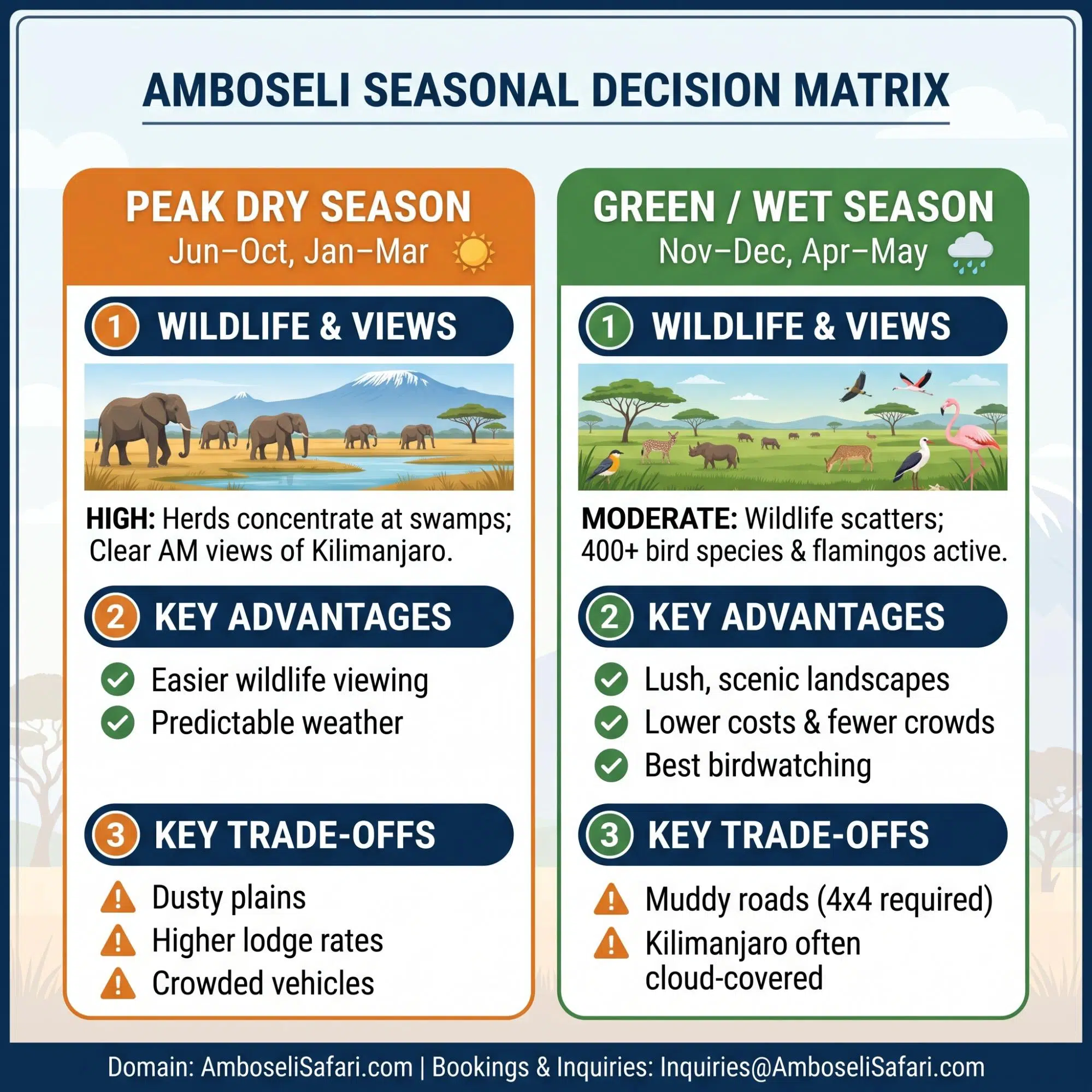
- Map and schedule: tracking Amboseli’s elephants, hyenas, and hippos at Key hotspot locations by time.
While Amboseli National Park covers a relatively small core of 392 square kilometers, the wider ecosystem relies heavily on neighboring community-owned lands. We map all of them in our guide to the Amboseli conservancy areas, but these two matter most:
- Selenkay Conservancy: A 15,000-acre pioneer in community conservation on the northern border. Land is leased directly from Maasai landowners, creating an exclusive, low-crowd alternative where walking safaris and night game drives are permitted — both are forbidden inside the main park under the Amboseli park rules and regulations.
- Kitirua Conservancy: A 30,000-acre tract on the southwestern border extending toward Tanzania, serving as an essential migratory corridor for Amboseli’s elephant bulls.
If you are looking to book, you can enquire now and our local experts will design your custom Amboseli safari.
Wildlife Tracking Hotspots & Timing Guide
Maximizing game drives inside Amboseli requires knowing where specific species gather throughout the day. Because predators and large mammals adjust their movements around thermal heat and water sources, timing your route is critical. Use this cheat sheet to target key animal sightings across the park’s primary habitats.
| Wildlife Target | Primary Location | Optimal Time |
|---|---|---|
Elephant Herds |
Enkongo Narok & Ol Okenya Swamps |
10:00 AM – 3:00 PM |
Hyena Pups |
Main Airstrip Concrete Culverts |
6:00 AM – 7:30 AM |
Hippo Pods |
Kioko Lake (South of Observation Hill) |
All day (Midday peak) |
Best Time to Visit Amboseli: Dry vs. Wet Seasons
Amboseli’s weather is highly seasonal, dictated by its location in the rain shadow of Mount Kilimanjaro. For rainfall figures and temperatures across the year, our Amboseli weather by month guide has the full breakdown.
The Dry Season (June to October, January to March)
This is the peak window for wildlife viewing. As the volcanic soil of the plains dries up, the surrounding vegetation dies back. Animals are forced to congregate around the permanent freshwater marshes of Enkongo Narok and Ol Okenya.
- The View: The skies are very clear, offering excellent views of Mount Kilimanjaro at sunrise.
- The Catch: Dust levels are extreme, and the park can feel crowded with vehicles near the marshes. You can check our detailed guide on the best time to visit Amboseli National Park for a month-by-month breakdown.
The Wet Season (November to December, April to May)
The rains transform the parched bed of Lake Amboseli into a shallow lake, and the dusty plains turn lush and green.
- The View: Ideal for birdwatchers, as migratory species arrive and thousands of seasonal pink flamingos settle on the flooded lakebed. Serious birders should also work the Sinet Delta in the north of the park, where the water birds concentrate.
- The Catch: Wildlife scatters throughout the wider ecosystem since water is plentiful everywhere. Kilimanjaro is frequently hidden in heavy cloud cover.
Amboseli Seasonal Decision Matrix
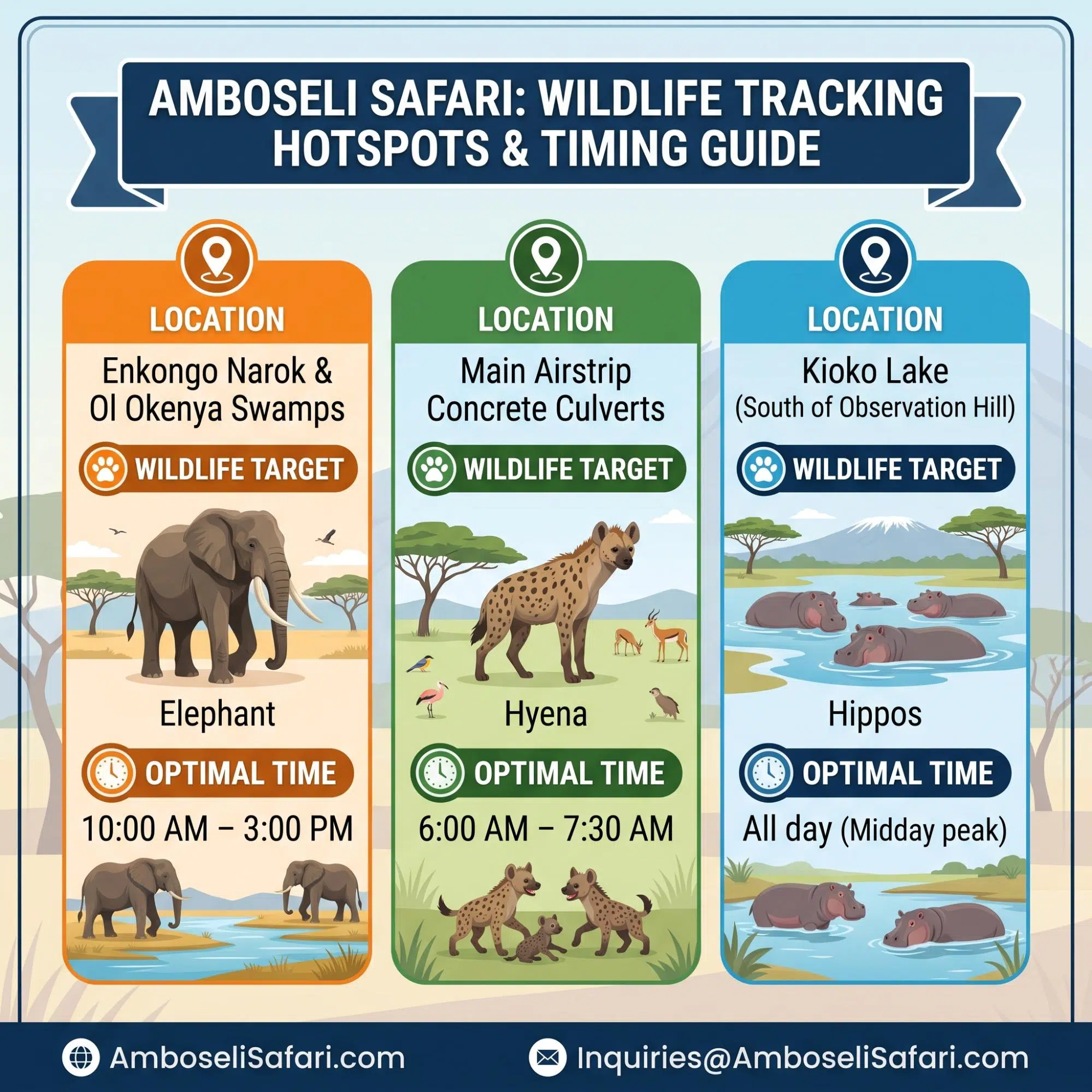
Choosing when to visit Amboseli depends on whether your priority is clear views of Mount Kilimanjaro or avoiding park crowds. While the dry season forces wildlife to concentrate around permanent marshes, the wet season offers lush landscapes and prime birdwatching opportunities. This quick seasonal matrix compares visibility, wildlife concentration, and travel trade-offs to help you decide.
| Season & Months | Wildlife & Mountain Views | Key Trade-Offs |
|---|---|---|
Peak Dry (Jun–Oct, Jan–Mar) |
High: Large herds at swamps; clear early morning
Kilimanjaro views |
Dusty plains; higher lodge rates; vehicle crowds around swamps |
Green / Wet (Nov–Dec, Apr–May) |
Moderate: Wildlife scatters; 400+ bird species &
flamingos active |
Kilimanjaro often cloud-covered; muddy roads require 4x4 |
Amboseli National Park Fees (2026/2027 Update)
To enter the park, you must pay daily conservation fees. The prices changed recently as part of the latest KWS tariff adjustments. Kenya Wildlife Service no longer accepts cash at the gates. You must pay beforehand using the government e-Citizen portal, or pay at the gate with a credit card or mobile money.
These daily fees are valid for 24 hours only.
Non-Resident Daily Entry Rates (USD)
- International Adult: USD 90 per day
- International Child / Student: USD 45 per day
- African Citizen Adult (Non-EAC): USD 50 per day
- African Citizen Child (Non-EAC): USD 25 per day
For any questions about vehicle entry permits or seasonal discounts, check our full guide to official Amboseli National Park entry fees.
Budgeting & Accommodation Comparison
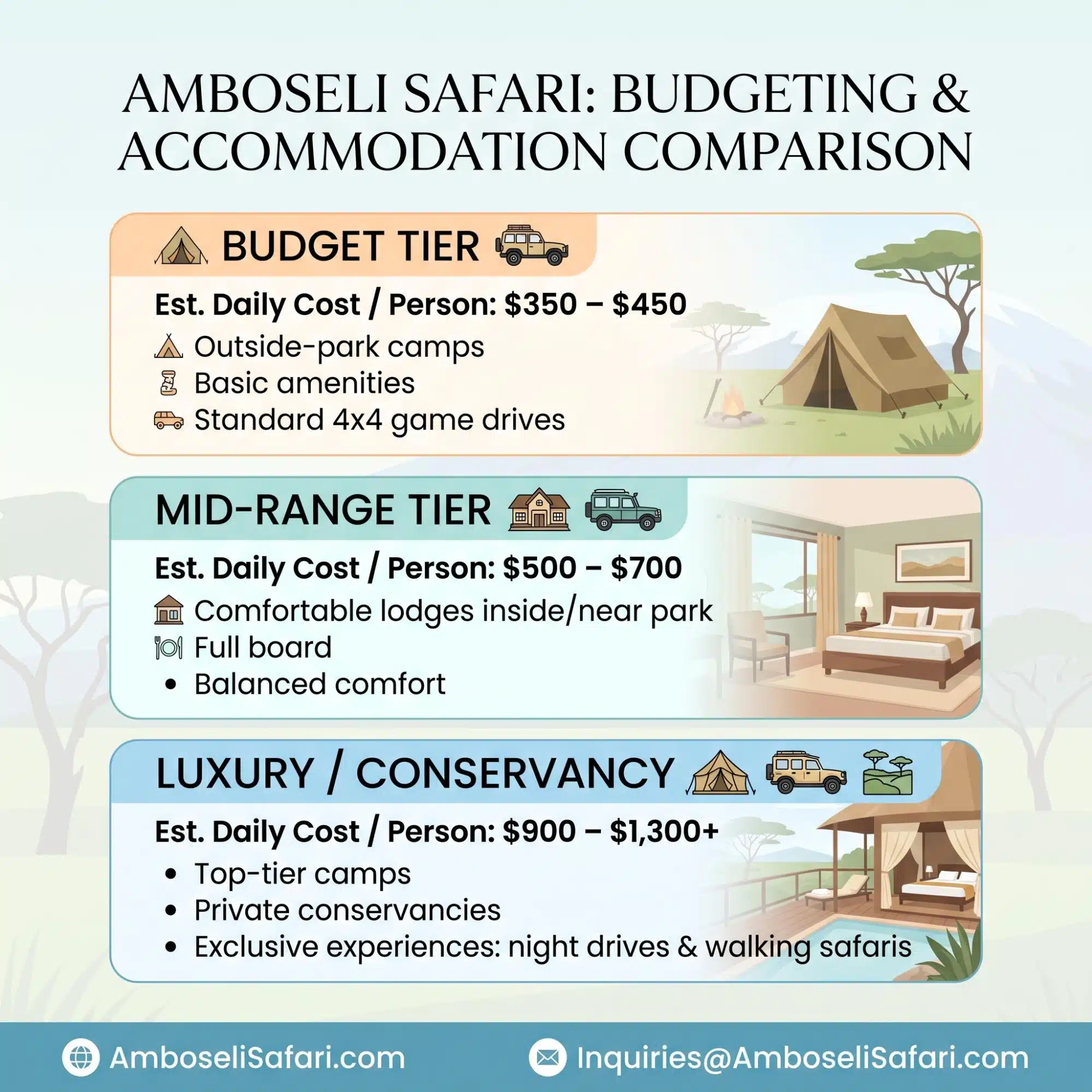
Planning an Amboseli safari budget requires balancing entry fees, transport logistics, and accommodation tiers. While budget camps located outside the gates lower nightly costs, luxury lodges inside or in private conservancies offer exclusive access and extra activities. This breakdown compares average daily costs across travel styles to assist in financial planning.
| Travel Style | Est. Daily Cost / Person | Included Experience |
|---|---|---|
Budget Tier | $350 – $450 |
Outside-park camps, basic amenities, standard 4x4 game drives |
Mid-Range Tier | $500 – $700 |
Mid-tier lodges inside/near park, full board, balanced comfort |
Luxury / Conservancy | $900 – $1,300+ |
Top-tier camps, private conservancies, night drives & walking safaris |
Common Mistakes to Avoid
Standard travel websites copy and paste the same descriptions. They tell you everything is perfect. But when you are on the ground, some real challenges can ruin your trip if you are not ready.
1. The Salty Water Trouble at Budget Camps
Many budget tented camps built just outside the park gates rely on shallow underground boreholes. Because of the volcanic soil of the Rift Valley, this water is highly alkaline.
- The Reality: Local drivers on the Kimana route advise that the water at these budget camps tastes extremely salty. It does not lather well with soap. It leaves your skin feeling dry, tight, and itchy after a shower. If you have sensitive skin, bring your own moisturizing body wash and use bottled water even for brushing your teeth.
2. The Alkaline Dust Camera Trap
The dust of the dry lakebed is very fine, like white baking flour. When the wind picks up, this dust gets into everything. Standard camera bags do not stop it.
- The Reality: Professional shooters at the Ol Tukai swamp advise wrapping your camera bodies in thick, double-zipped kitchen bags. Only take the camera out when you are ready to shoot. This fine alkaline dust will quickly ruin the internal focus motors of expensive lenses. You can read our practical Amboseli safari packing list for more gear recommendations.
3. The Steep Climb up Observation Hill
Observation Hill is the single best spot to view the swamp and the mountain. But the stone steps to the top are steep and uneven.
- The Reality: There are no handrails on the steepest gravel sections. If you are traveling as a senior, or have bad knees, this climb is very painful. We suggest reviewing our accessible safari options for seniors before booking. Additionally, the public toilets at the bottom of the hill often lose water pressure during the dry season. Make sure you use the facilities at your lodge before starting your morning drive.
For more detailed advice, read our self-drive safari tips for Amboseli.
Frequently Asked Questions
Is malaria a risk in Amboseli?
Yes, the park has large, permanent wetlands like the Enkongo Narok swamp. These freshwater marshes are perfect breeding grounds for mosquitoes. According to health travel guidelines from the World Health Organization, you should take malaria prophylactics and use insect repellent with at least 30% DEET, especially during the early evening when the wind drops.
When is the best time to see Mount Kilimanjaro?
Kilimanjaro is notoriously shy. During the day, warm air rises from the plains and creates thick clouds around the summit. Your best chance to see the snow cap is between 6:00 AM and 8:30 AM, or right after 5:30 PM.
Why are there no rhinos in Amboseli?
Historically, the park had a healthy black rhino population. However, severe poaching in the late 1970s and 1980s wiped them out. Today, you will see four of the Big Five here. If seeing rhinos is your top goal, enquire now and our team will design a custom safari that includes Lake Nakuru or Ol Pejeta.