
History of Amboseli National Park: Origins & Conservation Heritage
Overview
The History of Amboseli National Park spans over a century of cultural shifts, colonial conservation experiments, and groundbreaking wildlife research. Originally known to indigenous pastoralists as Empusel (“the salty, dusty place”), the area was designated the Southern Maasai Reserve in 1906, handed to local Kajiado Council management in 1961, and officially gazetted as a 392 km² National Park in 1974 under President Jomo Kenyatta. Recognized in 1980 as a UNESCO Man and the Biosphere Reserve, Amboseli is world-famous for its free-ranging elephant herds, historical Hollywood connections, and community conservation models.
Fast Navigation Links
- Geological Origins & Early History
- Colonial History (1906–1980)
- Hollywood, Hemingway & Ol Tukai
- Normatior: From Poachers to Lookout
- Echo, Tim & Elephant Science
- Ecological Turning Points & Droughts
- How to Visit These Historic Sites Today
- Frequently Asked Questions
Mount Kilimanjaro’s ancient volcanic eruptions reshaped this basin thousands of years ago, choking off the prehistoric lake that once covered the valley floor. What remained was a vast alkaline depression fed by hidden subterranean volcanic aquifers that still push melted snow and rainwater into spring-fed wetlands like the Enkongo Narok swamp.
Geological Origins & Early History of Amboseli National Park
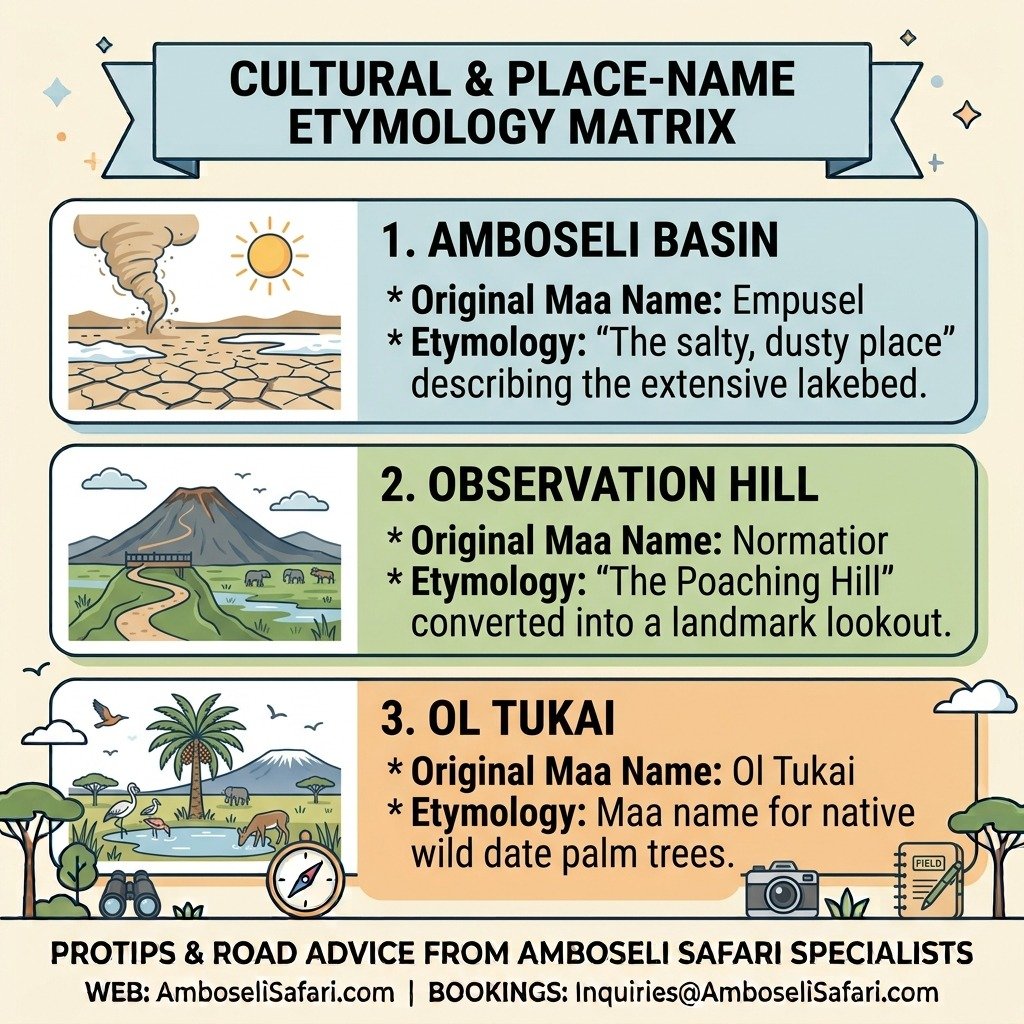
Indigenous Maasai pastoralists called this blinding, cracked basin Empusel—Maa for “the salty, dusty place.” For centuries, herdsmen moved their cattle between the dry salt flats of Lake Amboseli and the permanent green marshes beneath Kilimanjaro.
In 1883, Scottish geologist Joseph Thomson became the first European to cross Maasai territory here. Thomson recorded his awe at stepping directly off the blinding white salt crust of Empusel into lush oases packed with rhinos, buffaloes, and elephants. Navigating those same dry lakebed tracks on a self-drive requires deflating tires slightly so you don’t bog down in powdery alkali silt.
Cultural & Place-Name Etymology Matrix
Long before colonial administrative boundaries were drawn, the indigenous Maasai mapped the Amboseli basin through rich Maa place names. These terms reflected the harsh alkaline geology and unique flora that sustained their cattle for centuries. The reference matrix below details the cultural origin and meaning behind the park’s most historic landmarks.
| Historic Site / Term | Original Maa Name | Cultural & Historical Meaning |
| Amboseli Basin | Empusel | “Salty, dusty place” describing the lakebed. |
| Observation Hill | Normatior | “The Poaching Hill” converted into a lookout. |
| Ol Tukai | Ol Tukai | Maa name for native wild date palm trees. |
Colonial History of Amboseli National Park (1906–1980)
Administrative control over the basin shifted through several distinct phases over the past century.
| Year | Historical Milestone | Significance |
| 1906 | Southern Maasai Reserve Created | Initial British colonial protection layer |
| 1961 | Kajiado County Management | Early African experiment in local community governance |
| 1974 | Gazetted as National Park | Strict 392 km² central core established |
| 1980 | UNESCO Biosphere Designation | Global recognition of ecosystem conservation models |
The British colonial government set aside 3,261 square kilometers as the “Southern Maasai Reserve” in 1906, restructuring it as the Maasai Amboseli Game Reserve in 1948.
In 1961, administration handed over directly to the Kajiado County Council—one of East Africa’s earliest community-led conservation experiments, operating much like neighboring Narok County Council reserves.
Rising livestock numbers and tourist traffic prompted President Jomo Kenyatta to gazette the central 392 km² core as a strict National Park in 1974. UNESCO added further protection in 1980 by naming Amboseli a Man and the Biosphere Reserve. Today, core operations fall under the Kenya Wildlife Service.
These historical boundaries still define entry points across modern Amboseli National Park gates and neighbor Amboseli conservancies.
Hollywood, Hemingway & The Legend of Ol Tukai
In 1933, Ernest Hemingway pitched camp along the swamp edge. Nursing a severe bout of dysentery between hunts, he took notes under the shadow of Kilimanjaro—material that turned into “The Snows of Kilimanjaro” three years later.
Twenty years after Hemingway left, Hollywood built a semi-permanent camp at Ol Tukai to house Clark Gable and Grace Kelly while shooting Mogambo. The timber frameworks MGM left behind eventually formed the foundation for the park’s first public accommodations.
Visitors often mistake the name Ol Tukai for yellow-fever acacias (Acacia xanthophloeia), but it is Maa for the wild date palm (Phoenix reclinata) fringing the marshes. The clear dry months remain the best time to visit Amboseli for viewing Mount Kilimanjaro over these same palm groves, with historic properties like Ol Tukai Lodge Amboseli sitting directly on the original 1950 MGM filming footprint.
Normatior (Observation Hill): From Poachers to Lookout
The pyramid-shaped volcanic hill rising above the savanna was known as Normatior to local Maasai. Before strict park enforcement, local illegal hunters called it “The Poaching Hill.” Poachers used its elevated 360-degree viewpoint to track elephant herds moving through Enkongo Narok swamp while watching for approaching wardens.
When conservation efforts intensified, wardens carved a staircase straight out of native volcanic basalt rock to convert the poacher post into a tourist viewing deck. A carved basalt staircase leads to the summit of Observation Hill, providing a panoramic vantage point for wildlife photography across the plains.
Conservation History: Pipelines, Echo & Big Tuskers
When central swamps were fenced off for the 1974 park gazettement, local Maasai lost crucial dry-season cattle water. Tensions boiled over, leading herdsmen to spear park wildlife in protest.
Ecologist Dr. David Western brokered a breakthrough compromise in 1977 by installing external pipelines from park springs to cattle troughs on surrounding group ranches—concrete troughs that still line the outer perimeter today.
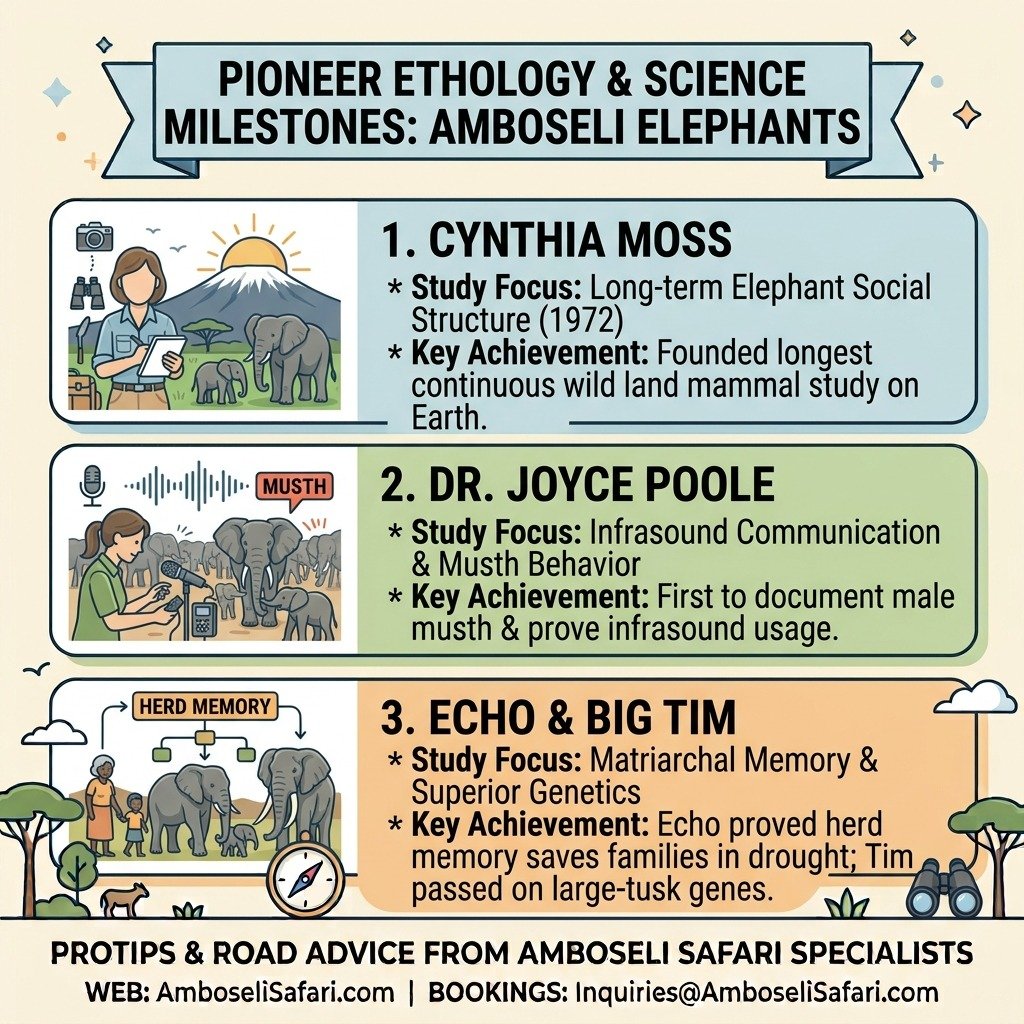
Scientific discovery exploded around the same time. Ethologist Cynthia Moss founded the Amboseli Elephant Research Project (AERP) in 1972, creating the longest continuous land-mammal study on Earth.
In these swamps, Dr. Joyce Poole first documented male elephant musth and proved elephants communicate using low-frequency infrasound. Researchers tracked Echo, a matriarch studied for 36 years who taught scientists how herd memory saves families during drought, alongside legendary “super-tusker” Tim, whose ivory scraped the ground until his natural death in 2020.
Understanding these herd structures enriches any encounter with Amboseli’s elephants, provided drivers adhere strictly to established park rules and regulations.
Pioneer Ethology & Science Milestones
Amboseli stands as the cradle of modern elephant ethology, hosting pioneer studies that forever changed human understanding of animal intelligence. Breakthrough research conducted in these swamps revealed complex family structures, low-frequency vocal communication, and the vital importance of matriarchal memory. Review the table below for a summary of the groundbreaking scientific milestones established in the park.
| Researcher / Subject | Field / Project | Breakthrough Contribution |
| Cynthia Moss | Elephant Research (1972) | Founded longest land-mammal study on Earth. |
| Dr. Joyce Poole | Ethology Studies | Discovered elephant infrasound & male musth. |
| Echo & Big Tim | Matriarch & Super-Tusker | Proved herd memory & genetics pass down. |
Ecological Turning Points: Severe Droughts & Changing Canopies
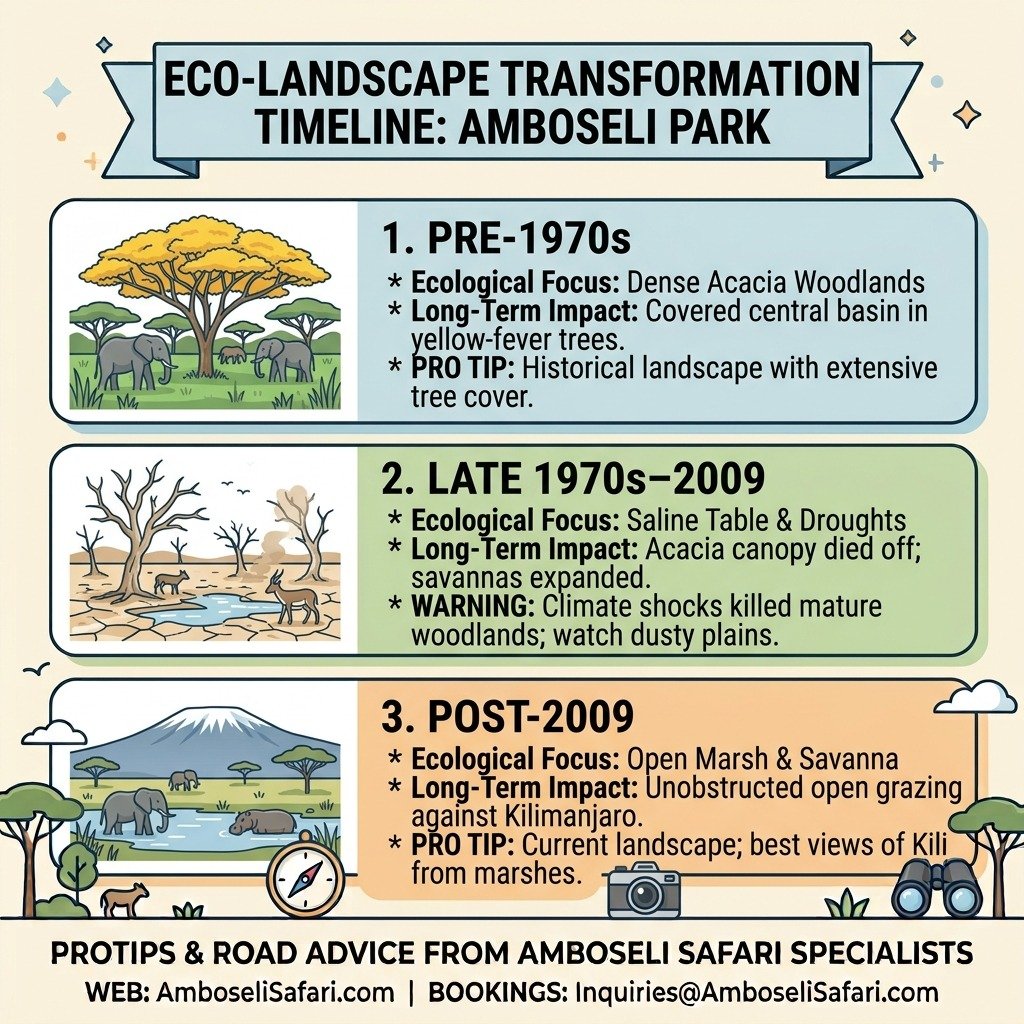
Fifty years ago, central Amboseli was covered by dense yellow-fever tree forests. Severe drought cycles—especially in the late 1970s and the extreme 2009 drought—combined with rising saline water tables to kill off the mature acacia canopy.
While the 2009 drought devastated plains game and older elephants, the loss of dense woodland opened up the vast, short-grass savannas seen today. The open marshes where elephants graze against Kilimanjaro’s backdrop are a direct outcome of these climate shocks.
Eco-Landscape Transformation Timeline
The iconic, wide-open views of elephants grazing in front of Mount Kilimanjaro are the result of dramatic ecological shifts over the last half-century. Rising underground salinity levels and recurring dry cycles systematically altered the vegetation across the central basin. This transformation timeline illustrates how dense acacia forests evolved into the expansive savannas seen today.
| Era / Event | Environmental Shift | Long-Term Ecosystem Impact |
| Pre-1970s | Dense Acacia Woodlands | Covered central basin in yellow-fever trees. |
| Late 1970s–2009 | Saline Table & Droughts | Acacia canopy died off; savannas expanded. |
| Post-2009 | Open Marsh & Savanna | Unobstructed open grazing against Kilimanjaro. |
How to Visit These Historic Sites Today
Exploring Amboseli’s historical landmarks, from Ol Tukai’s palms to Observation Hill, requires balancing daily KWS entry passes ($90 USD per 24 hours for non-resident adults), vehicle permits, and lodge transfers. Most travelers combine Amboseli with Tsavo West to cover two distinct conservation histories in a single 4-day route.
Combining local flight transfers, park conservation permits, and lodge bookings into a custom Amboseli safari package streamlines the logistics.
4-Day Amboseli & Tsavo West Safari Packages
Prices are total per person based on two adults sharing accommodation and a private 4×4 Land Cruiser.
| Season & Tier | Included Lodges | Price Per Person (USD) | Reserve Your Spot |
| Normal – Budget | AA Lodge Amboseli & Rhino Valley Lodge | USD 1,370 | Book Now |
| Normal – Mid-Range | Ol Tukai Lodge & Kilaguni Serena Lodge | USD 1,610 | Book Now |
| Normal – Luxury | Tortilis Camp & Severin Safari Camp | USD 2,150 | Book Now |
| Normal – Luxury Plus | Angama Amboseli & Finch Hattons | USD 3,560 | Book Now |
| Peak – Budget | AA Lodge Amboseli & Rhino Valley Lodge | USD 2,300 | Book Now |
| Peak – Mid-Range | Ol Tukai Lodge & Kilaguni Serena Lodge | USD 2,600 | Book Now |
| Peak – Luxury | Tortilis Camp & Severin Safari Camp | USD 3,250 | Book Now |
| Peak – Luxury Plus | Angama Amboseli & Finch Hattons | USD 5,050 | Book Now |
Package Inclusions:
- Private 4×4 Safari Land Cruiser with pop-up roof for wildlife viewing.
- Services of a TRA-licensed, English-speaking driver-guide.
- All KWS park conservation fees for Amboseli and Tsavo West.
- Full board accommodation (breakfast, lunch, dinner) at listed properties.
- Unlimited bottled drinking water in the vehicle during game drives.
- Emergency medical evacuation insurance cover.
Package Exclusions:
- International flights and Kenyan electronic Travel Authorization (eTA) fees.
- Driver-guide tips, alcoholic drinks, and personal laundry.
- Optional activities such as hot air balloon flights or cultural village visits.
Optional Add-Ons:
- Maasai Cultural Village Visit: USD 30 per person.
- Amboseli Hot Air Balloon Safari: USD 450 per person.
- One-Way Flight Upgrade (Wilson Airport to Amboseli Airstrip): USD 540 per person (Includes base airline ticket, rate protection cushion, and operator service fee).
Choosing where to stay in Amboseli often comes down to gate proximity. Calculating full trip expenses on our Amboseli safari cost breakdown helps budget for vehicle permits whether entering through Kimana Gate or Meshanani Gate.
Frequently Asked Questions
Why was Amboseli turned into a National Park?
Amboseli was gazetted as a National Park in 1974 to protect its spring-fed swamps, unique elephant population, and fragile basin ecosystem from overgrazing and unmanaged habitat loss.
Can Maasai still graze cattle inside Amboseli National Park?
No. Livestock grazing is illegal inside the 392 km² core park. Local Maasai graze cattle on surrounding group ranches and conservancies, using external water pipelines built under the 1977 agreement.
How old is the Amboseli Elephant Research Project?
Founded in 1972 by Cynthia Moss, the project is the longest continuously running study of wild land mammals in the world, tracking individual elephant family lines for over fifty years.