
Amboseli Tented Camps with Kilimanjaro View: Photos, Rates & Packages
Overview
Booking Amboseli tented camps with Kilimanjaro view requires knowing which properties offer a clear line of sight to Kibo peak before morning clouds roll in. Camps in private conservancies like ALOCA, Kuku, Selenkay, and Elerai offer dual-mountain vistas, waterhole photo decks, and great room positioning for sunrise photography. Full-board 3-day and 4-day safari packages in a private 4×4 Land Cruiser range from $870 per person for budget stays to $5,950 per person for fly-in luxury tented packages.
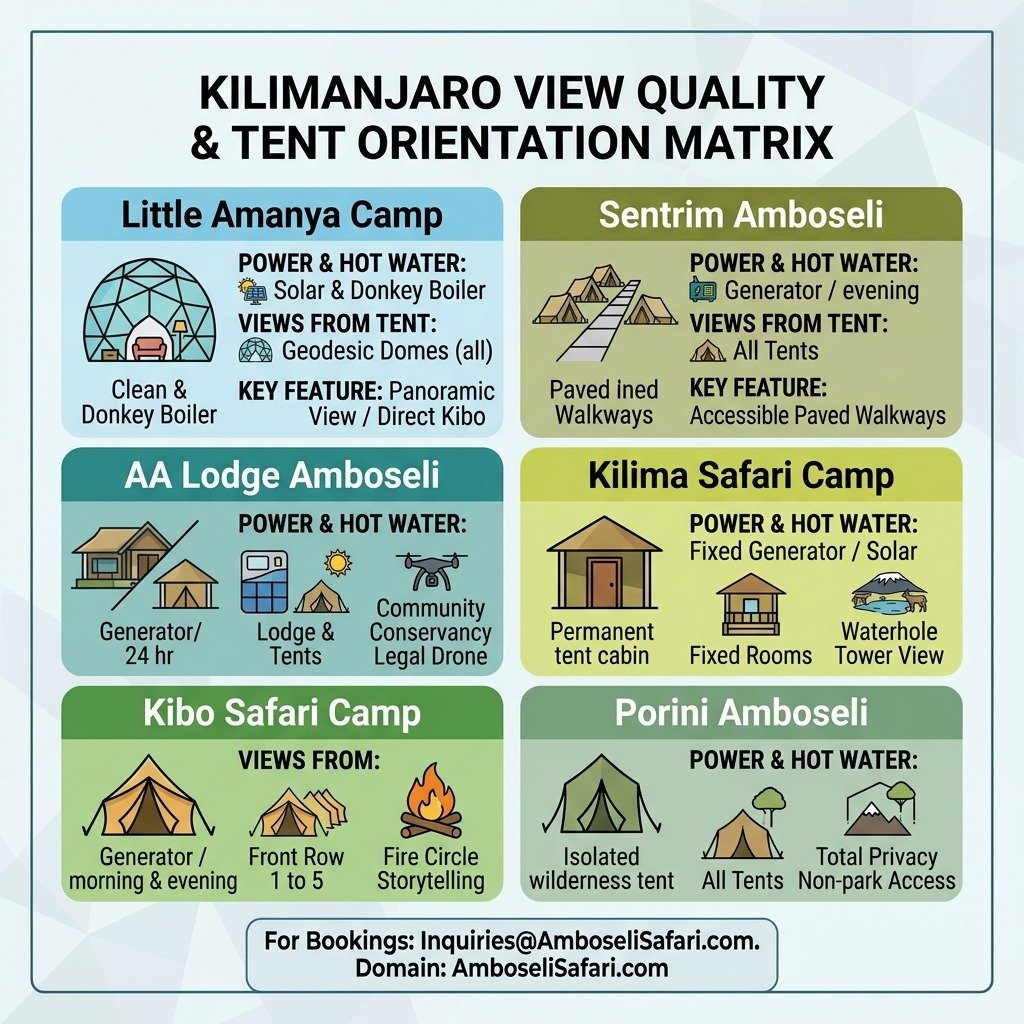
Kilimanjaro View Quality & Tent Orientation Matrix
Capturing an unobstructed view of Mount Kilimanjaro from your private canvas tent depends heavily on camp orientation, elevation, and seasonal cloud cover. While many Amboseli properties claim mountain views, sightlines vary significantly between early morning clear skies and afternoon heat haze. The reference table below compares top tented camps on exact peak visibility angles, photographic vantage points, and seasonal viewing logistics. Use this quick breakdown to choose the best tented camp for your Kilimanjaro viewing experience.
| Tented Camp | Peak Kili Sightline Angle | Best Viewing Window | Mountain View Feature |
| Tortilis Camp | Southwest slope / Direct peak | 06:00 AM – 08:30 AM | Elevated ridge location overlooking SW face |
| Kibo Safari Camp | Eastern face / Open plain | 06:00 AM – 09:00 AM | Unobstructed canvas veranda views |
| Little Amanya Camp | Full snowcap panoramic | 06:15 AM – 08:30 AM | 180° clear panels inside Geodesic Domes |
| Sentrim Amboseli | Southern slope framing | 06:00 AM – 09:30 AM | Level ground views from tented verandas |
| Kilima Safari Camp | Southeast peak angle | 06:30 AM – 09:00 AM | Two-story wooden tower over looking peak |
| Angama Amboseli | Full Kibo peak profile | 06:00 AM – 08:30 AM | Floor-to-ceiling canvas frame facing peak |
Fast Navigation Links
- Best Viewing Angles & Photography Tips
- Conservancy Tented Camps & Waterholes
- Verified Tented Camp Reviews & Kili Visibility
- Buyer’s Decision Guide
- Mountain Visibility Seasonality
- Park Logistics, Gates & Airstrips
- Common Pitfalls & Camera Logistics
- Safari Package Pricing
- Frequently Asked Questions
Best Viewing Angles & Photography Tips
Barefoot steps on freezing canvas at 05:30 AM are a reality in Amboseli. Cold desert air bites your face, and the smell of acacia woodsmoke drifts through camp while you pour hot coffee.
By 09:00 AM, heat off the dry lakebed turns into thick clouds around Kibo peak. Booking a camp on elevated ground or a rocky ridge gives you extra time to shoot photos before the mountain hides behind white cover.
Satao Elerai Camp
Satao Elerai sits on a high ridge in its own 5,000-acre conservation area, looking over the basin. You sit above the fine dust kicked up by morning Land Cruisers on the main park tracks. Photos stay crisp here until around 10:30 AM, well after valley-floor views turn hazy.
Amboseli Eco Camp
Positioned along the Oloitokitok slope near Kimana, these stilted wooden-and-canvas cabins look southwest. Your private deck faces the early sun directly as light hits the glaciers. Between 06:10 AM and 06:30 AM, early light turns Kibo and Mawenzi peaks a deep, soft pink before full daylight washes out the sky.
Private Conservancy Tented Camps & Waterhole Views
Private conservancies bordering the park sit on community land managed alongside local Maasai group ranches under Kajiado County guidelines. Staying in these private sanctuaries gives you private waterhole views, night game drives, and off-road tracking allowances strictly banned inside land run by the Kenya Wildlife Service (KWS).
Zebra Plains Amboseli Camp
Inside the private 35,000-acre ALOCA Conservancy, Zebra Plains built 34 tents aimed straight at Kibo and 12 facing the open savanna. A natural wildlife dam sits right in front of the main lounge deck. Elephants, giraffes, and zebras gather to drink here, letting you photograph animals at the waterhole with Mount Kilimanjaro framed directly behind them.
Dual-Peak Views from Elerai Ridge
Tented camps set along the upper Elerai ridge give you a rare two-mountain view. Mount Kilimanjaro dominates the southern horizon, while turning west at sunset reveals the dark, jagged silhouette of Mount Longido across the Tanzanian border.
Cultural Bush Kraals & Volcanic Cave Dining
Amboseli Cultural Camping
Set on the edge of the Ol Okenya marsh corridor, this community camp offers a genuine bush stay. You sleep in simple dome tents pitched inside a traditional thorn-bush Maasai Kraal (boma). Since the marsh is an active corridor for lions and spotted hyenas hunting after dark, resident Maasai warriors keep a central campfire burning all night to guard the camp perimeter.
Campi ya Kanzi
Located on the 275,000-acre Kuku Group Ranch in the Chyulu Hills foothills, Campi ya Kanzi holds a Gold Eco-Rating from Ecotourism Kenya. Its luxury canvas suites—Tembo and Kanzi—look south across open grassland toward Kibo. You can take guided walks up to the “Kunchu” hill lookout for private dawn breakfasts, or arrange a multi-course dinner inside a natural volcanic lava cave illuminated by lantern light.
Verified Tented Camp Reviews & Kili Visibility
Elewana Tortilis Camp (Kitirua Conservancy)
Rating: 4.8 / 5
Kitirua Hill sits high enough that acacia trees do not block your view of Kibo peak. Anthony usually avoids the central marsh tracks after 08:30 AM because minibus traffic kicks up too much dust for clean photos, making the quiet walking safaris around Tortilis a great alternative.
Room Tip: Tents 1 to 4 on the main ridge have the best height advantage for open mountain shots straight from bed.
Kibo Safari Camp (Maramaisha / Kimana Gate)
Pros: 2-minute drive to Kimana Gate; solid family tent setups; lively nightly Maasai fire-circle.
Cons: Tents in the back row have views partially blocked by trees.
Guide’s Note: Book Tents 1 to 5 in the front luxury row for clear views across open lawn during sunrise.
Porini Amboseli Camp (Selenkay Conservancy)
A quiet, 10-tent wilderness camp in the 15,000-acre Selenkay reserve. You trade quick gate access for total privacy, night drives, and guided bush walks. It takes 45 minutes to reach central KWS marsh tracks from here, but Tents 7 and 8 sit right in front of an active waterhole frequented by gerenuks and bat-eared foxes.
Ol Tukai Lodge (Central Park Marshes)
If you want elephants grazing 15 meters from your room all afternoon, this is the spot. Permanent chalets sit right on the fence line of the central swamp, backed by Mount Kibo. Request a chalet in the 300-series block for front-row camera angles, but keep in mind that strict KWS 06:00 PM park curfews apply.
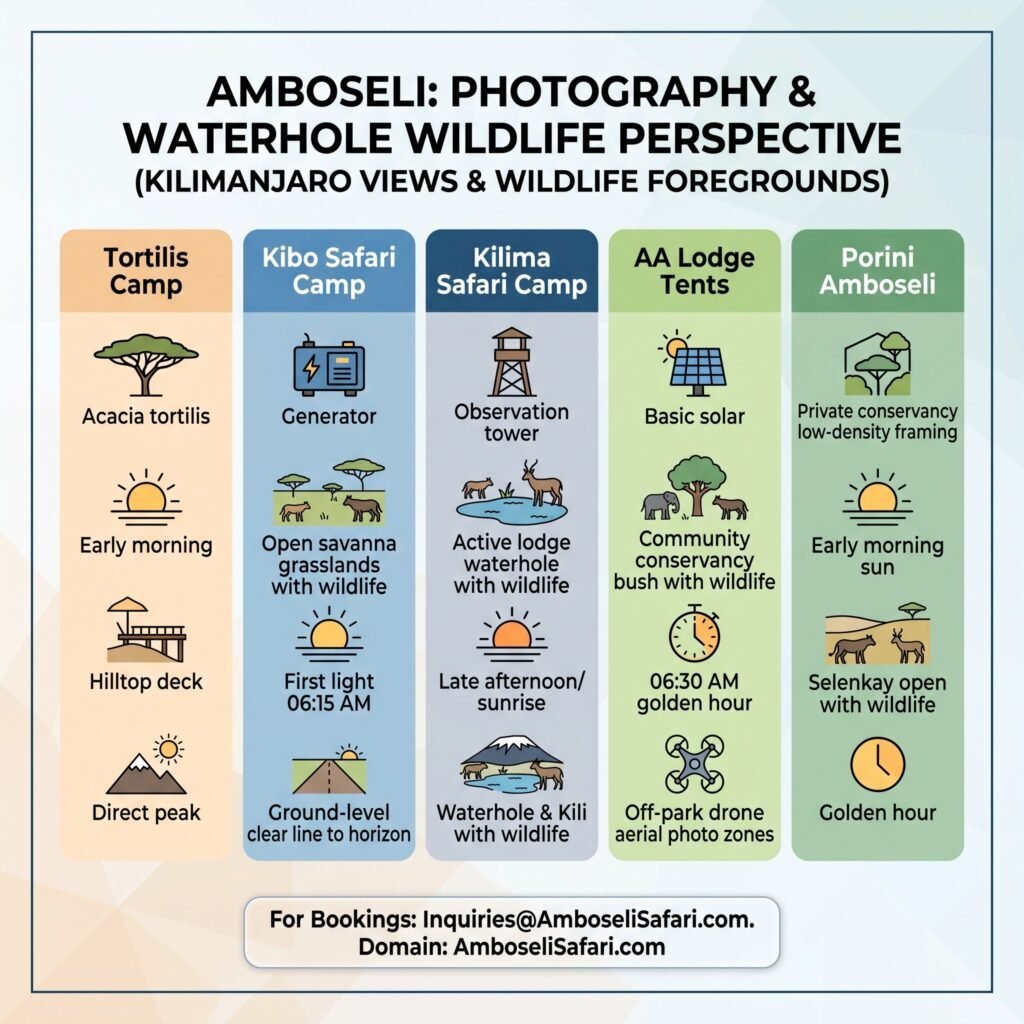
Photography & Waterhole Wildlife Perspective
Capturing iconic shots of wildlife set against the backdrop of Mount Kilimanjaro requires aligning the camp’s foreground terrain with early morning light angles. This reference breakdown details the unique camera vantage points, animal framing opportunities, and optimal photo windows across top tented locations to help you maximize your photography gear setup.
| Tented Camp | Foreground Composition | Best Photo Timing | Unique Camera Vantage |
| Tortilis Camp | Acacia tortilis woodland frame | Early morning sunrise | Hilltop deck overlooking marsh & peak |
| Kibo Safari Camp | Open savanna grasslands | First light (06:15 AM) | Ground-level clear line to horizon |
| Kilima Safari Camp | Active lodge waterhole | Late afternoon / Sunrise | Observation tower over waterhole & Kili |
| AA Lodge Tents | Community conservancy bush | 06:30 AM golden hour | Off-park drone aerial photo zones |
| Porini Amboseli | Selenkay open plains | Sunrise / Golden hour | Private conservancy low-density framing |
Buyer’s Decision Guide: Camp Selection by Travel Style
- For Wildlife Photographers: Amboseli Eco Camp, Zebra Plains Amboseli, or Satao Elerai Camp. These camps feature elevated viewing decks angled toward the peak, catching early morning light before clouds roll in.
- For Honeymooners & Luxury Travelers: Elewana Tortilis Camp, Angama Amboseli, or Campi ya Kanzi. Low-density conservancy camps with private plunge pools, butler service, and quiet game drives away from minibus crowds.
- For Families & Mid-Range Budgets: Kibo Safari Camp or Sentrim Amboseli. Both feature fenced grounds, large multi-bed canvas tents, swimming pools, and quick 2-to-5-minute runs to Kimana Gate.
Mountain Visibility & Photography Seasonality
Cloud cover over Mount Kilimanjaro shifts month by month. Planning around weather patterns helps ensure you do not arrive when the summit stays hidden behind dense clouds.
| Month Window | Weather Conditions & Mountain Visibility | Visibility Rating |
| Jan – Feb | Clear skies, dry conditions, and sharp morning views | Excellent |
| March | Transitional; clear early mornings with afternoon clouds | Good |
| Apr – May | Heavy rains, thick cloud cover, and low cloud ceilings | Challenging |
| June | Cooler air, clearing skies, and light dust haze | Moderate |
| July – Oct | Peak dry season; dust settles at dawn for crisp views | Excellent |
| November | Short rains; green landscapes with occasional clouds | Variable |
| December | Clear post-rain air and dramatic mountain sunsets | Good |
- January–February & July–October: Peak dry months in the ecosystem. Dust settles overnight, giving you clear mountain views between 06:00 AM and 08:30 AM before heat causes clouds to build.
- March & December: Good transitional months. Rain clears the air in December, producing sharp photos of the peak rising above green grass.
- April–May & November: Rainy season brings low cloud cover. Kibo peak can stay hidden behind clouds for several days in a row, though camps cut room rates by 30% to 40%.
Park Logistics, Gates, Airstrips & Conservation Impact
Driving from Nairobi
Driving to Amboseli takes 4 to 5 hours (~230 km). Head south on the paved Mombasa Road (A109) to Emali town, then turn right onto the C103 tarmac road toward Kimana Gate. The tarmac on the C103 is smooth, leaving only a few kilometers of bumpy dirt track to reach eastern camp gates.
Flight & Airstrip Options
- Amboseli Main Airstrip: Located inside the park, ideal for Ol Tukai Lodge or Amboseli Serena. Note that landing here requires paying daily KWS entry fees immediately on arrival.
- Kimana Sanctuary Airstrip: Serves eastern camps like Angama, Zebra Plains, and Kibo Safari Camp. Being outside the park lets you avoid park fees on arrival day.
- Selenkay Airstrip: Serves Porini Amboseli Camp inside Selenkay Conservancy.
Gate Strategy
- Kimana Gate: Best for eastern camps like Kibo, Sentrim, and AA Lodge. It offers the fastest road link to elephant feeding grounds at Enkongo Narok swamp.
- Iremito Gate: On the northern boundary. Handy for visitors driving down from Nairobi or staying at northern conservancy camps.
- Meshanani Gate: On the western border. Useful if you are coming from Namanga or crossing over from Tanzania.
Community Conservation
Staying in private conservancies like Selenkay, ALOCA, Kitirua, and Kuku protects crucial migration corridors. Daily conservancy fees go directly to Maasai group ranches in Kajiado County, funding local anti-poaching rangers, primary schools, and clean water projects.
Common Pitfalls, Fine Dust & Chilly Mornings
Fine white dust off the dry lakebed coats everything. It gets into your teeth, your clothes, and your camera lenses before you even pass the gate. Keep your camera gear sealed in dry bags until you stop for wildlife.
High-elevation desert air drops sharply at night. When morning coffee arrives at your tent at 05:30 AM, it feels chilly. Bring a warm fleece and beanie for early game drives.
Park entry permits run on a strict 24-hour clock ($90 USD per non-resident adult). If you enter Kimana Gate at 08:00 AM on Day 1, your pass expires at 08:00 AM on Day 3. Staying in the park past your cutoff incurs an extra day’s fee.
When tracking elephant matriarchs studied by the Amboseli Elephant Research Project, head out early near yellow-fever trees (Acacia xanthophloeia) so you can watch herds moving through muddy papyrus beds against the mountain backdrop.
Seasonal Kilimanjaro Viewing Logistics
Peak visibility of Kilimanjaro’s snow-capped summit shifts dynamically across Kenya’s rainy and dry seasons due to atmospheric dust and cloud buildup. Use this seasonal breakdown to align your travel dates with peak clear-sky windows, optimal snow cover levels, and high-contrast photo conditions.
| Season & Months | Kili Snowcap Visibility | Average Cloud Cover Time | Viewing Tip for Tented Stays |
| Dry Season (Jan–Mar) | High / Dust-free skies | Clears 06:00 AM; clouds 10:00 AM | Book east-facing tents for dawn light |
| Peak Dry (Jul–Oct) | Very High / Crisp views | Clears 06:00 AM; clouds 11:30 AM | Best for elephant + peak composite shots |
| Long Rains (Apr–May) | Medium / Heavy morning mist | Intermittent clear windows | Lower cloud ceiling; early 05:45 AM wake-ups |
| Short Rains (Nov–Dec) | High / Fresh snowcap coverage | Clears after rain showers | Maximum snow cover on Kibo peak |

Safari Package Pricing (2027 Rates)
Our road packages include a private 4×4 Safari Land Cruiser with a pop-up roof, full-board accommodation at your chosen tented camp, driver-guide fees, fuel, vehicle park entry, bottled water, and pre-paid KWS non-resident park permits ($90 USD per adult per 24 hours).
Our senior guide, Anthony Mule, brings over ten years of field experience in Amboseli, handling gate entries and game tracking across conservancy lines. Rates below reflect total per-person costs based on two adults traveling together.
3-Day & 4-Day Tented Safari Packages
| Package Duration & Tier | Standard Season (USD / Person)* | Peak Season (USD / Person)* | Action |
| 3-Day Rustic Cultural Safari (Amboseli Cultural Camping) | $870 | $1,520 | Book Now |
| 3-Day Mid-Range View Safari (Zebra Plains / Satao Elerai) | $1,180 | $1,940 | Book Now |
| 4-Day Eco-Luxury View Safari (Amboseli Eco Camp / Satao Elerai) | $1,750 | $2,780 | Book Now |
| 4-Day Fly-In Luxury Plus Safari (Safarilink Flight + Campi ya Kanzi) | $3,950 | $5,950 | Book Now |
*Prices reflect total per-person costs for two adults sharing a tent and a private 4×4 Land Cruiser. Standard Season covers January to May and November. Peak Season covers June to October and December. Includes full-board lodging, private transport, guide allowances, fuel, conservancy fees, and KWS permits. Fly-in packages include roundtrip flights from Wilson Airport (WIL).
Ready to secure your mountain-view tent? Use our safari booking form on Amboselisafari.com to lock in your private Land Cruiser.
Package Inclusions:
- Private 4×4 Safari Land Cruiser with pop-up roof for all game drives and transfers.
- TRA-licensed, English-speaking driver-guide.
- Full-board accommodation at your chosen tented camp.
- Pre-paid non-resident KWS park entry permits ($90 USD per 24 hours) and conservancy fees.
- Chilled bottled drinking water inside the vehicle cooler.
Package Exclusions:
- International flights, entry visas, and Electronic Travel Authorization (eTA portal) fees.
- Personal expenses like driver tips, alcoholic drinks, or laundry.
- Optional Maasai cultural village visits or hot air balloon safaris.
Optional Add-Ons:
- Authentic Maasai cultural village visit: USD 30 per person.
- Sunrise hot air balloon safari over Amboseli: USD 450 per person.
Frequently Asked Questions
Which tented camp has the best view of Mount Kilimanjaro?
Camps set on higher ground like Elewana Tortilis, Satao Elerai, and Amboseli Eco Camp offer great views because they sit above the valley dust. Zebra Plains Amboseli Camp also features 34 dedicated mountain-facing tents overlooking a natural wildlife dam.
Why does Mount Kilimanjaro get covered in clouds by mid-morning?
As the sun heats the savanna, rising thermal air creates condensation and cloud cover around Kibo peak by 09:00 AM. The best viewing windows are early morning (06:00 AM – 08:30 AM) and late afternoon before sunset.
Are tented camps in Amboseli safe from wild animals at night?
Yes. While conservancy camps are un-fenced to allow free animal movement, trained Maasai security guards (ascars) patrol the grounds continuously and escort guests to and from tents after dark.
What is the pink “Alpenglow” effect on Kilimanjaro?
Alpenglow happens at dawn (between 06:10 AM and 06:30 AM) when early sunlight catches Kibo’s glaciers while the surrounding plains are still in twilight, casting a pinkish-red glow across the snowcap.