
Satao Elerai Camp: Safari Reviews, Room Rates & Package Pricing
Property Note: Satao Elerai Camp sits in the private Elerai Conservancy near Amboseli. Don’t confuse it with Satao Camp, which sits over 200 kilometers east inside Tsavo East National Park.
Overview of Satao Elerai Camp
Satao Elerai Camp sits inside a private 5,000-acre conservancy 12 km southeast of Amboseli National Park. Built around massive granite boulders facing Mount Kilimanjaro, the camp features 12 deluxe tents with mountain-facing glass bathrooms and 5 stone cottages with hand-carved rock tubs. Guests enjoy an upper-level lookout deck, night game drives, and a 100% community-run Maasai craft market. Full-board safari packages in a private 4×4 Land Cruiser range from $895 per person for a 1-night standard season stay to $3,065 per person for a 3-night peak-season trip.
Fast Navigation Links
- Location & Giraffe Heritage
- Inside Park vs. Conservancy
- Best Time to Visit
- Boulder Rooms & Tents
- Dining & Facilities
- Upper Deck & Local Market
- Daily Safari Schedule
- Family Rules & Mobility
- Packing & Road Realities
- 2027 Package Pricing
- Frequently Asked Questions
Location & Giraffe Heritage
When Anthony takes you out at 06:00 AM, that 12 km dirt track down to Kimana Gate is where we usually spot our first elephant herds and giraffes browsing the high acacia canopy.
Satao Elerai Camp sits inside the private 5,000-acre Elerai Conservation Area, a sanctuary set up by local Maasai landholders and the African Wildlife Foundation (AWF). Positioned on an elevated ridge in Kajiado County, this land keeps an open migration path clear between the Amboseli basin, the Chyulu Hills, and the lower forests of Mount Kilimanjaro.
The name “Satao” comes from the local Waliangulu word for giraffe. You pay a daily $55 USD Elerai community fee here, and that money goes straight to local Maasai families twice a year for keeping their land un-fenced.
Reaching Enkongo Narok swamp early lets us watch elephants feeding in the papyrus marshes before tourist vans stack up at sightings. You can check seasonal game routes on our Amboseli National Park guide or drop us a note on our safari booking form to reserve your travel dates.
Inside Park vs. Private Conservancy
| Metric | Inside National Park (e.g., Ol Tukai / Serena) | Satao Elerai Camp (Private Conservancy) |
| Gate Drive | 0 minutes (Already inside the park) | 20 minutes down a bumpy dirt track |
| Crowd Levels | Heavy minibus clustering around big cats | Private sightings across 5,000 acres |
| Night Drives | Strictly banned by KWS after 18:00 PM | Included nightly with red spotlights |
| Walking Safaris | Banned on park roads | Guided on foot with armed Maasai rangers |
| Rules & Limits | Must stay strictly on designated dirt tracks | Off-road tracking allowed for key sightings |
Best Time to Visit & Weather
- July to October & January to February: Dry dirt tracks, minimal mosquitoes, and wildlife clustering around the permanent swamps. Kibo Peak clears predictably between 06:00 AM and 08:30 AM before thermal heat builds up clouds over the summit.
- April to May & November: Heavy rains turn dirt roads slick, requiring our Land Cruiser to lock in 4×4 low range. You get lower package prices, green scenery, and migratory birds arriving at the waterholes.
Satao Elerai Seasonal Travel & Photography Matrix
Placement: Place directly under the “Best Time to Visit & Weather” section.
Seasonal weather shifts dramatically impact cloud cover over Mount Kilimanjaro, trail conditions, and animal movement around the camp’s waterhole. Planning around rain and dry windows helps optimize photographic lighting and overall budget. Use this seasonal breakdown to match your travel dates with peak mountain visibility windows.
| Season Window | Kibo Peak Clear-Sky Window | Trail & Game Drive Conditions | Value & Logistics Advantage |
| Peak Dry (Jul–Oct & Jan–Feb) | 06:00 AM – 08:30 AM | Crisp, dry dirt tracks; high game density | Best time for classic elephant-and-Kibo photos |
| Transitional (Mar & Dec) | Early morning after rain clears | Green landscape; lower dust levels | Excellent post-rain clarity for landscape shots |
| Green Rains (Apr–May & Nov) | Intermittent cloud gaps | Slick tracks requiring 4×4 low range | Lower package rates & prime birdwatching |
Boulder Rooms & Tents
The central lodge is built directly around a massive cluster of natural granite boulders. Crossing the timber footbridge over the fish pond at reception, you hear weaver birds clattering endlessly in the reeds.
Accommodations split between 12 Deluxe Tents and 5 Stone Cottages:
- Stone cottages use natural rock walls and heavy acacia timbers. The hand-carved rock tubs take a few extra minutes to fill with hot water, but soaking while looking through floor-to-ceiling glass at the plains makes up for it.
- Deluxe tents sit on raised wooden decks under thatch. En-suite bathrooms face Mount Kilimanjaro directly, meaning you can look at Kibo peak right from the shower window.
- All rooms have 220V wall sockets running on solar arrays and backup generators, so charging camera gear overnight is simple.
Compare these room layouts against other options in our guide on Where to Stay in Amboseli.
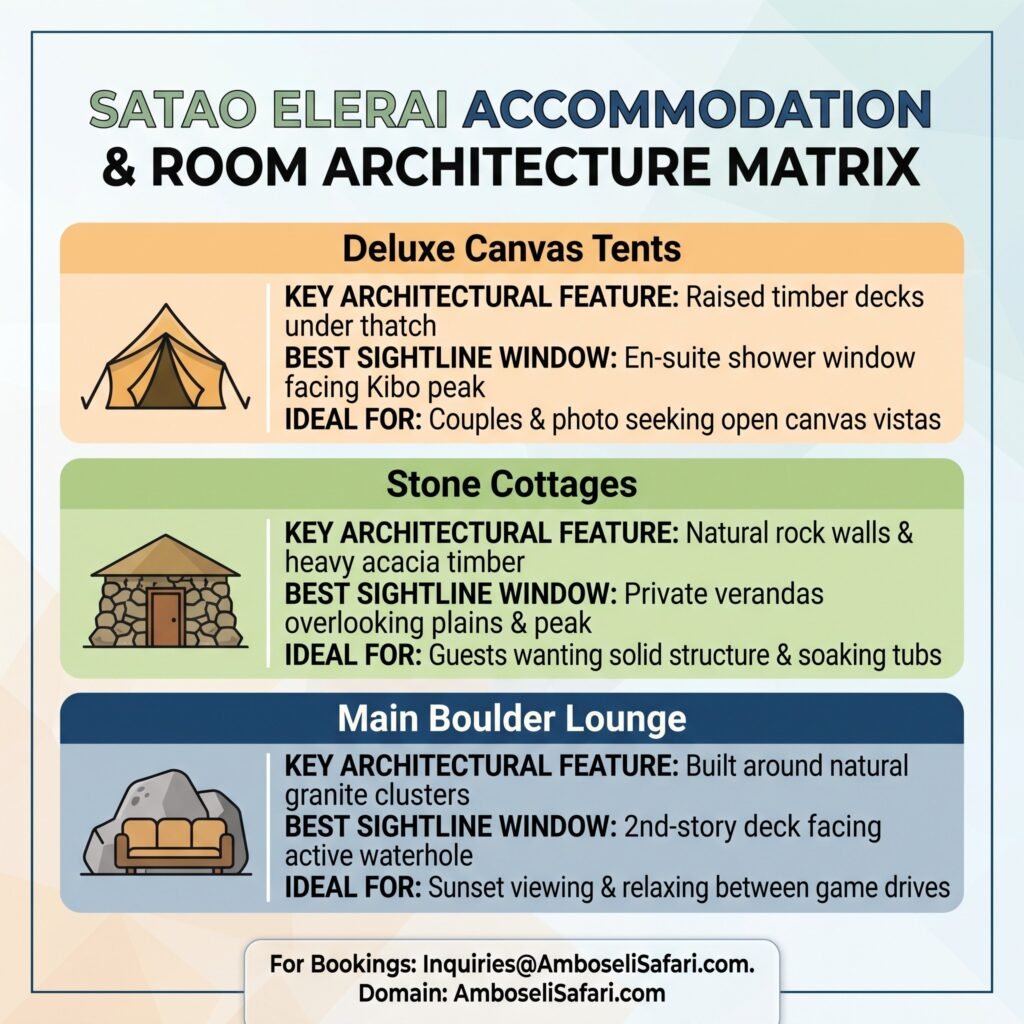
Satao Elerai Accommodation & Room Architecture Matrix
Choosing between Satao Elerai’s Deluxe Tents and Stone Cottages comes down to your preferences for privacy, views, and bathroom layout. While both options feature Mount Kilimanjaro sightlines, their structural designs offer very different daily experiences. Use this quick comparison to decide which room style best suits your safari needs before reserving your stay.
| Room Type | Key Architectural Feature | Best Sightline Window | Ideal For |
| Deluxe Canvas Tents | Raised timber decks under thatch | En-suite shower window facing Kibo peak | Couples & photographers seeking open canvas vistas |
| Stone Cottages | Natural rock walls & heavy acacia timber | Private verandas overlooking plains & peak | Guests wanting solid structure & soaking tubs |
| Main Boulder Lounge | Built around natural granite clusters | 2nd-story deck facing active waterhole | Sunset viewing & relaxing between game drives |
Dining & Facilities
Wake-up tea or brewed Kahawa Kenya coffee arrives at your tent door at 05:30 AM. Breakfasts feature cooked-to-order eggs and fresh fruit before morning game drives, while dinners are served as plated three-course meals in the main boulder dining room.
Kitchen staff handle Vegetarian, Vegan, Gluten-Free, and Halal diets easily if you tell us when booking.
The swimming pool is set directly into the rock deck near the bar. Wi-Fi works fine in the main boulder lounge, but we keep it out of the tents so guests can enjoy a quiet wilderness night without pinging phones.
Upper Deck & Local Market
The second-story wooden lookout deck sits right above the main boulder bar. Climbing the stairs gives you an elevated view over the camp’s active waterhole, where elands, zebras, and giraffes come to drink while the sun sets behind Mount Kibo.
Inside the main lounge, local Maasai women from Elerai village run their own craft market. They sell hand-beaded jewelry and wooden carvings directly to guests.
Every shilling stays with the artisan’s family. You get authentic beadwork, and the village earns direct income without middlemen taking a cut.
Daily Safari Schedule
- 05:30 AM: Fresh hot tea or coffee brought to your tent porch.
- 06:00 AM: Roll out toward Kimana Gate to reach central swamps at dawn.
- 12:30 PM: Return to camp for lunch and a swim in the rock pool.
- 16:00 PM: Afternoon game drive or guided bush walk across Elerai tracks.
- 18:30 PM: Grab a cold Tusker beer on the upper deck as Mount Kilimanjaro catches the last light.
- 20:00 PM: Plated three-course dinner, followed by an optional red-filter night drive looking for aardvarks and servals.
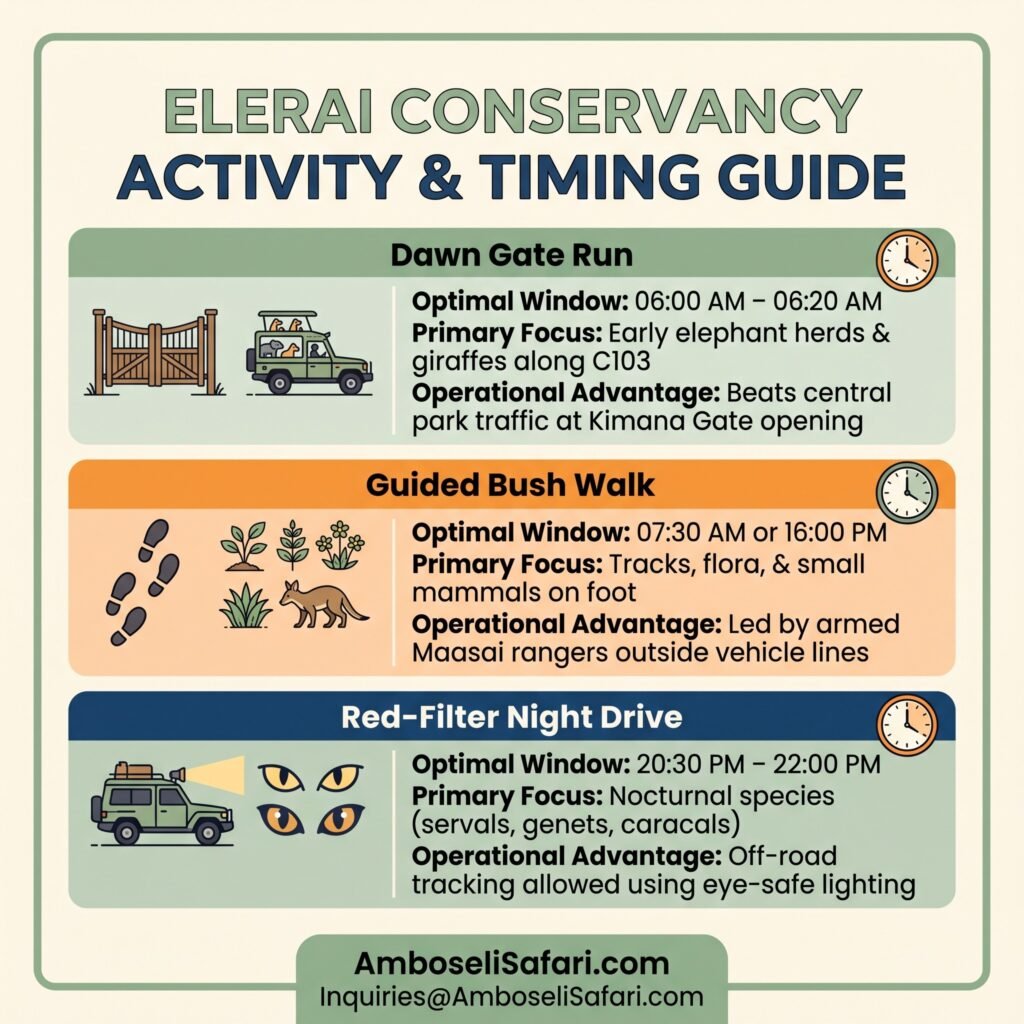
Elerai Conservancy Activity & Timing Guide
Staying in a private conservancy gives you access to activities strictly prohibited inside KWS-managed national parks. Aligning your daily schedule with optimal wildlife movement ensures you get the most out of night tracking and guided walks. This quick reference outlines recommended timing and key targets for Elerai’s unique safari experiences.
| Conservancy Activity | Optimal Time Window | Primary Wildlife / Feature Focus | Operational Advantage |
| Dawn Gate Run | 06:00 AM – 06:20 AM | Early elephant herds & giraffes along C103 | Beats central park traffic at Kimana Gate opening |
| Guided Bush Walk | 07:30 AM or 16:00 PM | Tracks, flora, & small mammals on foot | Led by armed Maasai rangers outside vehicle lines |
| Red-Filter Night Drive | 20:30 PM – 22:00 PM | Nocturnal species (servals, genets, caracals) | Off-road tracking allowed using eye-safe lighting |
Family Rules & Mobility
Children of all ages are welcome at camp. However, night game drives and guided bush walks require kids to be at least 6 years old so vehicles stay quiet near nocturnal animals.
Because the camp uses timber footbridges, stone steps, and gravel paths over natural boulders, guests with mobility challenges should ask us to book cottages closest to the main dining room.
Packing & Road Realities
- The 90 km dirt road off the Mombasa highway coats everything in fine red dust. Keep your camera lenses wrapped inside sealed dry bags until you reach camp.
- Desert mornings under Mount Kilimanjaro are freezing cold. Pack a thick fleece or jacket for the 06:00 AM drive, then layer down to light cotton by noon.
- Bring crisp post-2013 US Dollar bills or Kenya Shillings (KES) for driver tips and buying beadwork directly from the Maasai craft market.
Game Drive Realities & Park Access
That 20-minute run to Kimana Gate is a small price to pay for having the entire conservancy to yourself after dark. We roll out of camp by 06:00 AM so we reach the gate right as Kenya Wildlife Service (KWS) rangers open ticket check-in.
Because Satao Elerai sits outside park limits, our guides use handheld red-filter spotlights on night drives to find caracals, striped hyenas, and genets without blinding their eyes.
Mind the 24-hour KWS permit clock ($90 USD per non-resident adult). If we enter Kimana Gate at 08:30 AM on Day 1, your park ticket expires at 08:30 AM on Day 3. Staying inside the park past your cutoff time for lunch triggers a full extra day fee. We schedule Day 3 lunches back at Satao Elerai outside the gate to keep your budget intact.
When tracking bull elephants studied by the Amboseli Elephant Research Project, having private conservancy access lets us follow sightings off-road without competing with dozens of minibuses.
Check our Amboseli self-drive guide for route advice and fuel stops before driving down from Nairobi.
2027 Safari Package Pricing
Our road packages cover a private 4×4 Safari Land Cruiser, full-board lodging at Satao Elerai Camp, driver-guide fees, fuel, vehicle entry permits, chilled bottled water, Elerai conservancy fees (55USDpernight),andpre-paidKWSnon-residentparkpermits(90 USD per adult per 24 hours).
All transport, guide allowances, and hotel costs are bundled into the total per-person rates below based on two adults traveling together.
1 to 3-Night Satao Elerai Safari Packages (2027)
| Package Duration & Itinerary | Standard Season (USD / Person)* | Peak Season (USD / Person)* |
| 1 Night / 2 Days Express | $895 | $1,355 |
| 2 Nights / 3 Days Classic | $1,490 | $2,210 |
| 3 Nights / 4 Days In-Depth | $2,085 | $3,065 |
*Prices reflect total per-person cost for two adults sharing a tent or cottage and a private 4×4 Safari Land Cruiser. Standard Season covers January to May and November. Peak Season covers June to October and December. Includes full-board lodging, private transport, guide fees, fuel, Elerai fees, and KWS permits.
Use our safari booking form on Amboselisafari.com to hold your private 4×4 Land Cruiser and reserve your room at Satao Elerai Camp.
Package Inclusions:
- Private 4×4 Safari Land Cruiser with pop-up roof for all game drives and transfers.
- Services of a TRA-licensed, English-speaking driver-guide.
- Full-board accommodation at Satao Elerai Camp (breakfast, lunch, dinner).
- Pre-paid non-resident KWS park entry permits (90USDper24hours)andEleraiConservancyfees(55 USD per night).
- Daily game drives in Amboseli National Park and Elerai Conservancy.
- Chilled bottled drinking water inside the vehicle cooler.
Package Exclusions:
- International airfare, entry visas, and Electronic Travel Authorization (eTA portal) fees.
- Personal expenses like driver tips, alcoholic drinks, or laundry.
- Optional Maasai cultural village visits or hot air balloon safaris.
Optional Add-Ons:
- Authentic Maasai cultural village visit: USD 30 per person.
- Sunrise hot air balloon safari over Amboseli: USD 450 per person.
Review overall budget details on our Amboseli safari cost breakdown.
Frequently Asked Questions
Does Satao Elerai Camp have views of Mount Kilimanjaro?
Yes. Mount Kibo is clearly visible from the main lounge, upper lookout deck, cottage verandas, and en-suite tent windows. The peak is clearest between 06:00 AM and 08:30 AM before clouds cover the summit.
How far is Satao Elerai Camp from Kimana Gate?
The camp sits 12 km from Kimana Gate inside its own private conservancy. The drive takes about 20 minutes in our 4×4 Land Cruiser.
Can you do walking safaris at Satao Elerai Camp?
Yes. You can join guided walks across the 5,000-acre Elerai Conservancy accompanied by professional spotters and armed local Maasai rangers.
Is Satao Elerai Camp fenced?
No. The camp is completely un-fenced so wildlife can move freely across the corridor. Camp staff escort guests to and from tents after dark with flashlights.
Is there Wi-Fi at Satao Elerai Camp?
Yes. Free Wi-Fi works in the main public lounge and boulder bar area. Wi-Fi is intentionally kept out of guest rooms to maintain a quiet atmosphere.