
Best Photography Spots in Amboseli: Field Maps, Lighting & Safari Rates
Overview
Finding clean angles across the Best Photography Spots in Amboseli comes down to positioning your vehicle before morning thermal clouds roll over Mount Kilimanjaro. While many first-time visitors assume the park sits under Narok County Council, the ecosystem is entirely in Kajiado County under Kenya Wildlife Service (KWS) jurisdiction. Over 2,000 free-roaming elephants monitored by the Amboseli Elephant Research Project move between Enkongo Narok swamp and outer salt pans daily. From low-angle water reflections at Sinet Causeway to framing tuskers against mountain glaciers, timing your drives makes every frame count. Full-board 3-day and 4-day photography packages in a private 4×4 Land Cruiser range from $1,080 per person for budget camps up to $5,950 per person for fly-in luxury options on Amboselisafari.com.
Fast Navigation Links
- Photography Packages & Rates
- Daily Light & Location Map
- Sinet Causeway Reflection Mirror
- Kimana Sunrise & Tortilis Sunsets
- Ol Okenya Volumetric Light
- Kitenden Glacier Compression
2027 Photography Safari Packages & Rates
Getting sharp wildlife shots across open salt flats takes a stable vehicle platform. We outfit our private 4×4 Safari Land Cruisers with wide pop-up roofs so you can stand comfortably, rest heavy 400mm or 600mm telephoto glass on canvas beanbags, and track moving herds without engine vibration shaking your lens.
Package rates below cover total per-person costs based on two adults traveling together in a private vehicle.
3-Day & 4-Day Amboseli Photography Safari Packages
| Package Tier & Accommodations | Standard Season (USD / Person) | Peak Season (USD / Person) |
| 3-Day Budget Photo Safari (Sentrim Amboseli / AA Lodge / Amboseli Eco Camp) | $1,080 | $1,820 |
| 3-Day Mid-Range Photo Safari (Kibo Safari Camp / Zebra Plains / Kilima Safari Camp) | $1,280 | $2,050 |
| 3-Day Luxury Photo Safari (Ol Tukai Lodge / Amboseli Serena / Tawi Lodge) | $1,580 | $2,480 |
| 4-Day Fly-In Luxury Plus Safari (Safarilink Flight + Elewana Tortilis / Sanya Camp / Porini) | $3,950 | $5,950 |
Valid for 2026/2027 based on two adults sharing a room or tented suite with private 4×4 Land Cruiser transport.
Standard season runs January through May and November. Peak season spans June through October and December.
Price includes full-board lodging, private transport, guide allowances, fuel, and daily $90 USD KWS permits. Fly-in packages include roundtrip domestic flights from Wilson Airport (WIL) on Safarilink or Airkenya plus airstrip transfers.
Package Inclusions
- Private 4×4 Safari Land Cruiser with pop-up roof for camera beanbags
- Services of a TRA-licensed, English-speaking driver-guide
- Full-board accommodation at your chosen lodge or camp
- Pre-paid non-resident KWS park permits ($90 USD per 24 hours)
- Chilled bottled drinking water kept in the vehicle cooler
Package Exclusions
- International flights, visa fees, and entry processing through the official eTA portal
- Driver-guide tips, laundry, and alcoholic drinks
- Optional Maasai cultural village visits ($30 per person) or balloon safaris ($450 per person)
Optional Add-Ons
- Local Maasai village photo tour: USD 30 per person
- Sunrise hot air balloon flight over central marshes: USD 450 per person
We list complete transport logistics, fuel allowances, and entry fee breakdowns on our Amboseli safari cost breakdown page.
Daily Light & Location Map
If you linger too long at camp drinking coffee at first light, you will miss the mountain. In Amboseli, 15 minutes is the difference between an open view of Kibo peak and a thick wall of thermal cloud cover.
| Time Window | Prime Location | Light Angle & Quality | Target |
| 06:00 – 07:15 AM | Sinet Causeway (Junctions 25–26) | Low side-lit golden light | Symmetrical water reflections of wading herds before surface wind rises. |
| 06:15 – 08:30 AM | Kimana Gate Approach Tracks | High-contrast dawn backlight | Silhouetted giraffes and elephants framed against Mount Kilimanjaro. |
| 07:30 – 09:30 AM | Ol Okenya & Ol Tukai Forest | Morning light through dust | Herds moving through illuminated silt under yellow-fever trees (Acacia xanthophloeia). |
| 11:00 AM – 02:00 PM | Lake Amboseli Salt Pan (Empusel) | Harsh overhead sunlight | High-contrast black-and-white heat mirages and swirling dust pillars. |
| 04:30 – 06:30 PM | Tortilis Hill & Observation Hill | Warm golden hour & side-glow | Elephant lines marching across marsh edges against a purple mountain backdrop. |
Map out your travel dates and gate routes in advance using our Amboseli safari planning guide.
Sinet Causeway Reflection Mirror (Junctions 25–26)
When seasonal rains spill Sinet Stream across the causeway flats, you get roughly a 45-minute window of dead-calm water before morning thermal winds kick up and ruin the mirror surface.
Rest a wide-angle lens (16–35mm) on a wedge beanbag wedged onto the lower door sill. Drop your perspective down to floorboard level. Stopping down between f/8 and f/11 captures a 100% symmetrical double-reflection of elephants wading through pink dawn water.
If you are navigating the park on a self-drive, watch for rutted mud tracks along Sinet Causeway after heavy rain. Getting stuck here at dawn wastes your best light.
Here is the strategic SEO analysis and 3 mobile-optimized visual infographic tables tailored to boost your article’s rank for Best Photography Spots in Amboseli, increase information gain, and earn Position Zero snippets.
SEO & Content Strategy Analysis
To claim the #1 search rank and capture Featured Snippets for Best Photography Spots in Amboseli, your content requires structured, high-utility micro-data that addresses specific creative and technical intent:
- Information Gain: While your draft details general locations and times, adding structured comparative matrices for Optimal Lens Selection by Zone, Exposure & Camera Settings, and KWS Photography Regulations & Ethics introduces original, field-tested technical data that competing travel guides lack.
- Search Intent Alignment: Wildlife photographers searching this term need rapid answers on focal lengths, exposure compensation settings to preserve glacier highlights, and clear rules regarding drone bans and off-road restrictions.
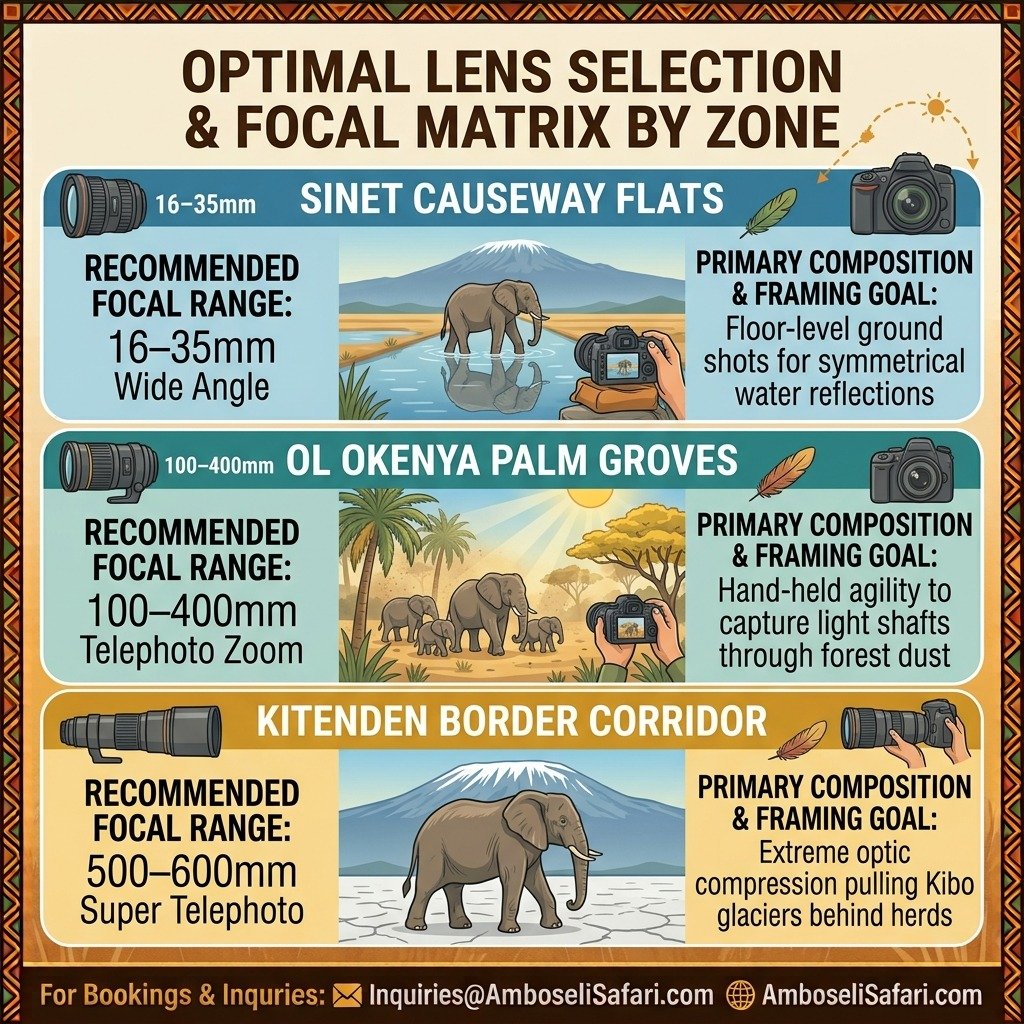
Optimal Lens Selection & Focal Matrix by Zone
Matching the right focal length to Amboseli’s distinct landscapes determines whether you capture sweeping environmental scenes or tight animal portraits. Wide-angle zooms perform exceptionally well along flooded causeways, whereas long telephotos compress distant mountain glaciers directly behind moving herds. This location-based focal matrix pairs recommended lens ranges with primary composition goals across key park zones. Use these pairings to switch optics efficiently before changing locations.
| Photography Zone | Recommended Focal Range | Primary Composition & Framing Goal |
| Sinet Causeway Flats | 16–35mm Wide Angle | Floor-level ground shots for symmetrical water reflections |
| Ol Okenya Palm Groves | 100–400mm Telephoto Zoom | Hand-held agility to capture light shafts through forest dust |
| Kitenden Border Corridor | 500–600mm Super Telephoto | Extreme optic compression pulling Kibo glaciers behind herds |
Kimana Sunrise & Tortilis Hill Sunsets
Framing animals against high-contrast skies requires knowing where standalone trees and high ground sit relative to the rising sun.
The Kimana Gate Umbrella Acacia
Near the eastern Kimana Gate perimeter stands a single, isolated umbrella acacia (Vachellia tortilis).
Park on the eastern approach track between 06:00 AM and 06:30 AM. Align crossing giraffes or elephants directly between your lens and the tree trunk. This gives you clean, high-contrast silhouettes against an orange sky before cloud cover builds over the mountain.
Tortilis Hill Lava Ridge
Observation Hill gets crowded with safari trucks at dusk. Tortilis Hill—a rough lava flow ridge in the far western sector near Kitirua—gives you a quiet, elevated vantage point instead.
Our senior guide, Anthony Mule, prefers Tortilis Hill for golden-hour work. The elevated western ridge lets you frame umbrella acacias and passing wildlife silhouetted against Mount Kibo’s western slopes as the sun drops behind the horizon.
Working the Light in the Ol Okenya Palm Groves
Unlike the dense yellow-fever tree forest at Ol Tukai, the wild Phoenix palm groves around Ol Okenya Marsh have wide canopy gaps.
Between 07:30 AM and 09:30 AM, low morning sunlight hits the fine alkaline silt kicked up by moving herds. That fine dust acts like a giant softbox when the sun hits it low, scattering golden light around the animals against dark palm foliage.
Ditch a heavy prime or fixed f/2.8 here if you are hand-holding; a versatile 100–400mm zoom gives you the agility needed inside a crowded pop-up roof. Underexpose by -0.7 to -1.0 EV to keep the bright dust shafts from blowing out highlights, locking focus on an elephant’s eye or tusk as it steps through the light beam.
You can compare lodging options near central swamps to keep your morning transit times under ten minutes.
Empusel Heat Mirages & Kitenden Glacier Compression
The open salt flats and southern border tracks offer two totally different optical scales.
Heat Mirages on the Empusel Salt Pan
Thermal heat rising off Lake Amboseli (Empusel) between 11:30 AM and 01:30 PM creates spinning dust devils (amboseli in Maa).
Shooting from door-sill height with a 16–35mm lens creates a strange optical distortion where animal lines walking through swirling dust look like they are floating across a water mirage. Convert these files to high-contrast black and white in post-processing—the chalky salt flats make striking monochrome frames.
Lens Compression along the Kitenden Corridor
The southern Kitenden boundary track runs close to Mount Kibo’s glaciers along the Tanzanian border.
Racking out to 500mm or 600mm pulls Kibo’s glaciers right onto the elephant’s back, creating dramatic scale. This extreme focal compression makes the mountain’s ice fields loom massive in your background frame.
Review track conditions across our main Amboseli National Park guide.
Camera Settings & Technical Field Notes
Equatorial sun reflecting off pale salt crust creates brutal exposure dynamic range that tricks camera meters.
Auto-metering gets fooled when framing a dark elephant hide against bright mountain ice. Switch to Highlight-Weighted Metering or Spot Metering on the snowpack. Dial in -0.7 EV exposure compensation to preserve glacier detail, then lift hide shadow detail in RAW post-processing later.
Set your shutter speed to at least 1/1600s for animals moving across open salt flats after 10:00 AM. Midday heat shimmer causes camera autofocus to hunt if your shutter speed drops too low.
Dust gets everywhere. Always wipe down your lens barrel with a dry microfiber cloth before shortening a zoom lens. Fine salt silt clings to rubber zoom rings. If you twist the zoom ring while dry dust is sitting on the barrel, it gets pulled past the rubber weather seals right into the internal glass elements, creating stubborn dust bunnies.
Read about research tracking routines in our guide to famous elephants in Amboseli.
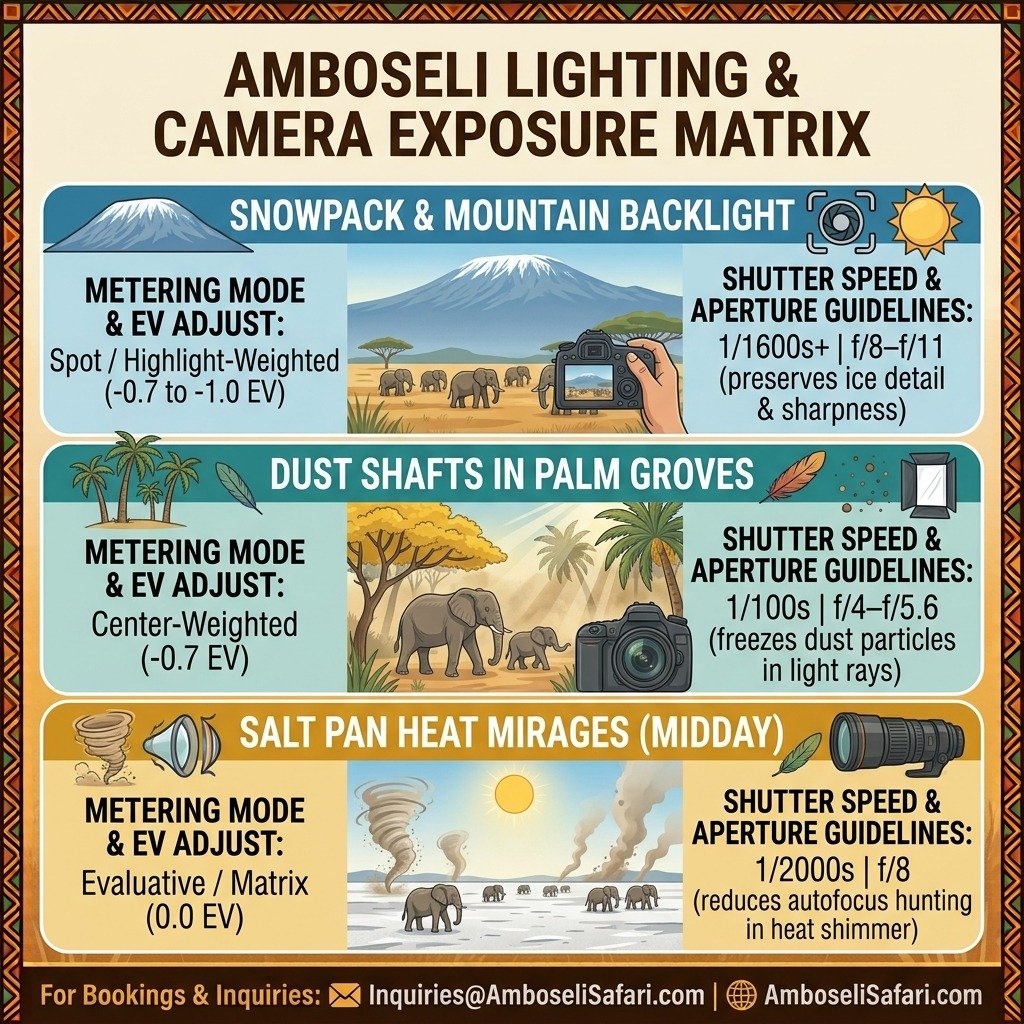
Amboseli Lighting & Camera Exposure Matrix
Harsh equatorial sun bouncing off white salt crusts can easily confuse camera metering systems and blow out mountain snowpack details. To maintain shadow textures on dark elephant hides while keeping glacier highlights sharp, photographers must adjust metering modes and exposure compensation dynamically. This technical settings matrix details exact shutter speeds, apertures, metering choices, and exposure adjustments for major lighting scenarios across the basin. Apply these baseline configurations during peak morning and afternoon windows.
| Lighting Scenario | Metering Mode & EV Adjust | Shutter Speed & Aperture Guidelines |
| Snowpack & Mountain Backlight | Spot / Highlight-Weighted (-0.7 to -1.0 EV) | **1/1600s+ |
| Dust Shafts in Palm Groves | Center-Weighted (-0.7 EV) | **1/1000s |
| Salt Pan Heat Mirages (Midday) | Evaluative / Matrix (0.0 EV) | **1/2000s |
KWS Photo Rules, Drone Permits & Ethics
Kenya Wildlife Service wardens strictly enforce regulations across the park:
- Tourist Photography: Standard cameras, zoom lenses, and beanbags are permitted under basic non-resident park fees ($90 USD per adult per 24 hours).
- Commercial Filming: Film crews using heavy tripods or production rigs need prior KWS commercial permits ($50 to $200 USD/day) plus an assigned KWS ranger escort.
- Drone Ban: Drones are strictly banned inside all KWS national parks. Flying an unlicensed drone leads to immediate gear confiscation and heavy fines.
- Off-Roading Prohibitions: Driving off designated tracks destroys fragile salt crusts and carries immediate vehicle fines ($100–$500 USD). You must stay inside your vehicle everywhere except at Observation Hill (Noomotio) or inside fenced lodge grounds.
If you are ready to book a private Land Cruiser equipped with beanbags and an expert driver-guide on Amboselisafari.com, send us a message through our safari inquiry form or reserve your dates via our main safari booking form.
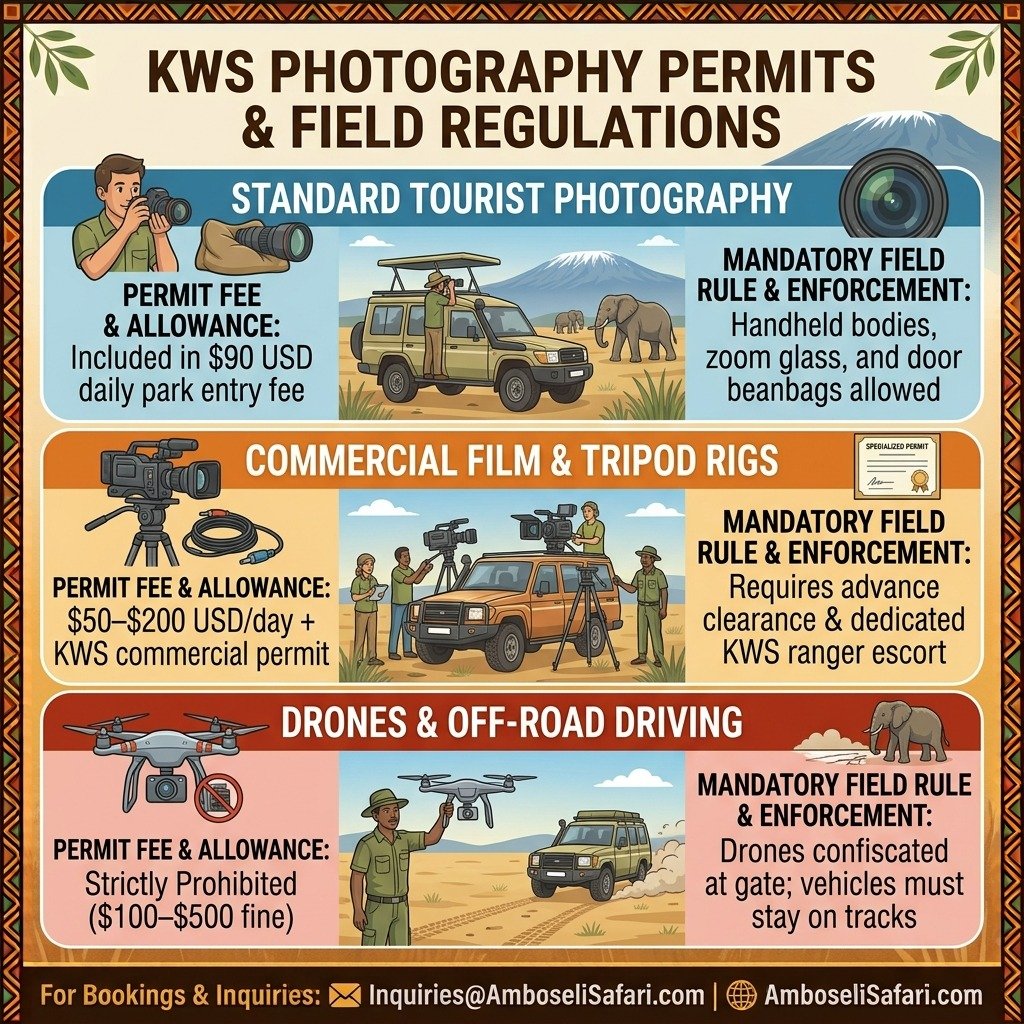
KWS Photography Permits & Field Regulations
Navigating Kenya Wildlife Service (KWS) regulations requires understanding the distinction between casual safari photography and commercial production standards. Unlicensed drone flights and off-road driving carry severe fines and immediate equipment confiscation across all national parks. This regulatory compliance matrix outlines fee structures, equipment allowances, and mandatory field rules for photographers in Amboseli. Review these compliance guidelines to avoid costly penalties during your safari.
| Category / Activity | Permit Fee & Allowance | Mandatory Field Rule & Enforcement |
| Standard Tourist Photography | Included in $90 USD daily park entry fee | Handheld bodies, zoom glass, and door beanbags allowed |
| Commercial Film & Tripod Rigs | $50–$200 USD/day + KWS commercial permit | Requires advance clearance & dedicated KWS ranger escort |
| Drones & Off-Road Driving | Strictly Prohibited ($100–$500 fine) | Drones confiscated at gate; vehicles must stay on tracks |
Frequently Asked Questions
Will I actually see Mount Kilimanjaro, or is it usually hidden in clouds?
Mount Kilimanjaro is usually clear at first light between 06:00 AM and 08:30 AM. By 09:00 AM, thermal heat rising off dry salt pans forms thick cloud cover over Kibo peak. Plan your key mountain photography drives for early morning.
Which single lens should I bring if I only want to carry one camera body?
A 100–400mm or 100–500mm telephoto zoom is the most useful single lens on an Amboseli safari. It is wide enough for environmental elephant portraits with Mount Kilimanjaro in the frame, while giving you enough reach for distant big cats.
Where can I get classic mirror reflection photos of elephants?
Drive out to Sinet Causeway between KWS Junctions 25 and 26 right after seasonal rains. Rest your camera on a door-sill beanbag at ground level before 07:00 AM while surface water stays glass-still.
Can I bring a drone to get aerial shots of the herds?
No. Recreational drone flying is strictly illegal inside all Kenya Wildlife Service national parks. Unlicensed drones are confiscated at entry gates and operators face steep fines.