
Maasai Culture and Village Visits in Amboseli: Etiquette, Fees & Logistics
Overview
Experiencing Maasai Culture and Village Visits Amboseli offers a direct look into how pastoralists share land with wild game. The Kenya Wildlife Service manages the park in Kajiado County, while Amboseli Elephant Research Project herds roam right up to community bomas.
Fast Navigation Links
- Multi-Day Safari Package Rates
- Boma Entry Fees and Cash Rules
- Best Times for a Visit
- Do’s and Don’ts Etiquette
- Quick Maa Language Phrases
- Boma Architecture and Walking Conditions
Pulling up to a homestead gate with our guide Anthony Mule always starts with a brief pause. He cuts the Land Cruiser engine, turns around in his seat, and gives everyone a quick rundown before anyone steps out onto the dirt. A village visit isn’t a museum tour. Families live here, raise their kids here, and pen their goats inside these thorn walls every single night.
7-Day / 6-Night Safari Package Rates (2 Nights Amboseli, 1 Night Lake Naivasha, 3 Nights Masai Mara)
Combining elephant tracking in Amboseli with Lake Naivasha and the Masai Mara gives you a complete cross-section of Kenya. Spreading this route across 7 full days (6 overnight stays) keeps you from spending your entire holiday rushing down tarmac highways. We run these circuits in private 4×4 Safari Land Cruisers fitted with pop-up roof hatches, heavy-duty suspension, and power charging outlets.
Rates below show total costs per person for two adults traveling together:
7-Day / 6-Night Circuit Rates & Lodging Options
| Package Tier & Route Details | Included Accommodations | Price Range Per Person (Low – Peak)* |
| Budget Tier<br>(Ground 4×4 Transport) | Amboseli Junction Eco Lodge, Fish Eagle Inn & Rhino Tourist Camp | From USD $2,180 to USD $4,150 |
| Mid-Range Tier<br>(Ground 4×4 Transport) | Kilima Safari Camp, Naivasha Sopa Lodge & Mara Sopa Lodge | From USD $2,780 to USD $5,250 |
| Luxury Tier<br>(Ground 4×4 Transport) | Ol Tukai Lodge, Enashipai Resort & Spa & Sarova Mara Game Camp | From USD $3,880 to USD $6,850 |
| Luxury Plus Tier<br>(Fly-In Flights Included) | Angama Amboseli, Chui Lodge & Mara Serena Safari Lodge | From USD $5,950 to USD $9,850 |
*Rates cover travel for two adults sharing a room or tented suite over a 7-day itinerary (6 nights) with a private vehicle and guide allowances. Standard/Low season covers January through May and November. Peak season spans June through October and December. Rates cover full-board lodging, transport, daily $90 USD KWS park entry permits, Mara conservation fees, Naivasha boat passes, and chilled vehicle water. Luxury Plus includes domestic flights from Wilson Airport (WIL) on Safarilink or Airkenya.
Want to tweak this route or check open travel dates? Send your details through our safari inquiry form.
Package Inclusions
- Private 4×4 Safari Land Cruiser with pop-up roof hatch and custom beanbag mounts
- Services of a TRA-licensed driver-guide skilled in cultural protocols and wildlife tracking
- Full-board accommodation covering breakfast, lunch, and dinner
- Pre-paid daily $90 USD KWS park entry permits, Mara fees, and boat sanctuary passes
- Chilled drinking water stocked in the vehicle cooler
Package Exclusions
- International flights, travel insurance, and entry processing via the official eTA portal
- Tipping your driver-guide, boma hosts, or lodge staff
- Alcoholic beverages, soft drinks, or personal laundry
- Optional village entry contribution ($20–$30 USD per person) or sunrise balloon flight ($450 USD)
Optional Add-Ons
- Local village entry voucher & cultural walkthrough: USD 30 per person
- Night game drive in a private conservancy: USD 50 per person
- Sunrise hot air balloon flight over central marshes: USD 450 per person
When looking through fuel math, driver allowances, and gate permits on our Amboseli safari cost breakdown, you’ll see how daily transport logistics shape the overall budget.
Boma Entry Fees & Cash Rules
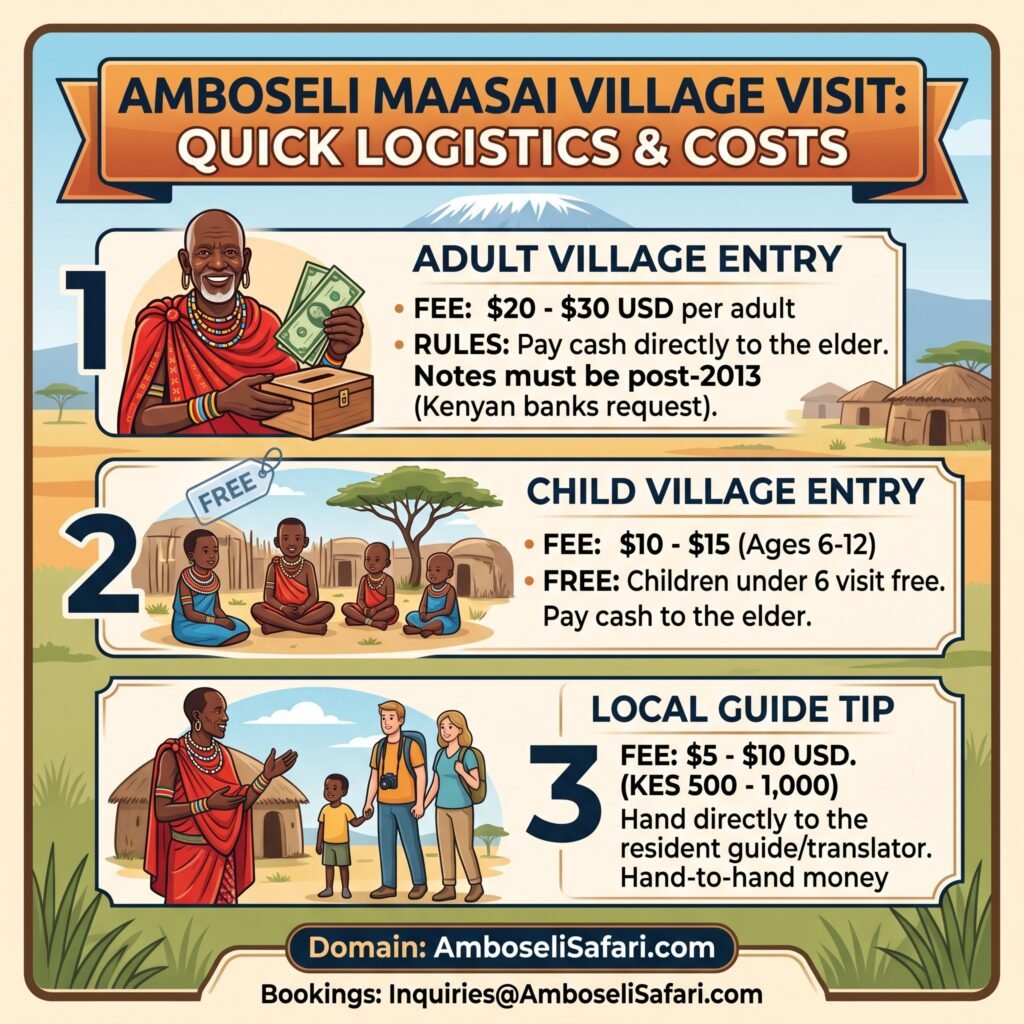
If you are paying your village entry directly on-site, bring paper money. Safaricom signal drops constantly near Meshanani and Kitirua gate boundaries, so card readers don’t work and M-Pesa mobile transfers fail right when you’re standing at the gate.
- Adult Entry: $20 to $30 USD per adult. Pay in cash directly to the elder. If using US Dollars, make sure the notes are crisp and printed after 2013—Kenyan banks reject older series due to local fraud policies.
- Child Entry: $10 to $15 USD for kids aged 6 to 12. Children under 6 visit free.
- Guide Tip: $5 to $10 USD (KES 500 to 1,000) handed to the local resident who walks you through the homes and translates.
- Lodge Transfers: If you stay inside park grounds at a lodge like Ol Tukai without a private vehicle, lodge front desks charge $40 to $70 USD just to drive you out to the gate.
Amboseli Maasai Village Visit: Quick Logistics & Costs
Planning a cultural visit to an Amboseli boma requires both practical preparation and cultural respect. This infographic breaks down the essential gate costs, cash requirements, and tip guidelines into a quick mobile reference. Use this snapshot to budget accurately and keep your entry smooth before arriving at the village boundary.
| Cost Item | Target Fee (USD) | Payment Method & Rules |
| Adult Village Entry | $20 – $30 per adult | Cash only to elders (US notes post-2013) |
| Child Village Entry | $10 – $15 (Ages 6–12) | Cash only; Under 6 visit free |
| Local Guide Tip | $5 – $10 (KES 500–1,000) | Hand directly to resident translator |
Boma Locations & Timing
Timing matters. Don’t visit at noon.
Plan your visit for early morning (07:30 AM to 09:00 AM) or late afternoon (04:00 PM to 05:30 PM). Morning visits catch cattle streaming out of the kraal into the bush, while late afternoon visits bring herds back home as the sun drops. You’ll also avoid walking around in 30°C heat.
A thorough walkthrough takes 60 to 90 minutes.
Homesteads near Kimana Gate sit close to eastern camps like Kibo Safari Camp and Kimana Bush Camp. If you’re coming off the Namanga border road or staying near Meshanani Gate, bomas on Olgulului-Ololarashi and Mbirikani group ranches sit right outside the park line.
Do’s and Don’ts Etiquette
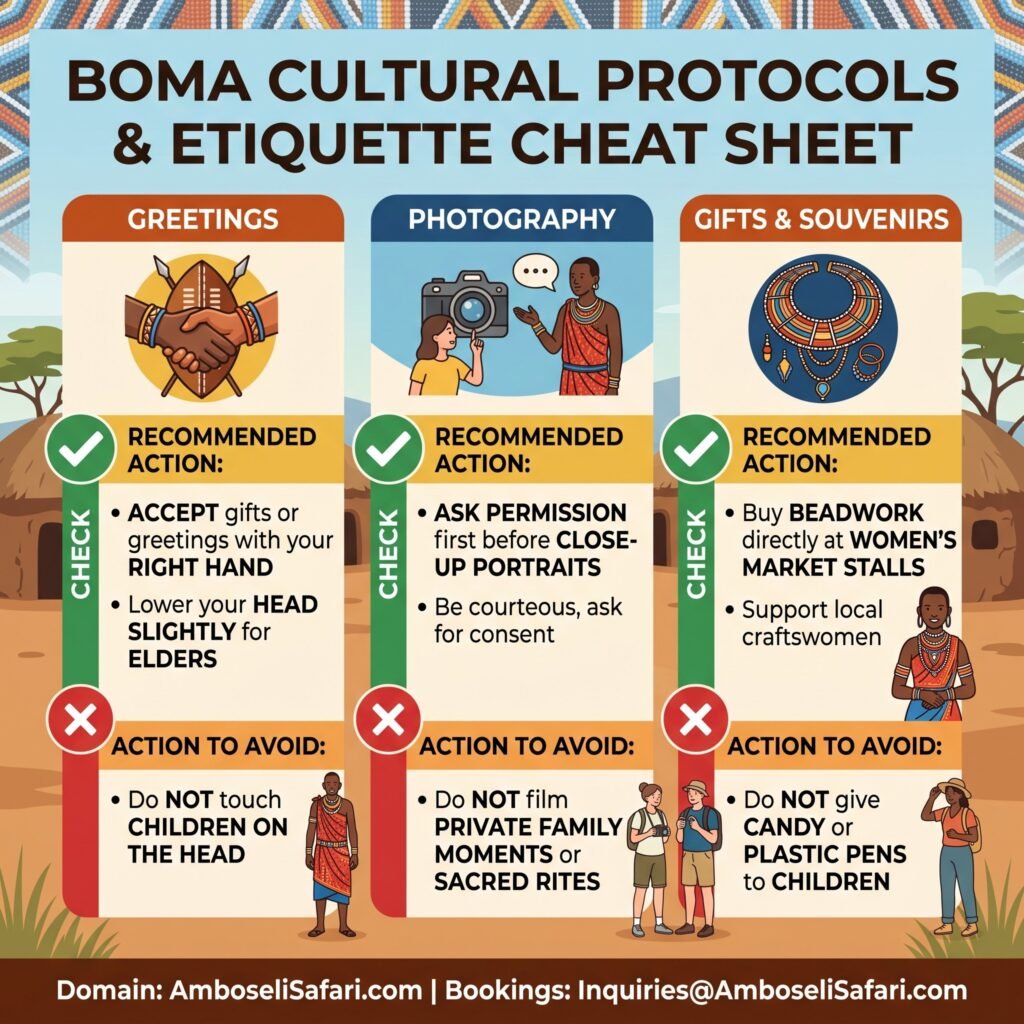
A few simple habits go a long way when walking inside a boma:
| Action Area | What to Do | What NOT to Do |
| Greetings | Accept tea or gifts using your right hand. Lower your head slightly when greeting elders. | Don’t touch children on the head. That gesture is reserved for elders conferring blessings. |
| Photos | Ask permission before taking close-up portraits, especially inside dark rooms. | Don’t film private family moments or sacred rites without permission. |
| Crafts | Buy beadwork directly from the women’s market if you want souvenirs. | Never hand out candy, plastic pens, or trash to children on the road. It creates dangerous begging habits. |
Boma Cultural Protocols & Etiquette Cheat Sheet
Interacting with local communities inside a living boma requires basic cultural awareness to ensure a respectful experience. This simple guide highlights proper greeting gestures, camera protocol, and ethical souvenir purchasing. Keep these core rules in mind to build genuine connection with your local hosts.
| Interaction Type | Recommended Action | Action to Avoid |
| Greetings | Accept items with right hand; bow head slightly | Do NOT touch children’s heads (elders only) |
| Photography | Ask permission before taking close-up portraits | Do NOT record private rites without consent |
| Gifts & Souvenirs | Buy beadwork directly at women’s market stalls | Do NOT give sweets or plastic pens to children |
Quick Maa Language Phrases
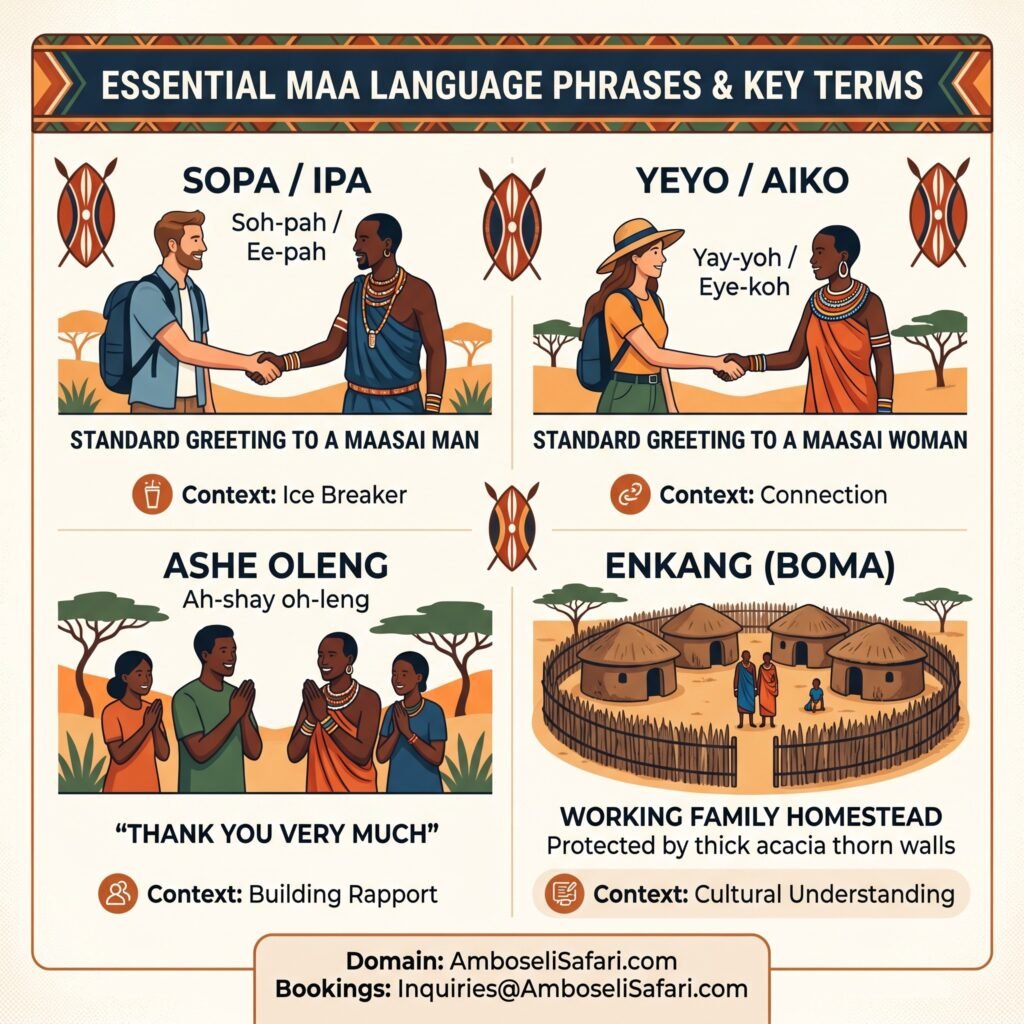
Throwing out a quick word in Maa breaks the ice faster than anything else:
- Sopa / Ipa: Hello to a man. You say Sopa, he replies Ipa.
- Yeyo / Aiko: Hello to a woman. You say Yeyo, she replies Aiko.
- Ashe oleng: “Thank you very much.”
- Sere: “Goodbye.”
Essential Maa Language Phrases & Key Terms
Learning a few words in Maa instantly bridges the gap and shows respect to the families hosting you. This reference guide pairs core greetings with key terminology so you can break the ice naturally. Use these common phrases to connect warmly during your boma tour.
| Maa Phrase / Term | Pronunciation / Meaning | Context / Usage |
| Sopa / Ipa | Soh-pah / Ee-pah | Standard greeting to a Maasai man |
| Yeyo / Aiko | Yay-yoh / Eye-koh | Standard greeting to a Maasai woman |
| Ashe oleng | Ah-shay oh-leng | “Thank you very much” (Ice breaker) |
| Enkang (Boma) | Working family homestead | Protected by thick acacia thorn walls |
Boma vs. Manyatta
Tourists swap the words boma and manyatta all the time, but locals draw a firm line between them.
A working family homestead is called an enkang (or boma). It has a thick outer ring of cut acacia thorn brush to keep lions away from cows and goats at night.
A manyatta is completely different. It’s a temporary, specialized settlement built strictly for warrior initiation ceremonies, like the Eunoto rite. You won’t visit a real manyatta on a standard day tour.
If you’re driving outer boundary tracks yourself, stay on marked dirt roads so you don’t cut across private grazing lands.
Lighting Fires Without Matches
Watching an elder make fire from scratch is impressive. They use two woods collected nearby: a hard drill stick (Olipiriti) and a flat wooden socket board carved from wild olive (Olorien) or Olmukutan wood. Dry elephant dung sits at the base as tinder.
If an elder hands you the stick, don’t press down hard. Pushing hard creates friction resistance that stops the spin. Keep your hands moving fast and light, and you’ll see smoke in less than thirty seconds.
Inside a Mud-Dung Home (Inkajijik)
Women build every house (inkajijik) in the village. They weave a framework of wooden saplings, then plaster the walls using a thick mix of mud, cow dung, wood ash, and water. Cow dung seals the roof against heavy rain, while wood ash keeps hungry termites from eating the timber structure.
Tiny 5-cm angled slots in the wall let light in while channeling smoke out from the cooking fire (Olpokela).
What to Expect Underfoot
- Crouch Low: Doorways measure barely 1.2 meters high. You’ll have to double over to get inside.
- Wear Real Shoes: Dirt pathways inside the boma are dusty, uneven, and littered with sharp kipikipik thorn burrs. Soft mesh running shoes and flip-flops get pierced instantly—wear leather trail shoes or hiking boots.
- Mobility Note: Strollers won’t roll over the thick dirt. If someone in your group has trouble bending down, they can sit on wooden benches inside the open central yard and watch the welcome dance comfortably.
When choosing between central KWS lodges and boundary camps, consider how far your rooms sit from these community sites.
Beaded Collars & Bush Retreats
Beadwork (Enkiteng) isn’t just decoration. The colors mean specific things:
- Red (Onyang’i): Bravery, unity, and cattle blood.
- Blue (Onyori): Sky and rain.
- White (Kibor): Cow’s milk, health, and peace.
Married women wear wide, flat circular beaded collars during dances. Unmarried girls wear narrow, flexible neck bands.
Far away from the main boma, young warriors host an Olpul—a wilderness retreat hidden in dense fever tree (Acacia xanthophloeia) thickets. They eat beef cooked over open campfires and drink tonics (Olamal) boiled from Olkiloriti tree roots to build stamina.
Keep an eye out for matriarch-led elephant herds crossing corridor tracks near these same acacia thickets.
Visiting Esiteti Primary School
Visits around the southern Elerai sector sometimes stop at Esiteti Primary School.
Elders ask that you don’t hand out candy or pens to students. Instead, visitors can throw charcoal-coated native tree seedballs around eroded school grounds to help reforest native acacia trees eaten back during dry spells.
If you’re planning your overall safari schedule around rain cycles, keep in mind that school terms pause during April, August, and December holidays.
Practical Notes from the Bush
Anthony always tells guests before stepping out of the Cruiser: “Remember you’re walking into someone’s home, not a photo set.”
Early mornings off the dry lakebed start cold under mountain winds, but by 10:00 AM the ground bakes. The air inside a boma smells of woodsmoke, dry earth, and crushed acacia pods. Goat bells clink in the kraal, and dust kicks up underfoot as warriors stamp their feet during the Adumu jumping dance.
Ready to book a Land Cruiser and experienced guide on Amboselisafari.com? Send your details through our safari inquiry form or request a custom quote via our main safari booking form.
Frequently Asked Questions
How much does a Maasai village visit cost?
Plan on $20 to $30 USD per adult and $10 to $15 USD per child. Pay cash directly to the elder at the gate to cover your welcome dance, guided walk, and photos.
Is photography allowed inside the village?
Yes. Once you pay the entry fee, photography inside the boma is welcomed. Just ask politely before taking close-up portraits of individual elders or kids.
What shoes work best for a boma tour?
Wear sturdy, closed-toe leather shoes or hiking boots. The ground inside the boma is uneven and filled with sharp kipikipik thorn burrs that go right through soft running shoes.
Do I have to buy crafts at the village market?
No. Browsing the craft stalls at the end of the walk is optional. If you buy something, bring small USD bills or Kenya Shillings.