
Kimana Sanctuary Kenya: Wildlife Corridor & Visitor Guide
Kimana Sanctuary Fast Facts
| Metric | Detail |
| Location | Kajiado County, Kenya (15 mins from Amboseli Kimana Gate) |
| Key Attractions | Craig the Super Tusker, Mnara Observation Tower, Ranger Foot Patrols |
| Management | Big Life Foundation & Sheldrick Wildlife Trust |
| Payment Rules | M-Pesa or Credit Card Only (KWS Passes Not Accepted) |
Fast Navigation Links
- Pinch Point & Crossing
- Super Tusker Foot Patrols
- Mnara Observation Tower
- Wildlife & Best Timing
- Driving Routes & Gate Fees
- Real-World Field Advice
- Safari Package Rates
- Frequently Asked Questions
Kimana is tiny compared to the main park, but it packs a heavy punch. While most safari trucks charge straight into Amboseli National Park to chase lions in the dust, this 5,700-acre community reserve offers quiet dirt tracks, walking safaris, and some of the largest bull elephants left in Africa.
The 70-Meter Pinch Point & Overhead Elephant Crossing
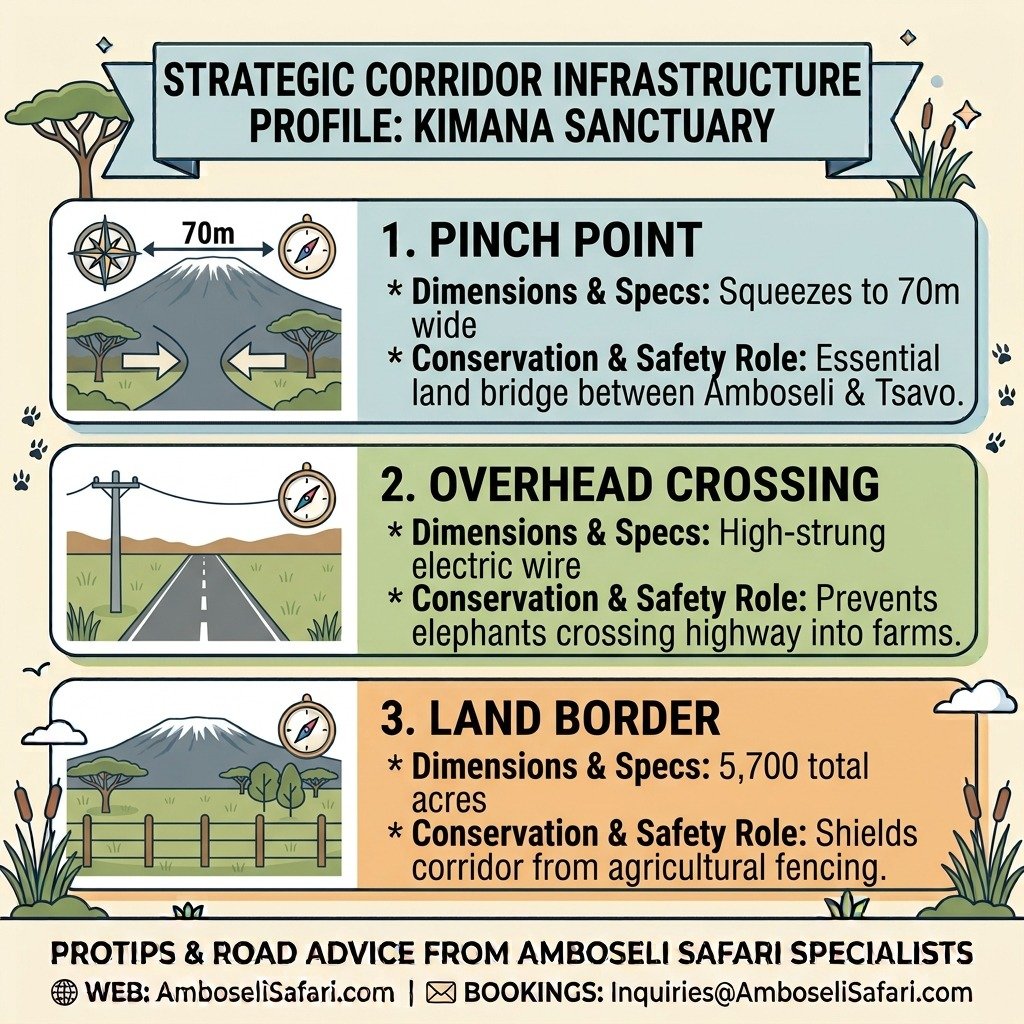
Kimana forms a thin land bridge linking Amboseli’s central marshes to the Chyulu Hills and Tsavo West. Without this passage, animals would be completely cut off by tomato farms and electric fences.
At its narrowest spot, the corridor squeezes down to just 70 meters wide between private agricultural plots.
Where this migration path hits the main tarmac road, engineers suspended an electrified wire high on tall telephone poles across the highway. Trucks pass underneath without an issue, but the wire stops elephants from stepping off the trail into village crops. It links directly into surrounding Amboseli conservancies just down the road from Kimana Gate.
Strategic Corridor Infrastructure Profile
As human settlements and agriculture expand across the Amboseli basin, physical land bridges become critical for animal survival. Engineering solutions like high-suspended electric wires allow massive megafauna to navigate between protected sanctuaries without disrupting tarmac traffic or crop fields. Review the strategic corridor profile below to understand how this narrow pathway keeps the ecosystem connected.
| Corridor Component | Dimensions & Specs | Conservation & Safety Role |
| Pinch Point | Squeezes to 70m wide | Essential land bridge between Amboseli & Tsavo. |
| Overhead Crossing | High-strung electric wire | Prevents elephants crossing highway into farms. |
| Land Border | 5,700 total acres | Shields corridor from agricultural fencing. |
Tracking “Craig” & Big Life Ranger Foot Patrols
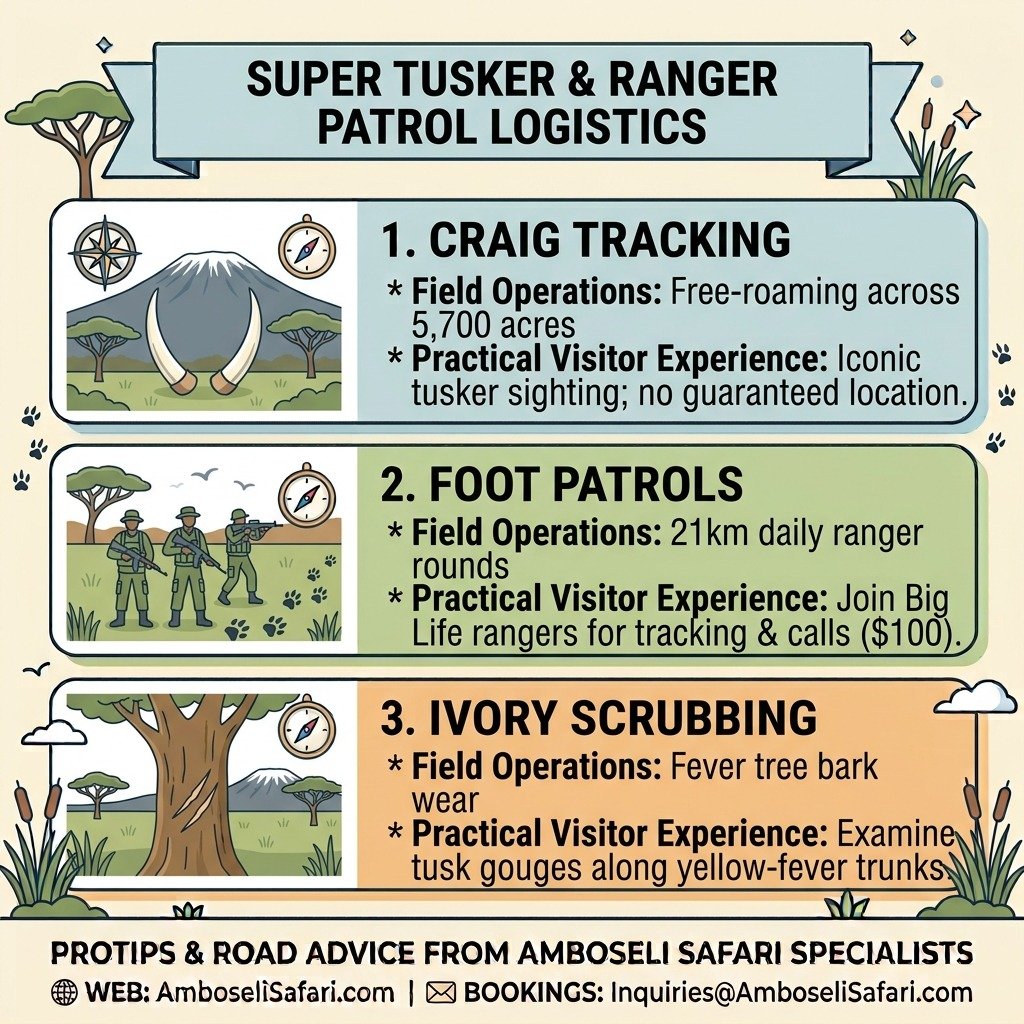
Photographers flock here for one main reason: Craig. He is one of Africa’s few surviving Super Tuskers, carrying massive ivory that weighs over 100 pounds per side and drags in the dirt when he walks.
You don’t have to stay glued to a Land Cruiser seat here either. You can join a Big Life Ranger Foot Patrol and trek alongside armed community rangers on their daily 21-kilometer security rounds. They teach you how to read fresh tracks in the silt and pinpoint animal calls.
Spending $100 on a ranger walk is a gamble—if Craig roamed off into community land that morning, you won’t see him. Still, walking open ground beneath Mount Kilimanjaro is worth the sweat regardless.
If you want to read more about how scientists track these giant bulls, check out our notes on Amboseli elephant research.
Super Tusker & Ranger Patrol Logistics
Exploring Kimana Sanctuary offers an intimate alternative to standard vehicle game drives, allowing visitors to walk on foot alongside community conservation teams. Tracking legendary bulls like Craig requires patience, skilled footmanship, and an understanding of riverine elephant behavior. The operational matrix below details what to expect on ranger security rounds and tusker tracking walks.
| Focus / Activity | Field Operations | Practical Visitor Experience |
| Craig Tracking | Free-roaming across 5,700 acres | Iconic tusker sighting; no guaranteed location. |
| Foot Patrols | 21km daily ranger rounds | Join Big Life rangers for tracking & calls ($100). |
| Ivory Scrubbing | Fever tree bark wear | Examine tusk gouges along yellow-fever trunks. |
The Mnara Tower & Riverine Woodlands
Deep inside the fever-tree forest along the Kimana River stands the Mnara (Swahili for tower). It is a wooden observation platform built right into the canopy, opening up views over the forest floor toward Kilimanjaro.
Stepping onto the wooden deck places you at eye level with nesting hornbills and kingfishers. Much like the elevated lookout on Observation Hill, it lets you scan the riverine thickets from above.
Look at the yellow-fever tree trunks near the base. They are gouged and missing lower bark where generations of Super Tuskers have rubbed their heavy ivory to soothe itchiness and scrape off minerals to chew.
Wildlife Checklist & Seasonal Timing
Kimana holds plenty of game thanks to permanent water from the river, but the thick brush means you have to work for your sightings.
Species Checklist
- Mammals: Super Tusker elephant herds, Maasai giraffe, Grant’s gazelle, gerenuk, lesser kudu, cheetah, leopard, spotted hyena, eland, impala, vervet monkeys, and yellow baboons.
- Birdlife: Over 200 recorded species, including African fish eagles, martial eagles, crowned cranes, and European rollers.
Seasonal Reality
- Dry Months (July–October & January–February): Animals crowd the riverbanks and waterholes. The thick brush thins out a bit, making game easier to spot.
- Rainy Months (November–December & March–May): Everything turns bright green and birdwatching is fantastic, but heavy mud makes driving tricky and wildlife scatters.
You can cross-reference these sightings with our broader Amboseli wildlife checklist.
Driving Logistics, Gate Fees & Intepsei Supply Stop
Planning a visit requires knowing the local driving routes and payment rules, which differ entirely from state-run national parks.
Getting There & Driving Times
Kimana is roughly 220 kilometers from Nairobi—a 4 to 5-hour drive down the C102 tarmac via Emali. If you are already touring Amboseli, the sanctuary entrance sits just 15 to 20 minutes from Kimana Gate.
Gate Fees & Payment Rules
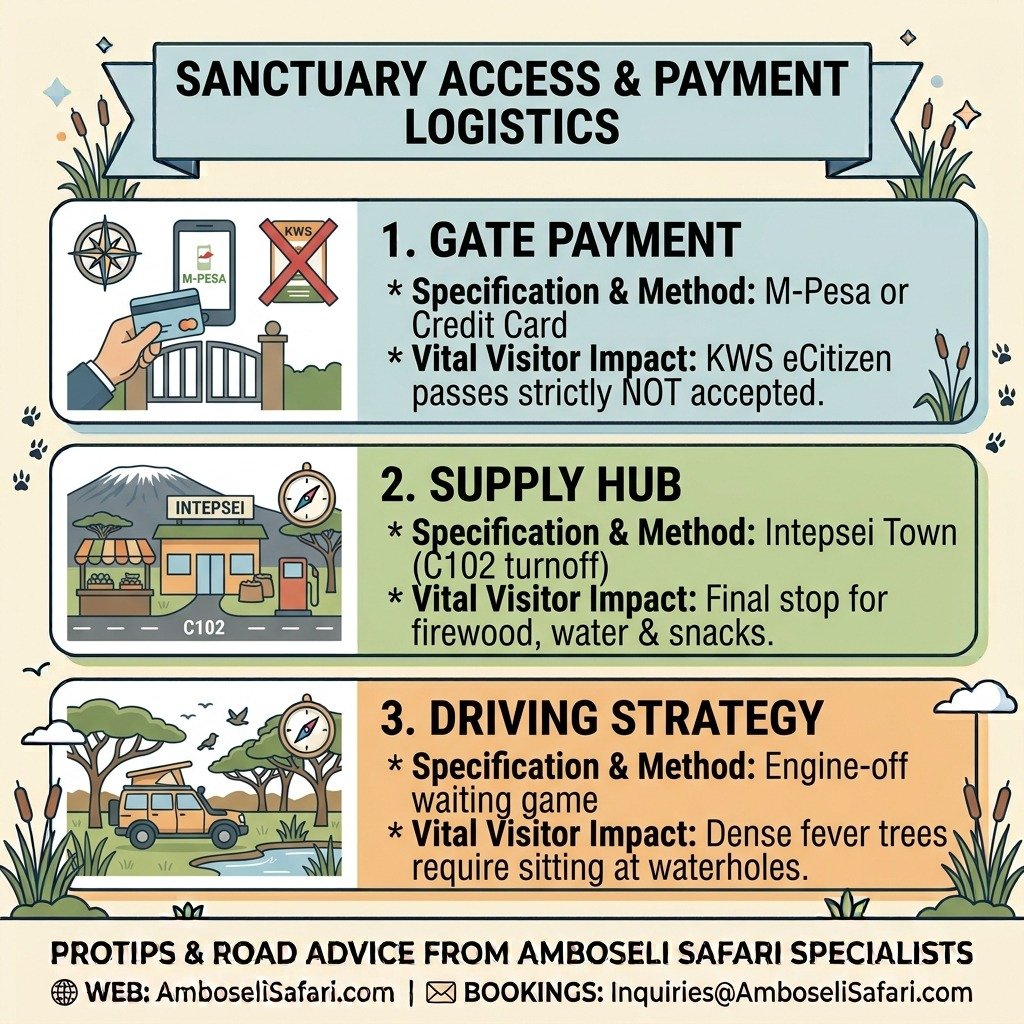
Kimana is run by the Sheldrick Wildlife Trust and Big Life Foundation. Standard KWS eCitizen park passes will not work here. All fees must be paid at the gate using M-Pesa or a credit card.
| Visitor Category | Daily Entry Fee |
| Non-Resident Adult | USD 25 |
| Non-Resident Child (10–18 yrs) | USD 12.50 |
| Child under 10 yrs | Free |
| Kenyan Citizen / Resident Adult | KES 1,000 |
| Vehicle Entry Fee | KES 600 – 1,000 per day |
Sanctuary Access & Payment Logistics
Because Kimana Sanctuary is managed independently by the Big Life Foundation and Sheldrick Wildlife Trust, standard national park rules and tickets do not apply here. Drivers and self-drive travelers must prepare alternative payment methods and adapt their viewing techniques for dense woodland tracks. Use the access checklist below to ensure smooth entry and optimal wildlife viewing.
| Category / Station | Specification & Method | Vital Visitor Impact |
| Gate Payment | M-Pesa or Credit Card | KWS eCitizen passes strictly NOT accepted. |
| Supply Hub | Intepsei Town (C102 turnoff) | Final stop for firewood, water & snacks. |
| Driving Strategy | Engine-off waiting game | Dense fever trees require sitting at waterholes. |
Supplies & Lodging
Public camping was banned to cut down on trash and noise in the corridor. You can stay in luxury at Angama Amboseli or rent Kimana House, a private four-bedroom eco-home. The pool at Kimana House is ice-cold—fed straight from river runoff—but it’s the only real relief after four hours in a dusty 4×4.
If you are self-driving, stop in the small town of Intepsei just before the turnoff. It is your last chance to buy firewood, bottled water, and basic snacks. Browse our guide on where to stay in Amboseli for other regional options.
Before hitting the road, review our practical Amboseli self-drive tips and refresh your knowledge on rules of Amboseli National Park.
Real-World Field Advice
Navigating Kimana’s thick fever-tree groves requires a different driving strategy than crossing Amboseli’s open salt flats.
Senior guide Anthony Mule pulled our Land Cruiser over near the fever trees and cut the engine. “Forget how you drive in Amboseli,” he said. “You won’t spot anything moving at twenty miles an hour here. You park, cut the motor, and wait.”
Five minutes later, two giant bulls stepped out of the thick brush three yards from our bumper.
You can cover Kimana’s main tracks in less than half a day. Paying double entry fees to visit both Kimana and Amboseli National Park on the same afternoon hurts your wallet, so schedule them on separate days.
Safari Package Rates & Itineraries
Combining Kimana’s woodland tracks with Amboseli’s open swamps creates a balanced multi-day safari. On Amboselisafari.com, our private tours bundle 4×4 transport, guide services, lodge bookings, and entry passes into a single rate.
Prices are based on two adults sharing a private 4×4 Safari Land Cruiser with a pop-up roof. Transport, fuel, and guide fees run USD 190 per person sharing per day in normal season and USD 400 per person sharing per day during peak dry season (July to October).
4-Day Amboseli, Kimana & Tsavo West Safari Packages
Prices are total per person based on two adults sharing accommodation and a private 4×4 Land Cruiser.
| Season & Tier | Included Lodges | Price Per Person (USD) |
| Normal – Budget | AA Lodge Amboseli & Rhino Valley Lodge | USD 1,370 |
| Normal – Mid-Range | Ol Tukai Lodge & Kilaguni Serena Lodge | USD 1,610 |
| Normal – Luxury | Tortilis Camp & Severin Safari Camp | USD 2,150 |
| Normal – Luxury Plus | Angama Amboseli & Finch Hattons | USD 3,560 |
| Peak – Budget | AA Lodge Amboseli & Rhino Valley Lodge | USD 2,300 |
| Peak – Mid-Range | Ol Tukai Lodge & Kilaguni Serena Lodge | USD 2,600 |
| Peak – Luxury | Tortilis Camp & Severin Safari Camp | USD 3,250 |
| Peak – Luxury Plus | Angama Amboseli & Finch Hattons | USD 5,050 |
Book a Custom Safari to tailor a private itinerary around your preferred dates.
Package Inclusions:
- Private 4×4 Safari Land Cruiser with pop-up roof for game drives.
- Services of a TRA-licensed, English-speaking driver-guide.
- All entry and conservancy fees for Amboseli, Kimana, and Tsavo West.
- Full board accommodation (breakfast, lunch, dinner) at listed lodges.
- Unlimited bottled drinking water in the vehicle.
- Emergency medical evacuation insurance cover.
Package Exclusions:
- International flights and Kenyan electronic Travel Authorization (eTA) fees.
- Driver-guide tips, alcoholic drinks, and personal laundry.
- Optional activities like hot air balloon rides or ranger walking fees.
Optional Add-Ons:
- Maasai Cultural Village Visit: USD 30 per person.
- Amboseli Hot Air Balloon Safari: USD 450 per person.
- Big Life Ranger Walking Safari Experience: USD 100 per person.
Check full itemized pricing on our Amboseli safari cost breakdown page.
Frequently Asked Questions
Can I use my KWS park ticket to enter Kimana Sanctuary?
No. Kimana Sanctuary is a private reserve managed by Big Life Foundation and Sheldrick Wildlife Trust. Entry fees are separate from KWS national park passes and must be paid at the gate using M-Pesa or a credit card.
Is seeing Craig the Super Tusker guaranteed?
No. Craig moves freely across 5,700 acres and neighboring group ranches. While he spends plenty of time in Kimana, wild animals roam naturally. Booking a ranger foot patrol gives you the best odds of finding his herd.
Are walking safaris allowed inside Kimana Sanctuary?
Yes. Unlike inside Amboseli National Park where walking is restricted to Observation Hill, Kimana Sanctuary allows guided walking safaris accompanied by armed Big Life rangers.