
Health and Vaccinations for Amboseli: Medical Prep, Dust Rules & Logistics
Overview
Preparing for Health and Vaccinations for Amboseli ensures a smooth trip across Kajiado County—often confused with Narok County Council. The Kenya Wildlife Service oversees this ecosystem, where Amboseli Elephant Research Project herds roam around Enkongo Narok swamp beneath Mount Kilimanjaro.
Fast Navigation Links
- 4 Day Safari Circuit Package Rates
- Mandatory and Routine Safari Vaccinations
- Malaria Prophylaxis and Tsetse Protection
- Food Safety and Gastroenteritis Rules
- Altitude Sun Protection and Heat
- AMREF Air Cover and Evacuation
Medical prep for the bush isn’t just a matter of getting a couple of routine jabs at a travel clinic. Once you drop off the tarmac onto the dry salt flats, you face fine alkaline dust, intense equatorial sun, and active mosquito pockets around the central marshes. Looking after your health on game drives takes basic common sense and a bit of field preparation. At Amboselisafari.com, we walk you through the practical health steps that actually matter on the ground.
4-Day Multi-Destination Safari Package (2 Nights Amboseli + 1 Night Lake Naivasha)
Long drives across washboard roads take a real physical toll if you rush your schedule. Pairing the open elephant marshes of Amboseli with the cooler, tree-shaded waterfront at Lake Naivasha gives your body time to rest between game drives. We run this circuit in private 4×4 Safari Land Cruisers equipped with pop-up roof hatches, high-clearance suspension, and onboard fridges stocked with cold bottled water.
Rates below show total costs per person for two adults traveling together:
4-Day Circuit Rates & Lodging Options
| Package Tier & Route Details | Included Lodges & Hotels | Price per Person (Low – Peak)* |
| Budget Tier | Penhy Eco Camp & Lake Naivasha Crescent Camp | From USD $1,280 to USD $2,080 |
| Mid-Range Tier | Tulia Amboseli Safari Camp & Sawela Lodges Naivasha | From USD $1,610 to USD $2,450 |
| Luxury Tier | Amboseli Serena Safari Lodge & Lake Naivasha Simba Lodge | From USD $2,250 to USD $3,280 |
| Luxury Plus Tier | Campi ya Kanzi & Kiboko Luxury Camp Naivasha | From USD $3,950 to USD $5,750 |
*Rates cover 2026/2027 travel for two adults sharing a room or tented suite with a private 4×4 Land Cruiser and driver-guide. Standard/Low season covers January through May and November. Peak season spans June through October and December. Rates include full-board lodging, private transport, driver allowances, fuel, daily $90 USD KWS park permits (plus the mandatory 5% eCitizen gateway processing fee), Naivasha sanctuary fees, and chilled vehicle water. Luxury Plus includes domestic flights from Wilson Airport (WIL).
If you want to adjust your schedule or reserve a private vehicle, send your request through our safari booking form.
Package Inclusions
- Private 4×4 Safari Land Cruiser equipped with a pop-up roof hatch and custom beanbag mounts
- Services of a TRA-licensed driver-guide skilled in field logistics and safety protocols
- Full-board accommodation covering breakfast, lunch, and dinner daily
- Pre-paid daily $90 USD KWS entry permits (plus 5% eCitizen fee) and Lake Naivasha sanctuary passes
- Chilled drinking water stocked in the vehicle cooler
Package Exclusions
- International flights, travel insurance, and digital Kenya entry processing through the official eTA portal
- Tipping your driver-guide or lodge staff
- Alcoholic beverages, soft drinks, or personal laundry
- Optional Maasai village entry vouchers ($30) or hot air balloon flights ($450)
Optional Add-Ons
- Local village entry voucher & cultural walkthrough: USD 30 per person
- Night game drive in a private conservancy: USD 50 per person
- Sunrise hot air balloon flight over central marshes: USD 450 per person
We lay out every vehicle day-rate, driver allowance, and park entry fee on our Amboseli safari cost breakdown page before you book.
Mandatory vs. Recommended Travel Vaccinations
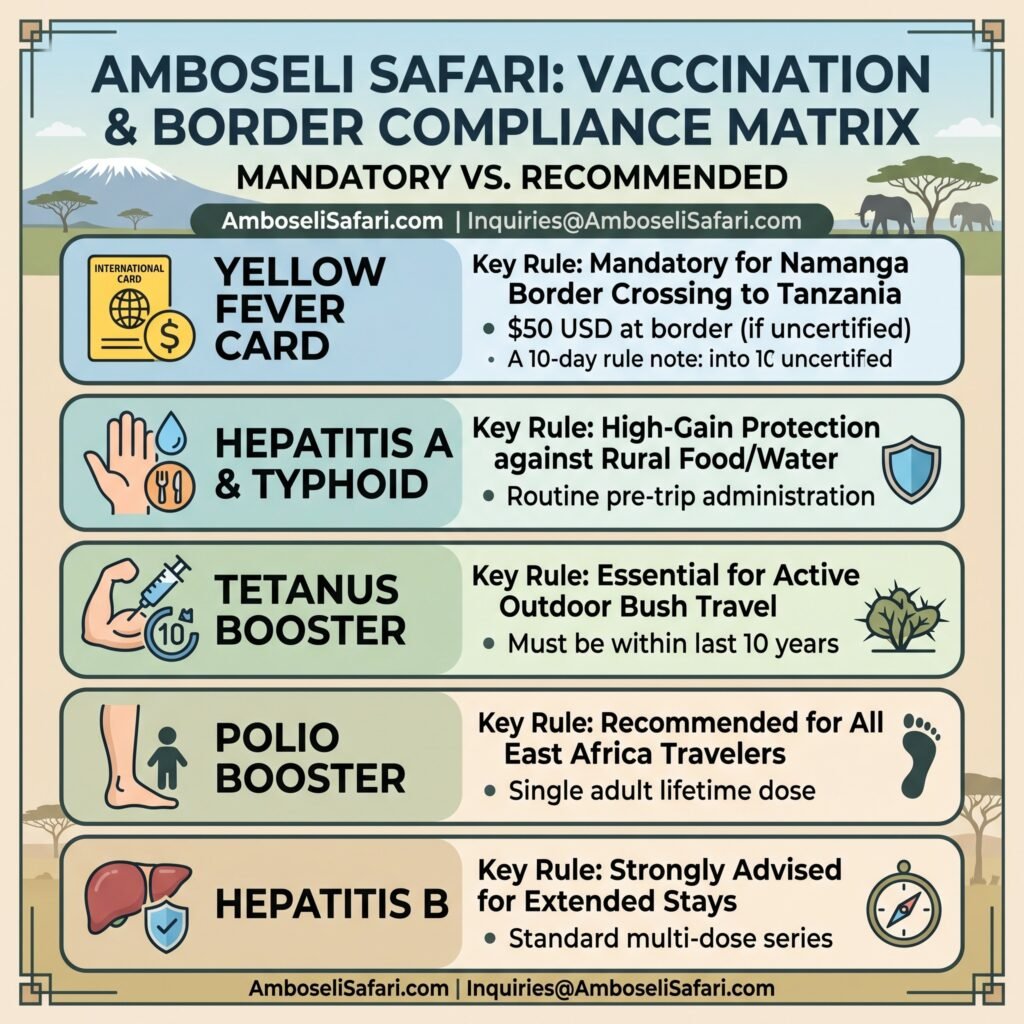
Flying directly into Nairobi from the US, Canada, or Europe means Kenya won’t ask for a Yellow Fever card at airport immigration. Border officers at the Namanga One-Stop Border Post (OSBP) are a different story if your trip crosses into Tanzania.
Namanga officials strictly inspect Yellow Fever certificates for anyone crossing from Kenya into Tanzania. Get the shot and make sure your yellow international card is stamped at least 10 days before you reach the border. Arriving at Namanga without valid proof means paying roughly $50 USD for an immediate shot at a small border clinic or getting turned around on the spot.
Beyond border mandates, check that your routine shots line up with CDC Traveler’s Health Guidelines:
- Hepatitis A and Typhoid vaccines protect against food or water contamination in rural towns.
- Make sure your Tetanus booster was done within the last 10 years.
- Hepatitis B is a smart idea for long trips or active outdoor travel.
- Adults who had their childhood polio series should get a single lifetime booster dose before heading to East Africa.
Keep these health checks in mind while organizing your wider itinerary through our Amboseli safari planning guide.
Quick-Reference Vaccination & Border Compliance Matrix
Navigating health requirements for Amboseli requires distinguishing between mandatory border mandates and recommended CDC safari immunizations. While Kenya does not check Yellow Fever cards for direct arrivals from non-endemic countries, border officials at Namanga OSBP strictly enforce verification for land crossings into Tanzania. Failure to show a stamped yellow card at least 10 days post-vaccination results in mandatory $50 USD border shots or immediate entry denial. Below is a concise breakdown of mandatory and routine health checks for East African travel.
| Vaccine / Requirement | Policy & Cost Details | Mandatory Target Audience |
| Yellow Fever Card | $50 USD at border (if uncertified) | Mandatory for Namanga border crossing to Tanzania. |
| Hepatitis A & Typhoid | Routine pre-trip administration | High-gain protection against rural food/water issues. |
| Tetanus Booster | Must be within last 10 years | Essential for active outdoor bush travel & thorn cuts. |
| Polio Booster | Single adult lifetime dose | Recommended for all travelers visiting East Africa. |
| Hepatitis B | Standard multi-dose series | Strongly advised for extended or remote safari stays. |
Malaria Pills, Tsetse Flies & Insect Protection
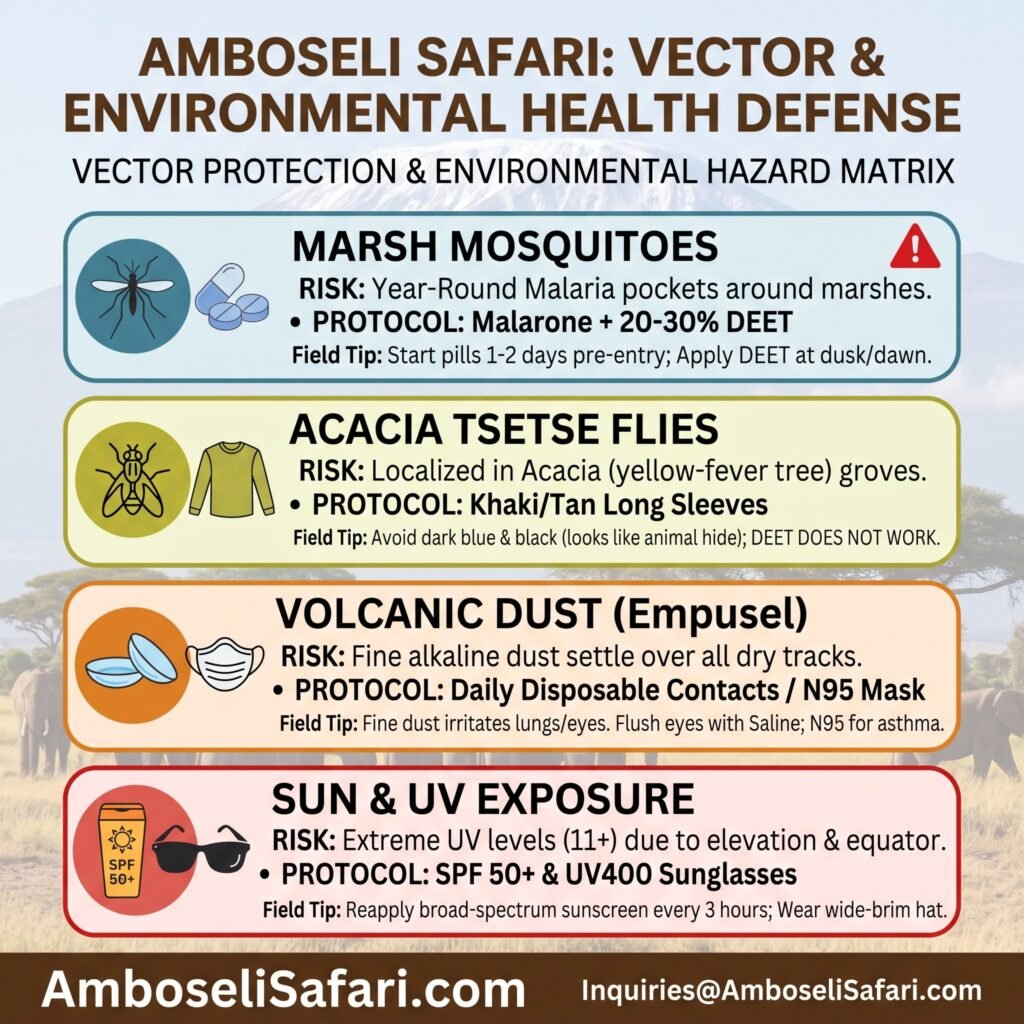
Permanent spring-fed marshes keep mosquito populations active year-round. You need prescription malaria pills.
Malarone (atovaquone/proguanil) is the standard choice because it causes fewer side effects than older alternatives. Start taking Malarone 1 to 2 days before entering the park, swallow one tablet daily with food, and keep taking them daily for 7 days after you leave the bush. Spray 20-30% DEET or Picaridin around your ankles and wrists during early morning and evening drives. Treating your cotton safari clothes with Permethrin spray before leaving home adds solid extra protection.
Tsetse flies are rare across most open plains here, but localized pockets nest in the yellow-fever tree (Acacia xanthophloeia) groves between Ol Tukai Lodge and Longinye swamp.
- Tsetse fly bites pack a sharp sting, and DEET sprays won’t stop them.
- Skip dark blue and black clothing completely—tsetse flies head straight for dark colors because they look like animal hides.
- Stick to light khaki, tan, or neutral green long-sleeved cotton shirts when driving through thick acacia brush.
You can inspect marsh layouts and fever tree groves across our main Amboseli National Park guide.
Vector Protection & Environmental Hazard Matrix
Amboseli’s distinct geography—combining year-round marshlands with dry alkaline salt pans—presents contrasting vector and environmental health risks. While mosquitoes thrive around permanent springs, tsetse flies concentrate specifically in yellow-fever tree (Acacia xanthophloeia) groves. Additionally, fine volcanic ash (Empusel) and high UV levels demand active physical protection during open-vehicle game drives. Use this tactical matrix to prepare the correct repellents, clothing, and eye-gear setups.
| Environmental Hazard | Recommended Protocol | Actionable Field Tip |
| Marsh Mosquitoes | Malarone + 20-30% DEET | Start pills 1-2 days pre-entry; apply DEET at dusk. |
| Acacia Tsetse Flies | Khaki/Tan long sleeves | Avoid dark blue/black clothing; DEET does NOT work. |
| Volcanic Dust (Empusel) | Daily disposable contacts | Discard after afternoon drives; switch to glasses. |
| Equatorial Sun (UV 11+) | SPF 50+ & UV400 glasses | Reapply sunscreen every 3 hours on open salt pan. |
| Asthma / Dust Inhalers | N95 mask + Ziplock pouch | Protect spacer chamber from fine ash airborne particulate. |
Rabies Risk, Stray Dogs & Emergency Care
Wild predators keep their distance from safari trucks, but domestic animals around boundary gates are a different story. Pastoralist Maasai dogs roam bomas, trading centers, and lodge gates near Kimana and Iremito. Never touch or feed stray dogs, habituated baboons, or vervet monkeys around picnic sites.
If an animal bites or scratches you, wash the wound with clean water and soap for at least 15 minutes right away. Rural health centers outside the gates do not stock human Rabies Post-Exposure Prophylaxis (PEP) or Rabies Immune Globulin (RIG). You will need immediate transfer to major Nairobi hospitals where full PEP treatments are kept on hand.
Food Safety, Tap Water & Upset Stomachs
Borehole and tap water across the basin carry heavy mineral salinity and volcanic ash runoff from Mount Kilimanjaro. Drinking unboiled tap water leads to sudden stomach bugs.
- Use sealed bottled water when brushing your teeth, even at high-end lodges.
- Avoid ice cubes made from untreated tap water.
- Stick to piping-hot cooked meals at lodge buffets, and pass on raw salads washed in tap water.
- Stick to peelable fruits like bananas, oranges, and passionfruit.
Pack a basic stomach kit in your daypack with Loperamide for mild diarrhea and Oral Rehydration Salts (ORS) for fluid recovery. Ask your doctor for a standby prescription of Azithromycin to handle severe bacterial stomach bugs.
Sun, Elevation & Volcanic Dust
At an elevation over 1,100 meters (3,600 feet) near the equator, midday UV levels hit 11+ fast. Put on broad-spectrum SPF 50+ sunscreen every three hours, wear a wide-brimmed safari hat, and use UV400 polarized sunglasses to cut glare off the white salt pan.
Fine volcanic ash (Empusel) settles over everything on dry tracks. If you wear monthly contact lenses, fine dust gets trapped underneath, causing painful corneal scratches. Switch to daily disposable contact lenses that you throw away after afternoon drives, or stick to wrap-around prescription glasses.
For travelers with asthma, fine volcanic dust acts as an immediate airway irritant. Store your rescue inhaler in a dust-proof ziplock bag alongside a spacer chamber, and wear an N95 mask during high-dust drives across open lakebeds.
Dehydration sneaks up on you quickly because sweat evaporates instantly in dry dust winds. Our senior guide, Anthony Mule, recommends stirring ORS electrolyte packets into your bottled water continuously during midday drives to avoid heat headaches and muscle cramps.
If you plan to drive yourself across these dry salt tracks, keep our practical Amboseli self-drive tips handy.
Health Documentation & Prescription Rules
Carrying personal medication into Kenya requires following standard customs rules. Fill out the health declaration section accurately on your digital Kenya electronic Travel Authorization (eTA).
Keep all prescription pills inside their original pharmacy bottles with your name clearly printed on the label. If you carry controlled medications—like strong prescription pain relievers or sleeping aids—bring a signed doctor’s note explaining your medical necessity and exact dosage.
Special Advice for Families, Seniors & Pregnancy
Different age groups need specific adjustments in the bush:
- Children: Dose pediatric malaria medications strictly by body weight. Keep kids drinking flavored electrolyte water, and make sure they wear chin-strapped sun hats during open-roof drives.
- Seniors: Midday heat drains energy fast. Plan afternoon rest breaks at your lodge between 12:30 PM and 3:30 PM to stay out of the hottest sun.
- Pregnant Travelers: Rough dirt tracks cause heavy vehicle bouncing. Sit in the middle row of the Land Cruiser—never the back row where the suspension hits hardest—and talk to your doctor about malaria precautions before booking.
AMREF Air Cover & Local Hospitals
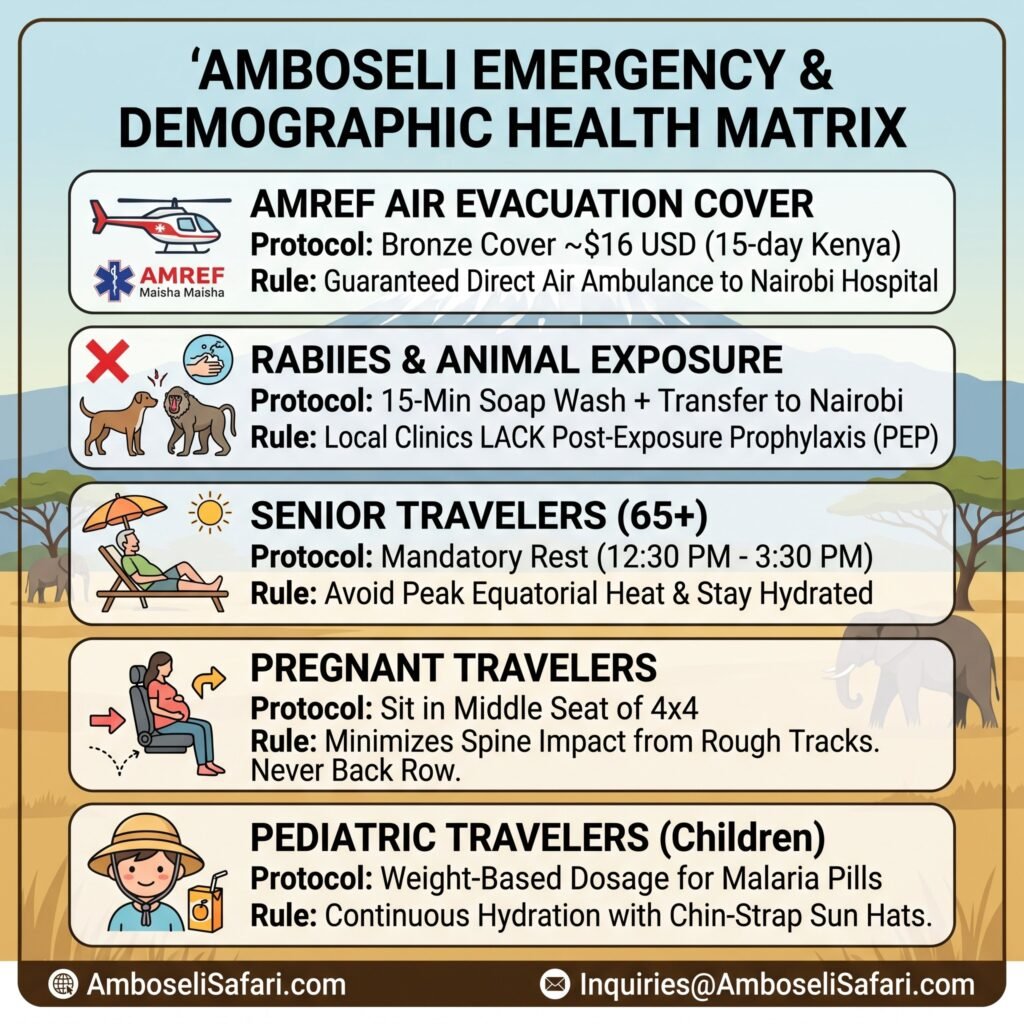
The KWS Ol Tukai Dispensary inside the park handles basic first aid, but it lacks surgical facilities or trauma gear. Serious medical emergencies require air ambulance evacuation directly to Nairobi.
Register for an AMREF Maisha Tourist Cover ($16 USD for Bronze 15-day coverage in Kenya, or $24 USD for Silver 30-day cross-border coverage) at flydoc.org before leaving home. This policy guarantees direct air ambulance landing rights at Amboseli Airstrip and emergency flight dispatch straight to Nairobi Hospital.
For local emergency care, Loitokitok Sub-County Hospital sits 50 km southeast on the slopes of Kilimanjaro, while Kimana Rural Health Center handles basic stabilization right outside Kimana Gate.
Check lodge access routes and gate locations when deciding where to stay in Amboseli.
Emergency Evacuation & Demographics Health Matrix
Emergency medical facilities within Amboseli National Park are limited to basic first-aid dispensaries that lack trauma and Rabies PEP capabilities. In the event of severe injuries, animal bites, or critical illness, direct air ambulance evacuation to Nairobi is necessary. Securing prepaid AMREF Maisha Tourist cover ensures immediate airlift dispatch directly from Amboseli Airstrip. The matrix below outlines emergency evacuation tiers alongside tailored advice for high-risk demographic groups.
| Category / Demographic | Emergency Protocol / Cost | Actionable Safety Rule |
| AMREF Bronze Cover | ~$16 USD (15-day Kenya) | Direct air ambulance dispatch to Nairobi Hospital. |
| Rabies Exposure | 15-min soap wash + Evac | Local clinics lack PEP/RIG; requires Nairobi transport. |
| Senior Travelers | Lodge rest (12:30–15:30) | Avoid peak equatorial heat; stay hydrated with ORS. |
| Pregnant Travelers | Middle seat in 4×4 Land Cruiser | Minimizes rough track bouncing impact on spine. |
| Pediatric Travelers | Weight-based dosage | Use chin-strap sun hats & flavored ORS electrolytes. |
Safari Medical First-Aid Checklist
Pack these essential medical supplies inside a dust-proof container before leaving Nairobi:
| Item | Recommended Quantity | Primary Safari Use |
| Sterile Saline Eyewash | 1 bottle (250 ml) | Flushing fine volcanic dust out of eyes after open drives |
| Oral Rehydration Salts | 10 sachet packets | Replacing electrolytes lost to heat and dry winds |
| Malarone Prophylaxis | Full course per person | Daily malaria prevention taken with meals |
| DEET / Picaridin Spray | 2 pump bottles | Evening mosquito protection around lodge grounds |
| Daily Disposable Lenses | Full supply + 5 spares | Preventing dust scratch injuries to corneas |
| Stomach Care Kit | Azithromycin & Loperamide | Treating traveler’s diarrhea and stomach bugs |
| Basic First-Aid Supplies | Bandages, gauze, tape | Dressing minor thorn scratches and cuts |
| Salbutamol Inhaler | 1 unit + spacer chamber | Managing asthma attacks triggered by volcanic dust |
Frequently Asked Questions
Can I use lodge tap water to brush my teeth?
No. Tap and borehole water carry high mineral salt levels and ash runoff from Mount Kilimanjaro. Always use sealed bottled water to brush your teeth.
Is a Yellow Fever certificate mandatory to enter Kenya?
Not if you fly directly into Kenya from non-endemic countries. However, if you cross the land border into Tanzania at Namanga, border officers strictly require a valid Yellow Fever card.
What happens if I experience a medical emergency inside the park?
Local dispensaries provide basic first aid. If you hold AMREF Maisha cover, an air ambulance is dispatched directly to Amboseli Airstrip to fly you to Nairobi Hospital.
Are malaria pills really necessary for an Amboseli safari?
Yes. Permanent marshes create active mosquito habitats year-round. Medical authorities recommend taking prescription malaria pills alongside insect repellent.