
Budget Amboseli Safari Tours: 3-Day Itinerary, Camps & Pricing
Overview of Budget Amboseli Safari Tours
A 3-day budget Amboseli safari tour (2 nights) costs between $900 and $1,860 per adult sharing in a private 4×4 Land Cruiser. Choosing community camps near Meshanani Gate, taking public SGR trains from Nairobi, packing picnic lunches, and managing off-grid generator hours keeps your total costs down while giving you full game drives beneath Mount Kilimanjaro.
Jump Ahead
- Cost Comparison Snapshot
- Meshanani Gate & Community Camp Options
- KWS Public Campsite Rules & eCitizen Permits
- Minibus Vans vs 4×4 Silt Risks
- SGR Train Transit & Local Hire Hacks
- Generator Power Hours & Budget Packing List
- Packed Lunch Strategy vs Lodge Buffets
- 3-Day Budget Safari Itinerary
- Safari Package Costs & Hotel Tiers
- Frequently Asked Questions
Cost Comparison Snapshot (3-Day / 2-Night Safari)
- DIY Backpacker (SGR Train + Public Campsite): ~$350 – $550 per person total. SGR economy ticket, shared matatus, pitch-your-own tent at KWS public site, self-cooked meals, and a local 4×4 guide hired at Kimana.
- Budget Tented Camp (Private 4×4 Road Trip): ~$900 – $1,080 per person. Private 4×4 Land Cruiser from Nairobi, 2 nights at a budget tented camp, full-board meals, and KWS permits included.
- Budget Safari Lodge (Private 4×4 + Lodge Room): ~$1,080 – $1,860 per person. Standard lodge room outside Kimana Gate, private Land Cruiser drives, and pre-paid park entry.
Anthony and I have been guiding groups across Kajiado for over ten years. We constantly see people dump $1,500 a night on fancy lodges because they think it’s the only way to get near Amboseli’s big tuskers. You don’t need a luxury budget to watch elephants against Mount Kilimanjaro. You just need to know how ground logistics work.
Cutting costs comes down to practical choices: picking quiet gates, skipping $50 hotel lunch buffets, and knowing when camp generators switch off.
Check wildlife movement patterns across the county before locking in your dates. If you want us to help map out a route, drop us a line through our safari planner.
Meshanani Gate & Community Camp Options
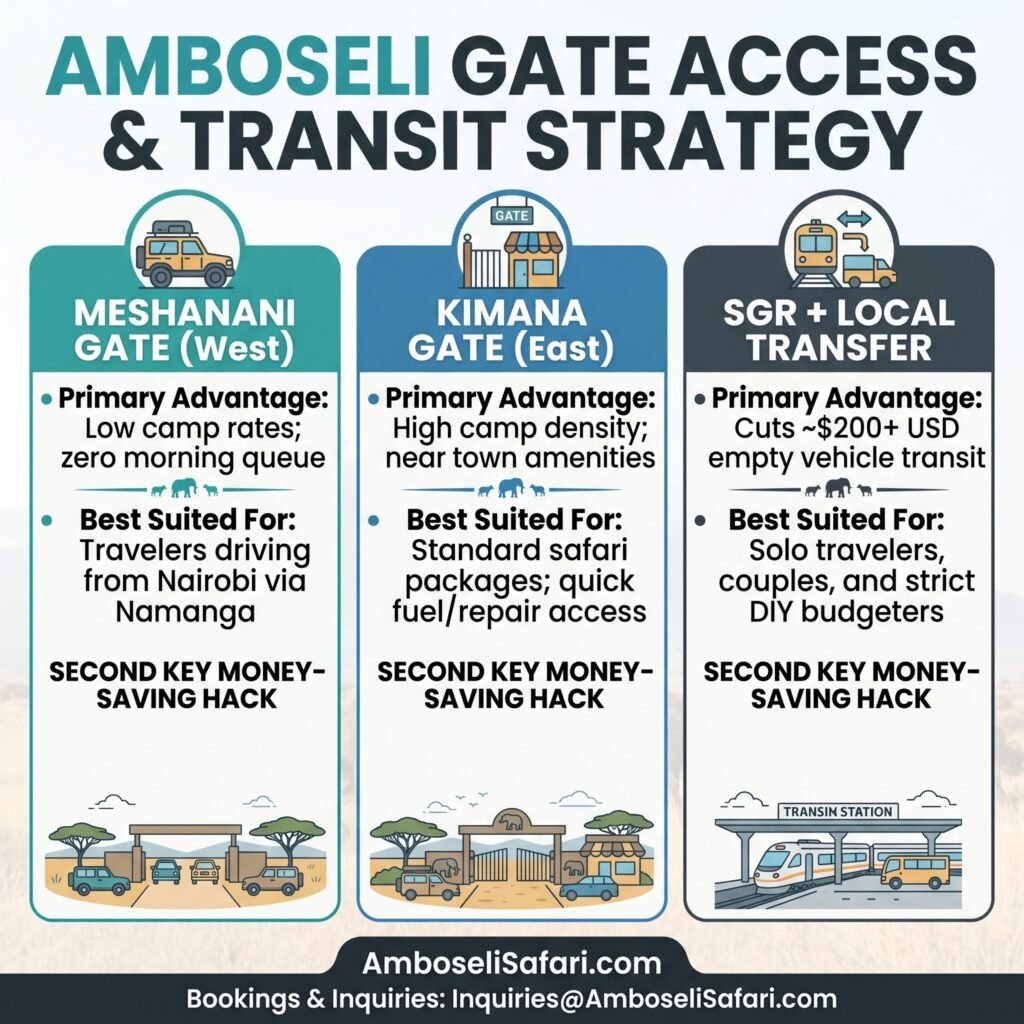
Most tour vans crowd around Kimana Gate on the eastern border. That heavy traffic inflates bed rates and creates annoying vehicle queues every morning at 06:00 AM.
If you drive in from Nairobi via Namanga, head for community-owned tented camps near Meshanani Gate on the western perimeter instead. Nightly rates run way lower because land lease fees on this side aren’t marked up like Kimana.
We usually pull up to Meshanani around 6:15 AM while the sky is still grey and ice-cold. You drive straight out onto the dry Lake Amboseli salt bed at first light—skipping the tour vans idling at Kimana entirely—and half the time you’ll have miles of open salt flats all to yourself.
Amboseli Budget Route & Gate Overview
- Emali SGR Station (North): Main drop-off along Mombasa Road for train travelers. Connects south to Kimana along the paved C102 highway.
- Meshanani Gate (West): Quiet entrance off the Namanga highway. Direct access to Lake Amboseli’s dry bed, surrounded by low-cost community camps.
- Kimana Gate (East): Main tourist hub with budget tented camps, petrol stations, and roadside tire repair shops (fundis).
- Observation Hill (Central): Elevated lookout point in the middle of the park with free public picnic tables and views across the marshes.
Read our detailed breakdown of Meshanani Gate access or look through budget options in our Amboseli accommodation guide.
Gate Access & Transit Strategy
Choosing the right entry point and transit method dramatically impacts your total trip cost and gate waiting times. Strategic gate choices allow travelers to avoid crowded eastern queues while securing lower nightly rates at surrounding community camps. Review this transit and gate comparison to select the most cost-effective entry strategy for your itinerary.
| Access Option | Route & Logistics | Cost & Time Advantage |
| Meshanani Gate (West) | Via Namanga highway; direct Lake Amboseli salt bed access | Lower camp lease rates; skips Kimana morning queues entirely. |
| Kimana Gate (East) | Via Emali highway (C102); main commercial safari hub | Heavy morning tour traffic; higher accommodation demand. |
| SGR + Local Transfer | Train to Emali station, matatu to Kimana, local 4×4 hire | Cuts empty vehicle fuel costs from Nairobi; saves $200+ USD. |
KWS Public Campsite Rules & eCitizen Permits
The Kenya Wildlife Service Public Campsite near park headquarters is the absolute cheapest place to sleep inside the reserve. You pay basic non-resident camping fees, but you bring your own tent, sleeping pad, and food.
There are no grocery stores or cold storage inside the park. Buy dry food, bottled water, charcoal, and fruit in Emali Town or Kimana Town before passing through the gate.
The campsite has a wire fence for large animals, but baboons scale it easily. Fabric tent zips won’t stop them. Store all food inside your car trunk or in lockable metal boxes. Leave a cooler bag on a back seat, and baboons will rip open your tent zips within five minutes.
Navigating the eCitizen KWS Permit Portal
- Set up an account on ecitizen.go.ke before leaving Nairobi.
- Search for Kenya Wildlife Service (KWS) and select Single Entry Park Permit for Amboseli National Park.
- Select Non-Resident Adult ($90 USD per 24 hours) and pick your entry time.
- Pay via card or M-Pesa. The M-Pesa payment gateway frequently times out after 10:00 PM when system maintenance runs, so buy your permit during the day to avoid gate arguments.
- Download the PDF e-ticket with its QR code to your phone and print a paper copy. Mobile coverage drops to zero at the gate, and wardens won’t let you through without a scannable QR code on paper or an offline phone screen.
See our full Amboseli camping guide for gear lists and rules.
Minibus Vans vs 4×4 Silt Risks
Budget group tours use 2WD or 4WD Toyota HiAce minibuses (“tour vans”) with pop-up roofs to keep per-person prices down. They work fine on dry, hard-packed ground. But when it rains? They’re trouble.
During dry months (January–February and July–October), minibuses handle main dirt tracks without issues. But when rain hits in November, April, or May, fine volcanic silt (solonetz clay) near Enkongo Narok swamp turns into slick, axle-deep mud. Minibuses on narrow highway tires spin out and get stuck constantly.
If you get flat tires on the road down from Nairobi, pull into Mama Mwangi’s vulcanizing shop near the Shell station in Emali—she’ll patch a tube in ten minutes for a few hundred shillings. In the park during rainy months, standard vans get stuck fast. Anthony swears by Cooper Discoverer AT3 tires on our 4×4 Land Cruisers because they clear wet silt off the treads instead of caking up like slick street tires.
Check current Amboseli road conditions before choosing a vehicle.
SGR Train Transit & Local Hire Hacks
If you’re traveling solo or as a budget couple, you can skip the $200+ private car transfer from Nairobi entirely by using local transit.
- Take the morning Madaraka Express SGR train from Nairobi’s Syokimau station down to Emali Station (Economy seats cost KSh 400 / ~$3 USD).
- Walk out to Emali town and jump into a shared matatu or shared taxi heading down the paved C102 road to Kimana Town for under $10 USD.
- Hire a local 4×4 guide based out of Kimana Town to meet you at your camp for game drives.
This cuts out empty vehicle fuel costs from Nairobi. Read more about public transit routes in our guide on how to get to Amboseli.
Generator Power Hours & Budget Packing List
Budget tented camps outside the gates run off-grid using diesel generators and solar battery setups.
Generators run on fixed schedules. Managers shut them off when guests leave for morning game drives (10:00 AM to 3:30 PM) and cut power completely overnight from 10:00 PM to 5:00 AM. When the generator cuts out, your tent goes pitch black.
Most budget tents have only one UK Type-G wall socket. Bring a multi-plug adapter strip or an external power bank so you can charge your phone, camera batteries, and headlamp during the short power window between 6:30 PM and 10:00 PM.
Essential Budget Packing Checklist:
- Heavy 20,000 mAh battery bank for overnight power cuts.
- Multi-plug adapter wall tap so you aren’t fighting over a single socket.
- Hard plastic or metal lockbox to keep camp baboons out of your snacks.
- Offline map apps like Maps.me downloaded to your phone before mobile signal dies at the gate.
- Lightweight dust gaiters and neck scarves to keep lake-bed dust out of your throat.
Review more packing advice on our Amboseli travel tips page.
Off-Grid & Logistics Quick Guide
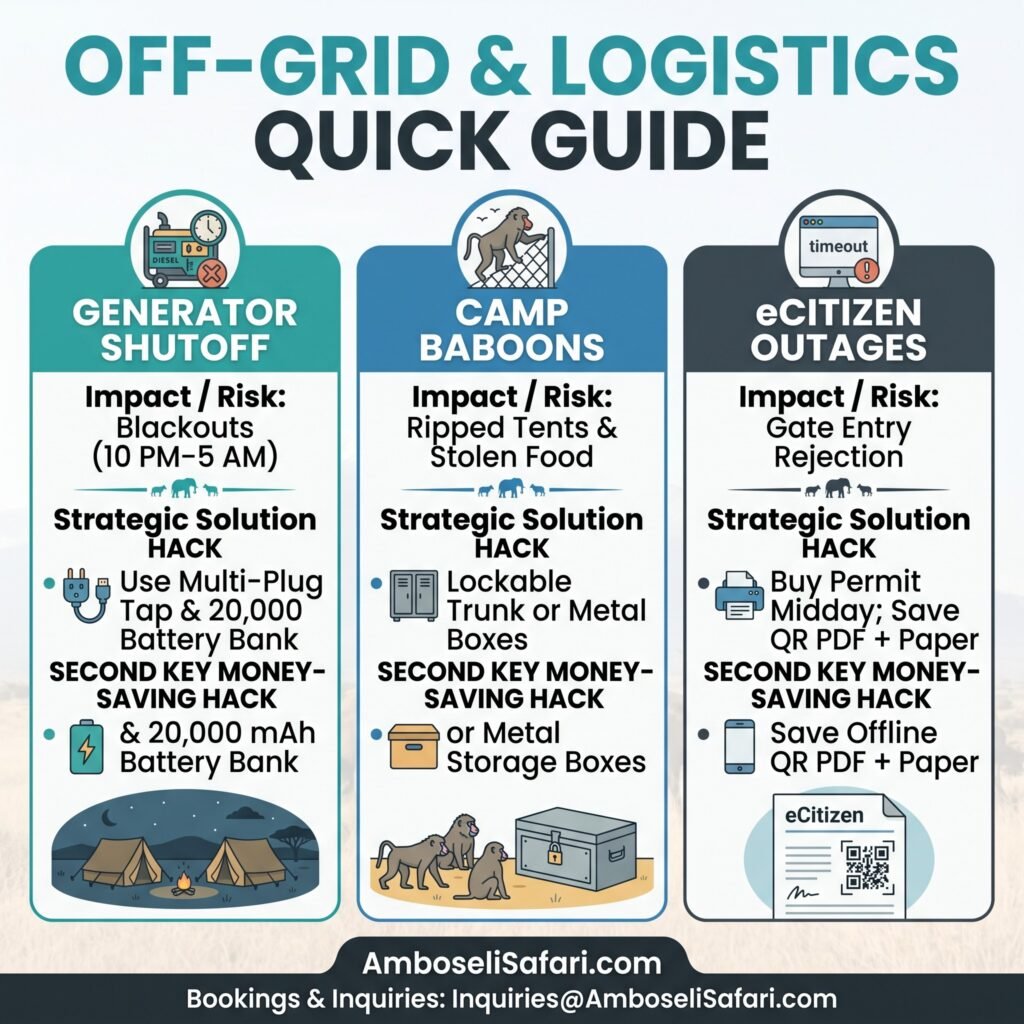
Navigating bush logistics requires preparing for off-grid power schedules, strict park food rules, and system delays. Simple gear additions can protect your equipment and food from local conditions and wildlife. Use this quick reference checklist to prepare for daily off-grid camp operations.
| Challenge | Impact / Risk | Strategic Solution |
| Generator Shutoff | Blackouts (10 PM–5 AM) | Multi-plug tap + 20,000 mAh battery bank |
| Camp Baboons | Ripped tents / stolen food | Lockable trunk or metal storage boxes |
| eCitizen Outages | Gate entry rejection | Buy permit midday; save offline QR PDF + paper |
Packed Lunch Strategy vs Lodge Buffets
Drop-in lunch buffets at inside-park lodges like Ol Tukai run $35 to $50 USD per person. That adds up fast.
Driving all the way back to your budget camp outside Kimana Gate for lunch eats up two hours of game viewing time and wastes fuel. Ask your camp for a packed picnic lunch box (10–15 USD) instead. That lets you stay inside the park for 12 straight hours on a single 24-hour KWS entry ticket.
You can eat your lunch at the public picnic tables on Mtaro Hill or Observation Hill, enjoying views over Enkongo Narok swamp without spending extra cash.
All park entry fees go through the official KWS portal on eCitizen. If you plan to extend your safari west toward Narok County territory like the Masai Mara, separate regional park fees apply.
Review our full KWS park fee guide for updated entry rules.
Complete 3-Day / 2-Night Budget Safari Itinerary
Day 1: Nairobi to Amboseli & Sunset Drive
Leave Nairobi at 06:00 AM in a private 4×4 Safari Land Cruiser to get ahead of the heavy truck traffic on Mombasa Road. Drive south through Emali and reach your budget camp near Kimana Gate in time for lunch. At 3:30 PM, enter through Kimana Gate for an afternoon game drive along Ol Okenya swamp to see elephant families feeding near yellow-fever tree groves (Acacia xanthophloeia).
Day 2: Full Day Swamps & Mount Kilimanjaro
Start engines at 06:00 AM sharp to catch pre-dawn views of Mount Kilimanjaro before thermal clouds blanket Kibo peak around 09:30 AM. Track bull elephants in Enkongo Narok swamp along research paths monitored by the Amboseli Elephant Research Project. Eat your packed picnic lunch at Observation Hill, then spend the afternoon driving the western salt flats before returning to camp by 6:00 PM.
Day 3: Breakfast & Return Transfer to Nairobi
Enjoy a relaxed breakfast at your budget camp. There are no game drives on this final day. Pack your bags, check out by 09:00 AM, and start the drive back to Nairobi, arriving in the city by 2:30 PM.
Safari Package Costs & Hotel Tiers
Our 3-day budget road package covers a private 4×4 Safari Land Cruiser for all 3 days (including driver-guide fees and fuel), 2 nights full-board accommodation, and pre-paid non-resident KWS park permits (2 x 24-hr permit blocks at $90 USD per adult per 24 hours).
Vehicle, fuel, and guide fees run USD 190 per person sharing per day during standard months, rising to USD 400 per person sharing per day during peak dry season (July to October).
| Budget Tier | Included Camps / Lodges* | Normal Season (Jan–June, Nov–Dec) | Peak Season (July–Oct) |
| Public Camping / Self-Catering | KWS Public Campsite / Community Sites | USD 900 per person | USD 1,560 per person |
| Budget Tented Camp | Kimana Safari Camp / Kibo Slopes | USD 980 per person | USD 1,700 per person |
| Budget Safari Lodge | AA Lodge Amboseli (Standard Room) | USD 1,080 per person | USD 1,860 per person |
*Prices based on two adults sharing a private 4×4 Land Cruiser. Budget camps run generator power on fixed schedules (power off 10 PM – 5 AM). Note: During heavy rain months, budget drivers may suggest small local road detours to avoid deep mud.
Send us a request through our safari booking form to reserve your 4×4 Land Cruiser and budget camp rooms.
Amboseli Budget Tier Breakdown
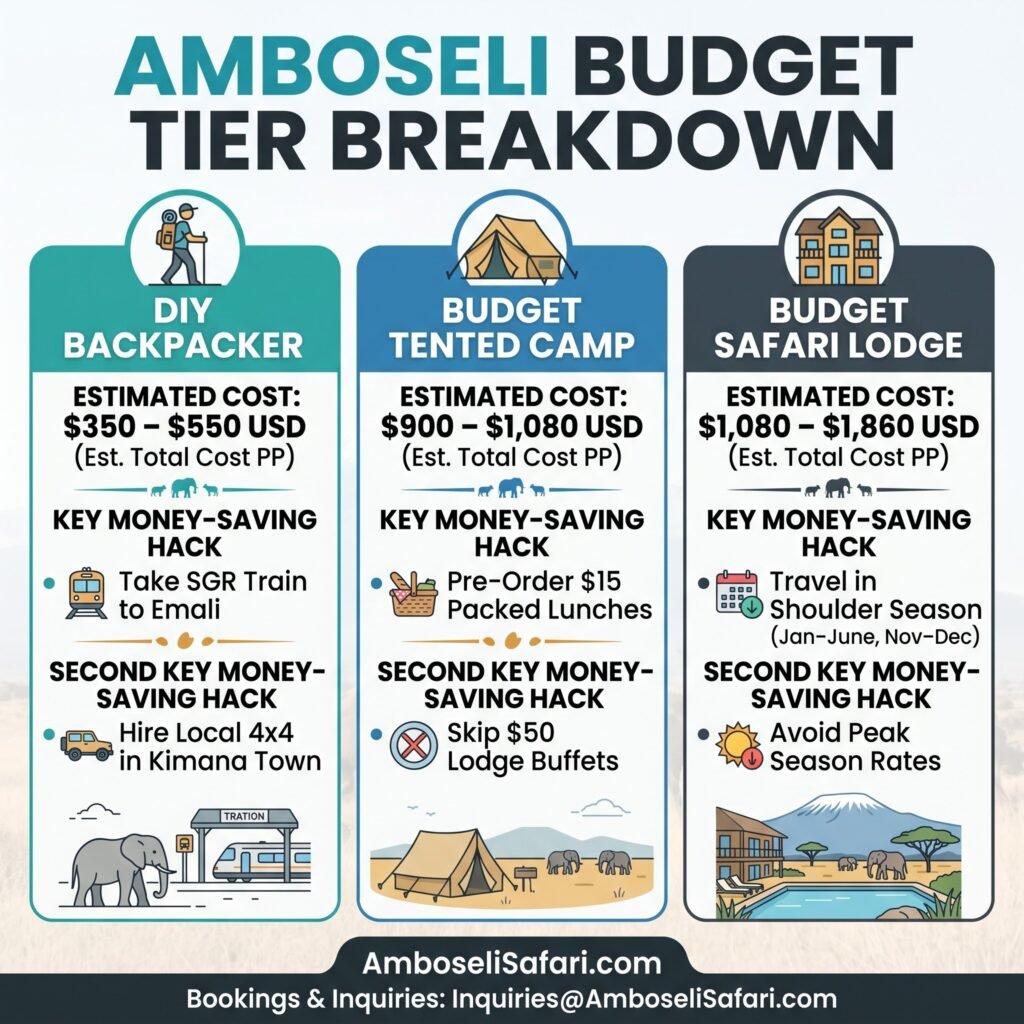
Budgeting for Amboseli depends heavily on whether you choose DIY ground transit, a budget camp, or a mid-tier lodge. While overall wildlife access remains identical across all tiers, operational trade-offs dictate your daily comfort and overall spending. Use this tier breakdown to match your budget with your expected comfort level.
| Safari Tier | Est. Total Cost (PP) | Key Money-Saving Hack |
| DIY Backpacker | $350 – $550 USD | SGR train to Emali + local 4×4 hire in Kimana |
| Budget Tented Camp | $900 – $1,080 USD | Pre-order $15 packed lunches to skip $50 buffets |
| Budget Safari Lodge | $1,080 – $1,860 USD | Travel during shoulder season (Jan–June, Nov–Dec) |
Package Inclusions:
- Private 4×4 Safari Land Cruiser with pop-up roof for all 3 days
- Services of a TRA-licensed, English-speaking driver-guide
- 2 nights full-board accommodation at selected budget camp or lodge
- Non-resident KWS park entry permits (2 x 24-hr permit blocks)
- Bottled drinking water in vehicle coolers and emergency medical evacuation insurance
Package Exclusions:
- International airfare and Electronic Travel Authorization (eTA) fees
- Personal expenses such as driver tips, souvenirs, laundry, or alcoholic beverages
- Optional Maasai cultural village visits or hot air balloon flights
Optional Add-Ons:
- Authentic Maasai cultural village visit: USD 30 per person
- Sunrise hot air balloon safari over Amboseli: USD 450 per person
- One-way flight extension connecting to the Masai Mara: USD 350 per person
Cash, Gear & Travel Logistics
- Bank tellers and lodge cashiers in Kenya reject pre-2013 US Dollar bills on the spot. Bring clean USD notes printed in 2013 or later without tears or heavy folds.
- Tip your 4×4 driver-guide around $15 to $20 USD per day total from your travel group.
- Reception tip boxes cover back-of-house staff; $10 USD per day covers room stewards and kitchen crew.
- Keep KES 5,000 to 10,000 ($35 to $70 USD equivalent) in small notes for roadside fruit purchases or small tips where vendors can’t change USD notes.
- Apply for your Electronic Travel Authorization at etakenya.go.ke at least a week before flying. Carry a physical Yellow Fever card if transiting through endemic zones, and pack a Type G UK 3-pin adapter to charge electronics during generator hours.
Frequently Asked Questions
What is the cheapest way to visit Amboseli National Park?
Take the SGR train from Nairobi to Emali, hop on a shared matatu to Kimana, and stay at a local community campsite or KWS site while hiring a local 4×4 guide for game drives.
Are budget camps outside Kimana Gate safe at night?
Yes. Camps have night watchmen (askaris) and perimeter fencing. Just keep your tent zips closed so insects and smaller wildlife don’t wander in.
Can we see big elephants on a budget safari?
Absolutely. Everyone enters the same park gates and drives the same swamp tracks regardless of what they paid for a bed. You see the exact same elephant herds, lions, and views of Kilimanjaro as luxury guests.