
Sinet Delta Amboseli: Wildlife, Routes & Safari Guide
Overview
The Sinet Delta Amboseli is a riverine wetland zone located in the northern sector of Amboseli National Park. Fed by spring water runoff carried by the seasonal Sinet River out of the Enkongo Narok swamp, this delta forms a critical transition zone where open papyrus marshes yield to dense Acacia tortilis and yellow-fever tree (Acacia xanthophloeia) thickets. Managed by the Kenya Wildlife Service (KWS) directly beneath Mount Kilimanjaro, the area supports the park’s highest concentration of Maasai giraffes, shelters over 200 bird species, and provides a quiet, low-density game drive loop away from crowded central park tracks.
Fast Navigation Links
- Acacia Transition & Giraffes
- Sinet River Runoff & Mud Traps
- Birding Micro-Habitat Species
- Midday Refuge Route Strategy
- Photographing Kilimanjaro Through Acacias
- Safari Packages & Rates
- Frequently Asked Questions
Turn north past Observation Hill (Normatior) and the dust suddenly stops. The open salt pan dies out, replaced by deep, cool shadows under a wall of yellow-fever trees. Most drivers on standard Amboseli National Park day-loops never make this turn, choosing instead to queue up near the central swamp tracks. That is their loss.
Acacia Transition Zone & Giraffe Concentration
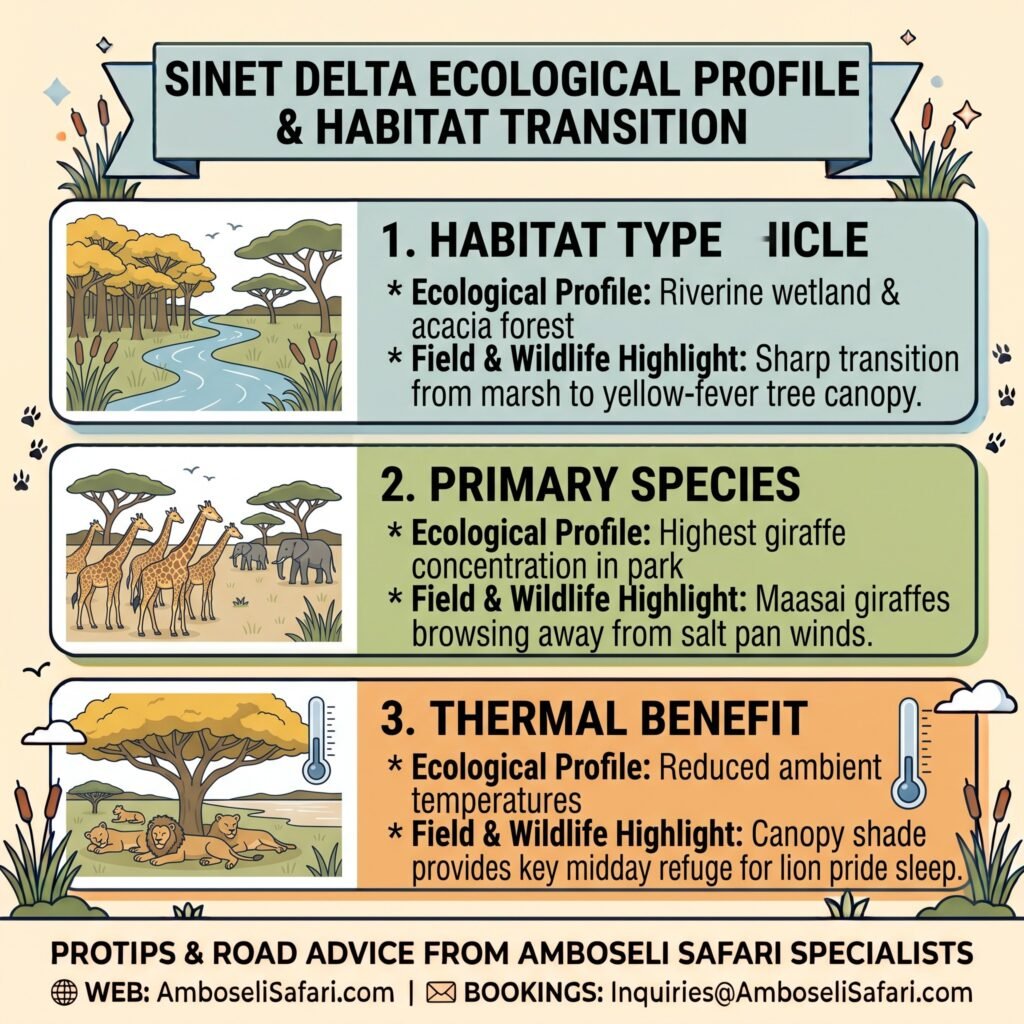
The boundary is stark. One minute you are looking at open papyrus reeds in the Enkongo Narok swamp, and the next you are driving through thick acacia woodland.
Giant bull elephants stick to the wet marsh. Giraffes do the opposite.
Amboseli Elephant Research Project data confirms the Sinet Delta holds the heaviest giraffe population in the entire park. They come for the acacia thorns, but they stay because the trees cut the biting afternoon wind coming off the salt pan. You can cut your engine and watch a family of twelve quietly browsing at eye level—no radio chatter, no diesel fumes from five other vans idling behind you. It is a completely different side of Amboseli wildlife that most tourists miss entirely.
Ecological Profile & Habitat Transition
Turning north past Observation Hill reveals the Sinet Delta, where open marshland yields to cool acacia woodlands. This unique riverine zone creates a sheltered micro-habitat protected from the harsh winds of the open salt flats. The profile below details the delta’s vegetation layers, primary wildlife sightings, and microclimate advantages.
| Delta Feature | Ecological Profile | Field & Wildlife Highlight |
| Habitat Type | Riverine wetland & acacia forest | Sharp transition from marsh to yellow-fever tree canopy. |
| Primary Species | Highest giraffe concentration in park | Maasai giraffes browsing away from salt pan winds. |
| Thermal Benefit | Reduced ambient temperatures | Canopy shade provides key midday refuge for lion pride sleep. |
Sinet River Overflow & Black-Cotton Mud Traps
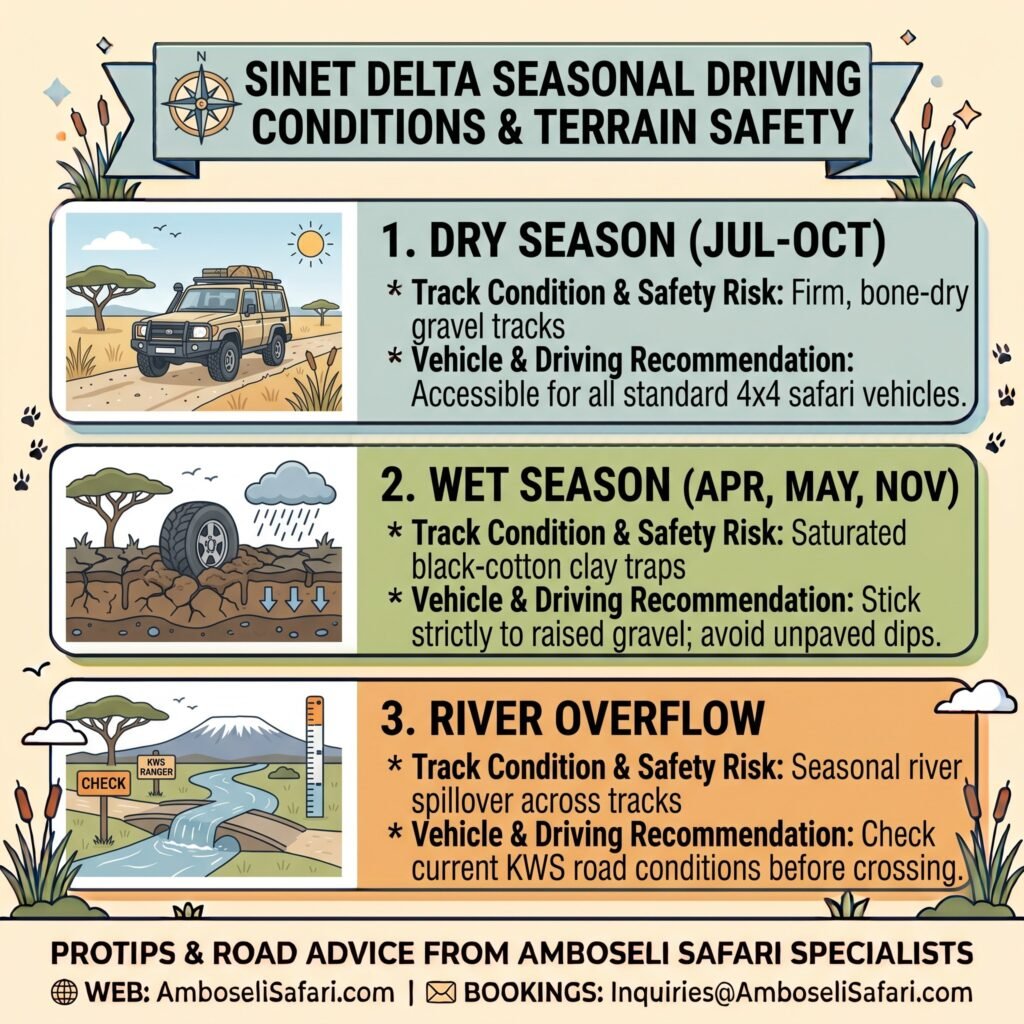
Clean spring runoff flows north through the seasonal Sinet River, cutting through the delta before vanishing into the dry lake basin.
In August, these tracks are bone-dry gravel. In April, May, or November? They are a trap.
Heavy rain causes the river to spill over its shallow banks, soaking the deep black-cotton clay beneath the dirt. Saturated black cotton isn’t just mud—it behaves like slick grease that instantly coats tire treads, turning even custom 4x4s into useless sleds. If you are doing an Amboseli self-drive during the rains, stay strictly on the elevated gravel tracks and verify current road conditions before crossing any unpaved dip.
Seasonal Driving Conditions & Terrain Safety
Navigating the Sinet Delta requires adapting your driving strategy to the prevailing season and soil conditions. While the dry months offer smooth gravel tracks, heavy rainfall transforms the surrounding black-cotton soil into slick mud traps. Review the safety matrix below to plan your route around seasonal river overflows.
| Season & Months | Track Condition & Safety Risk | Vehicle & Driving Recommendation |
| Dry Season (Jul–Oct) | Firm, bone-dry gravel tracks | Accessible for all standard 4×4 safari vehicles. |
| Wet Season (Apr, May, Nov) | Saturated black-cotton clay traps | Stick strictly to raised gravel; avoid unpaved dips. |
| River Overflow | Seasonal river spillover across tracks | Check current KWS road conditions before crossing. |
High-Density Birding Micro-Habitat
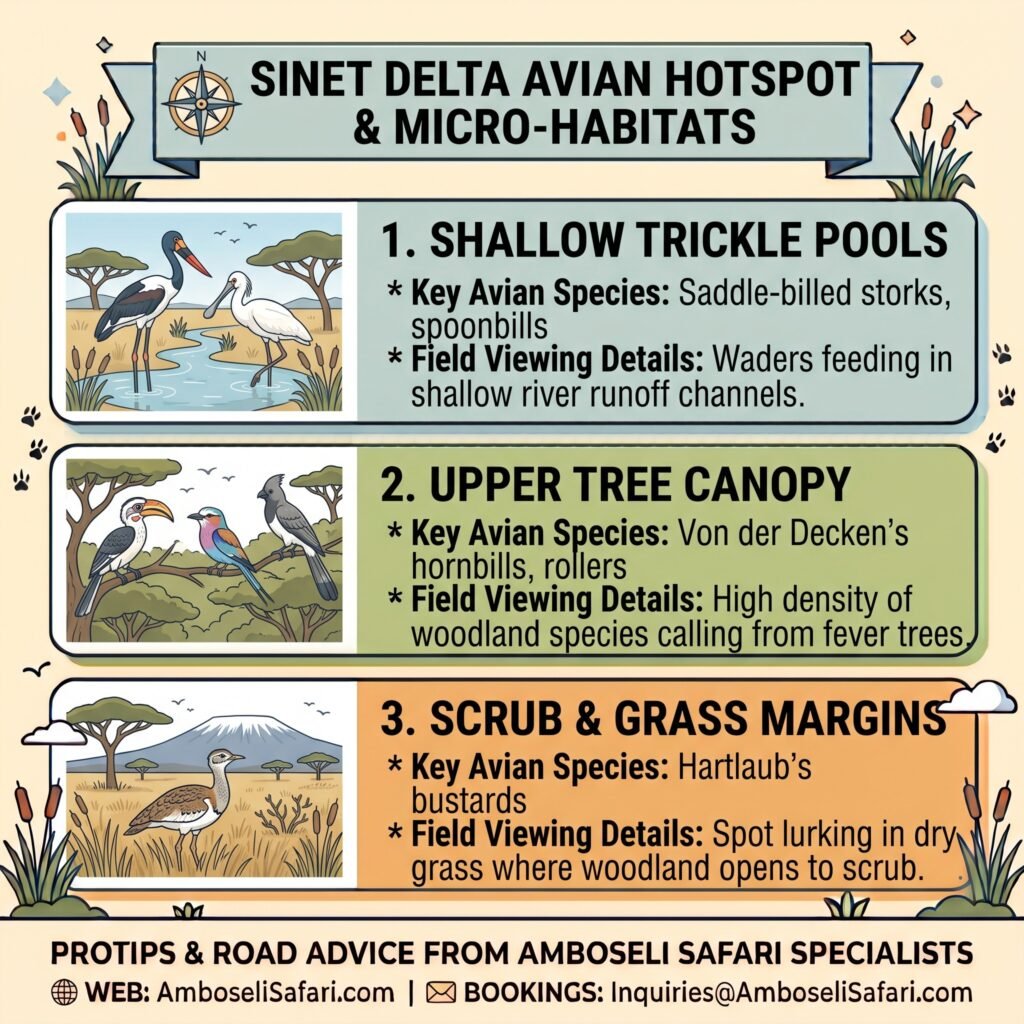
According to Kenya Wildlife Service field logs, over 200 of the park’s 420+ bird species use this narrow green strip. Because shallow trickle pools sit right underneath dense acacia branches, you get wetland waders and dry-bush species sharing the same tree shadow.
- Saddle-billed storks and African spoonbills wading through shallow runoff pools while spur-winged geese search for frogs nearby.
- Von der Decken’s hornbills, lilac-breasted rollers, and white-bellied go-away-birds calling from the upper fever tree canopy.
- Hartlaub’s bustards. You will usually spot them lurking in the dry grass right where the treeline opens into scrub.
A good bird watching guide is worth keeping on your lap here—you can easily check off thirty species before breakfast.
Avian Hotspot & Micro-Habitat Breakdown
Supporting over 200 recorded species, the Sinet Delta is one of Amboseli’s premier birding locations. The overlap of shallow water channels and dense fever tree canopies brings wetland waders and dry-bush species into the same immediate viewing zone. Use the birding breakdown below to identify key species across the delta’s distinct micro-habitats.
| Micro-Habitat | Key Avian Species | Field Viewing Details |
| Shallow Trickle Pools | Saddle-billed storks, spoonbills | Waders feeding in shallow river runoff channels. |
| Upper Tree Canopy | Von der Decken’s hornbills, rollers | High density of woodland species calling from fever trees. |
| Scrub & Grass Margins | Hartlaub’s bustards | Spot lurking in dry grass where woodland opens to scrub. |
Low Traffic & Midday Route Strategy
Around 11:30 AM, central park tracks turn into a sun-baked parking lot. Drivers crowd the base of Observation Hill, while the intense plain heat forces most animals deep into hiding.
That is your cue to head north into Sinet.
The thick acacia canopy drops ambient temperatures by several degrees, creating natural shade where lions love to lie up until late afternoon. You get quiet predator sightings while the rest of the park is fighting for parking spaces. It is a simple adjustment to your safari planning that completely changes your midday success rate.
Photographing Kilimanjaro Through the Acacias
Flat, empty salt-pan shots of Mount Kilimanjaro get repetitive fast. The Sinet Delta gives photographers actual foreground structure: gnarled fever-tree limbs and browsing giraffes framed against the snowcap.
Timing is everything. Be on this track between 6:30 AM and 8:30 AM before heat shimmer distorts the horizon. If you are serious about wildlife photography, bring a wide-angle lens alongside your telephoto—you’ll need it to capture the giraffe canopy and the mountain peak in one frame, especially during the clear-sky months that mark the best time to visit.
Safari Package Rates & Itineraries
Exploring the Sinet Delta alongside central park circuits is straightforward when booking a private package through Amboselisafari.com. Packages cover custom 4×4 transport, driver-guides, lodge stays, and daily park permits ($90 USD for non-resident adults).
Rates are based on two adults traveling together in a private 4×4 Safari Land Cruiser with a pop-up roof. Transport, fuel, and guide fees cost USD 190 per person sharing per day during normal season and USD 400 per person sharing per day during peak dry season (July to October).
We recommend a 4-day trip pairing Amboseli with Tsavo West National Park.
4-Day Amboseli & Tsavo West Safari Packages
Prices are total per person based on two adults sharing accommodation and a private 4×4 Land Cruiser.
| Season & Tier | Included Lodges | Price Per Person (USD) |
| Normal – Budget | AA Lodge Amboseli & Rhino Valley Lodge | USD 1,370 |
| Normal – Mid-Range | Ol Tukai Lodge & Kilaguni Serena Lodge | USD 1,610 |
| Normal – Luxury | Tortilis Camp & Severin Safari Camp | USD 2,150 |
| Normal – Luxury Plus | Angama Amboseli & Finch Hattons | USD 3,560 |
| Peak – Budget | AA Lodge Amboseli & Rhino Valley Lodge | USD 2,300 |
| Peak – Mid-Range | Ol Tukai Lodge & Kilaguni Serena Lodge | USD 2,600 |
| Peak – Luxury | Tortilis Camp & Severin Safari Camp | USD 3,250 |
| Peak – Luxury Plus | Angama Amboseli & Finch Hattons | USD 5,050 |
Request a custom safari quote on Amboselisafari.com to build an itinerary tailored to your exact dates.
Package Inclusions:
- Private 4×4 Safari Land Cruiser equipped with a pop-up roof for open game viewing.
- Services of an English-speaking, TRA-licensed driver-guide who knows the local circuits.
- Park entry permits and vehicle entry fees for both Amboseli and Tsavo West.
- Full board accommodation (breakfast, lunch, and dinner) at your chosen lodge tier.
- Unlimited bottled drinking water stocked in the vehicle cooler, alongside emergency medical evacuation insurance.
Package Exclusions:
- International airfare and electronic Travel Authorization (eTA) entry fees for Kenya.
- Personal expenses like driver tips, laundry services, or alcoholic beverages at the lodges.
- Optional excursions, including hot air balloon rides over the basin.
Optional Add-Ons:
- Maasai cultural village visit at USD 30 per person.
- Sunrise hot air balloon flight for USD 450 per person.
- One-way flight upgrade from Nairobi Wilson Airport to Amboseli Airstrip for USD 540 per person (includes flight, landing fees, and bush transfers).
When deciding where to stay in Amboseli, balance gate proximity against total accommodation fees on our safari cost overview.
Frequently Asked Questions
Where exactly is the Sinet Delta located in the park, and how do I get there?
It sits in the northern sector just past Observation Hill, right where the seasonal Sinet River drains out of the central marshes toward Lake Amboseli.
What specific animals am I most likely to spot around the delta?
Maasai giraffes are the main draw here, feeding in high concentrations throughout the acacia canopy. You’ll also regularly encounter waterbucks, impalas, vervet monkeys, and lions sleeping in the shade, along with dozens of waterbirds and woodland species along the water channels.
Is driving through Sinet Delta safe during wet weather?
No, exercise caution during the peak rain months of April, May, and November. Low-lying river crossings turn into sticky black-cotton clay that can trap even a heavy 4×4 Land Cruiser. Stick to raised gravel tracks and avoid unpaved mud channels if water is standing.