
Amboseli and Masai Mara Safari: 6-Day Itinerary, Flight Transfers & Pricing
Overview of Amboseli & Mara Safari
Combining 2 nights under Mount Kilimanjaro and 3 nights in the Mara plains costs between $3,380 and $14,080 per person depending on lodge tier and season. I’m Patrick, and I’ve designed this 6-day, 5-night package to pair road transport down to Amboseli with a direct 75-minute morning bush flight to the Masai Mara. We use a private 4×4 Land Cruiser to reach Amboseli, then fly you straight into the Mara so you avoid spending 8 hours eating dust in transit across the Rift Valley.
Jump Ahead
- Direct Bush Flight Transfer Options
- Managing Dual Digital Park Entrance Fees
- Driving Rules for Mai Mahiu Highway
- Complete Six Day Fly In Itinerary
- Selecting Your Nearest Mara Bush Airstrip
- Kilimanjaro Visibility vs Migration Matrix
- Cash Currency and Safari Tipping Guidelines
- Fly In Safari Packing List Checklist
- Senior Accessibility and Children Safari Policies
- Safari Package Pricing and Hotel Tiers
- Frequently Asked Questions About the Safari
Combining Amboseli and the Masai Mara packs Kenya’s two most famous wildlife parks into a single trip. After ten years of organizing these exact routes, I can tell you firsthand that getting the logistics right is the difference between tracking big cats and sitting endlessly in highway gridlock. We spend the first two days following elephant herds through sweet-smelling yellow-fever acacia groves before heading west to find lions in the tall grass of the Mara.
Connecting both parks efficiently takes deliberate planning. Driving from Nairobi down to Kimana Gate is smooth on paved asphalt. But heading overland from Amboseli across to the Mara takes over eight tiring hours on rough roads.
Before locking in your dates, check how seasonal wildlife movements shift across Kajiado County to line up your game drives, or send us a message through our trip planner if you want some custom route advice.
Direct Bush Flight Transfer Options
Linking Amboseli to the Masai Mara doesn’t mean driving back to Nairobi. You don’t have to waste half a day sitting in the Wilson Airport terminal. Local air charters—including Safarilink, Airkenya, and Governors’ Aviation—run direct morning flights right out of central Amboseli Airstrip (ASV) between 08:20 AM and 08:45 AM.
The flight takes about 75 minutes. You’ll land on the Mara plains by 10:00 AM. That leaves plenty of time to drop your gear at camp, grab a warm lunch, and still make the afternoon game drive.
Duffel Bag Dimensions & Strict Flight Rules
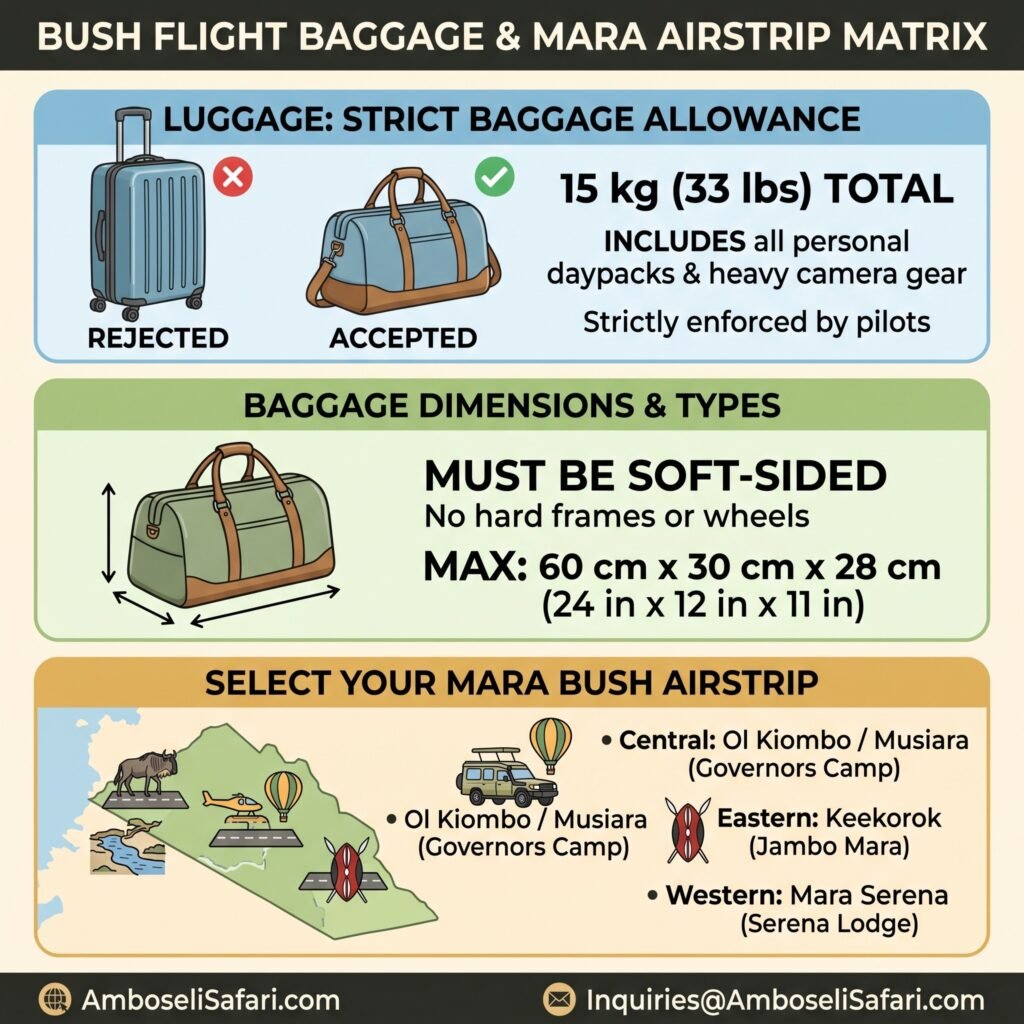
Bush pilots enforce a strict 15 kg (33 lbs) total allowance per traveler. Yes, that includes your camera gear and daypack.
All bags must be soft-sided duffels maxing out at 24 in x 12 in x 11 in (60 cm x 30 cm x 28 cm). Hard-shell suitcases, rigid frames, and rolling trolleys with metal handles? The pilots will literally leave them on the runway because they simply can’t flex into the aircraft’s small belly pod.
Bush Flight Baggage & Mara Airstrip Matrix
Bush flight connections between Amboseli and the Masai Mara skip an eight-hour overland highway drive, but they enforce non-negotiable luggage and airstrip protocols. Aircraft belly pods cannot accommodate rigid suitcases, and landing at an incorrect runway can add hours of rough driving to reach your lodge. This field readiness matrix outlines essential luggage dimensions and pairs major Mara airstrips with their nearest lodge options.
| Logistical Category | Operational Standard | Key Field Rule & Impact |
| Luggage Weight Limit | 15 kg (33 lbs) total per passenger | • Includes all personal daypacks and heavy camera gear. • Strictly enforced by bush pilots at Amboseli Airstrip. |
| Bag Type & Dimensions | Soft-sided duffels (60x30x28 cm) | • Must flex into small aircraft belly pods. • Note: Hard-shell suitcases & rolling trolleys will be rejected. |
| Airstrip Selection | Match flight ticket to camp zone | • Central: Ol Kiombo / Musiara (Governors Camp) • Eastern: Keekorok (Jambo Mara) • Western: Mara Serena (Serena Lodge) |
Selecting Your Nearest Mara Bush Airstrip
Amboseli keeps things simple with one main runway. The Mara is a sprawling mess of over six distinct bush landing strips, including Ol Kiombo, Mara Serena, Musiara, Keekorok, Kichwa Tembo, and Ngerende.
Land at the wrong airstrip, and you’re stuck with a 2.5-hour drive across the deeply rutted C12 track just to reach your room. Your teeth will rattle the whole way. When we map out your trip through Amboselisafari.com, we match your air ticket directly to your camp’s closest runway.
Managing Dual Digital Park Entrance Fees
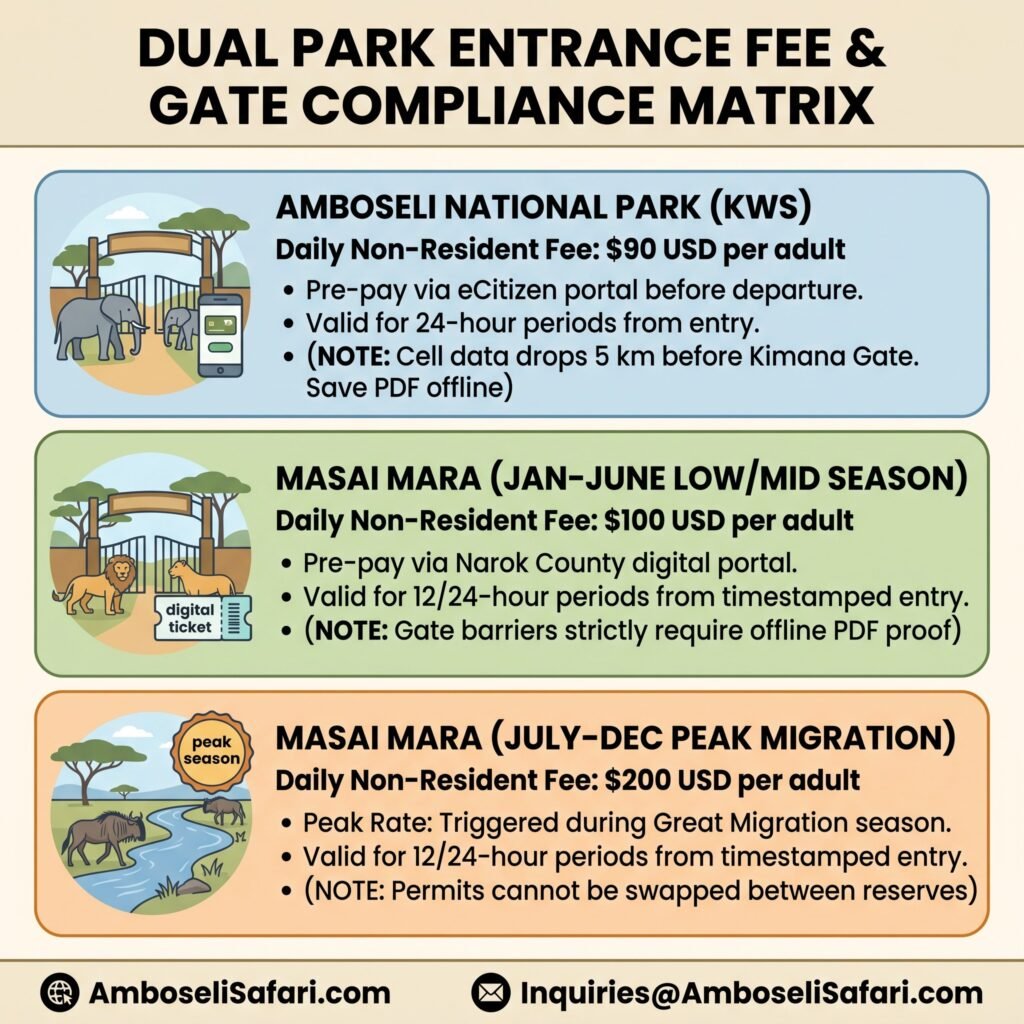
Entry permits for both reserves run on completely separate digital government portals. Cash is useless at the gates.
- Amboseli National Park: Run by the federal Kenya Wildlife Service (KWS). Permits are $90 USD per non-resident adult per 24 hours, paid online through the eCitizen portal.
- Masai Mara National Reserve: Governed by the Narok County Government. Permits cost $100 USD per adult daily from January to June, jumping to $200 USD per day during the peak Migration months (July through December).
You can’t swap park passes between reserves or buy them at the gate barriers. Cell service vanishes completely near Kimana Gate and deep inside the Mara. Make sure all digital receipts and QR codes are downloaded and saved offline to your phone before you ever leave Nairobi. Check our full breakdown of park fee calculations or review gate operational hours.
Dual Park Entrance Fee & Gate Compliance Matrix
Managing park entry requirements across two separate regional authorities requires navigating distinct pricing scales, validity rules, and gate platforms. While Amboseli runs under national Kenya Wildlife Service (KWS) digital rules, the Masai Mara operates under Narok County, which doubles its daily entry rates during peak wildebeest migration months. Use this fee and gate matrix to calculate exact permit expenses and avoid authorization delays at park barriers.
| Park & Authority | Daily Non-Resident Fee | Gate Payment Protocol & Validity Rule |
| Amboseli National Park (KWS) | $90 USD per adult | • Pre-pay via eCitizen portal before departure. • Valid for 24-hour periods from timestamped entry. • Note: Cell data drops 5 km before Kimana Gate. |
| Masai Mara (Jan–June) | $100 USD per adult | • Pre-pay via Narok County digital portal. • Valid for 24-hour periods from timestamped entry. • Note: Gate barriers strictly require offline PDF proof. |
| Masai Mara (July–Dec) | $200 USD per adult | • Peak Rate: Triggered during Great Migration. • Valid for 24-hour periods from timestamped entry. • Note: Cannot swap passes between reserves. |
Driving Rules for Mai Mahiu Highway
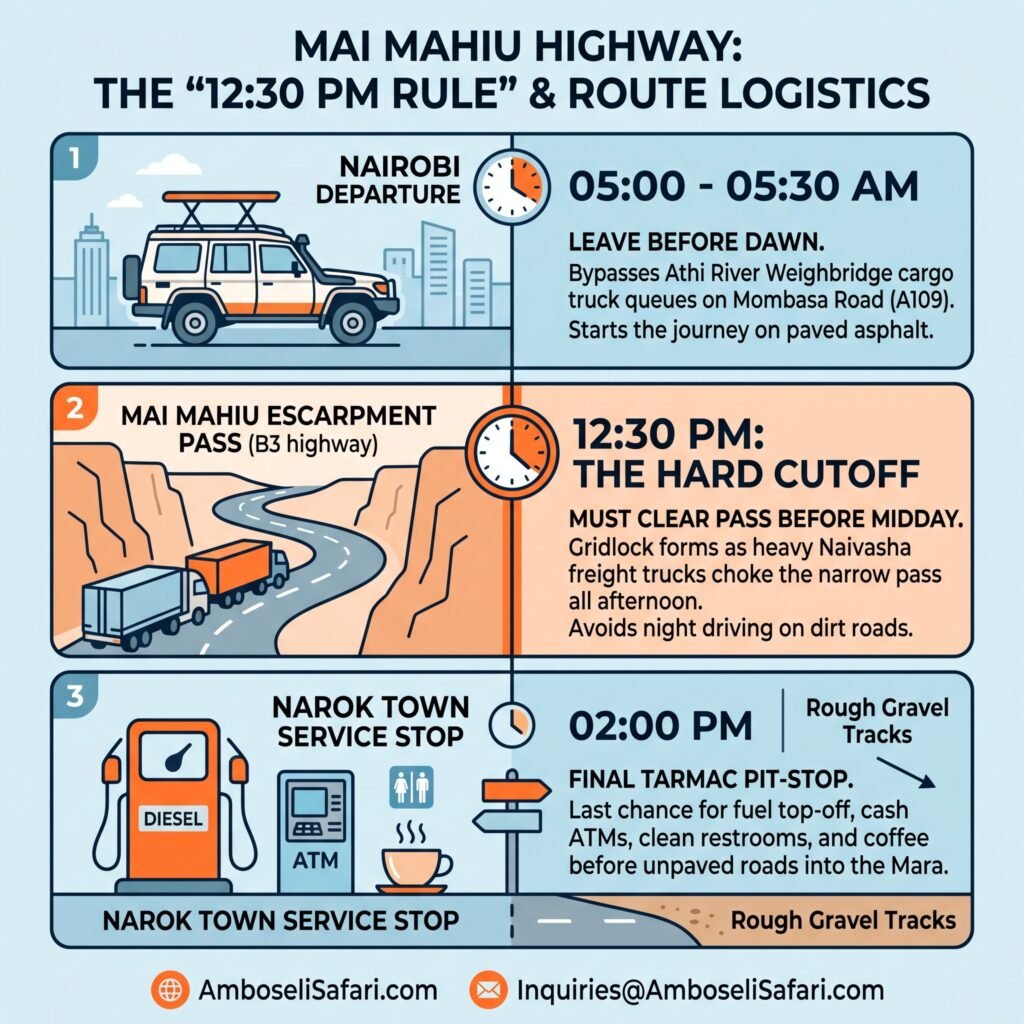
For itineraries that include driving overland between the two reserves, highway timing dictates your whole day. The 350-kilometer route heads down the B3 highway into the Great Rift Valley escarpment.
The Mai Mahiu “12:30 PM Rule”
I enforce a hard cutoff for our drivers on this leg. If our Land Cruiser isn’t past the Mai Mahiu escarpment by 12:30 PM, Anthony—our head guide—simply won’t let the team proceed. Heavy long-distance container trucks grinding out of Naivasha choke that narrow pass to a crawl all afternoon. Get stuck behind those freight convoys once, and you’ll miss your evening game drive completely. Plus, missing that midday window means you’ll be navigating unpaved dirt approaches into the Mara in pitch darkness.
Mai Mahiu Highway “12:30 PM Rule” & Route Logistics
For safari itineraries that include overland driving between Amboseli and the Masai Mara, highway timing dictates whether you reach camp for an afternoon game drive or get stuck in gridlock. The Great Rift Valley escarpment along the Mai Mahiu highway frequently locks up with heavy long-distance freight traffic by early afternoon. This route blueprint details crucial highway milestones, timing cutoffs, and required supply stops for overland transfers.
| Route Milestone | Target Timestamp | Critical Field Action & Purpose |
| Nairobi Departure | 05:00–05:30 AM | Bypasses Athi River weighbridge cargo truck queues on Mombasa Road (A109). |
| Mai Mahiu Escarpment | 12:30 PM (Hard Cutoff) | Must clear escarpment pass before heavy Naivasha freight trucks choke the narrow B3 climb. |
| Narok Town Stop | 02:00 PM | Final tarmac stop for fuel top-off, cash ATMs, clean restrooms, and road snacks before dirt tracks. |
The Narok Town Pit-Stop
Narok town marks the end of paved roads and the start of rough, corrugated gravel tracks. It’s your absolute last stop for a hot coffee, clean restrooms, a working ATM, and a full tank of diesel. Passing Narok without topping off risks running out of fuel out on the dirt tracks near Sekenani or Talek gates.
We treat transit days between reserves as pure travel days. Forcing a rushed game drive before a long highway slog just leaves everyone exhausted. Check current highway and park entrance conditions before deciding to drive overland.
Kilimanjaro Visibility vs. Mara Migration Seasonality Matrix
Balancing clear mountain shots in Amboseli with predator tracking and wildebeest river crossings comes down to picking the right months.
| Season & Months | Mount Kilimanjaro Visibility | Masai Mara Wildlife & Migration | Key Trade-Offs |
| Jan – Feb (Dry Window) | Clear pre-dawn light over Kibo peak. Haze kicks in around 10:00 AM. | High lion and cheetah activity along Talek and Musiara following local herds. | Prime photography along the C12 track. Lower Narok County park fees ($100/day). |
| Mar – May (Long Rains) | Clouds hide the peak a lot. The landscape turns incredibly green. | Birthing season for antelopes. Very few other vehicles out there. | Lowest package rates of the year. Unpaved tracks around Enkongo Narok turn to thick mud requiring 4×4 low range. |
| July – Oct (Peak Migration) | Clear at dawn (6:00–7:15 AM). By afternoon, dust devils ruin distant shots. | Absolute madness. 1.5 million wildebeest hitting the river banks. | Maximum predator action. You pay for it with peak season pricing ($200/day Mara park fee applies). |
| Nov – Dec (Short Rains) | Mountain pops out beautifully right after a heavy afternoon shower. | Migratory birds arrive. Local herds scatter into conservancies. | Great mid-season rates. Soft evening light. |
Complete Six Day Fly In Itinerary
Day 1: Nairobi to Amboseli by Road & Sunset Drive
We leave Nairobi by 6:00 AM in a private 4×4 Safari Land Cruiser to stay ahead of Mombasa Road truck traffic. You pull into camp right at lunchtime. At 3:30 PM, we head out for an afternoon game drive along Ol Okenya swamp to track elephant families feeding in the acacia groves.
Day 2: Full Day Amboseli Swamps & Mount Kilimanjaro
Engines start at 6:00 AM sharp. You have to beat the thermal clouds that cover Kibo peak by 9:30 AM. We track bull elephants in Enkongo Narok swamp along the same paths monitored by the Amboseli Elephant Research Project, then climb Observation Hill (Normatior) for a massive view over the central marshes.
Day 3: Morning Bush Flight to Masai Mara
After breakfast, we drop you at Amboseli Airstrip (ASV) for your 8:20 AM flight. You land in the Mara around 9:35 AM. Your Mara-based 4×4 guide will be waiting for you right on the dirt runway. By afternoon, you’re out exploring the savannah for lions.
Day 4 & 5: Full Days Masai Mara Game Viewing
Two full days out in the Mara. We track predator movements along the Mara River, follow the antelope herds, and can easily arrange visits to local Maasai community projects if you want to stretch your legs.
Day 6: Departure & Return Transport
Grab breakfast at camp, then begin your road transfer back to Nairobi in your private 4×4 Land Cruiser. You’ll be back in the city around 4:30 PM.
Cash, Currency, and Safari Tipping Guidelines
- Leave pre-2013 US Dollars at home. Tellers and lodge cashiers reject older bills on the spot due to past counterfeit scares. I’ve seen guests get totally stranded at gate entries trying to pay with crisp $100 bills printed in 2009. Bring new notes printed in 2013 or later.
- Driver-Guide Tips: Tipping your driver runs about $15 to $20 USD per day total from your travel group.
- Camp & Lodge Staff: Use the central “Staff Tip Box” at reception when checking out. Leaving $10 USD per day easily covers cooks, room stewards, and back-of-house staff.
- Kenya Shillings (KES): Keep some local cash (KES 5,000–10,000) handy. When you want to buy bananas by the highway or tip a porter, they won’t have change for a $50 bill.
Fly In Safari Packing List Checklist
- Neutral Apparel: Stick to khaki, tan, or olive cotton. Leave dark blue and black clothes at home—tsetse flies in the riverine woods target dark colors instantly, and their bite hurts.
- Camera Equipment: Bring a telephoto lens (300mm+) and a padded, dust-proof dry bag. Fine volcanic dust gets into absolutely everything out here.
- Power Adapters: Kenya uses UK 3-pin plugs (Type G). Most camps run on strict generator or solar hours, so pack a multi-port USB block to charge all your camera gear at once while the power is on.
- Warm Layering: A light jacket is mandatory. Pre-dawn game drives at 6:00 AM get genuinely cold (14°C / 57°F). You’ll shed it by midday.
Senior Accessibility and Children Safari Policies
- Senior Accessibility: Taking the 75-minute bush flight skips eight hours of brutal, corrugated road vibration across the Rift Valley. If you have back sensitivities, flying is simply the only comfortable choice.
- Children’s Policies: Bush air charters let infants under 2 years travel free on an adult’s lap. Lodges often enforce minimum age limits (usually 2 to 6 years) for open-vehicle game drives, but child discount tiers (30% to 50% off adult rates) apply to kids aged 3 to 11 sharing a room with two adults.
Safari Package Pricing and Hotel Tiers
This 6-day package covers your private 4×4 Land Cruiser transport in Amboseli (3 days of vehicle logistics), the direct bush flight to the Mara ($600 USD per person included), a dedicated 4×4 on the Mara side (5 days of vehicle logistics), 5 nights of full-board accommodation, and all pre-paid KWS and Narok County park fees.
Vehicle, fuel, and guide fees run USD 190 per person sharing per day normally, rising to USD 400 per person sharing per day during the peak dry season (July to December).
Featured Lodge Location Benefits
- AA Lodge Amboseli: Basic and no-frills, but it puts you 5 minutes from Kimana Gate without blowing your budget.
- Jambo Mara Safari Lodge: Right outside Sekenani Gate. Great for budget itineraries needing fast park access.
- Ol Tukai Lodge: Inside Amboseli’s central core. You step out of bed and you are basically in the swamp. Zero gate lines.
- Mara Serena Safari Lodge: Sits on a high ridge. The views over the Mara River are incredible.
- Tortilis Camp: Tucked in a private conservancy. You get walking safaris without the public gate crowds.
- Governors’ Camp: Deep in the riverine forest. Best spot for big cats right near your tent.
- Angama Amboseli & Angama Mara: Pure luxury. Floor-to-ceiling glass and sweeping views of the landscapes.
6-Day Amboseli & Masai Mara Safari Package Rates (2 Adults Sharing)
Prices reflect total per person cost for the entire 6-day, 5-night fly-in safari.
| Package Tier | Included Lodges (Amboseli / Mara) | Normal Season (Jan–June) | Peak Season (July–Dec) |
| Budget Tier | AA Lodge Amboseli / Jambo Mara Safari Lodge | USD 3,380 per person (Basic tents) | USD 5,780 per person (Basic tents) |
| Mid-Range Tier | Ol Tukai Lodge / Mara Serena Safari Lodge | USD 4,060 per person (Core park access) | USD 6,680 per person (Core park access) |
| Luxury Tier | Tortilis Camp / Governors’ Camp | USD 5,150 per person (Private conservancy) | USD 8,380 per person (Private conservancy) |
| Luxury Plus Tier | Angama Amboseli / Angama Mara | USD 9,300 per person (Ultra high-end) | USD 14,080 per person (Ultra high-end) |
If you want to adjust this route or hold flight seats on the bush planes, drop us a note through our trip planner.
Package Inclusions:
- Private 4×4 Safari Land Cruiser with pop-up roof for game drives in Amboseli (3 vehicle days).
- One-way bush flight from Amboseli Airstrip to Masai Mara (including airline taxes and landing fees).
- Private 4×4 Safari Land Cruiser with pop-up roof for game drives in Masai Mara (5 vehicle days).
- Services of TRA-licensed, English-speaking driver-guides in both reserves.
- 5 nights full-board accommodation (breakfast, lunch, dinner) at your chosen lodge tier.
- All KWS park entry permits for Amboseli and Narok County Council park fees for Masai Mara.
- Unlimited bottled drinking water in vehicle coolers and emergency medical evacuation insurance.
Package Exclusions:
- International airfare and Kenyan electronic Travel Authorization (eTA) visa fees.
- Personal expenses such as driver tips, souvenirs, laundry, and alcoholic beverages.
- Optional activities, such as hot air balloon flights.
Optional Add-Ons:
- Sunrise hot air balloon safari in the Mara: USD 450 per person.
- Authentic Maasai cultural village visit: USD 30 per person.
- Return flight from Masai Mara to Nairobi Wilson Airport: USD 350 per person.
To locate these properties relative to park entrance gates and core wildlife tracks, consult our complete guide on where to stay in Amboseli.
Frequently Asked Questions About the Safari
Can I bring my hard-shell Samsonite bag?
No. Bush airlines strictly cap luggage at 15 kg (33 lbs) per passenger, and bags must be soft-sided duffels. Hard suitcases with wheels will be rejected at the airstrip because they don’t fit in the plane’s hold.
Do we really need to fly, or can we just drive to the Mara?
I strongly recommend flying. The direct bush flight takes 75 minutes and drops you right in the park. Driving overland takes 8 to 9 hours across rough roads, meaning you burn a full day of your vacation just staring at highway traffic and eating dust.
When is the absolute best time to go to see both the mountain and the migration?
July through October is the peak window. Amboseli is extremely dry, pulling massive elephant herds right to the central swamps, while over in the Mara, the Great Wildebeest Migration is actively crossing the Mara River.