
Flight from Nairobi to Amboseli: Schedules & Flying Tips
Overview – Flight Essentials
- Flight Duration: 35–45 minutes direct flight time from Wilson Airport (WIL) to Amboseli Airstrip (ASV).
- Standard Airfare: $190–$250 USD per person one-way.
- Baggage Restriction: Strict 15 kg (33 lbs) weight limit per passenger in soft-sided duffel bags.
- Airlines: Flights operated by carriers like Safarilink, AirKenya, and FlyALS.
Fast Navigation Links
- Flight Schedules & Standalone Fares
- Wilson Departure Routine & Baggage Rules
- Window Seats, Thermals & Mountain Views
- Bush Circuits & Airstrip Ticket Clocks
- Multi-Park Fly-In Itineraries & Costs
- Frequently Asked Questions
Flight Essentials & Carrier Overview
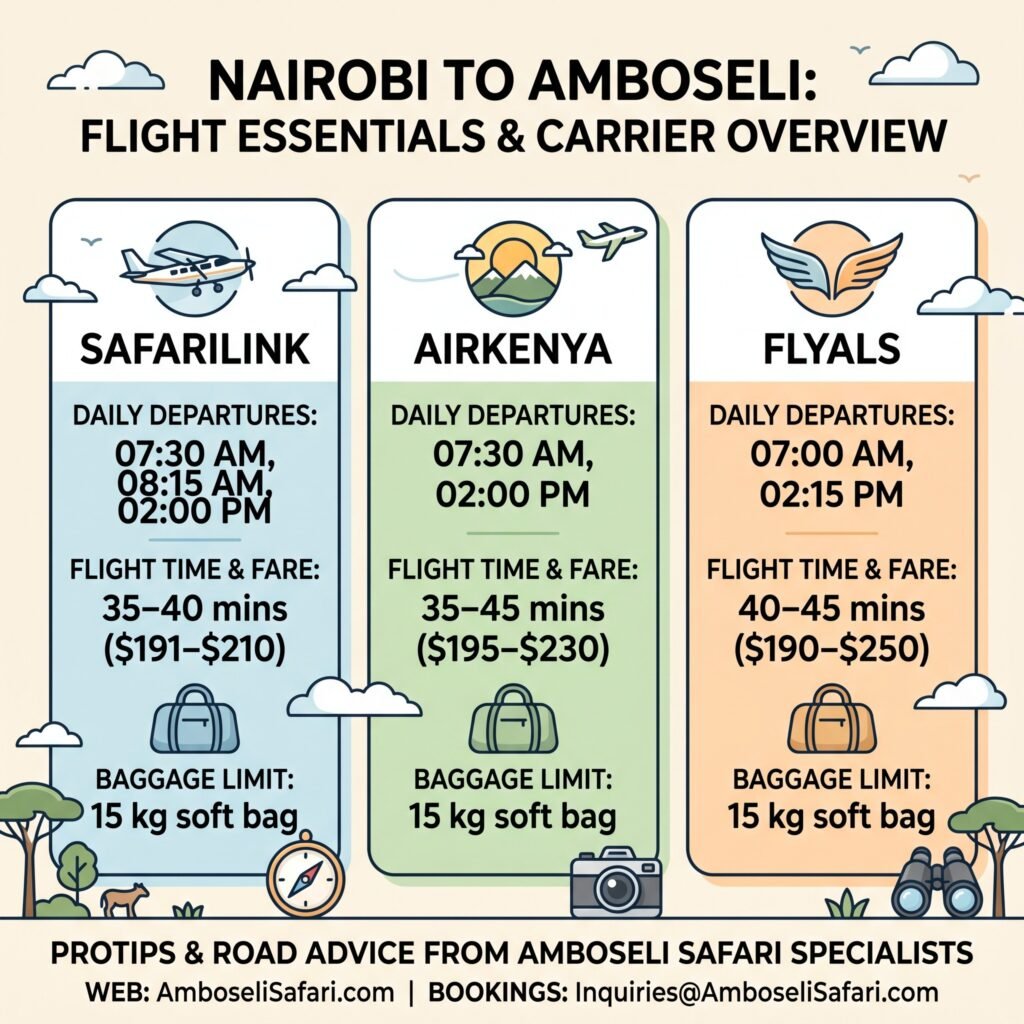
Flying from Nairobi to Amboseli is the fastest way to hit the game tracks without spending hours on the road. Below is a quick breakdown comparing daily flight times, standard ticket prices, and luggage restrictions across all three main bush carriers operating out of Wilson Airport. Use this quick reference to select the departure time that fits your safari itinerary best.
| Airline | Daily Departures | Flight Time & Fare | Baggage Limit |
| Safarilink | 07:30 AM, 08:15 AM, 02:00 PM | 35–40 mins ($191–$210) | 15 kg soft bag |
| AirKenya | 07:30 AM, 02:00 PM | 35–45 mins ($195–$230) | 15 kg soft bag |
| FlyALS | 07:00 AM, 02:15 PM | 40–45 mins ($190–$250) | 15 kg soft bag |
Direct Flight Schedules & Fares (WIL to ASV)
Point-to-point scheduled bush flights run daily out of Wilson Airport (WIL) straight to Amboseli Airstrip (ASV). Booking a standalone seat works best if you are arranging your own lodge transfers or meeting a private vehicle upon arrival.
If you arrive early at Wilson, grab a quick coffee at Artcaffe in Terminal 2 while waiting for your flight call.
Nairobi (WIL) to Amboseli (ASV) Flight Schedule
| Airline | Daily Departures (WIL) | WIL to ASV Flight Time | Typical One-Way Fare |
| Safarilink | 07:30 AM, 08:15 AM, 02:00 PM | 35–40 minutes | $191 – $210 USD |
| AirKenya Express | 07:30 AM, 02:00 PM | 35–45 minutes | $195 – $230 USD |
| FlyALS | 07:00 AM, 02:15 PM | 40–45 minutes | $190 – $250 USD |
Checking the WIL to ASV schedule reveals convenient morning departures that put you on the ground in time for a mid-morning game drive.
If you’re looking to save on airfare, target the shoulder seasons in April, May, or November when seat demand drops. AirKenya’s standard ticket prices generally range from $195 in the low season up to $230 USD during peak months.
Light aircraft operate under strict weight constraints, so make sure to review standard KWS park entry rules before departing Wilson.
15kg Luggage Limits, Storage Hacks & Freight Seats
Save yourself a headache at the counter and pack soft.
In my 10 years guiding out of Wilson Airport, I’ve seen dozens of guests forced to leave rigid hard-shell rollers behind on the terminal apron. Small turboprop aircraft enforce a strict 15 kg (33 lbs) limit per passenger, which includes your hand luggage and heavy camera gear.
Staff weigh every single bag together at check-in.
Hard-shell suitcases simply will not fit into Cessna belly pods—period. The holds beneath light aircraft are narrow and curved. If your bag cannot compress, it will not load onto the plane.
- Complimentary Terminal Storage: Both Safarilink and AirKenya provide free, secure left-luggage lockers at their Wilson terminals. Leave your heavy hard suitcases in Nairobi and fly into the bush with a compact duffel.
- Purchasing a Freight Seat: Photographers carrying heavy telephoto lenses can buy an extra “Freight Seat” when booking. This extra seat reservation costs roughly 75% of a standard passenger fare and grants an additional 65 kg to 75 kg weight allowance.
Check our full recommendations on our Amboseli safari packing list and our notes on carrying camera gear on safari.
Tactical Luggage & Seating Guide
Navigating light aircraft luggage rules and seating layouts requires a little planning before heading to Wilson Airport. Choosing soft-sided bags and picking the right window seat can make the difference between a seamless flight and leaving gear behind at the terminal. The table below outlines key luggage specs and tips to capture the best views of Mount Kilimanjaro during your flight.
| Item / Consideration | Target Spec | Critical Action |
| Bag Type | Soft Duffel Only | No rigid hard-shell suitcases allowed. |
| Excess Luggage | Locker / Freight Seat | Buy Freight Seat (~75% fare) for +65kg. |
| Best Mountain View | Left Side Window | Sit on port side on WIL → ASV morning flight. |
| Smooth Flying | Early Morning Flight | Book 07:00–08:30 AM to avoid mid-day thermals. |
Window Seats, Thermal Winds & Mountain Views
As the plane climbs out of Nairobi, the landscape changes quickly from urban suburbs to vast open plains. The short flight south depends heavily on your seating position and when your plane takes off.
Seating on bush aircraft is unassigned. Pilots distribute passengers based on weight and balance calculations. On morning flights leaving Wilson, ask for a window seat on the left side of the aircraft. As the plane descends into the basin, Mount Kilimanjaro appears directly off the port wing. On return flights back to Nairobi, switch over to the right side to keep the snowcap in view.
Timing matters just as much as your seat. Early morning departures (between 7:00 AM and 8:30 AM) give you the smoothest air and clearest skies.
By 10:30 AM, intense heat radiating off dry volcanic lakebeds kicks up mid-day turbulence across the valley approach. You will feel the plane bump along as it taxies on the dirt strip, and it often gets quite windy in Amboseli right as the pilot lines up for touchdown. Simultaneously, moisture evaporating from the Enkongo Narok swamp condenses into a thick ring of clouds around Kilimanjaro’s summit, hiding Kibo Peak by late morning.
Photographers planning aerial shots can consult our Amboseli wildlife photography guide for seasonal lighting details.
Bush Circuits & Airstrip Ticket Clocks
Scheduled bush flights do not always run direct routes. They often operate like a local bus line, picking up and dropping off passengers across several dirt strips in the ecosystem.
A typical morning leg might run from Wilson down to Amboseli Airstrip, continue to Kilaguni in Tsavo West, and finish at Diani Beach along the coast. If your flight makes intermediate stops, your travel time extends from 40 minutes to about an hour and twenty minutes. You will stay seated on the warm tarmac apron while ground crew offload baggage for local stops.
Where you land depends on your accommodation:
- Amboseli Airstrip (ASV / HKAM): The main public runway sits inside the park near KWS Headquarters and Observation Hill. Touching down here puts you right near central game tracks.
- Private Conservancy Airstrips: Lodges outside the park boundaries operate private dirt strips, including Tortilis Airstrip, Tawi Airstrip, and Selenkay Airstrip. Landing at a private strip lets travelers on late afternoon flights transfer straight to their camp without starting a $90 USD KWS park ticket for a short evening drive.
Your 24-hour KWS ticket activates immediately upon arrival at the airstrip.
A ranger stamps your printed eCitizen PDF receipt right at the airstrip booth. If your guide meets you on the dirt apron at 8:30 AM on Monday, your ticket remains valid until 8:30 AM on Tuesday.
Learn more about park access points in our guide to Amboseli National Park gates and review park entry costs on our Amboseli safari cost breakdown.
Amboseli Airstrip & Ticket Options
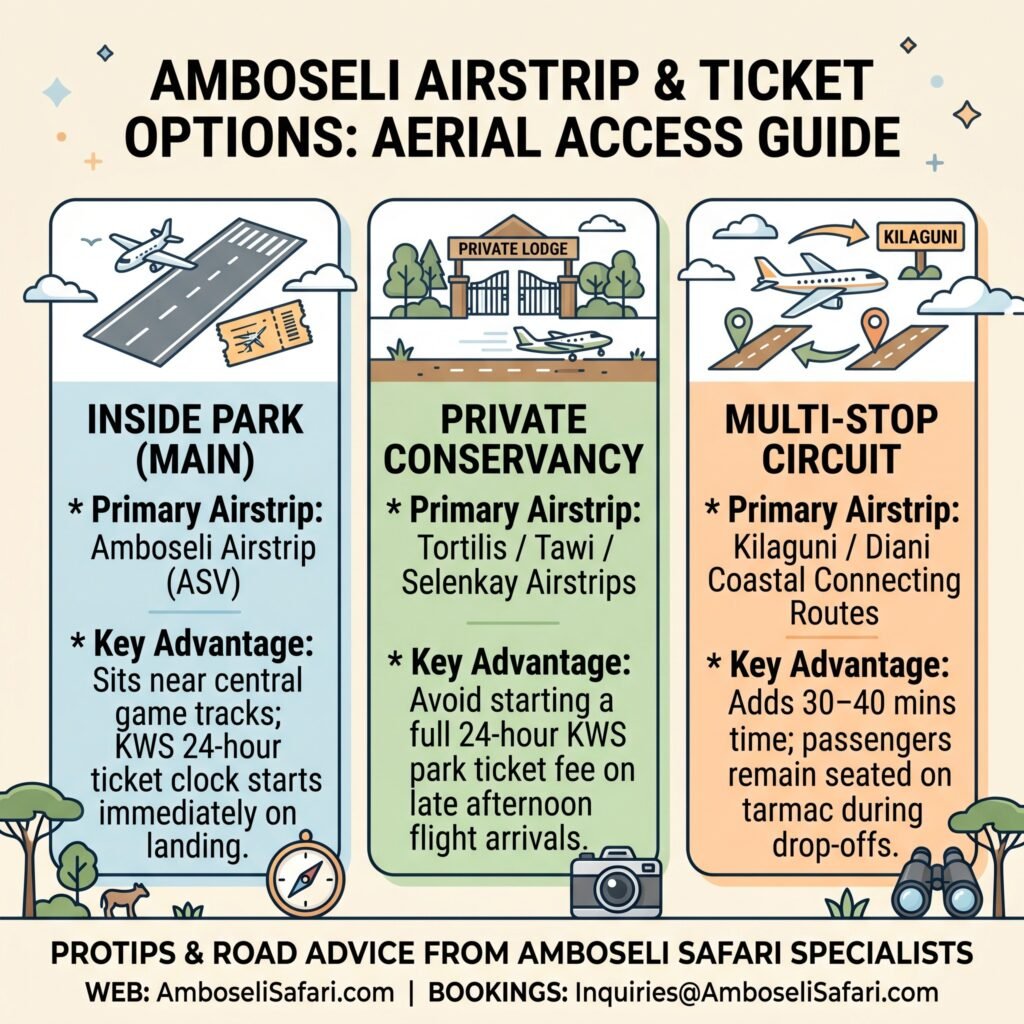
Your arrival strip determines how quickly your game drive begins and when your KWS park permit activates. Landing at the main public airstrip puts you near central KWS tracks, while private conservancy strips offer strategic advantages for late afternoon arrivals. Review this quick breakdown to understand landing options and ticket timing before booking your seat.
| Landing Location | Primary Airstrip | Key Advantage / Ticket Detail |
| Inside Park (Main) | Amboseli Airstrip (ASV) | Central game tracks; KWS 24h clock starts on landing. |
| Private Conservancy | Tortilis / Tawi / Selenkay | Skip KWS entry fee on late afternoon arrivals. |
| Multi-Stop Circuit | Kilaguni / Diani Connection | Adds 30–40 mins; remain on tarmac during stop. |
Multi-Park Fly-In Itineraries & Costs
When calculating separate lodge transfers, internal flight legs, and daily park fees, bundling your logistics into an all-inclusive package often makes much more sense than booking piecemeal. Combining Amboseli’s elephant herds with the volcanic landscapes of Tsavo West gives you two distinct safari regions without wasting full days on highway drives.
When booking through Amboselisafari.com, round-trip flights from Wilson Airport, private 4×4 Land Cruisers on the ground, KWS park permits, and lodge reservations are managed under one itinerary.
Package rates reflect two adults traveling together. Ground logistics use a private 4×4 Safari Land Cruiser priced at USD 190 per person sharing per day during the normal season and USD 400 per person sharing per day during the peak dry season (July to October). Flight upgrades are built into the total price, covering official airline seat costs, booking buffers, and operator handling.
4-Day Amboseli & Tsavo West Fly-In Safari Packages
Prices are total per person based on two adults sharing accommodation and a private 4×4 Land Cruiser.
| Season & Tier | Included Lodges | Price Per Person (USD) |
| Normal – Budget | AA Lodge Amboseli & Rhino Valley Lodge | USD 2,450 |
| Normal – Mid-Range | Ol Tukai Lodge & Kilaguni Serena Lodge | USD 2,690 |
| Normal – Luxury | Tortilis Camp & Severin Safari Camp | USD 3,230 |
| Normal – Luxury Plus | Angama Amboseli & Finch Hattons | USD 4,640 |
| Peak – Budget | AA Lodge Amboseli & Rhino Valley Lodge | USD 2,300 |
| Peak – Mid-Range | Ol Tukai Lodge & Kilaguni Serena Lodge | USD 3,680 |
| Peak – Luxury | Tortilis Camp & Severin Safari Camp | USD 4,330 |
| Peak – Luxury Plus | Angama Amboseli & Finch Hattons | USD 6,130 |
Planning Your Route: You can reserve your 4-Day Amboseli & Tsavo West Fly-In Safari Package or explore our fly-in Amboseli safari itinerary for a broader southern circuit trip.
Package Inclusions:
- Round-trip flights between Nairobi Wilson Airport and Amboseli / Tsavo airstrips.
- Private 4×4 Safari Land Cruiser with pop-up roof for game drives.
- Services of a TRA-licensed, English-speaking driver-guide.
- All KWS park conservation fees for Amboseli and Tsavo West.
- Full board accommodation (breakfast, lunch, dinner) at listed properties.
- Unlimited bottled drinking water in the vehicle.
- Emergency medical evacuation insurance cover.
Package Exclusions:
- International airfare and Kenyan electronic Travel Authorization (eTA) fees.
- Driver-guide tips, alcoholic drinks, and laundry.
- Optional activities such as hot air balloon flights.
Optional Add-Ons:
- Maasai Cultural Village Tour: USD 30 per person.
- Hot Air Balloon Safari over Amboseli: USD 450 per person.
- Extra Freight Seat for Heavy Luggage: USD 320 per flight sector.
If you are evaluating accommodation options, explore our detailed guide on where to stay in Amboseli National Park.
Frequently Asked Questions
How long before my flight should I arrive at Wilson Airport?
Arrive at Wilson Airport (WIL) 60 minutes before your scheduled departure. Check-in counters close 30 minutes prior to takeoff so ground crew can weigh luggage and calculate aircraft balance.
What happens if my luggage weighs more than 15 kg?
If your bag exceeds 15 kg and the flight is full, the airline will ask you to leave excess items behind in their terminal lockers. If the aircraft has spare payload capacity, airlines may charge an excess baggage fee of $3 to $5 USD per extra kilogram.
Do flights operate during the rainy season?
Yes, scheduled flights run year-round. Safarilink, AirKenya, and FlyALS operate throughout the April–May and November–December rainy seasons. Severe tropical storms can cause brief flight holds if dirt runways get waterlogged, but flights resume quickly once the downpour clears.